How Clear Aligners Move Teeth: The Science Explained
A straight, beautifully aligned smile is something many people desire. For decades, achieving that perfect alignment meant relying on traditional metal braces, complete with wires, brackets, and a highly visible metallic grin. Modern dentistry has introduced an alternative that offers both discretion and comfort. Clear aligners have completely transformed the field of orthodontics, allowing adults and teens to subtly correct their dental alignment.
Many patients wear these transparent plastic trays every day, watching their teeth gradually shift into place. But how do these seemingly simple pieces of plastic manage to accomplish such a significant physical change? Understanding the science behind this process reveals a fascinating interaction between biology, advanced technology, and biomechanics.
This guide will demystify the science behind clear aligners and their effectiveness. By exploring the biological mechanisms of tooth movement and the cutting-edge software used to map out your smile, you will gain a clear understanding of why this treatment is so successful.
The Biological Basics of Tooth Movement
To understand how clear aligners work, you first need to understand how teeth can move at all. Your teeth are not rigidly fused to your jawbone. Instead, they are suspended in their sockets by a complex system of tissues.
The Role of the Periodontal Ligament
The periodontal ligament is a hammock-like structure of connective tissue that surrounds the root of each tooth. It acts as a shock absorber during chewing and attaches the tooth to the surrounding alveolar bone. This ligament is highly responsive to physical force. When pressure is applied to a tooth, the periodontal ligament is compressed on one side and stretched on the other. This compression and tension send vital signals to your body, triggering a cellular response that allows the tooth to migrate.
Pressure and Tension: How Forces Influence Bone
When a clear aligner pushes against a tooth, it creates an area of pressure in the direction the tooth needs to move. Simultaneously, it creates an area of tension on the opposite side of the tooth. This dual action of pressure and tension is the fundamental driving force of all orthodontic treatment. The body senses this sustained force and responds by altering the bone structure around the tooth root.
Bone Remodeling: Osteoblasts and Osteoclasts
The actual movement of the tooth happens through a biological process called bone remodeling. On the pressure side of the tooth, special cells called osteoclasts break down the existing bone tissue, clearing a path for the tooth to move forward. On the tension side, where the periodontal ligament is stretched, different cells called osteoblasts get to work. Osteoblasts build new bone tissue to fill in the space left behind by the moving tooth. This continuous cycle of dissolving and rebuilding bone ensures your teeth remain securely anchored as they shift into their new, perfectly aligned positions.
How Clear Aligners Work: A Step-by-Step Guide
The biological process of bone remodeling requires highly controlled, continuous force. Clear aligners implant deliver this force through a carefully orchestrated, step-by-step system.
Initial Consultation and 3D Scanning
The journey begins with an in-depth evaluation of your unique dental anatomy. In the past, dentists took physical impressions using messy, uncomfortable putty. Today, most modern clinics use digital intraoral scanners. These scanners capture thousands of images per second, creating a highly accurate, high-resolution 3D model of your mouth. This digital model provides a comprehensive view of your teeth, gums, and bite, serving as the foundation for your entire treatment plan.
Treatment Planning with Advanced Software
Once the 3D model is generated, your dentist uses advanced orthodontic software to plan your tooth movements. The software simulates the exact trajectory each tooth must take to reach its final position. The movement is broken down into tiny, precise increments. A custom series of aligners is then designed, with each individual tray corresponding to a specific stage of this simulated movement.
The Aligner System
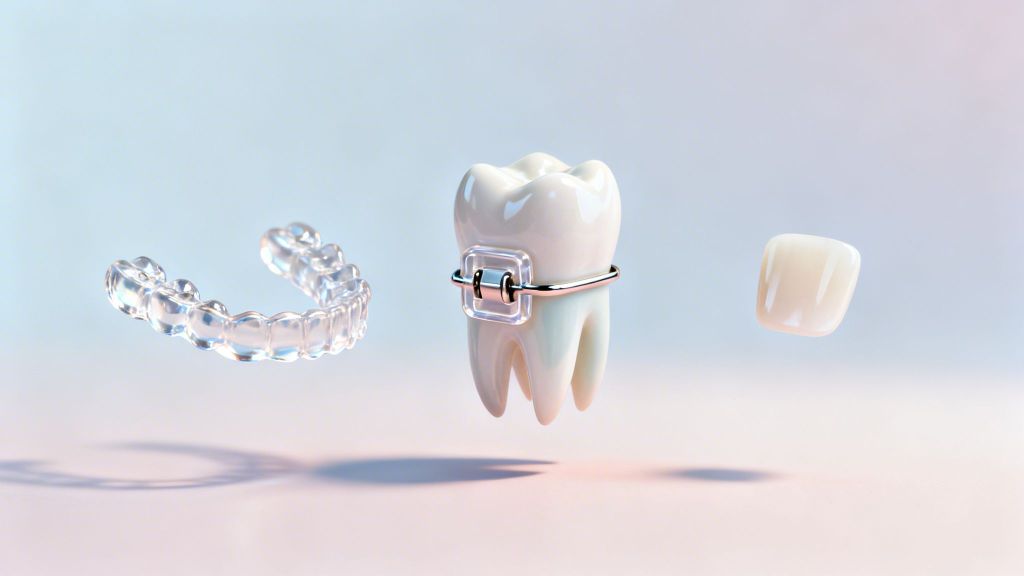
Clear aligners are crafted from a specialized, medical-grade transparent plastic. This material, often a custom-formulated polyurethane blend, is engineered to be both flexible enough to wear comfortably and rigid enough to exert the necessary force.
Because bone remodeling happens slowly, you cannot move a tooth to its final position all at once. Instead, you wear a sequential series of aligners. Each aligner is slightly different from the one before it. As you switch to a new tray, it applies gentle, continuous force to specific teeth, guiding them a fraction of a millimeter further along their planned path.
The Biomechanics of Clear Aligner Treatment
The success of clear aligner therapy relies on highly sophisticated biomechanics. Applying force to a tooth requires precision to ensure the tooth moves exactly as intended.
Controlled Force Application
Unlike traditional braces that apply force to all teeth simultaneously via a single wire, clear aligners can control the timing and amount of force applied to individual teeth. This means certain teeth can be moved while others act as anchors, remaining stationary. This precise control helps prevent unwanted tooth shifts and makes the treatment highly efficient.
The Power of Attachments
Sometimes, the smooth surface of a tooth makes it difficult for the plastic aligner to gain enough grip, especially when complex movements like rotation or extrusion are required. To solve this, dentists use attachments. Attachments are tiny, tooth-colored bumps of composite resin temporarily bonded to specific teeth. They act like small handles, giving the aligner something to push against. Different shapes of attachments are used to direct forces in very specific directions, significantly increasing the predictability of complex tooth movements.
Elastics and Auxiliary Appliances
For more complicated cases, especially those involving significant bite correction like overbites or underbites, aligners alone might not be enough. In these situations, dentists may incorporate orthodontic elastics. These rubber bands attach to small slits in the aligners or to button-like attachments on the teeth. They apply additional directional force between the upper and lower jaws, helping to align the bite properly while the plastic trays straighten the individual teeth.
Comparing Clear Aligners to Traditional Braces
Both clear aligners and traditional braces operate on the exact same biological principle. They both use continuous force to trigger bone remodeling. The key difference lies in their mechanics and aesthetics.
Braces pull teeth into place using brackets glued to the teeth and tensioned wires. Aligners push teeth into place using the tight fit of the custom-molded plastic.
Aesthetically, aligners are nearly invisible, making them a popular choice for adults and self-conscious teens. Beyond looks, the most significant advantage of clear aligners is their removability. Because you take them out to eat and drink, there are absolutely no dietary restrictions. Furthermore, maintaining proper oral hygiene is vastly simpler. You can brush and floss your teeth normally without having to navigate around metal brackets and wires.
The Patient’s Role in Successful Treatment
While the science behind the system is advanced, the ultimate success of the treatment relies heavily on the patient. Clear aligners only work when they are actually worn.
For optimal bone remodeling to occur, the forces applied to your teeth must be continuous. Dentists require patients to wear their aligners for 20 to 22 hours per day. Removing them frequently or leaving them out for extended periods disrupts the cellular response, slowing down treatment and potentially compromising the final result.
Proper hygiene and aligner care are also paramount. You must brush your teeth after every meal before putting the aligners back in to prevent trapping food particles and bacteria against your enamel. Additionally, regular check-ups with your dentist are necessary to monitor your progress, ensure the teeth are tracking according to the digital plan, and make any necessary adjustments.
Clear Aligners at The Dental Retreat
Achieving the best results requires more than just high-quality plastic trays. It requires expert oversight and personalized care. At The Dental Retreat, we take a comprehensive, patient-first approach to clear aligner treatment.
Dr. Rabeea Afzal personally oversees each step of the process. She customizes every clear aligner treatment plan to ensure that the aligners fit comfortably while effectively aligning your teeth in the most biomechanically sound way possible. By utilizing state-of-the-art 3D scanning technology and advanced treatment planning software, our team can predict your results with incredible accuracy.
When you choose The Dental Retreat for your clear aligner journey, you receive ongoing support, detailed progress tracking, and the expertise of a dedicated dental professional who understands the intricate biology of tooth movement.
Health Benefits Beyond Aesthetics
While most people seek orthodontic treatment for a straighter, more attractive smile, the benefits of clear aligners extend far beyond cosmetics. Proper dental alignment plays a crucial role in your overall oral health.
Improved Oral Hygiene and Gum Health
Crowded or overlapping teeth create tight crevices that are difficult to reach with a toothbrush or floss. Plaque and bacteria thrive in these hidden spaces, significantly increasing the risk of tooth decay and periodontal disease. By straightening your teeth, clear aligners make it much easier to maintain excellent oral hygiene, resulting in healthier gums and a reduced risk of cavities.
Better Bite Function and Reduced Wear
A misaligned bite can cause uneven distribution of chewing forces. Over time, this unequal pressure can lead to premature wear on your tooth enamel, chipped teeth, and strain on your jaw joints. Correcting your bite with clear aligners ensures that your teeth fit together perfectly, protecting your enamel and improving your overall chewing function.
Enhanced Confidence and Quality of Life
The psychological benefits of a healthy, straight smile cannot be overstated. When you are proud of your teeth, you are more likely to smile openly, speak confidently, and engage comfortably in social and professional settings. This boost in self-esteem can have a profoundly positive impact on your overall quality of life.
Your Path to a Straighter Smile
The process of moving teeth with clear aligners is a remarkable combination of natural biology and modern engineering. By applying precise, controlled forces through custom-designed plastic trays, aligners stimulate the bone remodeling process, gently guiding your teeth into their ideal positions. The use of advanced 3D software and carefully placed attachments ensures that even complex movements can be achieved predictably and comfortably.
This scientifically backed treatment offers a discreet, hygienic, and highly effective alternative to traditional metal braces. Not only does it yield beautiful cosmetic results, but it also promotes better long-term oral health and function.
If you are ready to transform your smile and experience the benefits of modern orthodontic science, reach out to our team. Consult with The Dental Retreat today to begin your personalized clear aligner journey.
The Dental Retreat
https://www.google.com/maps?cid=12091687882530918159
28047 Stockdick School Rd #200, Katy, TX 77493
(281) 717-6696
https://dentalretreattx.com/