All-on-4 vs. Traditional Dentures: Key Differences Explained
Losing teeth changes more than your smile. It affects how you speak, what you eat, and how you feel about yourself. For many people, that moment of loss leads to a single overwhelming question: what now?
Two of the most common answers are traditional dentures and All-on-4 dental implants. Both restore your smile. Both replace missing teeth. But beyond that, the similarities thin out quickly. The experience, the results, and the long-term impact on your oral health are worlds apart.
This guide breaks down everything you need to know about both options—how they work, what they cost, what recovery looks like, and who each one is best suited for. By the end, you’ll have a clearer picture of which path makes sense for your situation.
What Are Traditional Dentures?
Traditional dentures have been around for centuries, and for good reason—they work. They’re removable prosthetic devices, typically made from acrylic or a combination of acrylic and metal, designed to replace a full arch of missing teeth (complete dentures) or a few missing teeth (partial dentures).
How they work
Dentures sit on top of the gum line and are held in place by suction, natural tissue contours, or adhesive. They’re custom-fitted to your mouth, removed at night, and cleaned separately from your natural teeth.
The advantages of traditional dentures
-
Affordability: Dentures are generally the most cost-effective tooth replacement option upfront.
-
Non-surgical: No procedures, no healing time. Dentures are a good option for patients who can’t undergo surgery due to health conditions.
-
Accessibility: Most dental practices offer dentures, and the turnaround time from fitting to final product is relatively short.
-
Reversibility: Because no permanent changes are made to your mouth, the process is fully reversible.
The challenges you should know about
Dentures come with a set of trade-offs that are worth understanding before committing.
Stability issues top the list. Without anything anchoring them to the jaw, dentures can shift, slip, or click when you talk or eat. Many patients find this embarrassing and restrictive. Chewy, crunchy, or sticky foods often become off-limits.
Bone loss is a deeper, less visible concern. Your jawbone needs stimulation from tooth roots to maintain its density. Once those roots are gone, the bone gradually resorbs—meaning it shrinks. Traditional dentures don’t address this. Over time, bone loss changes the shape of your jaw and face, which leads to ill-fitting dentures that need to be refitted or replaced every few years.
Maintenance adds another layer of complexity. Dentures need daily cleaning, overnight soaking, and regular professional adjustments. Drop them, and they can crack or break.

What Is the All-on-4 Technique?
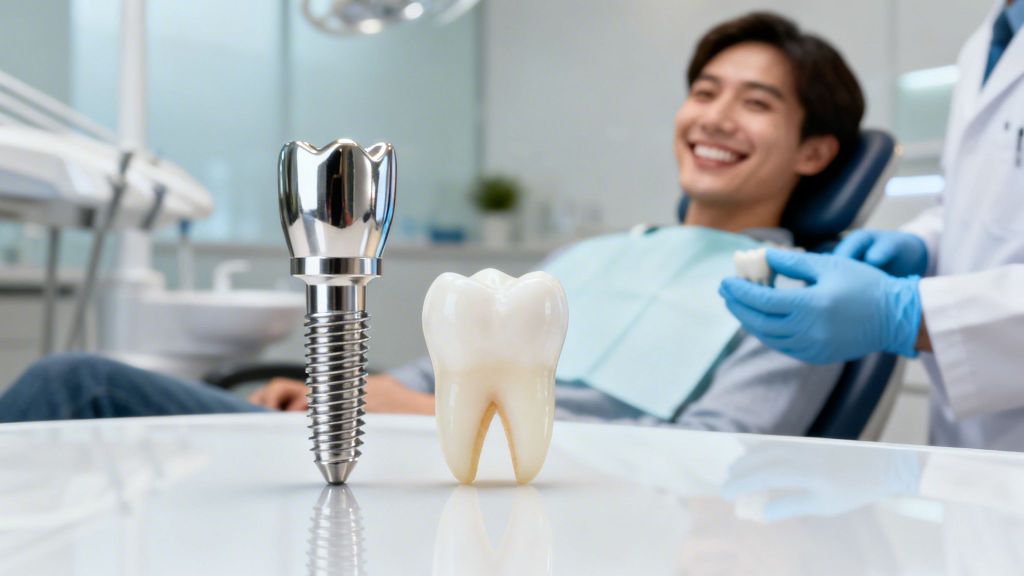
All-on-4 is a surgical implant technique that permanently replaces a full arch of teeth using just four strategically placed titanium implants. Two implants are placed vertically at the front of the jaw, while two are angled at the back to maximize contact with available bone. A fixed prosthetic arch is then attached to these implants.
The result is a full set of teeth that doesn’t come out. It functions, feels, and looks like natural teeth.
Why four implants?
The angled placement of the posterior implants is the key innovation. It allows the implants to engage more bone surface area without requiring bone grafting—a significant advantage for patients who have experienced some degree of bone loss.
The advantages of All-on-4
-
Permanent stability: The implants fuse with the jawbone through a process called osseointegration. Once integrated, the prosthetic arch stays firmly in place.
-
Bone preservation: Because the implants act like tooth roots, they stimulate the jawbone and help prevent further bone loss.
-
Natural aesthetics: All-on-4 restorations are designed to closely mimic the appearance of natural teeth and gums.
-
Dietary freedom: You can eat most foods without restriction—no adhesives, no slippage.
-
Long-term value: With proper care, All-on-4 implants can last decades, making them a strong long-term investment.
The trade-offs
All-on-4 is a surgical procedure, which means it involves recovery time, upfront cost, and not everyone is an immediate candidate. Patients with very low bone density or certain systemic health conditions may require additional assessment or preparatory treatment before proceeding.
All-on-4 vs. Traditional Dentures: A Direct Comparison
This is where the two options diverge most noticeably. Denture wearers often report reduced confidence when speaking publicly or eating out. The fear of slippage is real, and it affects daily life. All-on-4 implants eliminate that concern entirely. The prosthetic arch is anchored firmly in place, so biting, chewing, and speaking all feel natural.
Aesthetics
Both options can produce good aesthetic results, but All-on-4 typically delivers a more natural appearance. The implants support the facial structure from within, helping to maintain jawline definition. Denture wearers who experience significant bone loss over time may notice changes to the shape of their face—a hollowing or sunken appearance that no prosthetic on the surface can fully correct.
Cost
Upfront, traditional dentures implant win on cost. But the long-term picture is more nuanced. Dentures typically need relining or replacing every five to ten years. Add up adhesives, cleaning products, and professional adjustments, and the gap narrows considerably. All-on-4 implants, by contrast, are a larger investment upfront but require minimal maintenance and rarely need full replacement.
Long-term oral health
All-on-4 is the clear winner here. Preserving bone density, maintaining facial structure, and eliminating the need for adhesives all contribute to better long-term health outcomes. Traditional dentures, while effective at restoring aesthetics initially, do nothing to address the underlying bone loss that tooth loss sets in motion.

What Does the Procedure and Recovery Look Like?
Traditional dentures
Getting dentures typically involves several appointments. The dentist takes impressions, models the denture, adjusts the fit, and delivers the final product. The process usually takes a few weeks. There’s no surgical recovery, though new wearers often experience a period of adjustment—soreness, increased saliva production, and difficulty speaking naturally are common in the early stages.
All-on-4
The All-on-4 procedure is typically completed in a single day, often referred to as “same-day teeth.” Here’s a simplified breakdown:
-
Consultation and imaging: 3D scans and X-rays map your bone structure and plan implant placement.
-
Extraction (if needed): Any remaining compromised teeth are removed.
-
Implant placement: The four implants are surgically inserted under local anesthesia or sedation.
-
Temporary arch fitting: A temporary prosthetic is attached on the same day.
-
Healing period: Osseointegration takes three to six months. During this time, you wear the temporary arch while the implants integrate with the bone.
-
Final arch fitting: Once integration is confirmed, the permanent prosthetic is placed.
Recovery from All-on-4 surgery involves swelling, some discomfort, and a soft-food diet for the first few weeks. Most patients return to normal activity within a week, though full recovery takes longer.
Why Choose The Dental Retreat?
Making a decision between All-on-4 dental implants and traditional dentures is significant and shouldn’t be based solely on information from a blog post. The best choice for you depends on several personal factors, including your bone density, overall health, financial budget, and what you hope to achieve in the long term. These elements can only be accurately evaluated through a comprehensive clinical assessment by a dental professional.
At The Dental Retreat, we offer expert restorative consultations designed to give you a clear, complete understanding of all your options, empowering you to make a decision with confidence. Whether you’re considering implants for the first time, looking for an alternative to your current dentures, or simply want to learn more, our dedicated team is here to help. We take the time to listen to your concerns, understand your unique situation, and assess your clinical needs before recommending a personalized treatment path forward.
A valuable consultation goes beyond discussing what’s technically possible; it’s about discovering what’s genuinely right for you and your lifestyle.
Take the Next Step Toward a Confident Smile
Both All-on-4 dental implants and traditional dentures are effective options for restoring your smile and improving your quality of life, but they are designed to meet very different needs. All-on-4 dental implants offer long-term stability, help maintain bone health, and provide a natural look and feel that closely mimics real teeth. This makes them an excellent choice for those prioritizing durability, aesthetics, and a solution that feels as close to natural teeth as possible. On the other hand, traditional dentures are a more affordable and non-surgical option, making them a practical choice for individuals seeking a less invasive solution.
Deciding between the two depends on your unique needs, lifestyle, and goals. If you’re unsure which option is right for you, the best next step is to consult with a dental professional. At The Dental Retreat, we provide personalized assessments to help you understand your options and choose the solution that’s tailored to your health, budget, and long-term dental goals. Book a consultation today, and let’s find the best path to restoring your smile and confidence!
The Dental Retreat
https://www.google.com/maps?cid=12091687882530918159
28047 Stockdick School Rd #200, Katy, TX 77493
(281) 717-6696
https://dentalretreattx.com/