If you are missing a tooth, you may already be thinking about more than your smile. Chewing feels uneven. Photos feel awkward. You may even notice yourself avoiding one side of your mouth.
Dental implants can be a life-changing solution, but many patients in Katy, TX feel nervous when they hear they might also need a bone graft. That reaction is normal. New terms can make treatment sound more complicated than it is.
What is bone grafting for dental implants? It is a way to rebuild or strengthen the jawbone so an implant has the support it needs. Think of it as preparing the ground before setting a fence post. If the base is weak, the final result will not be as stable.
For many patients, this step is not about adding extra treatment. It is about making the implant safer, stronger, and more predictable over time. If you live in Katy, TX or nearby neighborhoods like Sunterra, Cane Island, Elyson, Katy Lakes, or Ventanna Lakes, this guide will help you understand what bone grafting is, why it matters, what recovery is like, and when it may be avoidable.
Your Path to a Lasting Smile with Dental Implants in Katy TX
A missing tooth often starts as a small daily frustration. You chew carefully. You smile with your lips closed. You tell yourself you will deal with it later.
Then later turns into months.
For many adults in Katy, that is the moment dental implants start to sound appealing. They are fixed, natural-looking, and designed to restore function in a way a removable option rarely can. But when a patient comes in for a consultation, one of the first questions is often, “Why can’t I just place the implant now?”
The answer usually comes down to bone.
Why missing teeth affect more than appearance
When a tooth is gone, the jawbone in that area no longer gets the same stimulation from biting and chewing. Over time, the bone can shrink. That can make implant placement harder, even if the gum tissue looks fine from the outside.
This surprises many patients. They expect the issue to be the gap they can see. The deeper issue is often the foundation they cannot see.
A patient may come in saying:
- “I lost this tooth a while ago” and not realize the jawbone may have changed since then.
- “I just want something permanent” but feel discouraged when they hear another step is needed.
- “I’m anxious about surgery” and worry bone grafting sounds more intense than it is.
A bone graft is often a preparation step, not a setback. It helps create the support an implant needs to last.
A calm, local approach to implant care
Patients in Sunterra, Cane Island, Katy Manor, Kingscrossing, Lakehouse, Marisol, The Grange, Anniston, Katy Lakes, Elyson, and Ventanna Lakes often want the same thing. They want clear answers, a gentle plan, and no pressure.
That is especially true if they are already searching for a dentist near me, dental implants near me, or a dentist in Katy, TX because they are ready to move forward but still feel uneasy.
Bone grafting can sound technical. It does not have to feel mysterious. Once you understand what it does, it becomes much easier to see why your dentist may recommend it before implant treatment, after a tooth extraction, or as part of a larger restorative dentistry plan.
What is a Dental Bone Graft and Why is it Necessary
You may hear "bone graft" and picture a major procedure. In reality, it is often a careful way to rebuild support in one small area so a future implant has a better place to heal.
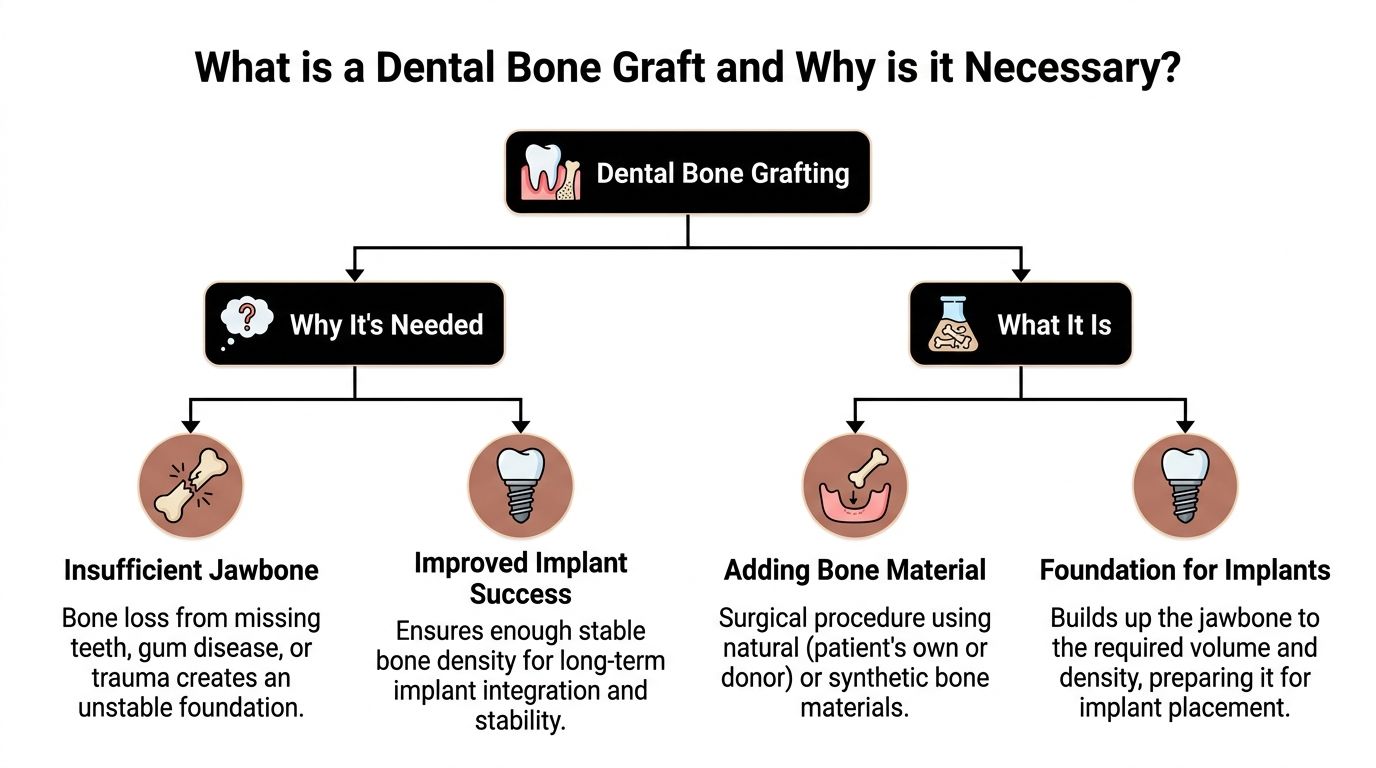
A dental bone graft adds bone material to a part of the jaw that has become too thin, too narrow, or too soft for an implant. The graft material acts like a scaffold. Your body gradually replaces or blends with that scaffold and builds stronger bone in the area.
An implant needs more than healthy-looking gums. It needs enough jawbone around it to stay secure during healing and to handle daily biting pressure afterward.
What bone grafting does
Bone grafting restores lost volume where support is missing. If the jaw has shrunk after a tooth was removed, the space may no longer be wide or tall enough for an implant to sit in the right position. A graft helps rebuild that shape.
That is why grafting is often recommended before implant placement or at the time of an extraction. It helps create conditions that are more predictable for long-term function, comfort, and appearance.
Why bone loss happens after tooth loss
After a tooth is lost, the jaw no longer receives the same pressure through the tooth root during chewing. Without that stimulation, the body begins to resorb bone in that area. The change can happen slowly and without obvious symptoms.
Patients are often surprised by this. The gums may look healed, and the space may not hurt, yet the bone underneath may have changed quite a bit. Bone loss can also happen because of gum disease, injury, infection, or a tooth that has been missing for many years.
Why your dentist may recommend it
Your dentist recommends a bone graft to improve the site, not to add an unnecessary step. In areas with reduced bone, grafting can help improve implant success and give the implant better support.
Just as important, it helps the implant go in where it should. That affects how the final tooth looks, how it feels when you chew, and how easy it is to keep clean over time.
At The Dental Retreat in Katy, this planning process is designed to feel clear and manageable. Advanced imaging helps your dentist measure the bone precisely, and sedation dentistry can help anxious patients feel relaxed if grafting is part of the plan. In a spa-like setting, the conversation often shifts from "Why do I need this?" to "Okay, I understand how this helps me get a healthier, lasting smile."
Common situations where grafting may be needed
A bone graft may be recommended if:
- A tooth has been missing for a while and the ridge has become narrower
- You recently had a tooth extraction and want to preserve the area for an implant
- Gum disease caused bone loss around a tooth
- An injury affected the jawbone
- Your implant needs better support for a stable, natural-looking result
Bone grafting is often a preparation step that makes implant treatment safer, more stable, and less stressful in the long run.
Understanding Different Types of Dental Bone Grafts
Hearing that you may need a bone graft can sound intimidating at first. In most cases, it means your dentist is choosing the right building material for the area where your future implant will sit.
The main difference between graft types is the source of the material. Your body does the healing. The graft acts as a framework that helps new bone develop in the right shape and volume.
At The Dental Retreat in Katy, we explain these options in plain language, review your 3D images with you, and talk through comfort measures such as sedation dentistry if you feel nervous. That way, the decision feels informed, not overwhelming.
The four main graft types
Some grafts come from your own body. Others come from screened donor tissue, animal-derived material, or synthetic materials. Each type can be appropriate in the right situation.
| Graft Type | Source | Key Patient Benefit |
|---|---|---|
| Autograft | Your own bone | Strong healing potential because it comes from you |
| Allograft | Human donor tissue | No second surgical site needed |
| Xenograft | Animal source, commonly bovine | Helps hold space and support bone growth |
| Alloplast | Synthetic material | No human or animal donor source |
Autograft
An autograft uses bone from your own body, often from an area close to the treatment site. Many dentists view it as a reliable option because it contains your own natural bone cells and proteins.
The tradeoff is straightforward. It may require a second surgical area to collect the bone, which can add soreness and recovery in that donor site.
Allograft
An allograft uses carefully processed donor bone from a human tissue bank. For many patients, this is appealing because it avoids taking bone from their own body.
It is often chosen when the goal is to rebuild support while keeping the procedure simpler. For an anxious patient, reducing the number of treatment areas can make the whole experience feel more manageable.
Xenograft
A xenograft usually comes from an animal source, most often bovine. It works like a scaffold, helping your body grow bone into the area over time.
This type is often useful when maintaining shape and volume is important. Some patients are comfortable with that option right away, while others prefer a different material based on personal beliefs or preferences.
Alloplast
An alloplast is a synthetic graft material made in a lab. It is designed to support new bone formation without using human or animal tissue.
Some patients prefer that for personal or religious reasons. In the right case, it can be a practical and effective choice.
How dentists choose the right one
Choosing a graft is a medical decision, but it is also a personal one. Your dentist looks at the shape of the bone defect, how much support the implant will need, whether the implant will be placed now or later, and any healing factors in your health history.
Patient comfort also matters. In a patient preference survey on graft type decisions, 23% of surveyed patients were willing to undergo bone harvesting from the hip. That helps explain why many treatment plans favor options that avoid a second surgical site when they are clinically appropriate.
The best graft is not the one with the most technical name. It is the one that fits your anatomy, your goals, and your comfort level.
For many patients at The Dental Retreat, that conversation becomes much easier once they see the scan, understand the purpose of the graft, and know they have options for relaxation in a calm, spa-like setting.
The Dental Bone Grafting Procedure at The Dental Retreat
You arrive for your appointment feeling tense, wondering whether bone grafting will be complicated or painful. By the time the plan is explained on a 3D scan and your comfort options are in place, the process usually feels far more manageable and predictable.
It starts with precise imaging
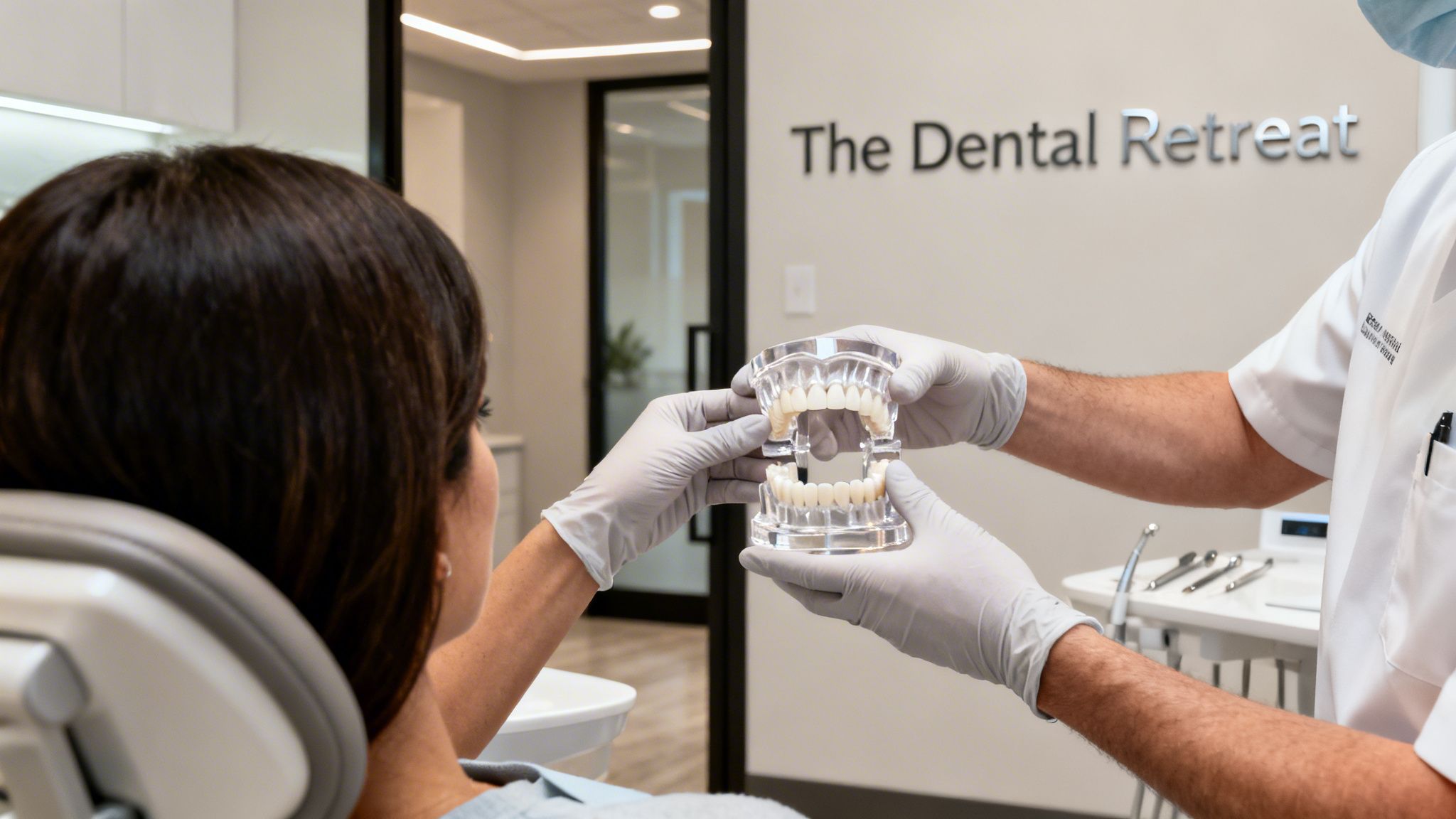
Bone grafting begins with seeing the area clearly. A CBCT scan gives your dentist a 3D view of the jaw, including the bone’s height, width, and the nearby structures that need to be respected during treatment.
That level of detail helps us plan the graft with much more confidence than a standard 2D X-ray. It also helps answer one of the biggest patient questions early: How much bone support is missing, and where?
Once the site is mapped, the graft material is placed where the jaw needs reinforcement. A membrane is often added over the graft to help protect the area while your body replaces that material with new bone. In guided bone regeneration, studies have reported bone gain in the range of about 1 to 2 mm per month, with many sites needing about 4 to 6 months of healing before implant placement, depending on the size and location of the defect, as described in this review of guided bone regeneration outcomes.
Bone grafting works much like setting up a scaffold while a wall is being rebuilt. The scaffold is not the final structure. It holds the space so your own bone can grow in and strengthen the area.
What happens during the procedure
The procedure itself is usually straightforward and carefully controlled.
First, the area is fully numbed with local anesthesia. If you feel nervous about oral surgery, sedation can be part of the plan. For many anxious patients, that alone changes the experience. Instead of bracing for every step, they are able to relax while the team works gently and efficiently.
After the area is numb, the dentist opens the gum tissue enough to reach the site, places the graft material where support is needed, and covers it when appropriate with a protective membrane. The tissue is then closed so the area can heal with as little disturbance as possible.
A simple way to picture the sequence is this:
- Map the site with 3D imaging
- Numb the area and add sedation if planned
- Place the graft where bone is lacking
- Protect and close the site for healing
Some grafts are done at the same time as a tooth extraction or implant placement. Others are done first, with the implant placed after the bone matures. The right timing depends on how much natural support is already present.
Comfort matters during treatment
Patients often worry more about the experience than the technical details. That is understandable. At a spa-like office, the setting can ease a lot of that fear before treatment even begins.
At The Dental Retreat, treatment may include comfort features such as noise-canceling headphones, TVs in treatment rooms, aromatherapy, and heated massage chairs, along with sedation options for patients who feel anxious about surgery. For someone in Katy who has been putting off implants because the process sounds intimidating, those details can make the visit feel calmer and more approachable.
Advanced technology helps with comfort too. Better planning usually means a more efficient procedure, fewer surprises, and clearer expectations. When patients can see the scan and understand why a graft is recommended, the procedure tends to feel less mysterious and less overwhelming.
Here is a helpful visual overview of implant treatment.
Questions patients often ask before the procedure
A few questions come up at almost every consultation.
- Will I be awake? Usually yes. The area is numb, and sedation may be available based on your needs and treatment plan.
- How long does the appointment take? It depends on the size of the graft and whether it is being combined with another procedure.
- Will I look swollen afterward? Mild swelling is common, and your dentist will give you clear instructions to help keep you comfortable.
Clear expectations lower fear. When you know what will happen, why it is being done, and how your comfort will be protected, bone grafting often feels much less intimidating than it sounds.
Your Comfortable Recovery and Healing Timeline
Recovery after bone grafting is usually more manageable than patients expect. The key is knowing what is normal and giving the area time to heal.
For many people, the first day is the most emotionally charged part. They go home wondering if every sensation means something is wrong. Usually, it does not.
The first day and first week
During the first day, it is normal to notice soreness, mild bleeding, and some swelling. You will want to rest, avoid disturbing the site, and stick to the instructions your dentist gives you.
Over the next several days, the area usually starts to settle. Soft foods are helpful. Gentle cleaning matters. Heavy chewing near the graft should wait.
A typical patient focus during this stage looks like this:
- Protect the area by avoiding hard, crunchy, or spicy foods
- Follow cleaning instructions so the site stays undisturbed
- Take medications as directed if your dentist prescribes them
- Attend follow-up visits so healing can be checked
The next few months
This is the part patients cannot see, but here critical work happens. The grafted area then begins integrating with your natural bone.
You may feel almost back to normal long before the bone is fully ready for an implant. That is why follow-up imaging and timing matter so much. Feeling fine is good, but your dentist still needs to confirm that the foundation is mature enough.
If you want a fuller view of the overall implant timeline, this guide on what to expect with a dental implant can help connect the dots between graft healing and final implant placement.
How PRF can make healing easier
Some offices use Platelet-Rich Fibrin, often called PRF, to support healing. PRF is made from a small sample of your own blood and contains natural growth factors that can be added to the surgical process.
Clinical information shows that PRF can reduce post-operative swelling by a significant percentage and help accelerate bone regeneration, improving comfort during recovery, based on this explanation of PRF in bone graft healing.
That matters to anxious patients because comfort is not just about the procedure day. It is also about how the days after treatment feel.
A smooth recovery usually comes down to two things. Protect the site and do not rush the timeline.
When to call your dentist
Your dental team should tell you exactly what to watch for. In general, contact the office if your discomfort seems to worsen instead of improve, if something feels loose in the area, or if you are unsure whether healing looks normal.
Good post-op care is part of treatment, not an afterthought. That is especially important if you are balancing family life, work, or school schedules in Katy Lakes, The Grange, or nearby communities and want a recovery plan that feels realistic.
Benefits of a Strong Foundation and Graft-Free Options
A dental implant lasts best when it has firm bone around it, much like a fence post lasts longer when the ground is packed and steady. That foundation affects how securely you chew, how natural the tooth looks, and how confidently the implant can serve you for years.
For patients at The Dental Retreat, this part of treatment often brings up an understandable question. If comfort is such a priority, why add a bone graft at all? The answer is simple. Sometimes a small step now helps you avoid a less stable result later.
Why a stronger base supports a better result
An implant joins with the jawbone. If the bone is too thin, too soft, or has shrunk after tooth loss, placing an implant in that area can limit the safest position and the final appearance.
That matters in different ways depending on the tooth. In the front of the mouth, support helps shape a smile that looks balanced. In the back, support helps handle chewing pressure. For larger smile restorations, bone support can also help your dentist plan treatment with more precision using advanced imaging instead of guesswork.
A good foundation also gives you more predictability, which is something anxious patients often value just as much as comfort. Clear planning, careful placement, and a stable base usually make the whole process feel less uncertain.
When grafting may not be needed
Not every implant patient needs a graft.
Some people still have enough healthy bone to support an implant right away. Others may qualify for a different treatment design that works around areas of bone loss. A detailed 3D scan helps your dentist see the actual shape and volume of bone before recommending anything.
For some full-arch cases, an approach like All-on-4 dental implants may reduce the need for grafting because the implants are placed in areas where bone is naturally stronger. That can shorten the treatment path for the right patient, though it is not the best fit for everyone.
A calm, patient-first way to decide
A thoughtful implant plan usually follows a simple logic:
- If your bone is healthy and stable, treatment may proceed without grafting.
- If bone support is limited but workable, your dentist may consider a different implant size, angle, or full-arch approach.
- If the area cannot support an implant reliably, grafting may be the safer way to protect your comfort and result.
At a spa-like office such as The Dental Retreat, the goal is not to push you toward more treatment. It is to explain what your mouth needs in plain language, answer your questions, and make the path feel manageable. Sedation options and modern technology help many Katy patients feel far more relaxed about treatment decisions that once sounded intimidating.
That reassurance matters. A bone graft is not an automatic extra step. It is a tool your dentist may use to build a healthier, more secure smile.
Why Choose The Dental Retreat for Your Implant Journey in Katy
Choosing where to get implant care is not only about credentials and equipment. It is also about how you feel during the process.
Many people looking for a dentist near me, cosmetic dentist near me, emergency dentist, or dentist in Katy, TX are not just comparing services. They are looking for a place where they will feel heard, informed, and comfortable.
A setting that helps anxious patients exhale
For patients who tense up before dental visits, environment matters. A calm, spa-inspired office can change the entire tone of treatment.
Amenities such as aromatherapy, heated massage chairs, TVs in each room, and noise-canceling headphones help reduce the sensory stress that often makes oral surgery and implant visits feel overwhelming.
Modern care with everyday convenience
Implant treatment often works best when it is part of a complete dental home. That means one office can also help with:
- Tooth extraction if a damaged tooth needs to come out first
- Dental X-rays and new patient exams for planning
- Restorative dentistry to rebuild function
- Cosmetic dentistry to refine the final appearance
- Emergency dentist visits if pain or infection speeds up the timeline
For families in Sunterra, Cane Island, Elyson, Katy Manor, and Ventanna Lakes, convenience matters almost as much as clinical skill. Extended hours, bilingual care, and clear explanations can make a big difference in whether treatment feels manageable.
Transparent options for patients without insurance
Cost concerns stop many people from scheduling a consultation. A good office should be able to discuss that openly.
The publisher information provided for this practice notes new patient offers that include a $99 full exam with cleaning and X-rays, a $49 problem-focused visit, $350 in-office Zoom whitening, and membership plans that start at $299 per year for patients without insurance.
Those details do not replace a personal treatment estimate, but they do show that affordability and planning are part of the conversation.
The right dental office does two things well. It plans carefully and communicates clearly.
If you are in Katy and want implant treatment explained in plain language, that combination can make the first appointment feel much less intimidating.
Frequently Asked Questions About Dental Bone Grafting
Does a bone graft hurt
Most patients feel pressure more than pain during the procedure because the area is numbed well. If you are anxious, ask about sedation options. Many people find that fear of the procedure is worse than the procedure itself.
Soreness afterward is common, but it is usually manageable with the aftercare plan your dentist gives you.
How long after a bone graft can I get my implant
It depends on how much grafting you need and how your body heals. Some cases allow very efficient sequencing. Others need a longer healing period before implant placement.
Your dentist should confirm readiness with an exam and imaging rather than guessing based on time alone.
Can bone grafting be avoided
Sometimes, yes. Some patients have enough natural bone for implant placement without grafting. Others may be candidates for mini implants or a different implant approach if the anatomy allows it.
There is strong patient interest in avoiding unnecessary grafting. Survey information shows 67% of patients would pay more for technology that helps avoid grafting, which highlights how important precise diagnostics are in treatment planning, according to this patient-focused discussion of graft-free alternatives and CBCT-guided decision-making.
How much does a dental bone graft cost in Katy TX
The cost depends on the amount of grafting, the material used, whether sedation is involved, and whether the graft is done with an extraction or as a separate procedure.
The best next step is a consultation. That visit allows your dentist to take images, evaluate the site, and give you a personalized plan with transparent fees.
Is bone grafting always done before implants
No. Some patients never need it. Others need only a small graft, while some require more substantial rebuilding. The key is not whether grafting is common. The key is whether your jawbone is ready to support an implant safely.
Is it worth doing if I want a long-lasting result
For the right patient, yes. Bone grafting can make the difference between trying to force an implant into a weak site and creating a healthier, more stable foundation first.
That is often the smarter route if your goal is a durable smile, comfortable chewing, and confidence in the result.
Bone Grafting FAQs in Katy, TX
Why is bone grafting needed for dental implants?
A bone graft builds up the jawbone where it is too thin or soft to support an implant, giving the implant a stable foundation.
Does bone grafting hurt?
Bone grafting is performed with local anesthesia and sedation options for comfort. Most patients have only mild soreness afterward that settles within a few days.
How long does bone graft healing take?
Healing typically takes a few months, allowing the grafted bone to fuse before the implant is placed.
Do you always need a bone graft for implants?
No. Many patients have enough bone for implants without grafting. Your dentist determines this from a 3D exam.
If you are considering dental implants and want honest guidance about whether bone grafting is necessary, schedule a consultation with The Dental Retreat. You can get a clear exam, advanced imaging, and a personalized treatment plan designed around comfort, function, and your long-term smile goals in Katy, TX.