If you searched for Image Orthodontics Katy TX, you're probably doing what many families in Katy do. You want straighter teeth, a healthier bite, and a dental team that feels approachable. You may also be comparing options for yourself, your teenager, or your child while trying to sort through braces, clear aligners, cost, comfort, and how treatment will fit into daily life.
That search is a good starting point, but the better question is broader. What kind of orthodontic care fits your goals, your schedule, and your comfort level here in Katy, TX?
Your Guide to Orthodontics in Katy TX
Orthodontic care in Katy isn't new. Some local practices have served the area for more than 14 years, which shows that Katy families have long looked for orthodontic care close to home rather than leaving the community for treatment. LaCenterra's listing for Image Orthodontics notes that local history, along with care for children, teens, and adults, in its Image Orthodontics listing at LaCenterra.

That matters if you live in Sunterra, Cane Island, Katy Manor, Kingscrossing, Lakehouse, Marisol, The Grange, Anniston, Katy Lakes, Elyson, or Ventanna Lakes. It tells you this isn't a fringe service. Families in Katy routinely seek local help for crowding, bite issues, and smile concerns.
Why local orthodontic care matters
When treatment takes months, convenience matters. You want an office that's easy to reach for scans, check-ins, refinements, and questions that come up between visits. You also want a team that understands family schedules, school calendars, sports, work meetings, and the pace of life in Katy.
A local orthodontic relationship also helps with continuity. If you already need a dentist in Katy, TX for cleanings and exams, cosmetic dentistry, or even an emergency dentist visit, it's helpful when your care plan fits into a bigger picture of oral health.
Practical rule: Don't choose orthodontic care based on a name alone. Choose it based on fit, communication, and whether the plan makes sense for your mouth and your life.
What people usually want to know first
Most new patients aren't asking for technical details at the beginning. They want answers to simple questions:
- Will this improve more than appearance? Many people want to know if treatment helps chewing, cleaning, and long-term wear.
- Can I avoid metal braces? Adults often ask about clear aligners first.
- Will my child need treatment now or later? Timing is a common source of stress.
- How often will I need visits? Busy families in Katy want predictable scheduling.
- Can I keep all my care in one place? That's often important for households that already need routine dental care, teeth whitening, restorative dentistry, or help with a broken tooth.
If you came here searching for Image Orthodontics Katy TX, the most useful next step is learning how orthodontics works and which option matches your needs.
Beyond Straight Teeth Understanding Orthodontic Goals
People often think orthodontics is only about appearance. A straighter smile can certainly boost confidence, but its true value often goes deeper than that.
Teeth should fit together in a way that lets you bite, chew, and clean them comfortably. When they don't, you may notice little daily frustrations that build over time. Food gets trapped more easily. Brushing takes longer. Certain teeth wear down faster. Your jaw may even feel tired after chewing.
Common bite problems in plain language
Here are a few issues people in Katy commonly ask about:
- Crowding means teeth overlap or twist because there isn't enough room.
- Spacing means there are gaps between teeth.
- Overbite means the upper front teeth sit too far over the lower teeth.
- Underbite means the lower teeth sit in front of the upper teeth.
- Crossbite means some upper teeth bite inside the lower teeth instead of outside.
- Open bite means some teeth don't touch when you bite down.
These aren't just labels. They affect how your teeth function every day.
Why alignment affects oral health
When teeth are crowded or out of position, brushing and flossing become harder. That doesn't mean someone is careless. It means the shape and spacing of the teeth make cleaning more difficult.
Poor alignment can also place uneven pressure on certain teeth. One side of the bite may do more work than the other. Over time, that can lead to chipping, flattening, tenderness, or stress on the jaw muscles.
A good orthodontic plan aims for more than a nice photo. It aims for a bite that works comfortably and a smile that's easier to maintain.
Orthodontics is part of a bigger care plan
People sometimes get confused. Orthodontics doesn't replace routine dental care. It works alongside it.
You may still need:
| Concern | Dental service that may help |
|---|---|
| Plaque buildup during treatment | Cleaning and exams |
| A chipped or worn tooth | Restorative dentistry |
| Staining after alignment | Teeth whitening |
| Missing teeth after alignment planning | Dental implants |
| Sudden pain or swelling | Emergency dentist care |
That's why many patients prefer a practice that looks at the whole mouth, not just tooth movement. If your teeth are going to shift into healthier positions, the rest of your dental care should support that result.
Clear Aligners vs Braces Which Is Right for You
This is a common decision patients want help with. Both braces and clear aligners can improve alignment. They just do it in different ways, and each option asks different things from the patient.
The biggest source of confusion today is clear aligners. Consumer interest has grown quickly. One cited market estimate put the global clear aligner market at about USD 4.5 billion in 2023 and projected roughly 30% annual growth through 2030 in the clear aligner market discussion referenced by Smiles on Orthodontics. More interest is good, but it also means more people assume aligners work equally well for every case. They don't.
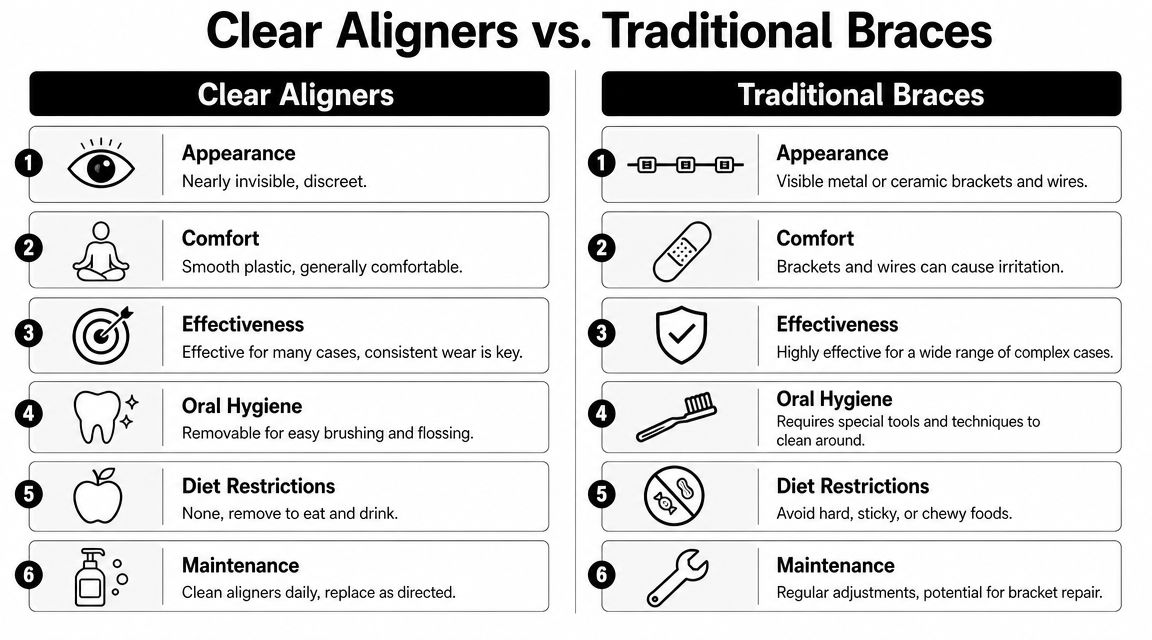
Side by side comparison
| Feature | Clear aligners | Braces |
|---|---|---|
| Appearance | Nearly invisible in daily life | More visible |
| Removal | Can be removed for meals and brushing | Fixed in place |
| Cleaning | Easier to brush and floss normally | Requires more technique around brackets and wires |
| Food choices | Fewer food restrictions because you remove them to eat | Hard, sticky, and chewy foods can be a problem |
| Compliance | You must wear them consistently | Treatment continues working because braces stay on |
| Complex cases | Good for many cases, but not all | Often better for more difficult tooth and bite movement |
When aligners tend to fit well
Aligners are often attractive to adults and teens who care about appearance and want flexibility. They can work well for mild to moderate crowding or spacing, and for patients who are organized enough to wear them as directed every day.
A lot of adults searching for a cosmetic dentist near me or orthodontic care in Katy like aligners because they feel less noticeable in meetings, photos, and social settings. They also simplify meals because there are no wires to work around.
For a detailed look at adult-friendly options, this guide on teeth straightening options for adults is a useful next read.
When braces may be the better choice
Braces still have an important role. If a patient has a more complicated bite issue, significant rotation, or tooth movement that needs stronger control, braces may be the more predictable tool.
This isn't a failure or a step backward. It's just the right appliance for the job. Good orthodontic planning means matching the method to the biology, not forcing every case into the same product.
Here's a visual overview many patients find helpful before a consultation.
What patients often miss: Clear aligners only work well when they're worn consistently. If they stay in the case too often, treatment slows down and results can drift off plan.
The right question to ask
Don't ask, “Which option is more popular?” Ask, “Which option gives me the safest and most realistic path to the result I want?”
That question leads to better conversations, especially if you're comparing care for a teen, balancing work travel, or trying to manage treatment around a busy family calendar in Katy.
What to Expect with Clear Aligner Treatment
For many adults and teens, clear aligners feel less intimidating than braces because the process is simple once you understand it. Anxiety usually comes from not knowing what happens at each stage.
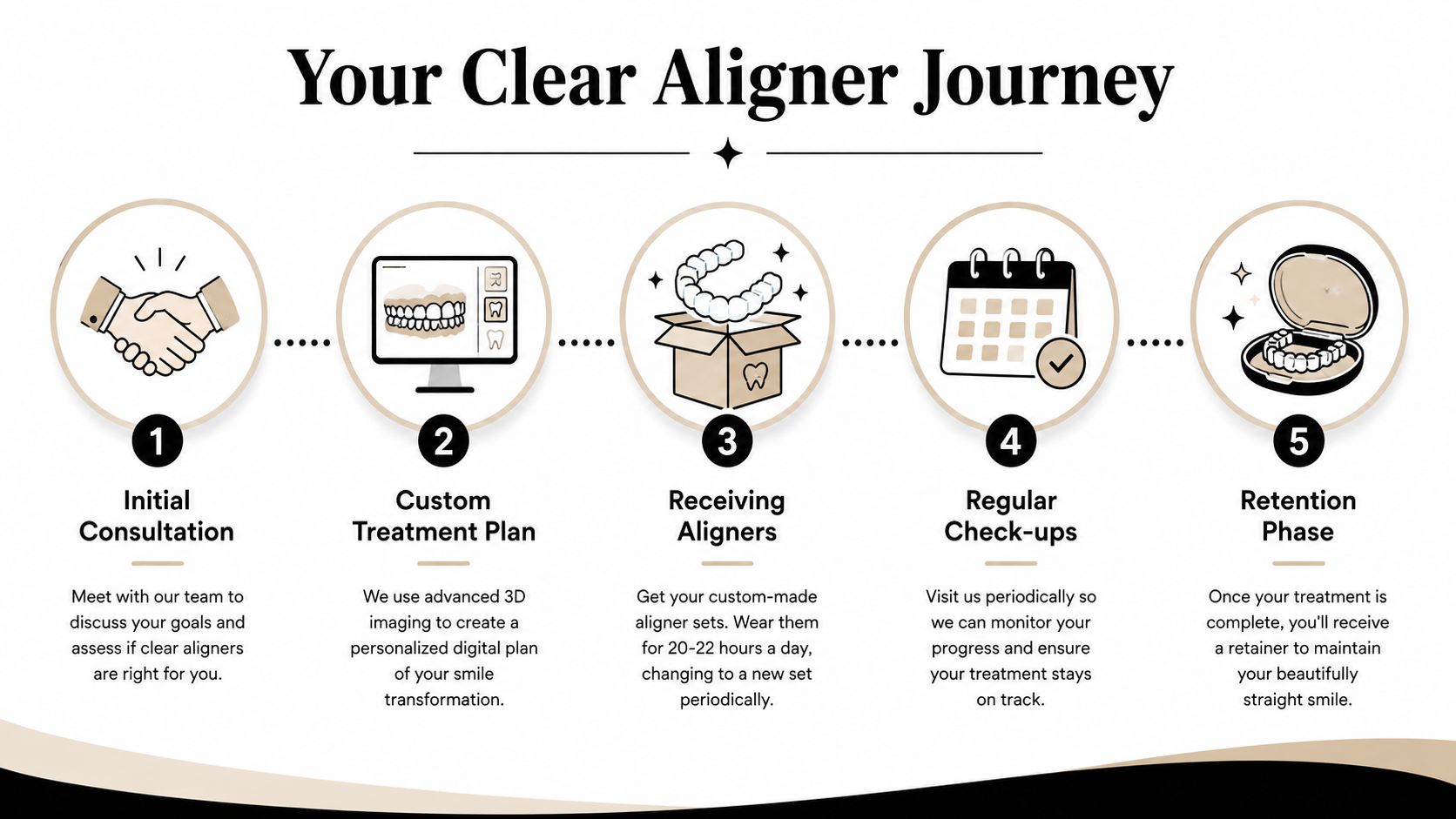
The first visit
Your first appointment is usually a conversation before it's anything else. You'll talk about what bothers you, whether that's crowding, a gap, a shifting bite, or front teeth that don't look even in photos. The exam helps determine whether aligners make sense or whether another approach would be smarter.
Many patients are relieved to learn that digital scanning can replace old-style putty impressions. That means no goopy trays, less mess, and a more precise view of your teeth.
Building the plan
After the scan, the provider maps out how your teeth would move step by step. This helps you understand what treatment is trying to fix, not just what the trays look like.
At this stage, some patients learn that aligners are a good fit. Others learn they may need braces or a hybrid approach. That's normal. The plan should match the case.
One local option patients may compare is The Dental Retreat, a Katy practice that offers clear aligner orthodontics along with general, cosmetic, restorative, implant, sedation, oral surgery, endodontic, and emergency dental services. For people who want to keep multiple types of dental care coordinated, that broader scope can be relevant.
Day to day life with aligners
Once aligners are delivered, daily habits matter more than anything else. You'll wear them most of the day and remove them for meals and drinks other than water. You'll also clean them regularly and switch to the next set as directed.
A few practical adjustments make the process easier:
- Keep the case with you. Napkins and pockets are how aligners get lost.
- Brush before putting them back in. Food and sugar trapped under trays can create problems.
- Expect short adjustment periods. New trays can feel snug at first.
- Stay consistent on travel days. Changes in routine are when wear time often slips.
If aligners fit well but suddenly stop seating properly, don't ignore it. That can be an early sign that the teeth aren't tracking the way they should.
Check-ins and the finish line
Check-in visits are usually straightforward. The team looks at how your teeth are moving, confirms the trays still fit properly, and decides whether any refinements are needed.
When treatment ends, retention begins. That part matters more than many people expect. Teeth have a memory, and without a retainer they can shift back toward their old positions. The straight smile you worked for needs support after active treatment ends.
For busy households in Elyson, The Grange, or anywhere else in Katy, clear aligners can be a practical choice. The key is honesty. If you know you'll wear them as directed, they can be very convenient. If not, another option may serve you better.
A Different Kind of Dental Visit
Orthodontic treatment asks something important from patients. You have to come back, ask questions, and stay engaged over time. That's harder when the dental setting makes you tense before you even sit down.
A calmer visit changes more than mood. It improves communication. When people feel less guarded, they ask better questions, share more about pain or worries, and make clearer treatment decisions.

Comfort matters more than people think
Many adults looking for a dentist near me aren't only comparing credentials or services. They're also trying to avoid the feeling of being rushed, lectured, or overwhelmed. That's especially true if they've put off dental care, had a painful experience in the past, or need more than one kind of treatment.
A more patient-friendly visit can include things like:
- Heated or massage chairs that help your body relax during longer visits
- TVs and noise-cancelling headphones so you aren't focused on every sound
- Aromatherapy and a quieter setting that feel less clinical
- Sedation options for people with strong dental anxiety or treatment fear
Why this affects orthodontic success
Orthodontics may sound simple on paper. In real life, people have concerns. They worry they'll ask a “dumb” question. They worry they won't tolerate scans or attachments. Parents worry about whether a child will cooperate. Adults worry they've waited too long.
Those concerns don't disappear because someone says, “You'll be fine.” They ease when the office environment supports the patient instead of adding to the stress.
Some people need information first. Others need reassurance first. Good care makes room for both.
It helps when care is comprehensive
Patients comparing Image Orthodontics Katy TX with broader dental options often discover that comfort and convenience overlap. If you may also need routine cleanings, whitening, a filling, help with a damaged tooth, tooth extraction, or emergency care, it can be easier when those conversations happen under one roof.
That doesn't mean every patient needs every service. It means your orthodontic plan should fit the rest of your oral health, not sit apart from it.
How to Choose the Right Orthodontic Partner in Katy
Choosing a provider gets easier when you stop thinking like a shopper and start thinking like a patient advocate for yourself or your family. The quality of the consultation often tells you more than the marketing does.
One useful point from Image Orthodontics' public information is that a practice may offer a phone number and broad service availability for children, teens, and adults. But a stronger sign of quality is whether the team offers a real conversation about your needs, not just a scheduling channel. That distinction is reflected in the public emphasis on consultation and age-inclusive care on the Image Orthodontics website.
Questions worth asking at a consultation
- How do you decide between aligners and braces for a case like mine? You want a specific clinical explanation, not a generic sales answer.
- What technology do you use to evaluate movement? Digital scans and visual planning can make treatment easier to understand.
- What happens if my teeth don't track as expected? Refinements and mid-course adjustments should be discussed plainly.
- How will this fit with my other dental needs? Ask about cleanings, cosmetic goals, restorative work, and emergency support.
- What will I need to do at home? This matters as much as what happens in the office.
Signs of a patient-centered practice
A thoughtful orthodontic partner should make you feel informed rather than pressured. Look for a team that listens carefully, explains tradeoffs, and gives you enough context to make a decision calmly.
If you're weighing providers, this article on how to choose a dentist can help you think through what matters beyond location and office branding.
A consultation should also feel personal. Children, teens, and adults don't always need the same plan, even if they're from the same family. A one-size-fits-all approach is usually a warning sign.
Katy Orthodontics Your Questions Answered
How long does orthodontic treatment take
It depends on the complexity of the case, the type of tooth movement needed, and how consistent the patient is with the plan. Simple cases may move faster than complex bite corrections. The most accurate answer comes after an exam and scan.
Are clear aligners only for adults
No. Adults often like them because they're discreet, but teens may also be candidates. Suitability depends more on bite needs and daily compliance than age alone.
Do braces work better than aligners
Sometimes yes, sometimes no. Braces can be better for certain complex movements. Aligners can work very well for many patients who wear them as directed.
Will I still need a retainer
Yes. Retainers help hold the final result after active treatment ends. Without retention, teeth can shift.
Can I combine orthodontic care with cosmetic dentistry
Often, yes. Some patients straighten first, then consider teeth whitening or other cosmetic improvements once the alignment is finished.
What if I haven't seen a dentist in a while
That's common, and it shouldn't stop you from getting answers. A good first visit should identify what needs attention now, what can wait, and whether orthodontic treatment should begin right away or after other care.
If you're in Katy, TX and looking for answers about braces, clear aligners, cosmetic dentistry, emergency treatment, or a family-friendly dentist in Katy, TX, the important thing is to start with a conversation that feels clear and pressure-free.
If you're ready to talk through orthodontic options, The Dental Retreat welcomes patients in Katy, Sunterra, Cane Island, Katy Manor, Kingscrossing, Lakehouse, Marisol, The Grange, Anniston, Katy Lakes, Elyson, and Ventanna Lakes. You can schedule a consultation to discuss bite concerns, clear aligners, and smile goals, or ask about current new-patient offers such as the $99 complete exam with cleaning and X-rays, the $49 problem-focused visit, and membership plan options starting at $299 per year.