You've just been told you need a gum graft. For many people, that moment brings two reactions at once. Relief that there's a way to treat gum recession, and worry about what recovery will feel like once the numbness wears off.
That worry is normal. Patients often ask the same things right away. Will I be in pain? What will I be able to eat? How long until I can get back to work, workouts, and normal brushing? If you're searching for a dentist in Katy, TX and trying to understand gum grafting surgery recovery before scheduling care, you deserve answers in plain language.
Recovery is usually much more manageable when you know what's normal, what needs extra care, and what signs mean it's time to call the office. The process isn't only about protecting the graft. It's also about staying comfortable, reducing stress, and giving your body the calmest path to healing.
Your Gum Grafting Guide with Your Katy TX Dentist
Hearing that your gums have receded enough to need surgery can feel unsettling. A patient might come in from Elyson or Cane Island thinking they only have a little tooth sensitivity, then learn that exposed roots and thinning gum tissue need attention. The procedure itself solves an important problem. The uncertainty afterward is what tends to create the most anxiety.
Gum grafting is done to protect vulnerable tooth roots and strengthen areas where the gumline has pulled away. Without enough healthy tissue, teeth can become more sensitive and harder to protect over time. That's why your recovery matters so much. The surgery is only one part of the treatment. Healing well is what helps the graft settle in and do its job.
What recovery usually feels like
Patients typically do not describe recovery as constant pain. They usually describe it as tenderness, tightness, swelling, and a need to be careful. The first few days require the most attention. After that, patients usually notice steady improvement if they follow instructions closely.
A common point of confusion is this: feeling better doesn't mean the area is fully healed. The graft can be delicate even when discomfort is improving. That's why your day-to-day choices matter so much.
The smoother recoveries usually come from simple habits done consistently. Resting, eating the right foods, and leaving the area alone.
What patients in Katy often want to know first
Here are the practical questions patients commonly ask before treatment:
- How long will I be out of routine: Expect the early phase to require a slower pace, especially during the first several days.
- Will the gums look strange: Yes, they may look pale, white, or uneven at first. That can be part of normal healing.
- Can I still clean my mouth: Yes, but not in your usual way around the graft site.
- When can I exercise again: You'll need to avoid strenuous activity early on because too much physical strain can interfere with healing.
- What if I'm anxious about dental treatment: That's common, and it's worth discussing before surgery so your care team can plan around your comfort.
For patients in Katy, TX, including neighborhoods like Sunterra, Katy Manor, and Ventanna Lakes, the biggest relief usually comes from having a clear recovery plan. When you know what the next few hours and days should look like, the experience feels far less intimidating.
Immediate Post-Op Care The First 48 Hours
The first two days are all about protection. Your body is starting the earliest stage of healing, and the graft needs a quiet, stable environment. This is the time to think gentle, soft, cool, and still.
A simple visual guide can help you remember the basics.

What to do right away
When you get home, focus on a few priorities:
- Rest first: Plan to spend the day resting rather than running errands, cleaning, or socializing.
- Use gauze as directed: Gentle pressure helps control oozing and protects the site.
- Take pain medication on schedule: Staying ahead of discomfort usually works better than waiting until pain builds.
- Apply a cold compress: Place it on the outside of your cheek in short intervals to help with swelling.
- Keep your head raised: Sleeping slightly upright can make you more comfortable.
What to avoid
These actions can disturb the area when it's most vulnerable:
- No straws: Suction can interfere with early healing.
- No forceful rinsing or spitting: Gentle is the rule.
- Don't poke the site: Avoid touching it with fingers or your tongue.
- Skip strenuous activity: Lifting, intense workouts, and anything that raises blood pressure too much can make bleeding and swelling worse.
- Avoid chewing near the graft: Even soft foods should stay away from the surgical side if possible.
Practical rule: If an action creates pressure, pulling, or friction in your mouth, it probably shouldn't happen during the first 48 hours.
The next resource may help if you like seeing instructions demonstrated visually.
What's normal in the first two days
It's common to notice some bleeding or oozing, mild to moderate discomfort, and swelling that begins to build. The area may feel unfamiliar. If tissue was also taken from the roof of your mouth, that donor site can feel especially tender.
Here's a quick reference:
| What you notice | Usually means |
|---|---|
| Light oozing | Early healing is underway |
| Swelling | Your body is responding normally to surgery |
| Soreness as numbness fades | Expected after the procedure |
| A feeling of tightness | Common as tissues settle |
The best “spa-inspired” recovery tip is simple. Set up a calm recovery space before surgery. Keep your medications, water, pillows, gauze, and soft foods within reach. Choose quiet entertainment, lower the lights, and give yourself permission to be still. Comfort isn't extra. It helps you avoid unnecessary stress and movement.
Your Healing Timeline The First Two Weeks
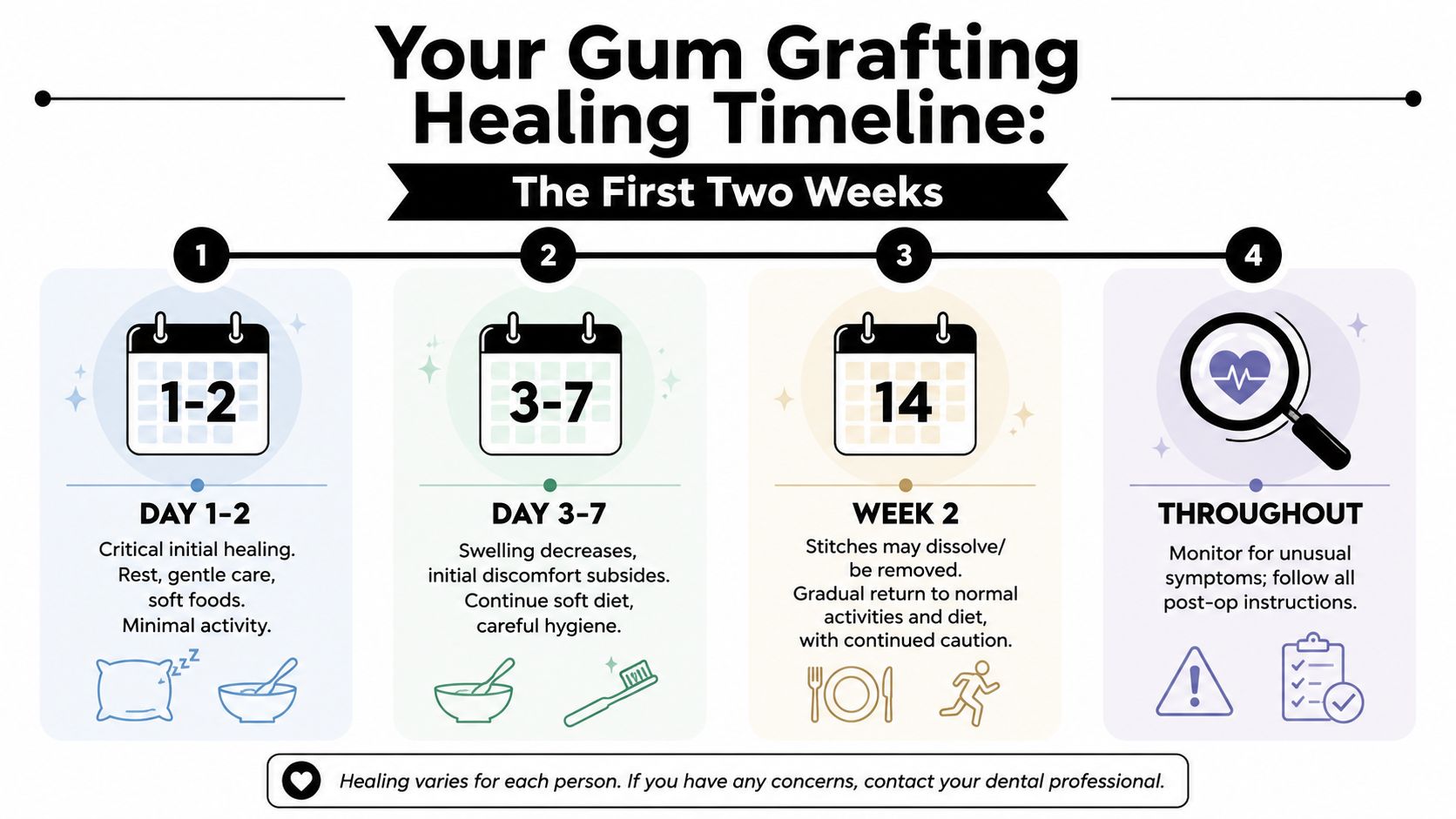
This phase is where most patients start to feel more encouraged. Day by day, the area usually becomes less tender, less swollen, and easier to live with. The key is not to confuse improvement with permission to rush.
Cleveland Clinic notes that most patients recover in about 1 to 2 weeks, although healing can take longer when multiple areas are treated. The same source states that gum graft surgery has a success rate of over 90% when patients follow postoperative instructions, including avoiding strenuous exercise for at least the first week (Cleveland Clinic on gum graft surgery).
A timeline can make that easier to picture.
Days one through three
These early days are usually the most protective. Swelling and soreness are often at their most noticeable here. You may feel tired, and your eating will still be limited to very soft foods.
The graft may not look the way people expect. It can appear pale or coated. That visual change often worries patients, but appearance alone doesn't tell the whole story in early healing.
Days four through seven
By this point, many people notice a shift. The discomfort often starts easing, and swelling tends to settle down. You may still need pain relief, but often less than in the beginning.
A whitish layer over the site can appear during this period. Think of it as part of the healing surface rather than something you should scrub away or inspect closely. Looking at the area too often by pulling the lip can irritate healing tissue, so it's best to resist that urge.
A graft can look unusual before it looks healthy. That doesn't mean something is wrong.
Week two
Week two usually feels much more normal. You may have more energy, less soreness, and more confidence eating a slightly broader range of soft foods. This is also when many patients return for a follow-up visit so the area can be checked and, if needed, stitches can be removed.
That appointment matters. It confirms whether healing is progressing the way it should. If you live in Katy Lakes, Marisol, or Lakehouse and need a local dental office for gum treatment, follow-up access is one of the practical details worth thinking about before booking care.
A simple two-week overview
| Time period | What patients often notice | What matters most |
|---|---|---|
| Days 1 to 3 | Soreness, swelling, tenderness | Rest and protect the graft |
| Days 4 to 7 | Gradual improvement, healing surface changes | Stay gentle and consistent |
| Week 2 | Feeling more like yourself | Keep follow-up care and don't rush |
The encouraging part is that gum grafting surgery recovery is usually predictable when you follow instructions. That doesn't mean every day looks identical. It means the overall direction should be steady improvement.
If your job is mostly desk work, you may feel ready to resume routine tasks sooner than someone with a physically demanding job. If your treatment involved more than one area, the timeline can feel a bit slower. Both situations can still fall within normal healing.
What to Eat and How to Keep Your Mouth Clean
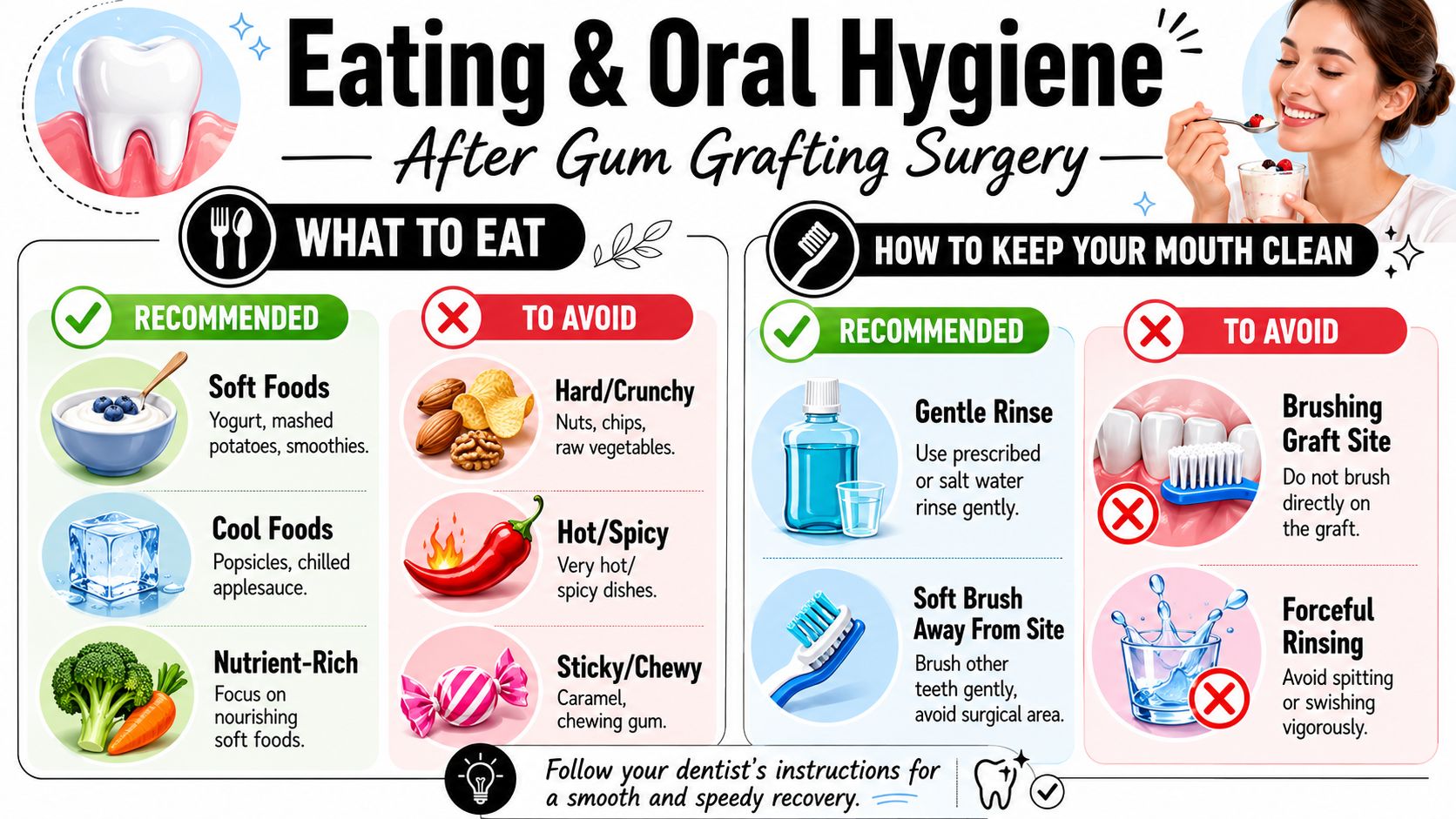
Food and oral hygiene are where many patients feel the most unsure. You know you need to eat and keep your mouth clean, but you also don't want to disturb the surgical site. The answer is to simplify both routines.
This quick visual can help you remember the basics.
Foods that are usually easiest
Choose foods that are soft, smooth, and easy to swallow without much chewing.
Good options often include:
- Yogurt and pudding: Cool and easy on the mouth.
- Applesauce: Gentle texture with no chewing.
- Mashed potatoes: Soft and filling.
- Smooth soups: Let them cool to lukewarm first.
- Scrambled eggs: Soft and easy once you're ready for a bit more substance.
- Smoothies without seeds: A cup is better than a straw.
- Oatmeal or soft pasta: Useful later in recovery when tenderness is easing.
For more practical meal ideas, this guide to best foods to eat after dental surgery is a helpful reference.
Foods that tend to cause trouble
Avoid anything that can scrape, sting, stick, or pull at the site:
- Crunchy foods: Chips, nuts, crusty bread, raw vegetables
- Spicy foods: These can irritate the area
- Very hot foods or drinks: Heat can make the site more sensitive
- Sticky foods: Chewy candy and similar foods can tug on healing tissue
- Foods with small particles: Seeds and fragments can collect where you don't want them
How to clean your mouth safely
You still need oral hygiene during recovery. The difference is that you'll clean around the graft differently than the rest of your mouth.
A safe pattern usually looks like this:
- Leave the graft area alone with your toothbrush unless your dentist tells you otherwise.
- Brush the other teeth gently so plaque doesn't build up elsewhere.
- Use the prescribed rinse exactly as directed if one was given to you.
- Let liquids move gently in your mouth rather than swishing hard.
- Be careful when spitting and keep it minimal early on.
The goal isn't perfect brushing at the surgical site. The goal is clean enough without disruption.
A comfort-focused daily routine
Many patients do better when they make meals and hygiene a little more intentional during recovery:
| Time of day | Helpful habit |
|---|---|
| Morning | Eat something soft before discomfort catches up with you |
| Midday | Rinse gently after meals if instructed |
| Evening | Brush non-surgical areas slowly and without rushing |
| Bedtime | Set out water, gauze, and anything you may need overnight |
This is also where recovery can feel a little less clinical. Use a cool compress if it still soothes you. Choose quiet meals instead of eating on the go. Sit upright for a while after eating. Small comfort choices often prevent bigger problems.
Long-Term Healing and Signs of Complications
By the end of the first couple of weeks, many patients assume the healing process is basically finished. Functionally, you may feel much better by then. Visually and biologically, though, the area is still maturing.
One clinical-style recovery guide states that initial healing takes about 2 weeks, soft-tissue healing typically takes 4 to 6 weeks, and full tissue maturation and color blending may continue for up to 6 months. The same source reports that serious complications are uncommon at 2% to 3% overall (clinical recovery timeline for gum graft healing).
Why the gums may still look different
This is one of the most common misunderstandings after surgery. The graft may feel stable before it fully matches the surrounding tissue. Color, contour, and texture can continue to improve gradually.
That means a gumline that looks slightly patchy, thick, or uneven early on isn't automatically a bad sign. Cosmetic blending takes longer than many people expect.
When to call the office
Complications are uncommon, but it's still important to know when something deserves attention. Contact your dental team if you notice:
- Bleeding that doesn't seem to settle
- Pain that is severe or keeps getting worse instead of better
- Pus, a bad taste, or a foul odor
- A sudden change that makes the graft look detached or clearly abnormal
- Swelling or discomfort that feels out of proportion to how you've been healing
If you've been dealing with recession and want to understand the problem itself more clearly, this article on what causes receding gums in adults gives helpful background.
Most recoveries stay on track. The point of knowing warning signs isn't to make you anxious. It's to help you respond early if something doesn't seem right.
For patients in Kingscrossing, Anniston, or The Grange, local access matters here too. If you need an emergency dentist, a tooth extraction, restorative dentistry, or ongoing periodontal care, being established with a nearby office makes follow-up much easier.
Experience Compassionate Dental Care in Katy TX
The experience around surgery matters almost as much as the procedure itself. Patients heal better when they feel informed, supported, and comfortable asking questions. That's especially true if you're already nervous about dental treatment or you're looking for a new dentist in Katy, TX who offers more than rushed, one-size-fits-all care.
A patient-centered dental office should make room for both clinical precision and comfort. That can mean thoughtful guidance before surgery, a calm environment on treatment day, and clear support afterward if you have concerns about healing, eating, or oral hygiene. If you're searching for a dentist near me, cosmetic dentist near me, emergency dentist, or even dental implants near me, those same qualities matter across every service.

For families and adults in Katy, TX, including Sunterra, Cane Island, Elyson, Katy Lakes, and Ventanna Lakes, it's worth choosing a practice that can support both routine dental care and advanced treatment in one place. That continuity helps whether you need gum care, cleaning and exams, dental X-rays, cosmetic dentistry, restorative dentistry, tooth extraction services, or sedation for a more relaxed visit.
If you're ready to talk with a local team about gum recession, recovery expectations, or your next step in treatment, schedule a consultation with The Dental Retreat. Their Katy team provides complete dental care in a calm, spa-inspired setting designed to help you feel informed, comfortable, and cared for from your first visit onward.