A lot of people who search for a cosmetic dentist near me are in the same place emotionally. They cover their mouth when they laugh, crop their smile out of photos, or keep zooming in on one chipped tooth, one dark spot, or one uneven edge that seems to draw all their attention.
If that sounds familiar, you're not being vain. Your smile affects how you speak, how you show up in social settings, and how confident you feel day to day. Patients across Katy, TX, including Elyson, Ventanna Lakes, Katy Lakes, and Cane Island, often start with one simple question: should I choose veneers or bonding?
Your Guide to a Confident Smile from a Dentist in Katy TX
That question usually comes up after months or years of putting it off. Some people want a brighter, more even smile before a wedding, interview, or family photos. Others are tired of looking at a chipped front tooth every morning. Many want improvement, but they don't want to commit to the wrong treatment.
Why this choice feels harder than it should
Veneers and bonding can both improve the look of front teeth. That's why online advice often feels confusing. One article makes bonding sound like the easy answer. Another makes veneers sound like the only way to get a beautiful result.
The truth is simpler. Both can work well. The right option depends on what you want fixed, how long you want the result to last, how quickly you want treatment done, and how much change you're looking for.
Some smiles need a precise repair. Others need a full redesign. Those are not the same treatment goals.
What patients in Katy usually want to know first
Most new patients aren't asking for a technical lecture. They want clear answers to practical questions:
- Will it look natural? You want your teeth to look like your teeth, only better.
- How much tooth structure is involved? Many people want the most conservative option possible.
- How long will it last? A short-term cosmetic fix and a long-term smile plan are very different decisions.
- Can this fit my budget and timeline? If you have an event coming up, treatment speed matters.
If you're comparing veneers vs bonding teeth, think of this as a consultation guide in written form. The goal isn't to push you toward one procedure. It's to help you understand the key trade-offs so you can choose confidently and protect your oral health while improving your smile.
Understanding Dental Veneers and Composite Bonding
Both treatments improve the appearance of visible teeth, but they do it in different ways.
What veneers are
Dental veneers are thin, custom-made shells that cover the front surface of teeth. In cosmetic dentistry, they're usually made from porcelain. Their job is to change how a tooth looks in color, shape, size, and overall symmetry.
A simple way to think about veneers is this. They function like a custom-fit cover for the front of the tooth. Because they're designed outside the mouth and then placed onto the tooth, they give the dentist more control over the final smile design.
Veneers are often considered when someone wants a broader cosmetic change across several front teeth. They can help create a more uniform smile when the concern isn't just one chip or one spot of discoloration.
What bonding is
Composite bonding uses a tooth-colored resin that is placed directly on the tooth, shaped by hand, and hardened in the office. It's a direct treatment, which means the dentist builds and refines the repair chairside rather than sending a restoration to a lab.
Bonding is best understood as an artistic repair. It can smooth a chipped edge, close a small space, improve the look of a worn corner, or blend a minor discoloration into the surrounding tooth.
For patients exploring dental bonding treatment, the appeal is easy to understand. It's conservative, fast, and often a strong choice when the problem is limited to a small area.
Clinical perspective: Bonding adds and reshapes. Veneers cover and redesign.
Why the materials matter
Porcelain and composite resin don't behave the same way over time. Porcelain is crafted to deliver a polished, enamel-like finish. Composite resin is versatile and repair-friendly, but it's still a different material with different strengths.
That material difference affects the final conversation in the operatory. If a patient wants to fix one tooth with minimal change to natural structure, bonding often enters the discussion quickly. If the patient wants a more extensive smile makeover with consistent color and shape across multiple visible teeth, veneers usually make more sense.
Neither option is automatically better. The better option is the one that matches the size of the problem and the level of change you desire.
Key Differences Veneers vs Bonding Side-by-Side
Here's the quickest way to compare veneers vs bonding teeth in a way that helps with decision-making.
| Factor | Veneers | Bonding |
|---|---|---|
| Material | Usually porcelain shells placed on the front of teeth | Tooth-colored composite resin shaped directly on the tooth |
| Time involved | Usually a multi-visit process | Commonly completed in one visit |
| Best for | Broader cosmetic changes and smile uniformity | Small chips, minor gaps, localized repairs |
| Tooth preparation | Often involves enamel reduction | Usually more conservative with minimal prep |
| Long-term feel | Better for patients seeking a longer-horizon cosmetic solution | Better for patients wanting a simpler, lower-commitment correction |
Durability
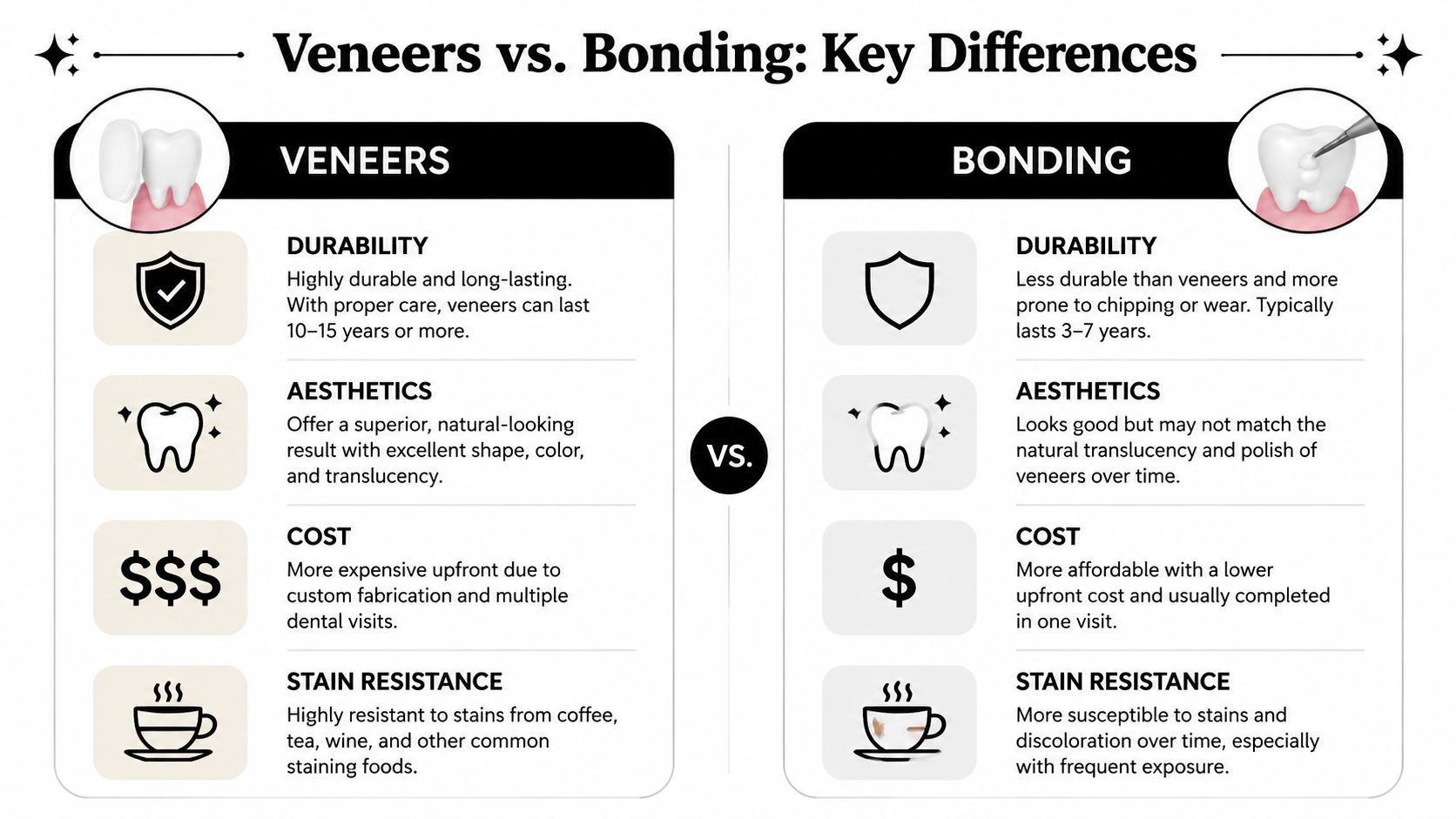
This is one of the biggest differences. A key clinical distinction is durability: multiple dental sources describe porcelain veneers as lasting about 10 to 15 years or more, while composite bonding is commonly cited at 3 to 7 years with proper care. That same guidance notes bonding is often quoted around $100 to $500 per tooth and veneers commonly range from $500 to $2,500 per tooth in this comparison of veneers and dental bonding longevity and cost.
That doesn't mean bonding is a poor choice. It means it's usually a different kind of choice. Bonding is often ideal when the repair is modest and the patient wants a lower upfront commitment.
Big-picture difference: Bonding is often the budget-friendlier entry point. Veneers are more often chosen as a longer-term cosmetic investment.
Aesthetics
If your main goal is a more polished, uniform smile, veneers usually offer more control. Because they're custom fabricated, they're especially useful when several teeth need coordinated changes in shape, size, and brightness.
Bonding can also look beautiful, especially for smaller corrections. In the right case, a carefully sculpted resin repair can blend very naturally with surrounding enamel. Where bonding becomes less predictable is in larger cosmetic cases where multiple teeth need the same exact finish and symmetry.
This short video gives a helpful visual overview of the decision.
Cost
Patients searching for a dentist in Katy TX often want a straight answer here. Bonding usually costs less upfront. Veneers usually cost more because they involve custom fabrication and a more involved process.
What matters clinically is value, not just price. If you need a small repair on one tooth, veneers can be more treatment than the situation calls for. If you want a long-lasting change across the front of your smile, bonding may not give you the level of longevity or consistency you want.
Stain resistance
Veneers generally hold color better over time. Porcelain is less prone to staining than composite resin, which matters if you drink coffee, tea, or red wine regularly and want your cosmetic result to stay bright and stable.
Bonding can still serve patients well, but it asks for more acceptance of maintenance. If someone wants the most stain-resistant cosmetic option between the two, veneers usually come out ahead.
The Treatment Process What to Expect at The Dental Retreat
The process matters almost as much as the result. Many patients aren't just comparing veneers vs bonding teeth by appearance. They're comparing time, comfort, commitment, and how much they want done to the tooth.
What bonding usually looks like
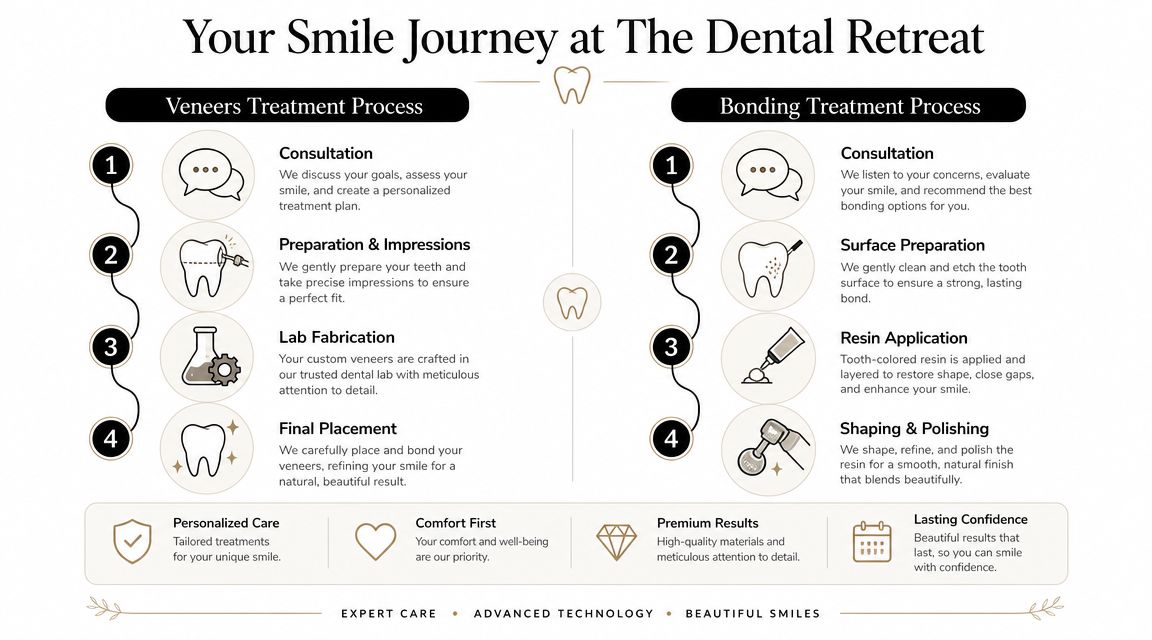
From a workflow and invasiveness standpoint, bonding is typically a single-visit procedure that uses tooth-colored composite resin applied directly to the enamel. Veneers usually require two to three visits because they involve enamel reduction, impressions, and lab fabrication before final cementation, as explained in this overview of bonding and veneers treatment steps.
For a bonding appointment, the visit is usually straightforward:
- Evaluation of the tooth so the dentist can confirm the issue is small enough for a direct repair.
- Surface preparation to help the material adhere properly.
- Placement and sculpting of the composite resin directly on the tooth.
- Light curing and polishing so the repair blends smoothly with the surrounding enamel.
Bonding appeals to patients who want a quick turnaround. If the goal is to fix a chip before an event or improve one area without a larger cosmetic plan, this can be a very practical treatment.
What veneers usually involve
Veneers take more planning, and that's part of their strength. The process usually starts with a smile consultation where the dentist evaluates bite, tooth shape, enamel condition, and the outcome the patient wants.
A typical veneer process often includes:
- Planning and design, where tooth proportions, smile line, and shade are discussed
- Preparation, which may include removing a small amount of enamel so the veneers fit naturally
- Impressions or scans, used to fabricate the custom veneers
- Final placement, where each veneer is checked for fit, appearance, and bite before cementation
This extra time is one reason veneers are often chosen for broader smile makeovers. The process allows for more detailed control over the final result.
Veneers are not just a repair. They're a custom restorative-cosmetic design process.
What comfort and recovery are usually like
Patients are often relieved to learn that both options are generally well tolerated. Bonding is typically gentle because it usually involves little preparation. Veneers can involve more sensitivity because some enamel reduction is often part of the process, but patients usually do well when the plan is carefully managed.
From a comfort standpoint, what matters most is clear communication. People feel less anxious when they know whether the treatment is a same-day repair or a multi-visit smile redesign. That expectation-setting makes the experience smoother from the first appointment through the final polish.
For patients in Katy Manor, Kingscrossing, Sunterra, and nearby neighborhoods, the practical difference is simple. Bonding fits the patient who wants a conservative fix fast. Veneers fit the patient who wants a more complete outcome and accepts a longer process to get it.
Which Smile Solution Is Right for You
The best cosmetic treatment is the one that fits your goals, not the one that sounds more dramatic online.
Bonding may be the better fit when
Bonding is often a smart option if your concerns are small and localized. That includes a minor chip, a slight gap, a worn edge, or one tooth that needs a modest cosmetic improvement.
It can also be the right choice if you want a more budget-conscious option or you'd rather avoid a larger commitment while you test how much cosmetic change feels right for you.
Bonding often makes sense for patients who say things like:
- “I only want to fix one or two small things.”
- “I'd like the most conservative option possible.”
- “I want a cosmetic improvement without a bigger smile makeover.”
Veneers may be the better fit when
Veneers are usually the stronger choice when the patient wants a more complete transformation across visible teeth. They're often considered when shape, color, size, and symmetry all need improvement together.
This option is also better suited to patients who want a result that feels more polished and consistent across the whole smile, especially when uniformity matters more than keeping treatment minimal.
Patients leaning toward veneers often sound like this:
- “I want my front teeth to match better.”
- “I'm looking for a longer-term cosmetic solution.”
- “I want a more dramatic change in my smile.”
If your goal is repair, bonding deserves a serious look. If your goal is redesign, veneers usually deserve stronger consideration.
The decision usually comes down to four priorities
When I help patients think this through clinically, the decision usually turns on four things:
- Scope of change. Are we fixing one detail or reshaping the whole smile?
- Timeline. Do you need something faster, or are you comfortable with a multi-step process?
- Budget. Is lower upfront cost the main priority right now?
- Longevity expectations. Are you comfortable with more maintenance, or do you want a longer-horizon solution?
If you're in Lakehouse, Marisol, The Grange, or Anniston and searching for a cosmetic dentist near me, this is the most useful mindset to bring into a consultation. Don't ask which treatment is best in general. Ask which treatment is best for your specific smile.
Begin Your Smile Makeover Journey in Katy TX
Patients who look for a dentist near me or a cosmetic dentist near me usually don't want pressure. They want clarity. They want someone to listen to what bothers them, look carefully at the teeth, and explain what will and won't work.
That's why a cosmetic consultation should feel personal. The right starting point isn't a sales pitch. It's a conversation about what you notice when you smile, what you'd like to change, and whether the smartest answer is bonding, veneers, teeth whitening, orthodontic treatment, or a combination of services.
Why a local consultation matters
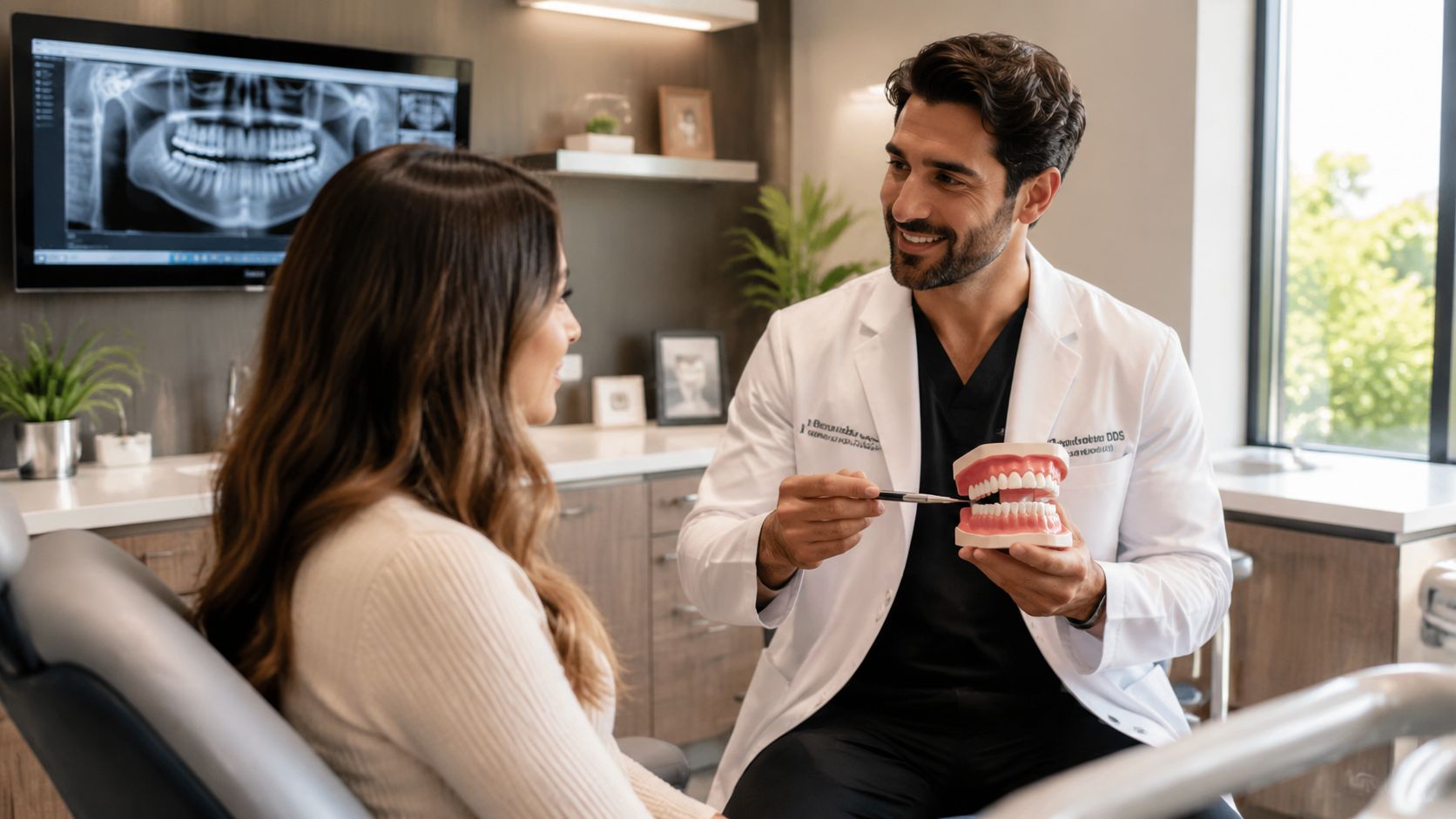
A good exam does more than look at color and shape. It also checks bite pressure, enamel condition, gum health, and whether a cosmetic plan will hold up over time. Sometimes the best path is cosmetic dentistry alone. Sometimes restorative dentistry, a cleaning and exam, dental X-rays, or even clear aligners should come first.
For patients whose main decision metric is durability and color stability, porcelain veneers generally outperform composite bonding, with guidance commonly citing bonding at about 3 to 7 years and veneers at about 10 to 15 years or longer in this discussion of veneer and bonding durability. For other patients, that longer horizon still may not outweigh the simplicity of bonding for a smaller concern.
A comfortable setting changes the experience
Dental care feels easier when the environment lowers stress instead of adding to it. Many adults who need cosmetic work also put off routine cleanings, new patient exams, or restorative care because they're anxious in the dental chair.
A practice designed around comfort can make a real difference. Spa-like amenities, a calm pace, and a judgment-free tone help patients move forward with treatment they've delayed for years. That matters whether you're coming from Sunterra, Cane Island, Elyson, or Katy Lakes for cosmetic dentistry, emergency dentist care, or a complete smile plan.
If you've been comparing options and still feel unsure, that's normal. The next step doesn't have to be committing to treatment. It can be sitting down with a dentist in Katy TX, talking through your goals, and finding out which approach fits your smile, timeline, and budget best.
Common Questions About Veneers and Bonding
Can you whiten teeth that have veneers or bonding
Whitening doesn't work the same way on dental materials as it does on natural teeth. If you're considering cosmetic treatment and also want a brighter smile, discuss whitening before final shade selection so the overall result looks balanced.
If cost is part of your decision, it helps to review a realistic breakdown before choosing treatment. This guide on how much veneers cost can help you understand the investment side of the conversation.
Is bonding or veneers painful
Most patients handle both very well. Bonding is usually the easier appointment because it tends to be conservative and often requires minimal tooth preparation. Veneers may involve more sensitivity because they commonly require a preparation phase, but the experience is generally manageable and planned carefully.
How do you care for your new smile
Daily habits matter. Brush, floss, keep up with cleanings and exams, and avoid using your front teeth as tools. If you clench or grind, tell your dentist so your cosmetic work can be protected appropriately.
For bonding, be especially mindful of staining foods and drinks and hard biting habits. For veneers, long-term care still matters even though the material is more stain resistant.
Which one looks more natural
Both can look natural in the right case. The question isn't which one is more natural in theory. The question is which one fits the tooth, the bite, and the level of change needed. Small repairs often look excellent with bonding. Larger smile redesigns often look more refined with veneers.
If you're ready to talk through veneers vs bonding teeth with a team that puts comfort, clarity, and personalized care first, schedule a consultation with The Dental Retreat. Located on Stockdick School Rd. in Katy, the practice welcomes patients from Sunterra, Cane Island, Elyson, Ventanna Lakes, Katy Manor, and nearby communities for cosmetic dentistry, new patient exams, whitening, restorative care, and more.