A lot of people looking up oral sedation vs IV sedation in Katy are doing it for the same reason. They know they need dental care, maybe a tooth extraction, dental implants, a cleaning and exam, or help from an emergency dentist, but anxiety keeps getting in the way. Sometimes it's fear of pain. Sometimes it's the sound of the drill, a strong gag reflex, or one difficult experience years ago that still sticks.
That hesitation is common, and it doesn't mean you're a bad dental patient. It means you need a care plan that matches your comfort level.
For patients searching for a dentist near me in Katy, TX, the primary question usually isn't which sedation method is “better” in the abstract. It's which option makes your visit feel manageable, safe, and realistic for the treatment you need. That might be a shorter visit with oral sedation. It might be a more controlled experience with IV sedation for a longer procedure. The right choice depends on your anxiety, your medical history, and the kind of dental care you're having.
Comfortable Dental Care in Katy Understanding Your Options
A patient may spend weeks thinking about calling the dentist, then close the browser right before booking. Another may sit in the parking lot with a racing heart before a routine cleaning. Someone else may need restorative dentistry or cosmetic dentistry, but keeps postponing treatment because even a simple new patient exam feels overwhelming.
That's where sedation dentistry changes the experience. It gives anxious patients a way to move forward without white-knuckling their way through the appointment.
In Katy, TX, that matters for busy adults, families, and anyone trying to stop a small dental problem from turning into a larger one. Delaying care can make simple issues harder to treat. A cavity can become a toothache. A cracked tooth can lead to a tooth extraction. A missing tooth can eventually call for restorative options such as dental implants.

Why comfort matters before treatment starts
When people feel stressed, they often avoid the exact care that would help them feel better. Sedation dentistry can interrupt that cycle by making appointments feel more approachable.
Patients often consider sedation for:
- Routine care with high anxiety like cleaning and exams, dental X-rays, or new patient exams
- Restorative treatment such as fillings, crowns, or more extensive dental care
- Surgical visits including tooth extraction and other oral surgery needs
- Longer appointments such as dental implants or multiple procedures in one visit
Dental anxiety doesn't have to be “severe” to deserve support. If it's enough to make you postpone care, it's worth addressing.
A calmer path forward
Good sedation planning isn't about removing your control. It's about helping you feel calm enough to get the care your mouth needs. For some people, that means taking a prescribed pill ahead of time. For others, it means a deeper, closely monitored option during treatment.
If you've been searching for a dentist in Katy, TX because you want a different kind of experience, sedation is often the first conversation worth having. It can make everything from preventive visits to cosmetic dentistry and emergency dental services feel far more manageable.
How Sedation Dentistry Eases Dental Anxiety
Sedation dentistry helps reduce the fear response that can make dental visits feel impossible. It doesn't replace treatment. It makes treatment accessible.
For many anxious patients, the hardest part isn't the procedure itself. It's the anticipation. The days leading up to the appointment can feel worse than the visit. Sedation helps by lowering tension, reducing dread, and making it easier to stay relaxed while the dental team works.
What sedation dentistry actually does
Sedation is used to help patients feel calmer during dental care. Depending on the method, you may feel relaxed, drowsy, less focused on the procedure, or less likely to remember much about it afterward. The goal is comfort, not force.
This can be helpful across a wide range of care, including:
- Preventive visits when anxiety is high enough that even a cleaning feels difficult
- Restorative dentistry when multiple areas need treatment and the idea of sitting through it feels overwhelming
- Surgical care for procedures like tooth extraction
- Advanced treatment such as dental implants or full smile rehabilitation
Why anxiety often leads to delayed care
Dental fear has a way of building on itself. Someone avoids one appointment, then worries they'll be judged for waiting. That makes the next appointment even harder to schedule.
Sedation can help break that cycle by making the visit feel possible again.
Practical rule: The best sedation plan is the one that helps you actually get the care you've been putting off.
Sedation supports treatment, not pain control by itself
This point matters. Sedation helps with relaxation and awareness. Your dentist still uses local anesthetic when numbing is needed for the procedure itself. In simple terms, sedation helps you feel calmer about the visit, while local anesthesia addresses the treatment area.
That combination can be especially useful for people who:
- Have a strong gag reflex
- Struggle to sit still because of anxiety
- Need several treatments in one appointment
- Feel embarrassed returning after years away from dental care
A controlled setting makes a difference
Sedation dentistry should feel organized and predictable. Before anything begins, the dental team reviews your health history, medications, and treatment plan. That way, sedation is matched to your needs instead of chosen as a one-size-fits-all fix.
Many patients who search for dentist near me, emergency dentist, or tooth extraction are really searching for relief in two forms. They want relief from the dental problem, and relief from the fear of dealing with it. Sedation can help with the second part so the first can finally be treated.
Oral Sedation vs IV Sedation A Detailed Comparison
A patient may tell me, “I want to be calm, but I still want this to feel manageable.” That is the right way to approach oral sedation vs IV sedation. The goal is not to pick the strongest option. It is to choose the level of support that fits your anxiety, your procedure, and how much guidance you may need during the visit.
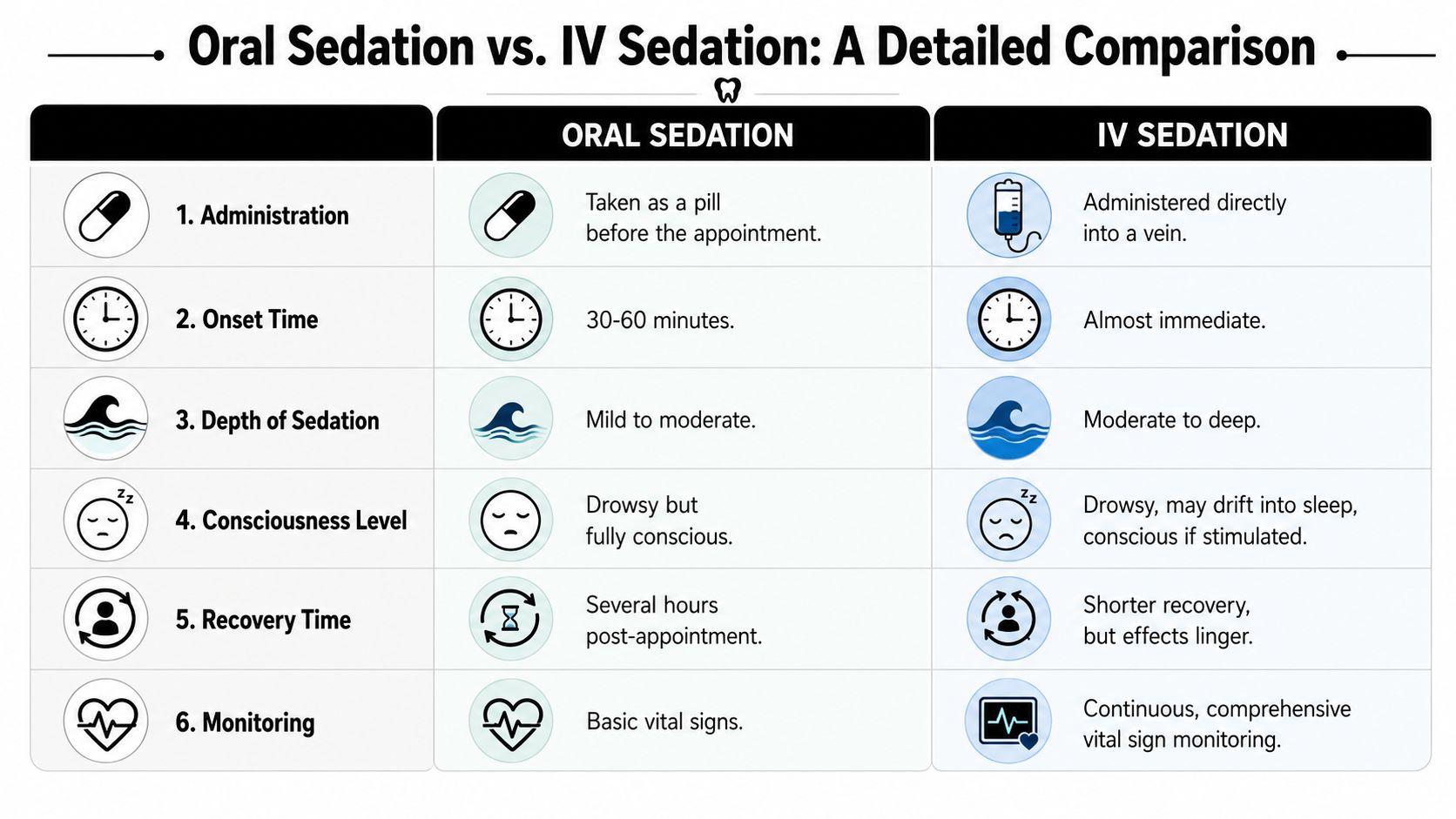
The two biggest clinical differences are how the sedation begins and how precisely it can be adjusted once treatment starts. Oral sedation is taken before the appointment and follows a more fixed course. IV sedation works quickly and gives the doctor more flexibility during treatment.
Here's a quick side-by-side look.
| Feature | Oral Sedation | IV Sedation |
|---|---|---|
| How it's given | Taken as a pill before the appointment | Delivered directly into a vein |
| Onset | Effects develop gradually after you take it | Works within minutes |
| Dose control | Fixed dose once swallowed | Can be titrated during the procedure |
| Typical depth | Mild to moderate conscious sedation | Moderate to deep sedation |
| Best fit | Milder anxiety, simpler visits | Longer, more complex, or highly anxiety-provoking procedures |
| General cost range | About $200 to $400 | About $500 to $1,200+ per session |
| Driving afterward | Avoid driving for 24 hours | A ride home is still needed |
How the experience starts
Oral sedation begins before you ever sit in the chair. You take the medication in advance, then give it time to absorb through the digestive system. The effect tends to come on more gradually, which many patients like because it feels less clinical and less intimidating.
IV sedation starts differently. Because the medication is delivered directly into the bloodstream, the calming effect begins much faster, as explained in this overview of oral sedation and IV sedation timing in dentistry.
That timing matters. If anxiety tends to build once treatment begins, faster onset can make the whole appointment feel more controlled.
Depth and control during treatment
Oral sedation usually keeps you relaxed, drowsy, and less focused on the procedure, while still able to respond. For many patients, that is enough to turn a stressful visit into one they can handle comfortably. The limitation is that once the pill is taken, the dose is set.
IV sedation gives the dental team more minute-by-minute control. If the procedure runs longer than expected or your comfort needs change, the sedation level can be adjusted during treatment. That added control often makes IV sedation a better fit for severe dental fear, strong gag reflexes, or procedures that are more involved.
Patients who want a clearer picture of the process can review this guide on how dental sedation works before their visit.
At The Dental Retreat in Katy, that clinical decision is paired with environment. Some patients do very well with oral sedation because the setting itself already lowers their stress level. A quiet, spa-like atmosphere, thoughtful pacing, and comfort-focused amenities can reduce how much sedation support they need. Others feel safest knowing IV sedation offers a deeper level of relaxation and more control during care.
A short video can also help clarify what IV sedation looks like in practice.
Cost and practical trade-offs
Cost is part of the decision, and patients deserve a clear answer about that. IV sedation usually costs more because it requires additional monitoring, equipment, and clinical oversight. One dental source places oral sedation around $200 to $400 and IV sedation around $500 to $1,200+ per session in this review of IV sedation vs oral sedation costs and clinical differences.
Recovery planning matters too. With either option, you should expect lingering grogginess and arrange help getting home if your dentist instructs it. IV sedation often involves a bit more planning on the front end, but for the right patient, that extra preparation can make treatment feel far more manageable.
The practical question is simple. Which option gives you the calm you need without adding more than the appointment requires? For some patients, that answer is a pill and a soothing environment. For others, it is the deeper, more adjustable support of IV sedation.
Which Sedation Method Is Best for Your Dental Visit
You finally decide to book the appointment you have been putting off. Then a new worry shows up. How will you get through the visit comfortably?
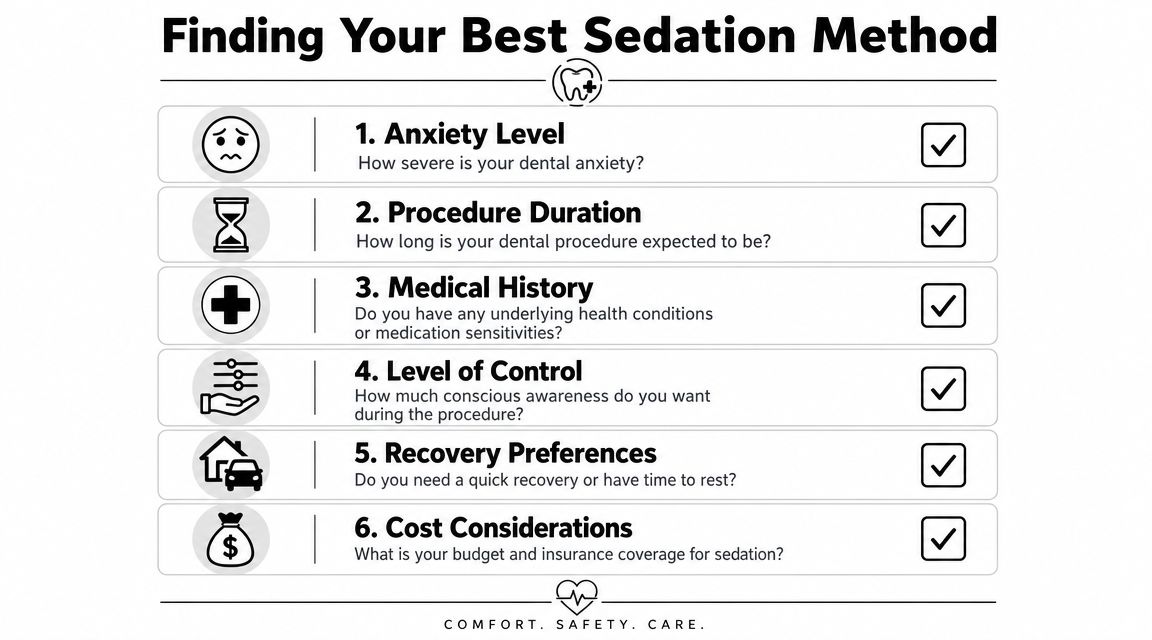
The right answer depends on more than the procedure itself. It depends on your anxiety level, your medical history, how much awareness you want during treatment, and what helps you feel safe. At The Dental Retreat, the goal is not to push every patient toward the deepest option. It is to match the level of support to the person in the chair, so the experience feels calm, appropriate, and manageable.
When oral sedation often makes sense
Oral sedation is often a good fit for patients who need help taking the edge off, but do not need a deeper level of support. I often recommend it for people who are uneasy about treatment yet still feel comfortable with a lighter approach, especially in a setting designed to reduce stress from the moment they arrive.
It may make sense if you:
- Prefer to avoid IV placement
- Need help relaxing for a shorter or simpler visit
- Are having treatment such as a filling, crown, or other straightforward care
- Want a more budget-conscious sedation option
- Feel reassured by a calm, spa-like environment and comfort amenities
For the right patient, a prescribed pill plus a soothing setting can be enough to turn a dreaded visit into one that feels very manageable.
When IV sedation is often the better choice
IV sedation is often the better option when anxiety runs high, the procedure is longer, or comfort needs may shift during treatment. Because the medication can be adjusted during the appointment, it gives the clinical team more control if you need a deeper level of relaxation.
That often matters for:
- Severe dental anxiety or dental phobia
- Longer appointments or multiple procedures in one visit
- A strong gag reflex
- Patients who want very limited awareness of treatment
- More involved surgical care, including some extraction and implant visits
For some patients, that flexibility is what allows them to stop postponing care.
If your comfort level may change once treatment begins, IV sedation gives your dental team more room to respond safely and appropriately.
The questions that usually decide it
The decision usually becomes clearer after a few practical questions.
- How anxious are you before you even sit in the chair?
- How long and how involved is the procedure expected to be?
- How aware do you want to be during treatment?
- Would avoiding an IV help you feel calmer, or would deeper relaxation help more?
- How much do cost, recovery planning, and transportation matter for this visit?
Patients who visit our sedation dentistry team in Katy, TX often feel relieved once they hear that this is not a contest between oral sedation and IV sedation. It is a comfort decision. Some people do very well with oral sedation, especially when the environment already feels quiet and supportive. Others feel safest with IV sedation because it offers more control during a longer or more difficult appointment.
The best method is the one that fits your needs closely enough that getting dental care finally feels possible.
Your Sedation Experience at The Dental Retreat in Katy
What many anxious patients want isn't only sedation. They want the whole visit to feel calmer from the moment they walk in. The environment matters. The pace matters. The way the team speaks to you matters.
That's part of what makes a spa-like dental setting meaningful rather than decorative. A waiting area that feels quiet instead of rushed, treatment rooms designed for comfort, and amenities that reduce sensory stress can all help lower the emotional temperature before dentistry even starts.

What a more calming visit can look like
In a comfort-focused practice, sedation isn't treated as a dramatic last resort. It's one part of a patient experience built around reducing friction and fear.
That can include amenities such as:
- Aromatherapy to soften the clinical feel of the visit
- Heated massage chairs that help patients release muscle tension
- Noise-cancelling headphones for people who are triggered by dental sounds
- TVs in treatment rooms to give patients something else to focus on
For anxious patients, these details aren't small. They can make the difference between feeling trapped and feeling supported.
Why the setting matters for local patients
Patients in Katy often aren't only looking for information. They're looking for a nearby office where they can follow through on care. That includes residents in Sunterra, Cane Island, Katy Manor, Kingscrossing, Lakehouse, Marisol, The Grange, Anniston, Katy Lakes, Elyson, and Ventanna Lakes who want a dentist in Katy, TX that feels approachable for routine care and advanced treatment alike.
Sedation may be part of visits involving:
- General dental care, including overdue cleanings and exams
- Restorative dentistry when several teeth need treatment
- Cosmetic dentistry for patients who feel anxious about longer smile improvement visits
- Dental implants and other more involved procedures
- Emergency dental services when pain is already high and stress is even higher
Experience still matters after the appointment
A randomized ophthalmic-surgery study found oral sedation was noninferior to IV sedation on immediate post-op satisfaction, with mean scores of 5.10±0.90 for oral versus 5.00±0.86 for IV. A follow-up study found the longer-term comparison favored IV more, with mean satisfaction of 5.23±0.90 for oral versus 5.60±0.61 for IV, and oral sedation was not noninferior at follow-up, according to this study on oral sedation and IV sedation patient satisfaction over time.
That doesn't mean one method is automatically right for every patient. It does reinforce something important. How patients remember the experience matters, especially when the goal is helping someone feel comfortable returning for future care.
Patients who want to explore local options can review sedation dentistry in Katy, TX to get a clearer sense of how sedation may fit into their treatment plan.
A good sedation experience should help with today's procedure and make the next visit easier to face.
Common Questions and Scheduling Your Stress-Free Visit
A patient often tells me the same thing at this stage. “I know I need the dental work. I just don't know if I can get through the appointment.” That is exactly the kind of conversation sedation dentistry is meant to support.
Will I be completely asleep
Usually, no. With oral sedation or IV sedation, the goal is deep relaxation and comfort while you remain able to respond to the team. Many patients feel drowsy, calm, and less aware of time, and some remember very little afterward.
Is sedation dentistry safe
Safety starts before the appointment. We review your medical history, current medications, past experiences with sedation, and the type of treatment you need so the plan fits you. In a properly screened and monitored setting, sedation can make care feel more controlled and far less overwhelming.
Will I need someone to drive me home
Yes. Plan for a responsible adult to bring you to the visit and take you home afterward. As noted earlier, sedation can affect judgment, coordination, and reaction time for the rest of the day, so patients should not drive themselves home.
Which is better for tooth extraction or dental implants
The better choice depends on the procedure and on you. A shorter, simpler visit may be a good fit for oral sedation if you mainly need the edge taken off. IV sedation is often the better option for longer appointments, more involved treatment, or patients who want a deeper level of relaxation and more moment-to-moment control during the visit.
What if I've been avoiding the dentist for years
That is very common, and it does not make you a difficult patient. It usually means you need a slower start, clear explanations, and a plan that respects your comfort level.
At The Dental Retreat, we focus on making the visit feel manageable from the moment you arrive. The setting is calm, the pace is thoughtful, and the experience is designed to feel more like a retreat than a rushed dental appointment. For many anxious patients, that atmosphere matters almost as much as the sedation itself.
If you have been searching for a dentist near me, cosmetic dentist near me, dental implants near me, or emergency dentist in Katy, the first step can be simple. Start with a conversation about what worries you, what treatment you may need, and what level of support would help you feel safe enough to begin.
If you're ready to talk through oral sedation vs IV sedation with a team that prioritizes comfort, reach out to The Dental Retreat. Patients in Katy, TX, including Sunterra, Cane Island, Elyson, and Ventanna Lakes, can schedule a consultation to discuss anxiety, treatment needs, pricing, and what kind of visit will feel most manageable. If you're new to the practice, the office also offers a $99 full exam with cleaning and X-rays, a $49 problem-focused visit, and membership plans that start at $299 per year for patients without insurance.