If you've ever been told, “You don't need a regular cleaning anymore. You need periodontal maintenance,” you probably had an immediate question: Is something wrong with my gums?
That reaction is common. Many people hear the term for the first time while sitting in a dental chair, already a little tense, and it can sound more serious or more confusing than they expected. They may wonder if they did something wrong, whether this will be painful, or how often they'll need to come back.
The good news is that periodontal maintenance isn't a punishment and it isn't a mystery. It's a careful, ongoing plan to help protect teeth and gums after gum disease has already been found and treated. For many adults in Katy, TX, including families in Sunterra, Cane Island, and nearby neighborhoods, understanding the right periodontal maintenance frequency makes the whole process feel much more manageable.
Your Dentist in Katy TX for Periodontal Health
A patient might come in for what they think is a routine cleaning and leave with a new phrase on their treatment plan. Suddenly, a simple appointment feels complicated. They hear “maintenance,” “pockets,” or “gum disease history,” and their mind jumps straight to worst-case scenarios.
That worry makes sense. Gum care often feels less visible than a cavity or a chipped tooth, so it can be harder to understand why the schedule changes. You may not feel dramatic pain. You may brush every day. You may even think your mouth seems fine.
Healthy-looking teeth don't always mean the gums underneath are stable.
When dentists talk about periodontal maintenance frequency, we're trying to answer one practical question: How often do your gums need professional help to stay calm and stable? The answer isn't the same for everyone. One person may need close follow-up because inflammation returns quickly. Another may do well with a longer interval because their home care is excellent and their risk is lower.
Why this topic causes confusion
A few things make this hard for patients:
- The name sounds technical. “Maintenance” can feel vague if no one explains what is being maintained.
- It replaces a familiar routine. Many understand twice-yearly cleanings. A different schedule can feel unsettling.
- It affects real life. Time off work, family responsibilities, insurance, and budget all matter.
What matters most
A good periodontal plan should protect your health without making you feel trapped by a rigid rule. It should be clear. It should be realistic. And it should help you keep your natural teeth as long as possible while fitting your life in Katy, whether you're searching for a dentist near me, a new patient exam, or a long-term dental home.
What Periodontal Maintenance Is and How It Differs from a Regular Cleaning
You might hear "maintenance" and wonder whether it is just another word for a regular cleaning. It is not. The difference matters because each visit is designed for a different gum condition and a different level of risk.
Periodontal maintenance is ongoing therapeutic care for patients who have had periodontitis, which is gum disease that has already affected the supporting tissues around the teeth. A regular cleaning, also called a prophylaxis, is for patients whose gums are healthy and stable.
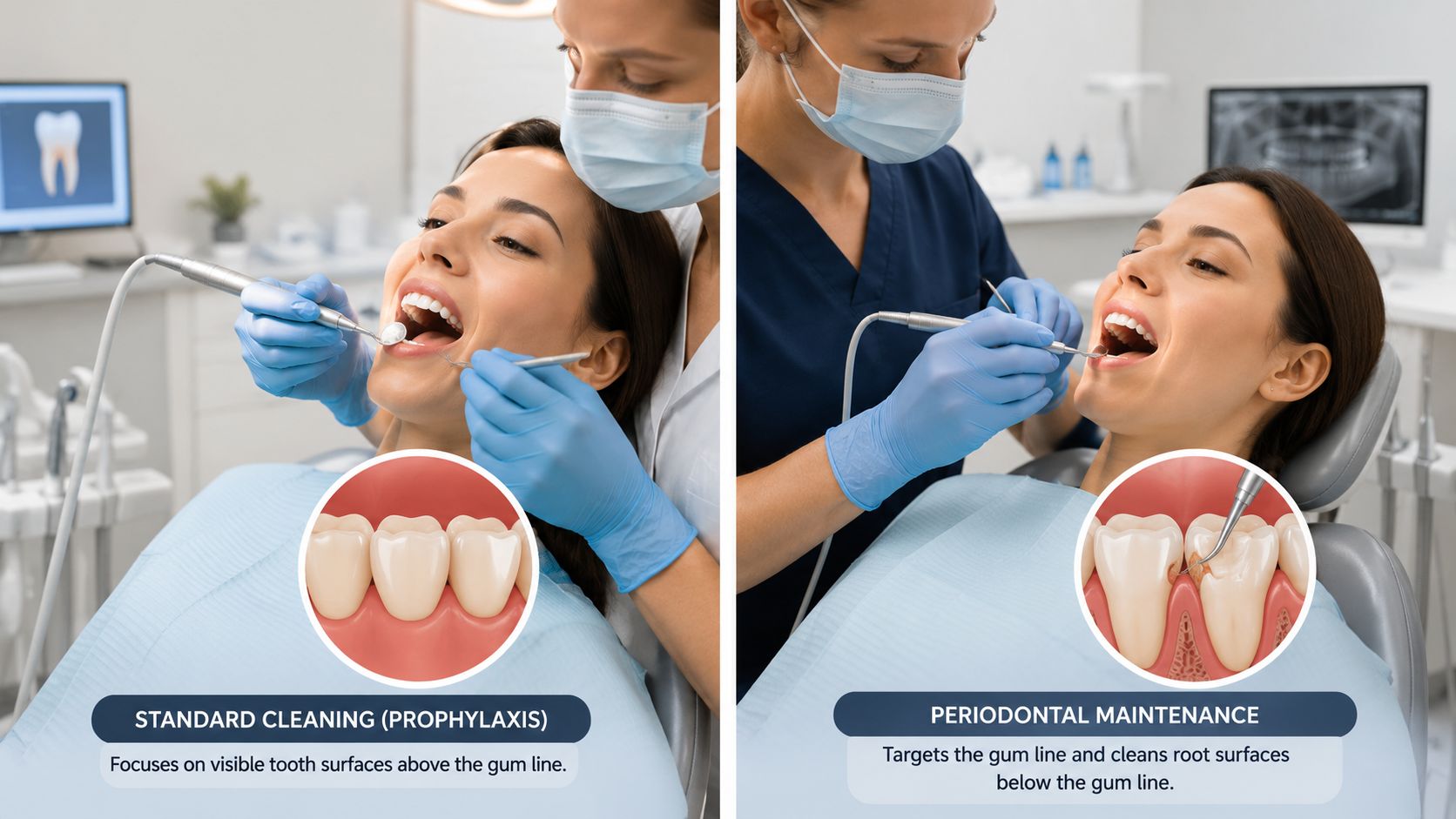
A regular cleaning focuses on the areas you can usually see and feel. It removes everyday plaque and tartar above the gum line and in shallow spaces around the teeth.
Periodontal maintenance goes further. It pays close attention to the root surfaces and the spaces under the gums where harmful bacteria tend to return after gum disease. In plain terms, one visit is meant to keep a healthy mouth healthy. The other is meant to keep a previously infected mouth stable.
What periodontal maintenance focuses on
During periodontal maintenance, your dental team looks closely at the areas where gum disease is more likely to flare up again:
- Below the gum line, where bacteria can collect in deeper pockets
- Around root surfaces, where rough deposits can trigger inflammation
- Sites with past bone loss or deeper pocketing, which often need more careful cleaning and checking
- Changes in the gums, such as bleeding, tenderness, or deeper measurements over time
This is why patients are often switched out of the standard cleaning routine after gum treatment. A regular cleaning is not designed to manage a history of periodontitis. Periodontal maintenance is.
If that still feels abstract, a house analogy may help. A regular cleaning is like routine housekeeping in rooms that are in good shape. Periodontal maintenance is closer to checking the foundation after water damage. You do not ignore the visible parts of the home, but you give extra attention to the areas that are more vulnerable because they have had trouble before.
Why your cleaning type may change after treatment
After deep cleaning or other gum therapy, the goal shifts from active treatment to keeping the condition controlled. That means watching for small signs of relapse before they turn into bigger problems. It also means choosing the right type of appointment, not just the most familiar one.
At The Dental Retreat, we talk through that choice with you. Your plan should reflect what your gums need and what is realistic for your life in Katy, including your schedule, comfort level, and budget. If you want a clearer picture of how active gum therapy and follow-up care fit together, this guide to periodontal disease treatment explains the full process.
A simple rule helps here. If you have been treated for periodontitis, your future cleanings are usually based on maintenance, not on the standard healthy-gums schedule.
The 3-Month Guideline and The Evidence Behind It
A lot of patients in Katy ask the same fair question after gum treatment. “Why three months? Why not every six?” If you are already making time, arranging childcare, or planning around a budget, that number can feel like a rule handed down without much explanation.
There is a reason behind it. Gum disease tends to return in cycles, and the bacteria under the gumline can rebuild fast enough that many dentists prefer to check in before that bacterial community has too much time to mature and trigger more inflammation again. Three months became a common starting interval because it often lines up with that biologic pattern.

Why dentists often start at three months
Your gums heal, but they also remember.
That is one of the simplest ways to understand periodontal maintenance after periodontitis. Once the supporting tissues around teeth have been damaged, they can stay stable for a long time with good care, but they usually need closer watching than gums that have never had disease. A three-month visit is often used to interrupt bacterial regrowth before it has a chance to cause deeper inflammation.
A garden works as a helpful comparison here. If weeds used to take over one area, you do not wait half a year to check that patch again. You inspect it sooner, clear out what is returning, and keep the soil healthy before the problem spreads.
Research supports the idea that longer gaps can carry more risk for patients with a history of periodontitis. One evidence review on supportive periodontal care found more tooth loss in groups with less frequent maintenance than in groups seen more often. That does not mean every person needs the exact same interval. It does mean spacing visits too far apart can make stability harder to maintain.
What the research really says
The part many patients find reassuring is this. Good research does not point to one rigid schedule for every mouth.
The review above also noted that the ideal interval should be based on risk, not a one-size-fits-all calendar. That matters because your schedule at The Dental Retreat should come from a conversation, not just a default setting in the appointment book. We look at what your gums are doing clinically, then balance that with the practical side of life in Katy, including your work schedule, your comfort with treatment, and what feels manageable financially.
Here is the plain-English version:
| Recall idea | What it means for you |
|---|---|
| Three months is a common starting point | It gives many patients a safer window for controlling bacterial return after gum treatment |
| Longer gaps may increase risk | More time between visits can allow inflammation and breakdown to return before it is caught |
| Your best schedule may change over time | If your gums stay healthy and your home care stays strong, your interval may be adjusted with your dentist |
That partnership matters. The goal is not to keep you on a short schedule forever. The goal is to find the frequency that protects your teeth and gums without asking you to commit to more treatment than you need.
A video can also help if you're more of a visual learner.
The three-month guideline works best as a starting point your dentist and you can adjust together, based on how your gums respond and what is realistic for your life.
How We Personalize Your Periodontal Maintenance Schedule
The most helpful conversation about periodontal maintenance frequency doesn't start with a number. It starts with your risk.
Some patients hear “every three months” and assume that schedule is permanent no matter what. Others hope they can stretch visits far apart because life is busy. Neither extreme is ideal. Good care sits in the middle. It responds to what your gums are doing.

The factors that shape your schedule
Dentists look at several moving parts when deciding whether your interval should stay shorter or become longer.
Severity and history
If you started with more advanced periodontitis, deeper pockets, or more areas of attachment loss, your gums usually need closer professional monitoring. The tissues may be stable now, but they can also relapse faster if plaque control slips.
Home care habits
This isn't about judgment. It's about what your mouth shows over time. If you brush thoroughly, clean between your teeth consistently, and keep inflammation low, your maintenance needs may be different from someone whose gums bleed regularly between visits.
Smoking and other risk factors
Tobacco use, ongoing inflammation, and similar risk factors can make gum disease harder to control. In those cases, shorter intervals are often safer because the margin for error is smaller.
Systemic health
Your overall health affects your gums more than many people realize. The evidence summarized in this review on periodontal care and systemic conditions notes that patients with uncontrolled diabetes may require a strict 3-month interval to help prevent disease progression, while those with controlled conditions and good hygiene may be able to extend to 6 months.
Why risk-based care is better than rigid rules
A one-size-fits-all schedule can backfire. If the plan is too aggressive for a low-risk patient, it may feel overwhelming, expensive, or hard to maintain. If the plan is too loose for a high-risk patient, disease can restart undetected.
The evidence review discussed earlier supports this risk-based approach. It notes that high-risk patients may require 3-month intervals, while low-risk patients with excellent home care and no major risk factors can often maintain health with extended intervals of 6 to 12 months, even though the practical decision still depends on clinical findings.
A partnership, not a command
Trust is paramount. The right schedule should come from a real conversation:
- What do your gums look like today
- How stable have they stayed between visits
- What health conditions are in the picture
- What schedule can you realistically keep
A plan you can follow consistently is usually better than an ideal plan you can't sustain.
That doesn't mean convenience overrides health. It means the strongest treatment plan respects both clinical reality and real life. When patients understand the reasoning, they're more likely to stay engaged, ask questions, and keep up with care.
Signs You May Need More Frequent Periodontal Care
Your gums give clues between appointments. If something changes, it's worth speaking up early instead of waiting for your next cleaning and exam.
The goal isn't to make you monitor every tiny sensation. It's to help you notice patterns that may mean your periodontal maintenance frequency needs to be adjusted.
Changes to watch for at home
- Bleeding that keeps happening. If your gums bleed when you brush or floss and it isn't improving, that can signal inflammation.
- Swollen or tender gums. Gums that feel puffy, sore, or irritated may need professional reassessment.
- Bad breath that doesn't resolve. Ongoing odor can be linked to bacterial buildup below the gum line.
- Teeth that seem different in position. New spacing, a shifting bite, or teeth that feel slightly “off” can point to changing support around the teeth.
- A spot that keeps bothering you. One area that repeatedly feels sensitive, catches food, or looks red deserves attention.
When overall health changes the picture
Your medical history matters. If your diabetes becomes harder to control, if you start a medication that affects your mouth, or if your immune system is under more stress, your gums may need closer follow-up even if your routine hasn't changed.
This is especially important for patients with systemic conditions. As noted in the earlier linked review, people with uncontrolled diabetes may need a stricter three-month schedule, while those with controlled health conditions and strong home care may sometimes do well with longer intervals.
When to call sooner
You don't need to self-diagnose gum disease. You just need to notice when your mouth isn't behaving like it usually does.
A simple rule helps:
If your gums are getting easier to manage, your current plan may be working. If they're getting harder to manage, your schedule may need to change.
If you're also looking for a dentist in Katy, TX for routine dental care, emergency dentist visits, tooth extraction concerns, or restorative dentistry, it helps to choose one office that can see the full picture of your oral health over time.
Your Care Experience at The Dental Retreat in Katy
Understanding gum care is one thing. Feeling comfortable enough to follow through is another. For many patients, especially those with dental anxiety, the environment matters almost as much as the treatment plan.
At a patient-centered practice in Katy, the experience should feel organized, gentle, and respectful from the first visit. That matters whether you're coming from Katy Lakes, Elyson, Ventanna Lakes, or The Grange for periodontal maintenance, dental x-rays, a new patient exam, or a second opinion after being told you need more than a standard cleaning.

What a thoughtful visit should include
A good periodontal maintenance appointment shouldn't feel rushed. It should include time to review changes in your health, check how your gums are responding, and clean the areas that are hardest for you to manage at home.
Patients often do best when their visit includes:
- A careful review of your current gum condition so the schedule isn't based on guesswork
- Gentle instrumentation and clear communication so you know what the team is seeing
- A comfort-focused setting with support for anxious patients
- Simple home care coaching that fits your habits instead of sounding unrealistic
Why affordability affects consistency
Many people skip needed care because they assume it won't fit their budget. That's one reason membership plans can make a real difference, especially for patients without insurance who still want consistent professional care.
The publisher information for this article notes that the practice's membership plans start at $299 per year and include savings for periodontal maintenance. That's useful because gum health doesn't improve through good intentions alone. It improves when care stays consistent.
One dental home helps
Patients dealing with gum disease often need more than one kind of service over time. They may need routine cleanings and exams, restorative dentistry, cosmetic dentistry, emergency dentist care, or discussions about dental implants if tooth support has already been affected.
Having one trusted office for those conversations can make care feel less fragmented. Instead of repeating your history to different providers, you can work with a team that understands your gums, your comfort level, and your long-term goals.
The best dental experience isn't just clinically sound. It also makes it easier to keep showing up.
Take the Next Step for a Healthy Smile in Katy TX
The most important thing to remember is simple. Periodontal maintenance frequency should be personalized. The common three-month guideline is often a smart starting point, but it isn't the whole story.
Your schedule should reflect your gum history, your home care, your health, and what you can realistically maintain. That's how care becomes sustainable. That's also how it becomes less intimidating.
If you've been putting this off because you're worried about cost, nervous about treatment, or unsure whether you really need something other than a regular cleaning, it's worth having the conversation. Patients in Katy Manor, Kingscrossing, Lakehouse, Marisol, and Anniston don't need perfect knowledge before they come in. They just need a place to start.
A practical first step
If you're comparing options for a dentist near me or a dentist in Katy, TX, look for a practice that can explain the difference between prevention and periodontal therapy in plain language, review your x-rays and gum measurements carefully, and help you understand the likely next step without pressure.
If cost is part of your hesitation, this page on periodontal maintenance cost can help you understand the financial side before you book.
What to do next
You don't have to commit to a lifetime schedule today. You only need an accurate evaluation and a plan that makes sense.
If you've noticed bleeding gums, you've been told you need maintenance instead of a regular cleaning, or you're searching for cleaning and exams, cosmetic dentist near me services, restorative dentistry, or dental implants near me from one reliable office in Katy, this is a good time to schedule that first conversation. For many patients, a low-pressure new patient exam is the moment everything starts to feel clearer.
If you're ready to stop guessing and get a personalized plan for your gums, schedule a visit with The Dental Retreat. Their team in Katy, TX offers a calm, judgment-free approach, complete dental care, and new-patient options that make it easier to take the first step.