You notice it when you drink cold water. One tooth suddenly feels sharp and sensitive. Then you look in the mirror and think your teeth seem longer than they used to. That combination often sends people searching for a dentist near me in Katy, TX because gum recession can feel subtle at first, then become hard to ignore.
The good news is that you usually have more than one path forward. Some people need improved home care and periodontal cleaning. Others need bonding to protect exposed root surfaces. And when the goal is to restore the gumline itself, surgical root coverage may be the best answer. The right choice depends on why the recession happened, how advanced it is, and what matters most to you, including comfort, healing, and avoiding unnecessary treatment.
Your Local Guide to Gum Recession Treatment in Katy TX
Gum recession means the gum tissue has moved away from the tooth, exposing more of the root. Patients often describe it in practical terms. Their smile looks uneven, one area feels tender, or brushing now causes sensitivity that wasn't there before. Some worry they're about to lose a tooth. Others assume it's only cosmetic.
It isn't something to ignore, but it also isn't something to panic about. Modern gum recession treatment options are far more customized than many people expect. Care can range from a conservative deep cleaning to soft tissue grafting and minimally invasive repositioning procedures. What works best depends on the cause.
What patients usually notice first
A receding gumline rarely announces itself dramatically. More often, it shows up as a pattern:
- Longer-looking teeth because more root structure is visible
- Cold sensitivity when exposed root surfaces react to temperature
- A notch near the gumline that catches a fingernail or toothbrush bristle
- A smile that feels uneven in photos or conversation
Those changes matter because the root surface isn't designed to stay exposed. It can become sensitive, collect plaque more easily, and wear differently than enamel.
Practical rule: The best first step isn't choosing a procedure. It's finding out whether the recession is still actively progressing and what's driving it.
Why local care matters
If you're looking for a dentist in Katy, TX because your gums are pulling back, convenience matters, but so does continuity. Gum recession often requires more than one visit and a plan that may include exams, dental x-rays, periodontal therapy, cosmetic protection for exposed roots, or referral within a full-service dental setting for related needs like bite adjustment, clear aligners, restorative dentistry, or emergency treatment if pain suddenly flares.
For patients in Sunterra, Cane Island, Katy Manor, Kingscrossing, Lakehouse, Marisol, The Grange, Anniston, Katy Lakes, Elyson, and Ventanna Lakes, it helps to know that treatment doesn't have to be one-size-fits-all. A thoughtful plan should answer a few basic questions clearly: what's causing the recession, what can stop it, what can cover the root, and what recovery will be like.
Understanding Why Gums Recede and How We Diagnose It
Gum recession is easier to understand if you picture a shoreline slowly pulling back. The tooth stays in place, but the gumline recedes and leaves more root exposed. Sometimes that change happens because inflammation has damaged the supporting tissues. Sometimes it happens because the tissue is naturally thin and repeated trauma, pressure, or tooth position pushes it farther back over time.
It also helps to know you're not alone. Approximately 88% of people over age 65 have gum recession on one or more teeth, according to Cleveland Clinic's overview of gum recession. The same source notes that it generally isn't reversible on its own, but it can be managed to prevent progression and restore the gumline.
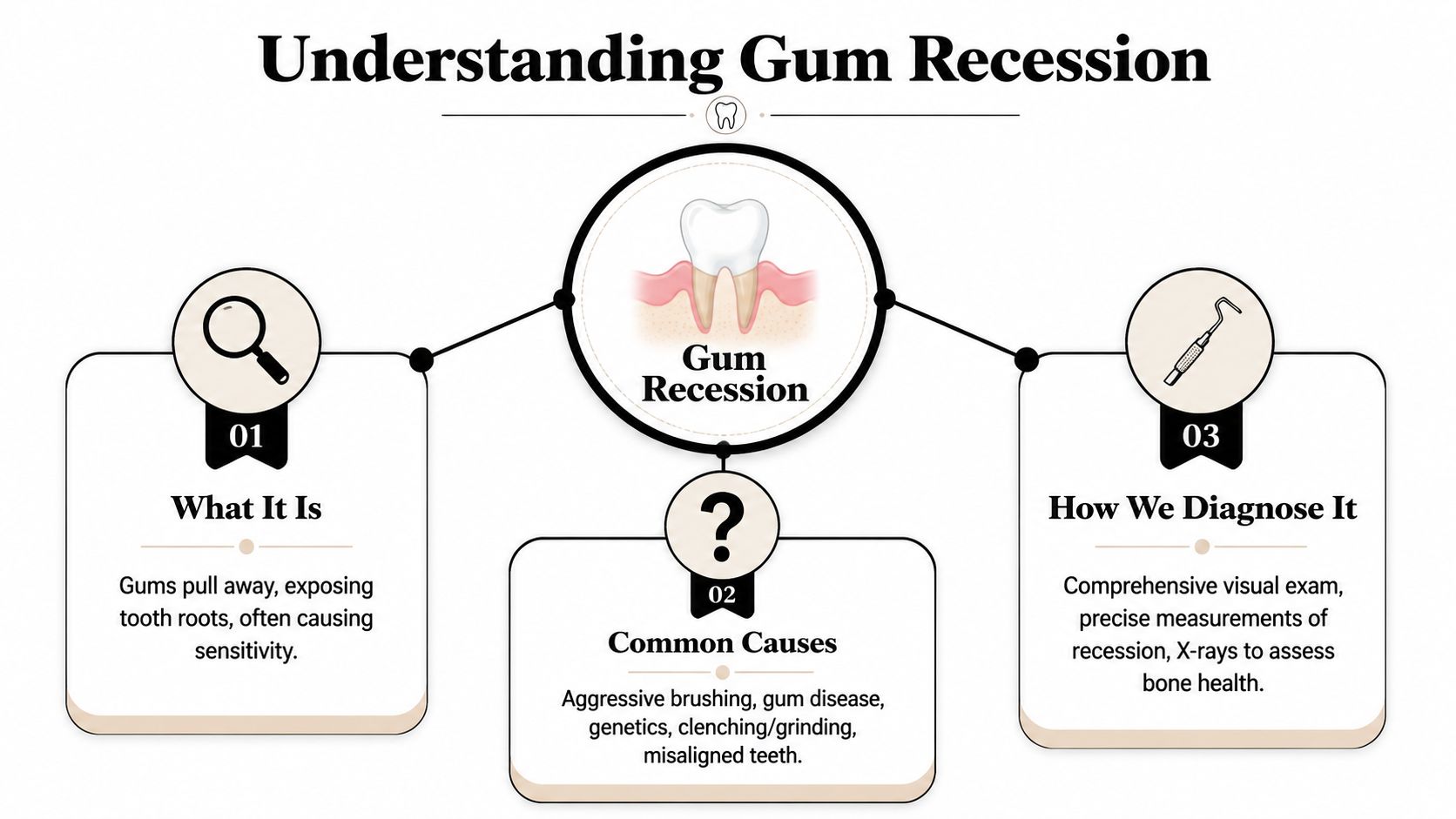
Common causes behind a receding gumline
Recession usually comes from more than one factor. A patient may have thin tissue genetically, brush too aggressively, and also clench at night. Another may have gum disease plus teeth that sit outside the ideal bone envelope.
A few common contributors include:
- Periodontal disease that damages the supporting tissues
- Aggressive brushing with too much pressure or the wrong technique
- Genetics and thin tissue that make the gums easier to wear down
- Clenching and grinding that place repeated force on the teeth
- Tooth position or bite issues that create strain in certain areas
- Inflammation around restorations or plaque-retentive areas
If you want a closer look at the underlying triggers, this guide on what causes receding gums in adults gives a helpful overview.
How a dentist diagnoses it
A useful recession exam is gentle, but it should be detailed. The goal isn't just to confirm that the gums have moved. The goal is to understand why.
A thorough evaluation often includes:
| What we check | Why it matters |
|---|---|
| Visual gumline changes | Shows where roots are exposed and how esthetics are affected |
| Recession measurements | Helps track whether the area is stable or worsening |
| Tissue thickness | Influences which treatment options are realistic |
| Bite and tooth position | Identifies pressure or alignment issues that may contribute |
| Dental x-rays | Helps assess supporting bone and rule out deeper periodontal damage |
Exposed roots are the visible problem. The real diagnosis comes from understanding the tissue, bone, inflammation, and bite together.
First Steps Non-Surgical Gum Recession Treatments
Many patients hope there's a solution that doesn't involve surgery. Sometimes there is, especially when the main issue is active inflammation rather than missing tissue. Non-surgical care is the place to start when the gums are inflamed, plaque is accumulating below the gumline, or sensitivity is the symptom causing the most trouble day to day.
According to this clinical overview of effective treatment for gum recession, non-surgical therapy such as scaling and root planing is most effective when recession is driven by active inflammation. These measures reduce bacterial load and can stabilize progression, but they don't regenerate lost gum tissue. For actual root coverage, surgical techniques are the more definitive option.
What non-surgical treatment can do well
Think of this phase as removing the reason the recession is getting worse.
Scaling and root planing is a deep cleaning below the gumline. It removes biofilm and calculus from root surfaces so inflamed tissue has a chance to settle down. If bleeding, puffiness, or periodontal pockets are part of the picture, this step matters.
Antibacterial rinses or antibiotics may be used in selected cases to reduce the bacterial burden further. These don't rebuild the gumline, but they can make the environment healthier.
Dental bonding can cover a sensitive exposed root surface. That's useful when a patient wants comfort and protection, even if the tissue itself isn't being moved back over the tooth.
What these options cannot do
Honest treatment planning matters. Non-surgical care can stop progression, improve comfort, and create a healthy foundation. It can't replace tissue that is already gone.
That distinction is important:
- For inflammation control, non-surgical treatment may be the main answer
- For sensitivity relief, bonding or desensitizing measures may help quickly
- For cosmetic root coverage, these approaches usually won't deliver the final result patients expect
How treatment decisions are usually made
A simple comparison helps:
| If the main problem is | Best initial direction |
|---|---|
| Bleeding and periodontal inflammation | Scaling and root planing |
| Root sensitivity without major cosmetic concern | Desensitizing care or bonding |
| Thin tissue with visible root exposure | Evaluation for surgical coverage |
| Multiple contributing factors | Stabilize inflammation first, then reassess |
For many patients, especially those balancing work, family, and long commutes around Katy, the most conservative plan is the right one. Control the disease first. Recheck the tissue. Then decide if the next step should be cosmetic protection, restorative care, or surgery.
Advanced Surgical Options for Restoring Your Gumline
Once the gums are healthy and stable, the discussion shifts. Not "how do we calm this down?" but "how do we cover the root and rebuild a stronger gumline?" To achieve this, surgical care offers the most direct solution.
A gum graft is a bit like patching a worn area in a lawn. The goal isn't only to make it look fuller. The goal is to place or reposition durable tissue where coverage and protection are needed most.

The most predictable root coverage approaches
Modern periodontology treats coronally advanced flap with a connective tissue graft and tunneling with a connective tissue graft as the most predictable surgical approaches for root coverage, based on this review in the National Library of Medicine. The same review notes that biomaterials such as acellular dermal matrices are strong alternatives for patients who want to avoid a second surgical site at the palate.
That matters because not every patient values the same thing. Some want the established benchmark for predictability. Others are highly motivated to avoid donor tissue from the roof of the mouth.
Here is the educational video many patients find useful before a consultation:
How the main surgical options compare
| Procedure | Tissue source | Best use | Main advantage | Main trade-off |
|---|---|---|---|---|
| Connective tissue graft | Usually the palate | Root coverage and thicker tissue | Strong track record and esthetics | Requires a donor site |
| Free gingival graft | Usually the palate | Increasing width or toughness of gum tissue | Durable tissue gain | Can look less blended in some areas |
| Pedicle graft | Nearby existing gum tissue | Isolated areas with enough adjacent tissue | Uses local tissue with no separate donor site in some cases | Only works in selected sites |
| Acellular dermal matrix or similar biomaterial | Donor biomaterial | Patients avoiding palate harvest | No second surgical site | Not every case is ideal for biomaterials |
When minimally invasive approaches make sense
Some recession defects are good candidates for tunneling or other soft-tissue repositioning approaches that limit visible incisions. These techniques can be especially appealing when several teeth are involved or when the tissue is delicate and preserving blood supply is important.
The best surgical plan isn't the newest technique or the oldest technique. It's the method that fits the anatomy, the tissue quality, and the patient's priorities.
What makes someone a good candidate
A clinician usually looks at four practical questions before recommending surgery:
- Is the cause controlled such as plaque, inflammation, or traumatic brushing?
- How much root is exposed, and is there enough supporting tissue to work with?
- What is the patient trying to solve, sensitivity, appearance, progression, or all three?
- Would the patient prefer to avoid a palate donor site if a biomaterial could be appropriate?
This is also where broader, integrated care matters. Some patients with recession also need bite management, clear aligner planning from a cosmetic dentist near me, restoration of worn areas, or treatment sequencing around missing teeth and future dental implants near me. Gum treatment doesn't happen in isolation.
Your Recovery and Achieving Long-Lasting Results
Individuals can handle a procedure once they understand what healing looks like. The unknown is usually worse than the recovery itself. Gum recession treatment recovery is less about doing something dramatic and more about protecting a small, carefully treated area while it bonds and matures.

The first days after treatment
Right after a graft or tissue repositioning procedure, mild soreness, swelling, and tenderness are normal. If the palate was used as a donor site, that area may feel different from the treated gumline. Some patients also have a protective dressing.
During this period, the priorities are simple:
- Protect the site by avoiding touching, pulling the lip, or brushing directly on it
- Choose soft foods so chewing doesn't disturb the healing tissue
- Take medications as directed if your dentist prescribes or recommends them
- Rest sensibly and avoid strenuous activity if your instructions say to limit it
The next few weeks
Healing becomes less dramatic, but it still needs attention. Sutures may dissolve or be removed, and cleaning instructions usually change gradually rather than all at once. Most patients return to their normal routine in stages, not overnight.
For a more detailed overview, this resource on gum grafting surgery recovery walks through what many patients can expect.
Don't judge the final result too early. Soft tissue changes over time, and the gumline often looks more settled as healing progresses.
What protects the result long term
The procedure matters, but maintenance determines whether the result lasts. A technically excellent graft can still be put at risk if the original cause isn't addressed.
Long-term success usually depends on:
- Gentle brushing technique with the right pressure
- Consistent hygiene visits and periodontal maintenance when recommended
- Managing clenching or grinding if excess force contributed
- Monitoring tooth position and bite when alignment is part of the problem
- Prompt attention to sensitivity or new recession instead of waiting
Patients sometimes ask if gum recession can return after treatment. It can if the underlying cause remains active. That's why the most durable plans pair the procedure with behavior changes, follow-up care, and periodic reassessment.
Experience Comfortable Care at The Dental Retreat in Katy
Even when patients understand their options, many still hesitate because they're worried about the experience itself. Gum procedures can sound intimidating. That's where comfort isn't a luxury. It's part of good care.
At a practice designed around a calm patient experience, details change how people feel walking in and how they recover walking out. A spa-inspired setting can lower tension before treatment even starts, especially for patients who usually avoid dental visits until sensitivity becomes impossible to ignore.
Why comfort matters during periodontal care
Gum recession treatment often involves precise work, extra time in the chair, and close follow-up. If a patient is anxious, every part of that process feels harder. A more soothing environment helps patients stay relaxed and makes it easier to move forward with needed care instead of postponing it.
At The Dental Retreat in Katy, comfort-focused features support that experience in practical ways:
- Massage and heated chairs help patients settle in during longer visits
- Aromatherapy softens the clinical feel many people associate with dentistry
- Noise-cancelling headphones reduce the sounds that tend to trigger anxiety
- TVs in treatment rooms give patients something familiar to focus on

Sedation and transparent planning
For patients who feel especially nervous about periodontal treatment, oral conscious sedation can make the appointment much more manageable. That option matters for people who have delayed care, had difficult dental experiences before, or understand they do better with extra support.
Comfort also includes financial clarity. The Dental Retreat offers practical pathways that help patients get evaluated before committing to a larger treatment plan. New patients without insurance can consider a $49 problem-focused visit, a $99 complete exam with cleaning and X-rays, and membership plans that start at $299 per year. Those plans can be especially useful when ongoing periodontal maintenance is part of protecting the final result.
A good fit for patients seeking more than routine care
Patients searching for an emergency dentist, a dentist near me, or a local office for a full range of dental care often discover that recession isn't the only issue in play. They may also need cleaning and exams, cosmetic planning, restorative dentistry, clear aligners, treatment for a cracked tooth, or even a future tooth extraction if another area can't be saved.
A practice that can coordinate those needs under one roof makes treatment less fragmented and easier to understand. In Katy, that can be the difference between putting off care and finally getting it done.
Common Questions About Gum Recession Treatment
Will a gum graft hurt
Most patients are relieved to find that the procedure sounds worse than it feels. The area is numbed during treatment, and recovery is usually more about soreness and tenderness than severe pain. If you're anxious, ask about sedation before the day of treatment so the plan reflects your comfort level.
How much does gum recession treatment cost
The cost depends on the severity of the recession, how many teeth are involved, and which technique fits your case. A simple non-surgical approach is different from a connective tissue graft or a biomaterial-based procedure. The most useful consultation is one that explains your options plainly, including whether a staged approach makes sense and how membership plans or financing may reduce the immediate burden.
Can my gums grow back without treatment
In general, recession doesn't reverse on its own. What can improve without surgery is inflammation, tenderness, and sensitivity if the cause is addressed early. If the goal is true root coverage, surgical treatment is usually the more definitive path.
Can gum recession come back after treatment
It can. A successful procedure doesn't make the mouth immune to future trauma or inflammation. If hard brushing, periodontal disease, grinding, or bite stress continue, the tissue can recede again. That's why follow-up visits, home care coaching, and maintenance matter just as much as the procedure itself.
When should I stop watching and book an exam
If you notice a new sensitive area, a root that looks exposed, bleeding around the same tooth repeatedly, or a gumline that looks uneven in photos, it's time. Early evaluation gives you more treatment options, and those options are often simpler than what becomes necessary later.
If you're noticing sensitivity, longer-looking teeth, or a gumline that doesn't look right, schedule an evaluation with The Dental Retreat. Patients across Katy, TX, including Sunterra, Cane Island, Katy Manor, Kingscrossing, Lakehouse, Marisol, The Grange, Anniston, Katy Lakes, Elyson, and Ventanna Lakes, can get clear guidance, comfort-focused care, and a treatment plan that fits both oral health and peace of mind.