A lot of people start looking for an orthodontist in Cinco Ranch the same way. They catch their smile in a photo, notice crowding in the mirror, or realize their bite doesn't feel quite right when they chew. They want to fix it, but they're also wondering how long it will take, what it will cost, and whether treatment will fit into an already busy life in Katy.
That uncertainty is normal. Families in Katy, TX and nearby neighborhoods like Sunterra, Cane Island, Katy Manor, Kingscrossing, Lakehouse, Marisol, The Grange, Anniston, Katy Lakes, Elyson, and Ventanna Lakes often want a straighter smile, but they also want a process that feels manageable. If you've searched for dentist near me, cosmetic dentist near me, or dentist in Katy, TX, you're probably not just gathering information. You're trying to find a place where the treatment itself feels clear, comfortable, and worth it.
Orthodontic care can be part of a bigger smile plan, too. Some patients come in thinking only about alignment, then start asking how straighter teeth may support easier cleanings, cosmetic dentistry, or future restorative dentistry. Others are already established dental patients looking for one office that can also help with cleaning and exams, dental x-rays, new patient exams, emergency dentist visits, tooth extraction needs, or even long-term options like dental implants near me after other issues are addressed.
Your Journey to a Confident Smile in Cinco Ranch
You might be the parent comparing options after noticing your child's teeth are coming in crowded. You might be an adult who skipped orthodontics years ago and now wants a more polished smile for work, social events, or simple self-confidence. Or maybe you've had dental work before and you're realizing that straightening your teeth could make the rest of your dental care easier.
That's why the search for an Orthodontist in Cinco Ranch often feels bigger than just choosing braces or aligners. You're choosing a routine, a timeline, and a level of comfort you'll live with for months. For many people in Katy, that decision sits right alongside practical concerns like school pickup, work schedules, insurance questions, and whether appointments will be easy to keep.
What patients usually worry about first
Patients often don't start with technical questions. They start with everyday ones.
- Will it be obvious? Adults often ask whether clear aligners can help them avoid the look of metal braces.
- Will it interrupt daily life? Parents want to know how treatment affects sports, meals, and school.
- Will the cost make sense? Families want a clear explanation before committing.
- Will it be uncomfortable? Patients with dental anxiety want to know what visits will feel like.
Practical rule: The best orthodontic plan isn't just the one that can move teeth. It's the one you can realistically stick with.
Why local convenience matters
Orthodontic care isn't usually a one-visit service. It's a relationship over time. That's one reason local patients often look for care close to home in Katy, TX instead of choosing an office farther away. If you live in Elyson, Ventanna Lakes, Cane Island, or Katy Lakes, shorter drives and easier scheduling can make a real difference in how smoothly treatment fits into your week.
Patients also tend to feel more confident when they understand the whole picture early. That includes not just the smile result, but how orthodontic treatment may connect with regular dental care, teeth whitening later on, cosmetic dentistry goals, and long-term mouth health. A straighter smile can feel exciting. It should also feel understandable.
Why Straightening Your Teeth is About More Than Looks
A straight smile can look great, but orthodontics isn't only cosmetic. Orthodontics specifically targets malocclusion, or an improper bite, to prevent long-term health issues including excessive trauma and wear on teeth, while also improving oral functions like speech and eating efficiency, as explained in this overview of orthodontic care and malocclusion.
That matters because teeth aren't supposed to meet randomly. They're designed to work together. When they don't, small daily forces from chewing and clenching can land in the wrong places.
What an improper bite can do
Think of your bite like the alignment of a door. If the hinges are off, the door may still close, but it rubs, sticks, and wears unevenly over time. Teeth can behave the same way.
A bite problem may lead to:
- Uneven wear that chips or flattens certain teeth faster than others
- Hard-to-clean areas where crowding makes brushing and flossing more difficult
- Chewing problems that make meals less comfortable
- Speech issues in some cases, especially when teeth don't meet properly
Some people also notice that one side of the mouth seems to do more work than the other. Others say they avoid smiling widely because overlapping or protruding teeth make them self-conscious. Those concerns are real, but the deeper issue is function. When the bite is off, the whole system has to compensate.
Why function comes first
Orthodontic treatment works by improving how teeth fit together, not just how they line up in a photo. That can support better comfort during daily activities like eating, talking, and keeping your mouth clean.
A healthier bite often makes home care simpler because there are fewer tight, awkward spaces where food and plaque collect.
That's one reason orthodontic planning can overlap with general and restorative dentistry. If someone has crowding, older fillings, worn edges, or is considering cosmetic dentistry later, alignment may create a better foundation for future care. It can also help patients protect dental work they already have.
Signs it may be time to get evaluated
You don't need to diagnose yourself before scheduling a consultation. Still, a few clues often push people to start searching for an orthodontist in Cinco Ranch or a dentist in Katy, TX who offers alignment treatment.
- Crowded front teeth that are getting harder to floss
- Teeth that don't seem to touch evenly when you bite down
- A smile that has shifted over the years
- Difficulty cleaning around overlapping teeth
- Concern about long-term wear on certain teeth
Orthodontic care fits into the same big picture as cleaning and exams, dental x-rays, restorative dentistry, and cosmetic smile goals. It's not separate from oral health. For many patients, it's part of finally making everything work together.
Choosing Your Path Clear Aligners vs Traditional Braces
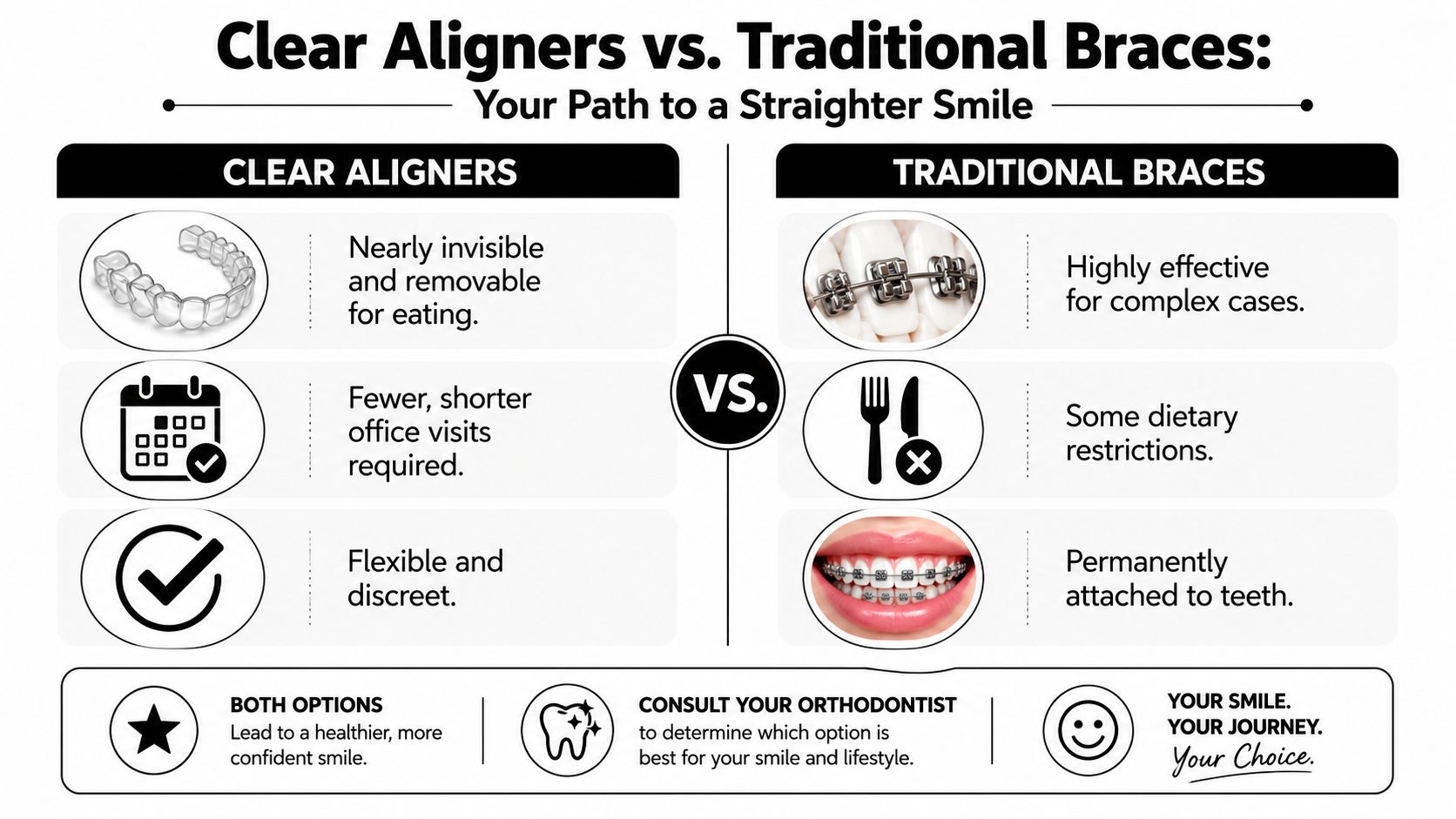
For most patients, the question isn't whether straightening works. It's which method fits their life. The two main options are clear aligners and traditional braces, and each has strengths.
What clear aligners offer
Clear aligners use a series of removable trays that gradually guide teeth into new positions. Patients like them because they're discreet, easy to remove for meals, and simpler to work around when brushing and flossing.
For many adult cases, clear aligner orthodontics using high-precision digital workflows can show a mean treatment acceleration of 15 to 20 percent compared to traditional fixed braces, according to this clear aligner treatment overview.
That doesn't mean aligners are always the right answer for every smile. It means they can be a strong option when the case and the patient's habits are a good match. Removability is both a benefit and a responsibility. If aligners stay in the case instead of in your mouth, treatment won't stay on track.
When braces still make the most sense
Traditional braces are fixed to the teeth, so they're always working. That makes them especially useful for patients who want a treatment option that doesn't depend on remembering to put trays back in after every meal or snack.
Braces are also well known for handling a wide range of tooth movements. In many offices, they remain a dependable choice for more involved bite corrections and alignment problems. If someone has significant crowding, rotation, or a bite issue that needs tight control, braces may be the cleaner mechanical solution.
One simple way to choose: If you value removability and a low-profile look, aligners may feel better day to day. If you want an appliance that stays on and keeps working without your help, braces may be the better fit.
Side by side comparison
| Feature | Clear Aligners (e.g., Invisalign) | Traditional Braces |
|---|---|---|
| Appearance | Nearly invisible for most daily interactions | More noticeable because brackets and wires stay attached |
| Eating | Removed for meals, so there are fewer food limitations | Some foods are best avoided to protect brackets and wires |
| Cleaning | Easier to brush and floss after removing trays | Requires more careful brushing around hardware |
| Daily routine | Depends on wearing trays consistently | Works continuously because it stays on the teeth |
| Comfort style | Smooth plastic trays | Brackets and wires may create friction spots |
| Best fit | Often popular with adults and image-conscious teens | Often helpful for more complex movements |
Some patients also compare office routines before deciding. If you want a deeper look at the day-to-day tradeoffs, this guide on clear aligners vs. traditional braces in detail is a helpful next read.
Which one matches your lifestyle
A parent choosing for a teen may focus on compliance. An adult professional may care most about appearance at work. Someone who already juggles a packed schedule may prefer the treatment that feels easiest to maintain.
Here are a few practical examples:
- Busy adult professional often leans toward clear aligners because they're subtle in meetings and social settings.
- Patient who snacks often may prefer braces, since aligners require more discipline around eating and reinserting trays.
- Teen involved in sports or performances may like aligners for appearance, but only if they'll wear them reliably.
- Patient with a more involved bite issue may do better with braces if fixed control is the priority.
The right choice isn't the trendiest one. It's the one that balances appearance, comfort, cleaning, and consistency in real life.
Your Orthodontic Treatment Journey What to Expect
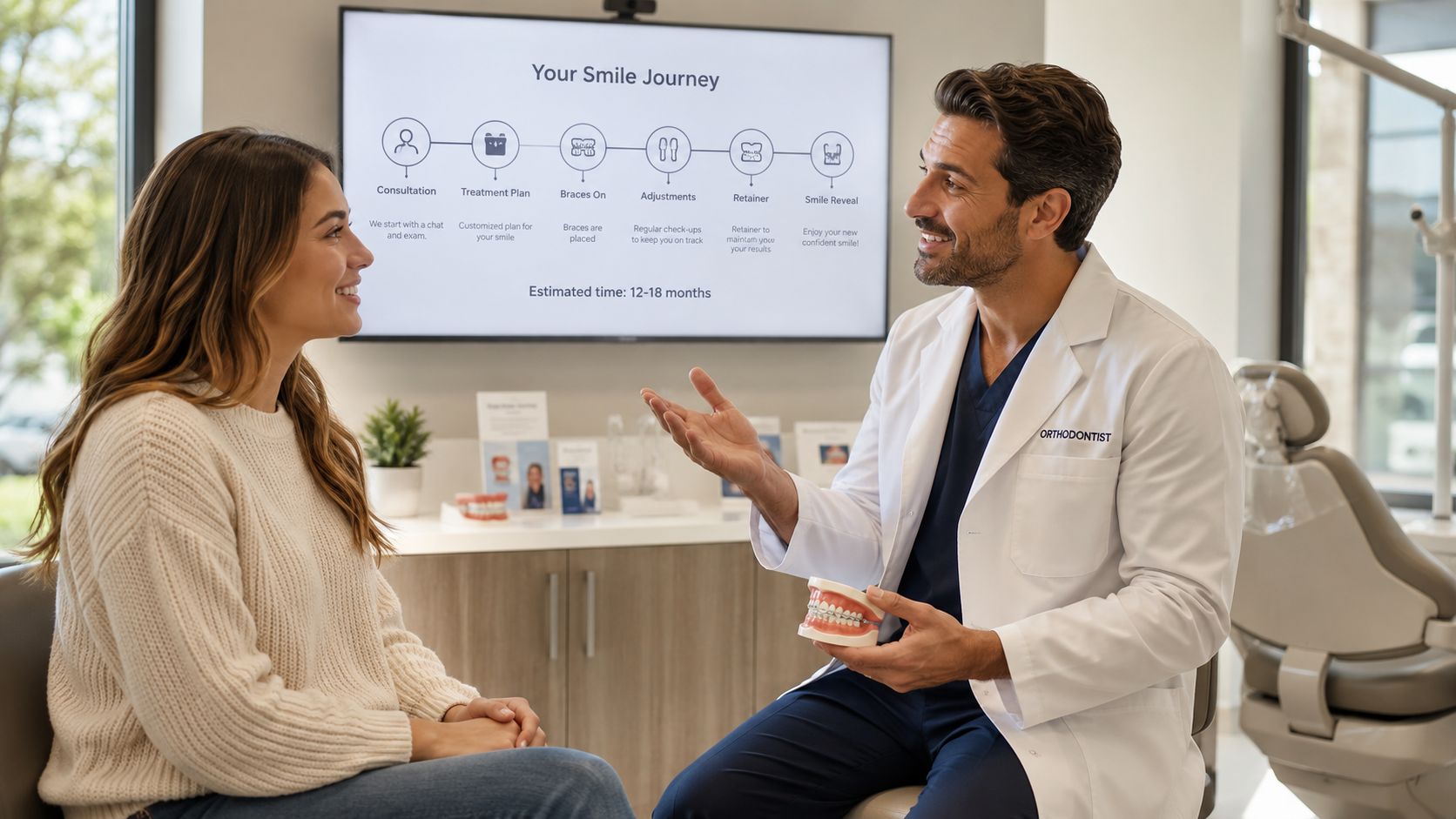
The process feels much less intimidating when you know what happens first, what happens next, and what your role is along the way.
Step one starts with records and goals
The first visit usually focuses on understanding your teeth, your bite, and your priorities. That often includes an exam, digital images, and a conversation about what you want to change. Some patients care most about crowding. Others are focused on a front tooth that shifted or a bite that feels uneven.
This part matters because orthodontics isn't one-size-fits-all. The same smile concern can have more than one treatment path depending on your schedule, age, habits, and dental history.
Step two is building the plan
Once the records are reviewed, the next step is mapping out how the teeth should move. That's where digital planning becomes helpful. It lets the dental team show you what's happening now, what the goals are, and why one option may make more sense than another.
Patients often feel less anxious once they can see the plan in plain language. If you're considering aligner treatment specifically, this overview of the treatment timeline for clear aligner therapy can help you picture the sequence more clearly.
Step three is active treatment
When treatment begins, there's usually a short adjustment period. Teeth move because light, steady pressure is applied over time. Orthodontic treatment requires regular adjustments, typically every 4 to 6 weeks, to maintain the gentle, consistent pressure needed for gradual and safe tooth repositioning, according to this explanation of braces adjustment timing.
That schedule is one reason local convenience matters. Follow-up visits are part of the process, whether you have braces that need adjustments or aligners that require progress checks.
A quick visual can make the process easier to understand:
Step four keeps your results in place
Once teeth are in their new positions, treatment isn't finished until retention is handled properly. Retainers help hold the result while the supporting tissues stabilize. Without that final step, teeth can drift.
What surprises many patients: The active phase gets the attention, but retention is what protects all the work you just completed.
A predictable process lowers stress. When patients know what the visits are for, how often they'll come in, and what each phase is trying to achieve, treatment feels less mysterious and much more doable.
Navigating the Cost of Orthodontic Care in Katy
You finally decide you are ready to straighten your teeth. Then the practical questions show up fast. How much will this cost, what does insurance help with, and can the monthly payment fit your regular budget without adding stress?
That pause is common. Orthodontic treatment is usually planned, not rushed, so people want clear numbers before they commit. A good consultation should make the financial side feel easier to understand, the same way a written treatment plan makes the clinical side easier to follow.

Why price confusion causes delays
For many families, the hardest part is not the idea of paying for treatment. It is the uncertainty around the full picture.
Orthodontic fees can vary based on the type of treatment, how complex the tooth movement is, how long care is expected to take, and whether other dental needs should be handled first. Clear aligners and braces may also come with different cost structures depending on the case. If those details are not explained early, people often stay in research mode and postpone a decision they were close to making.
It helps to look at the cost the way you would look at a home project. The total matters, but so does the timeline, what is included, and whether any steps need to happen first.
What to ask during a consultation
A useful financial conversation should feel specific and calm. You should leave knowing the total estimate, the likely monthly payment, and what could change that number.
These questions usually help:
- Does my insurance include orthodontic benefits, and are there age limits?
- What is included in the full treatment fee?
- What would I pay out of pocket?
- Are there down payment and monthly payment options?
- Do I need any care before treatment starts, such as an exam, dental x-rays, or treatment for an urgent dental problem?
- If I want cosmetic improvements later, such as whitening, when should I plan for that?
Clear answers matter because they turn a vague worry into a plan you can evaluate.
Looking at the full smile budget
Orthodontics is often one part of a larger dental plan. Some patients are ready to start right away. Others may need a new patient exam, updated x-rays, or treatment for decay, infection, or damaged dental work first. After alignment is complete, some people choose whitening or other cosmetic services to finish the look of their smile.
That bigger picture matters because the best value is not always the lowest sticker price. The best value is a treatment sequence that makes sense for your health, your schedule, and your budget.
If you do not have insurance, an in-house membership plan may help make routine dental care more predictable while you prepare for orthodontic treatment. Some practices offer membership options starting at $299/year, which can reduce the financial guesswork around preventive visits and ongoing care. The helpful question is simple. What is included, and how does it fit with the rest of your smile goals?
Clear pricing helps patients make calm, informed decisions. It does not change the need for treatment, but it does make the path feel much more manageable.
For patients in Katy, Elyson, Ventana Lakes, and nearby neighborhoods, the most helpful cost conversation is one that connects treatment choices, insurance, payment options, and comfort from the start. That kind of planning supports the whole experience, not just the final bill.
The Dental Retreat Difference A Calmer Orthodontic Experience
Clinical skill matters, but comfort matters too. Many adults put off treatment because they assume every dental visit will feel tense, rushed, or overstimulating. That's especially true for patients who already feel nervous in a dental chair.

Comfort changes the whole experience
A calmer setting can make it easier to begin treatment and easier to stay consistent with it. At a modern spa-like office, patient comfort may include amenities such as aromatherapy, heated massage chairs, noise-cancelling headphones, and TVs in treatment rooms. Those details may sound small, but they can make appointments feel much more manageable for anxious patients.
For some people, the environment is the deciding factor. They already know they want straighter teeth. What they need is a place where they don't feel judged, pressured, or overwhelmed.
Why convenience matters as much as technology
Orthodontic care works best when it fits real life. Extended hours help working adults and busy parents. Bilingual care helps families feel understood and informed. A practice that can also provide general, cosmetic, emergency, and restorative services creates continuity, especially for patients who don't want to bounce between multiple offices.
That broader support matters when orthodontics is only one part of your care. If you need regular cleanings, cosmetic dentistry, a problem-focused visit, tooth extraction planning, or same-day attention from an emergency dentist, it helps when your dental home can coordinate the whole picture.
The best patient experience doesn't remove every responsibility. It removes friction, so keeping up with care feels easier.
For many Katy families, that's the key distinction. They're not only looking for an orthodontist in Cinco Ranch. They're looking for a dental experience that respects their time, their anxiety level, and their long-term goals.
Frequently Asked Questions About Orthodontics
Will orthodontic treatment hurt
Most patients feel pressure or soreness when treatment starts or when trays or appliances change, but it's usually temporary. People often describe it as tenderness rather than sharp pain.
How do I keep my teeth clean with braces or aligners
With aligners, remove the trays before eating and brush before putting them back in. With braces, brush carefully around brackets and wires and take extra time at the gumline. Keeping up with cleaning and exams during treatment is important.
Do I still need regular dental checkups
Yes. Orthodontic treatment moves teeth, but routine dental care still matters for cavity prevention, gum health, and monitoring the rest of your mouth.
Are clear aligners always better than braces
Not always. Aligners are popular because they're removable and discreet, but braces can be the better tool for some bite problems or for patients who don't want to worry about wearing trays consistently.
Can adults still straighten their teeth
Absolutely. Many adults choose orthodontic treatment because they want a healthier bite, easier cleaning, or a smile that feels more confident and polished.
If you're ready to stop guessing and start planning, The Dental Retreat can help you take the next step with clear answers, a comfortable environment, and a personalized approach to orthodontic care in Katy, TX. Whether you're exploring clear aligners, thinking about cosmetic dentistry, or searching for a dentist near me who understands the full patient experience, scheduling a consultation is a smart place to begin.