If you're looking at a treatment estimate and feeling stuck on words like deductible, copay, and coinsurance, you're not alone. Many patients in Katy, TX, including families in Sunterra and Cane Island, want to move forward with care but pause when the financial terms feel harder to understand than the dental visit itself.
That uncertainty can make people delay cleanings, put off a tooth extraction, or wait too long to call an emergency dentist. It can even keep someone from asking about dental implants near me or cosmetic dentist near me because they assume the cost will be confusing or out of reach.
Understanding deductibles and copays gets much easier when you break each term into plain language. Dental coverage also works differently from medical coverage in a few important ways, especially around preventive care. Once those pieces click, it becomes much easier to plan for cleaning and exams, restorative dentistry, cosmetic dentistry, and even larger treatments with confidence.
Navigating Dental Costs with a Dentist in Katy TX
A common local scenario goes like this. A parent from Cane Island books a new patient exam because a child has sensitivity. A couple in Elyson schedules cleaning and exams after missing a year. Someone in Ventanna Lakes searches for a dentist near me because a filling fell out and they may need an emergency dentist.
Then the paperwork starts.
They see terms like deductible, copay, annual maximum, preventive, basic, and major. The treatment itself may be straightforward. The insurance language doesn't feel that way. Patients often tell the front desk they don't mind paying for the care they need. They just want someone to explain what they're paying for and when.
That concern is reasonable. Dental costs can feel vague when a plan summary uses short labels without showing how they work in a real appointment. One person may expect a routine cleaning to apply toward a deductible. Another may assume a copay lowers the deductible balance. A third may think dental and medical insurance follow the same rules.
Most dental cost stress starts with uncertainty, not with the treatment itself.
For families in Katy Manor, Kingscrossing, Lakehouse, Marisol, The Grange, Anniston, and Katy Lakes, clarity matters as much as convenience. People want to know whether preventive care is covered, what happens if they need a filling, and whether a larger service like restorative dentistry or dental implants near me will involve out-of-pocket costs right away.
A simple starting point helps. Think of your dental plan as a set of separate buckets instead of one running total. One bucket is your monthly premium. Another may be your deductible. Another may be a fixed copay for certain services. Some services may also involve coinsurance. If you're reviewing benefits before your visit, a practice's finances and insurance information can help you prepare better questions ahead of time.
Where patients usually get tripped up
- Preventive care assumptions: Many patients don't realize preventive services are often treated differently from fillings, crowns, or other restorative dentistry.
- Medical versus dental confusion: People often expect dental benefits to behave like health insurance benefits, even though the structure can be different.
- Timing questions: Patients may not know whether they owe something at the visit, after insurance processes the claim, or both.
If you've searched for a dentist in Katy, TX because you need answers before booking, you're asking the right questions. The rest of this guide breaks the topic down one piece at a time.
Your Dental Deductible Explained
A dental deductible is the amount you pay out of pocket for certain covered services before your dental plan starts paying its share. A helpful way to think about it is a hurdle. Until you clear it, you're responsible for covered costs that fall into the deductible category.

According to Cigna's explanation of how dental insurance works, a dental deductible is commonly $25 to $100 per person annually, and it usually applies to covered basic or major services. The same source notes that this deductible does not apply to preventive care like exams or cleanings, which are often covered at 100%.
Think of it as a yearly hurdle
If your plan has a deductible, it doesn't mean every visit will trigger it. It usually matters when you move beyond preventive care and into services like fillings, crowns, or root canals. That distinction is one of the biggest reasons patients feel relieved after someone explains their benefits in plain English.
Here's the practical meaning:
- Preventive visits may bypass the deductible: Cleanings, exams, and fluoride are often handled separately.
- Basic or major work may trigger the deductible: A filling or crown is more likely to involve that out-of-pocket step first.
- The deductible is separate from your premium: Paying for insurance each month doesn't mean the deductible has already been met.
Why this matters for everyday dental care
This structure encourages preventive dental care. If you've been putting off dental x-rays, a new patient exam, or routine cleaning and exams because you assume you must meet a deductible first, that may not be true under your plan.
Practical rule: Don't assume a cleaning and exam will work the same way as a filling or crown. Dental plans often separate preventive care from restorative care.
That difference is especially important for families trying to budget around school schedules, work obligations, and unexpected dental pain. If someone in Sunterra comes in for a routine visit, the cost rules may be very different than for someone in Katy Lakes who needs restorative dentistry after a broken tooth.
One more detail patients forget
Deductibles are tied to the plan year. They aren't a lifetime threshold, and they don't usually carry over once the benefit period ends. If you've already used a good portion of your benefits this year and know you may need treatment soon, it's smart to ask how timing could affect your share of the cost.
When seeking a dentist in Katy, TX, and desiring transparent answers before scheduling, understanding the deductible is the first big piece of the puzzle.
Understanding Your Dental Copay
A dental copay is different from a deductible because it isn't a running total. It's a fixed fee attached to a specific service. A simple analogy is a ticket price. You know the amount in advance, and it doesn't change based on the full cost of the service.

According to Grin Magazine's definition of premium, deductible, copay, and coinsurance, a dental copay is a fixed fee, such as $20 for a routine cleaning or $50 for a filling, paid at the time of service. That same explanation notes the amount doesn't change regardless of the total cost of care.
Copay versus deductible
Patients often mix these two up because both involve paying out of pocket. The difference is how they work.
| Term | How it works | What to remember |
|---|---|---|
| Deductible | A cumulative amount you must meet first for certain covered services | Think of a hurdle you clear over time |
| Copay | A set fee for a specific visit or treatment | Think of a flat ticket price |
A deductible builds. A copay doesn't.
The confusion that causes surprise bills
One of the most common misunderstandings is believing a copay automatically reduces the deductible. In many plans, it doesn't. That means you can pay a copay for one service and still owe your full deductible for another category of treatment later.
People in neighborhoods like Marisol or The Grange can get frustrated. They paid something at a previous appointment, so they assume they already made progress toward bigger treatment. Then a filling, crown, or tooth extraction estimate looks higher than expected.
Paying a copay doesn't necessarily move you closer to meeting your deductible.
Where copays show up in real life
You may see a copay tied to a routine visit, a cleaning, or another covered service listed in your plan. Some plans rely more on copays. Others lean more heavily on deductibles and coinsurance. That's why two patients getting the same treatment can have very different out-of-pocket costs.
When you're comparing estimates, these questions help:
- Is this service covered with a fixed copay or subject to the deductible first?
- If there's a copay, is there also coinsurance afterward?
- Does this service fall under preventive, basic, or major care?
Those are the questions that make understanding deductibles and copays less stressful and much more predictable.
Putting It All Together Real World Scenarios
Definitions help, but dental costs make the most sense when you see them in action. Below are two common examples that show how benefits may work at a dental office in Katy, TX.
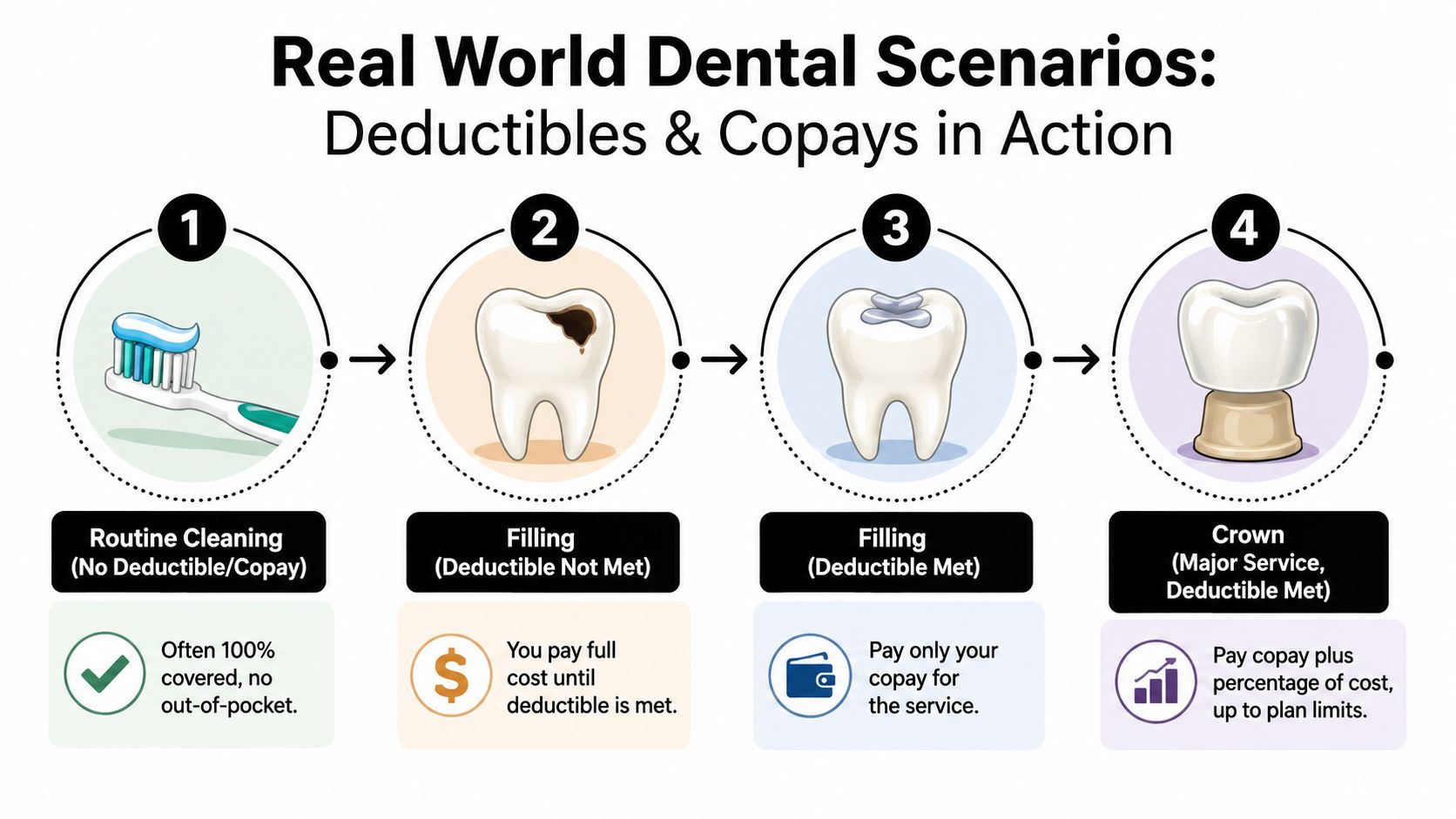
Scenario one routine cleaning and exam
A patient in Katy Manor books cleaning and exams after searching for a dentist near me. They haven't been in for a while and worry that insurance won't help until they meet a deductible.
In many dental plans, preventive care works differently. Exams and cleanings are often covered under preventive benefits rather than being held behind the deductible. So the patient may come in for a routine visit, get dental x-rays if included under the plan terms, and owe little or nothing at the appointment, depending on their specific coverage.
That surprises a lot of people. They expected the visit to act like medical care, where a deductible often sits in front of many services. Dental benefits often separate preventive services to make regular care easier to access.
Scenario two filling after a cavity is found
Now consider a patient in Kingscrossing who comes in for a new patient exam and learns they need a filling. In this scenario, deductible and coinsurance questions usually begin.
If the patient's deductible for covered basic services hasn't been met, they may need to pay that portion first. After that, the plan may begin sharing the cost. In many plans, that shared cost is coinsurance rather than a fixed copay, which means the patient pays a percentage and the plan pays the rest.
A useful medical-style example helps clarify the idea of a deductible and coinsurance relationship. This explanation of deductibles and coinsurance describes a deductible as the amount a person pays first, using $1,500 as an example, after which coinsurance can apply, such as the patient paying 30% and the insurer paying 70%. Dental plans vary by contract, but the sequence often feels similar. First the deductible, then the cost sharing.
The calendar matters more than many patients realize
Dental benefits don't keep running forever on the same deductible progress. According to Delta Dental's explanation of dental insurance deductibles, dental insurance deductibles reset once every 12 months, typically aligned with the calendar year.
That timing affects treatment decisions in practical ways:
- Late-year treatment: If you've already met your deductible, treatment before year-end may reduce your out-of-pocket share.
- Early-year treatment: If January has started, the deductible usually begins again for applicable services.
- Phased treatment: For larger restorative dentistry plans, timing can influence how benefits apply.
If you're scheduling treatment near the end of the year, ask how the benefit-year reset could affect your estimate.
A simple way to read your estimate
When you look at a treatment plan, scan it in this order:
Service type
Is it preventive, basic, or major?Deductible status
Has your plan's deductible for that category already been met?Cost sharing after that
Does the plan use a copay, coinsurance, or another fixed patient portion?
This approach can make even more complex care, such as crowns, tooth extraction, or follow-up restorative visits, feel much easier to understand.
Smart Ways to Manage Dental Costs in Katy
Knowing the terms is helpful. Having a plan is better. For patients in Katy, TX, especially families balancing routine care with unexpected needs, the smartest strategy is to reduce surprises before treatment starts.
One reason dental benefits feel confusing is that they aren't structured exactly like medical benefits. Cigna's overview of copays, deductibles, and coinsurance notes that dental insurance mechanics are structurally distinct from medical ones. That same source also points to an emerging shift toward standalone dental membership plans that use flat annual fees instead of traditional copay structures.
Start with the clearest cost path
If you have dental insurance, use it thoughtfully. Ask whether the office is in network, which preventive services are commonly covered, and whether your upcoming treatment is considered preventive, basic, or major. Those three answers often clear up most uncertainty.
If you don't have insurance, or if your plan has a high deductible or limited benefits, compare the complexity of insurance against a simpler option. A membership plan can remove several layers of confusion because it usually focuses on straightforward preventive care access and clear savings on additional treatment.
Patients exploring dental insurance alternatives often prefer that kind of simplicity. Instead of trying to decode what counts toward what, they can focus on consistent care, known preventive benefits, and a more direct understanding of treatment costs.
Why membership plans appeal to local families
For people in Sunterra, Cane Island, Katy Lakes, and Elyson, convenience matters. So does predictability. A membership model can be a practical fit for patients who want regular care without the usual insurance friction.
Common advantages include:
- Clear preventive value: Many membership plans include routine care such as exams, cleanings, and x-rays.
- Straightforward savings: Additional treatment may come with a defined discount rather than a complicated insurance calculation.
- Fewer benefit surprises: You don't have to guess whether a copay applies, whether the deductible has been met, or whether a claim will process the way you expected.
A simple financial structure also helps patients act sooner when they need care. That's important whether you're scheduling a basic filling, asking about cosmetic dentistry, or comparing options for dental implants near me.
When you want fewer unknowns
Some patients want the traditional insurance route. Others want something easier to follow from day one. Neither choice is wrong. The key is matching the payment approach to the way you use dental care.
For a closer look at a simpler approach to cost planning, this short overview is helpful:
If you've been delaying treatment because the billing side feels harder than the dental side, that's a sign to ask about alternatives. The right setup should make it easier to keep up with preventive care, address pain early, and move ahead with restorative dentistry or cosmetic services without second-guessing every line item.
Your Dental Insurance Questions Answered
Patients usually reach the same handful of questions once the basic terms make sense. Here are direct answers that can help you take the next step with more confidence.
How do I know if a dental office accepts my plan
Call before your visit and have your insurance card nearby. Ask whether the office can review your plan details, estimate benefits, and explain whether your appointment is likely to fall under preventive, basic, or major care. That quick conversation can save a lot of confusion later.
It's also smart to ask what your plan may cover for dental x-rays, new patient exams, emergency dental services, or restorative dentistry. Benefit summaries can be brief, and the wording doesn't always answer the question you have.
What if I have no insurance at all
You still have options. Many patients without insurance choose a membership plan or use a new patient special to get established and address concerns early. That can be especially helpful if you've been postponing a cleaning, dealing with discomfort, or searching for an emergency dentist after a sudden problem.
For larger needs such as tooth extraction, restorative dentistry, or questions about dental implants near me, ask for a written treatment estimate and discuss phased care if appropriate. Good planning often makes treatment feel more manageable.
Do copays count toward my deductible
Usually, no. That's one of the biggest trouble spots for patients trying to estimate costs on their own. According to the American Academy of Pediatrics resource on cost sharing and deductibles, in most plans, copays do not contribute to the deductible, and 78% of parents incorrectly believe their child's copay helps meet that deductible.
A payment at one visit doesn't always reduce what you'll owe for a different kind of treatment later.
Is cosmetic dentistry covered
Usually, cosmetic-only services are less likely to be covered than medically necessary or restorative care. If you're interested in teeth whitening, veneers, or a smile makeover, ask for a consultation and a written estimate based on your goals. That gives you a clearer picture of what's elective, what's functional, and how to prioritize treatment.
What should I bring to my first visit
Bring your photo ID, insurance card if you have one, a list of medications, and any questions about pain, sensitivity, or treatment you've been postponing. If you're comparing options for cosmetic dentist near me, dentist in Katy, TX, or emergency dentist care, write your questions down before you come in. You'll get better answers when the details are fresh.
When should I stop waiting and book
Book when you're due for preventive care, when something hurts, or when you're avoiding smiling, chewing, or sleeping comfortably because of a dental issue. Early care is often simpler than delayed care. That's true for cavities, broken teeth, gum concerns, and many situations that start small and become more expensive later.
If you're ready for clear answers and a calmer dental experience, The Dental Retreat welcomes patients across Katy, TX, including Sunterra, Cane Island, Katy Manor, Kingscrossing, Lakehouse, Marisol, The Grange, Anniston, Katy Lakes, Elyson, and Ventanna Lakes. Whether you need routine dental care, a second opinion, help with understanding benefits, cosmetic dentistry, restorative dentistry, tooth extraction, emergency dentist services, or want to explore dental implants near me, you can schedule an appointment and get straightforward guidance on your options.