If you're reading this, there's a good chance you're tired of working around your teeth. Maybe you avoid photos. Maybe meals have turned into a process of choosing whatever is easiest to chew. Maybe dentures move more than you'd like, or several teeth are failing at once and you're trying to figure out whether there's a more permanent answer.
That situation is common for adults in Katy, TX and neighborhoods like Sunterra, Cane Island, Katy Manor, Kingscrossing, Lakehouse, Marisol, The Grange, Anniston, Katy Lakes, Elyson, and Ventanna Lakes. The hard part isn't only the dental problem. It's the daily strain of feeling unsure about your smile, your speech, and what happens next.
Full arch dental implants can change that. They replace a complete upper or lower set of teeth with a fixed solution that feels far more stable than a removable denture. Just as important, the right result depends on more than surgery day. Long-term success comes from careful planning, sound biomechanics, and steady maintenance afterward. That's where patients often need honest guidance, not hype.
Your Guide to a New Smile in Katy TX
Many people who ask about full arch dental implants aren't starting from a blank slate. They've often been dealing with years of cracked teeth, advanced wear, gum problems, repeated dental work, or dentures that never felt secure. By the time they look for a dentist in Katy, TX, they're not usually chasing something cosmetic alone. They want relief, confidence, and a plan that makes sense.
A typical story sounds like this. Someone can still get through the workday, but they chew on one side, skip certain foods, and smile with their lips closed. They may have old bridges, loose teeth, or extractions on the horizon. Socially, that can wear people down more than they expected.
Full arch treatment works best when it solves both problems at once. Function and appearance.
For many patients, the turning point comes when they realize they don't have to patch one tooth at a time forever. When an entire arch is compromised, replacing the full set with a fixed implant-supported restoration can be more predictable than trying to save teeth that no longer have a stable future.
Why people start looking for a permanent option
Removable dentures can help some patients, but they don't work the same way as teeth anchored in bone. They can shift, rub, and make people feel cautious when they eat or talk. If you've been searching online for dental implants near me or a cosmetic dentist near me in Katy, you're probably looking for something that feels more secure and more natural in everyday life.
Patients also want clarity. They want to know whether they are a candidate, whether extractions are needed, whether sedation is available, and how the process unfolds from start to finish.
What matters most early on
The first step isn't choosing a brand name technique. It's understanding your anatomy, your bite, your health history, and the condition of the teeth and bone you have now.
A well-planned full arch case should answer questions like these:
- Which teeth can be kept, if any. Some mouths are better served by a full replacement plan than by repeated repair.
- How the final teeth will function. The bite, speech, smile line, and cleaning access all matter.
- What long-term care will look like. Full arch dental implants are durable, but they still need maintenance and follow-up.
That kind of planning gives patients something they've often been missing for a long time. A clear path forward.
What Are Full Arch Dental Implants
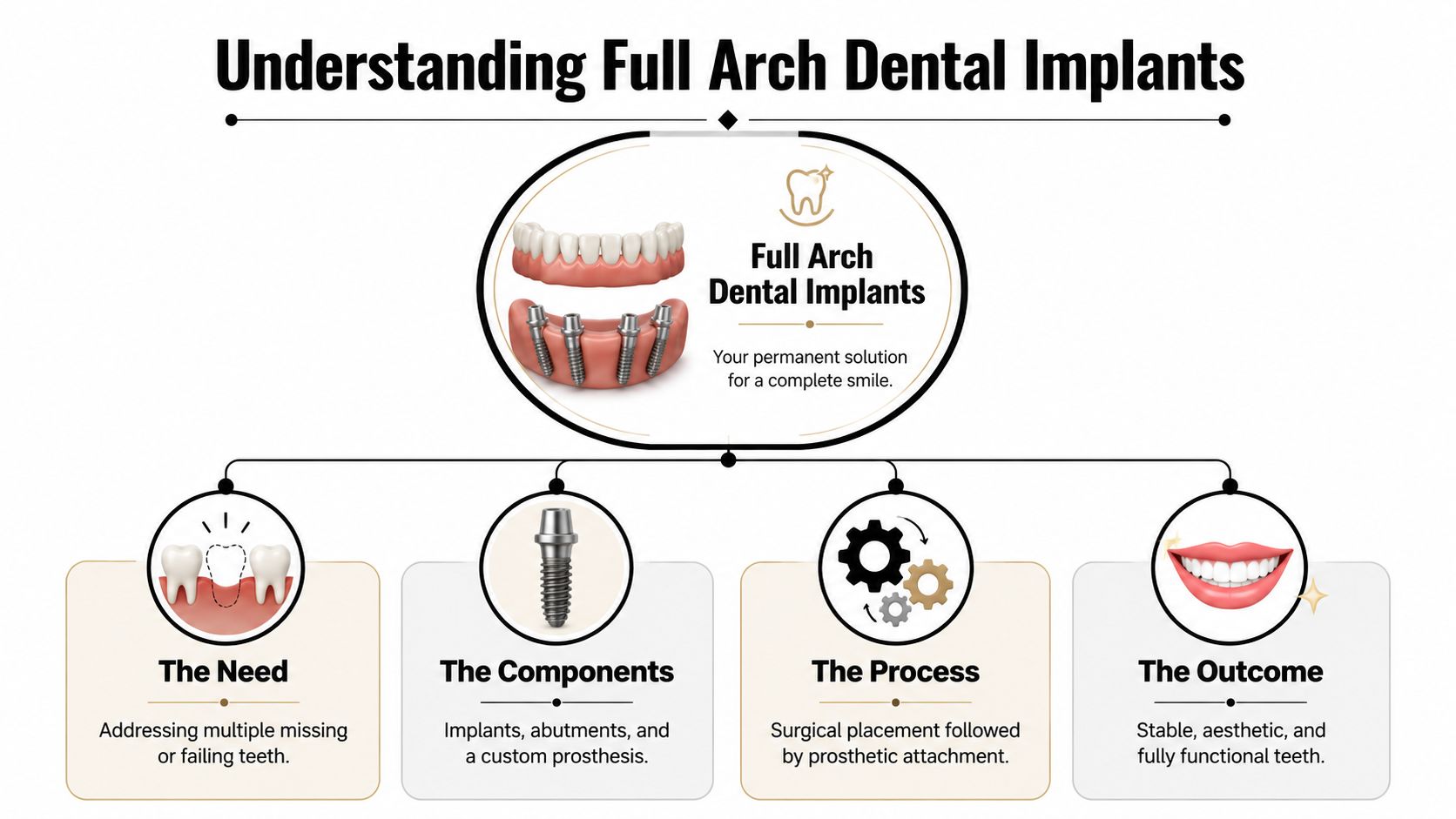
Full arch dental implants replace an entire upper arch, lower arch, or both with a fixed set of teeth supported by implants placed in the jawbone. In simple terms, the implants act like artificial roots. They support a custom restoration that stays in place, rather than a denture that comes in and out.
Much like rebuilding a house with a solid foundation, the visible teeth matter, of course. But the stability comes from what supports them underneath.
The three parts patients should understand
A full arch system usually includes three main components.
- The implant. This is the titanium post placed into the jawbone.
- The abutment. This is the connector between the implant and the final prosthesis.
- The prosthesis. This is the custom-made arch of teeth that restores your smile and chewing ability.
Those parts have to work together. If one part is chosen without considering the others, the final result can be harder to clean, less stable, or less comfortable.
Why implant number and angle matter
People often hear that full arch treatment uses four to six implants, and that's true in many cases. But the exact number isn't chosen at random. It depends on bone quality, arch shape, load distribution, and where the final teeth need to sit.
In the All-on-4 concept, Nobel Biocare describes a layout that uses two straight anterior implants and two posterior implants tilted up to 45°, and notes that successful immediate full-arch cases typically require implant lengths of at least 11 mm in that concept, as explained in Nobel Biocare's All-on-4 treatment concept.
That detail matters because full arch care isn't just about fitting implants into available bone. It's about creating a stable restoration that handles force in a controlled way over time.
Practical rule: The visible smile may look simple. The engineering underneath it isn't.
Why this feels less intimidating once it's explained
When patients first hear terms like abutment, angulation, and prosthesis, the process can sound complicated. In reality, the concept is straightforward. A small number of strategically placed implants support a full set of teeth. The plan is designed around strength, appearance, and cleanability.
That's why a good consultation doesn't rush to talk only about the before-and-after photo. It explains what will be placed, why it's being placed that way, and how the final smile will function once healing is complete.
Comparing Full Arch Techniques and Types
There isn't one universal design for full arch dental implants. Some patients do well with four implants. Others benefit from six. Some need a different layout because of bone anatomy, bite force, or the position of the planned teeth. The right choice comes from diagnosis, not marketing.

All-on-4 and All-on-6 are not interchangeable
The terms sound similar, but they don't mean the same thing in practice.
| Approach | What it generally means | When it may make sense |
|---|---|---|
| All-on-4 | A full arch supported by four implants, often with tilted posterior implants | Useful when anatomy and bone distribution allow a stable four-implant design |
| All-on-6 | A full arch supported by six implants | Often considered when additional support or load distribution is desirable |
| Implant-supported bridge for a partial arch | A fixed solution for several missing teeth, but not a full arch replacement | Helpful when the whole arch doesn't need replacement |
Some patients come in asking specifically for All-on-4 because it's the term they've seen online. That's understandable, but the better question is whether four implants are the right choice for their mouth.
What drives the decision
The main issue is biomechanics. A full arch restoration has to distribute biting forces in a way the implants, bone, and prosthesis can tolerate. More support can be useful in some cases, but only if it fits the patient's anatomy and restorative plan.
Factors that influence the design include:
- Bone quality and volume. Denser or more abundant bone can support different strategies than limited bone.
- Arch length and bite pattern. The way upper and lower teeth meet changes how force is transferred.
- Space for hygiene and prosthetic access. A beautiful bridge that traps plaque or is difficult to service creates long-term problems.
Some patients also need extractions or other preparatory treatment before a fixed arch is even considered. Others may have a partial arch situation where an implant-supported bridge is more conservative than replacing every tooth.
One-size-fits-all treatment usually misses something
The biggest mistake in this area is choosing the technique first and planning around it later. That's backward. Technique names are useful shorthand, but they shouldn't override diagnosis.
For patients who want a closer look at one common option, this guide on All-on-4 dental implants pros and cons explains how that design is typically evaluated.
A thoughtful plan asks not only, "Can we place the implants?" It also asks whether the final teeth will be stable, maintainable, and realistic for the long term.
The Life-Changing Benefits of Full Arch Implants
The strongest reason patients choose full arch dental implants is simple. They want to live more normally again. They want to eat without worrying about movement. They want to speak without feeling the prosthesis shift. They want to smile without editing themselves.
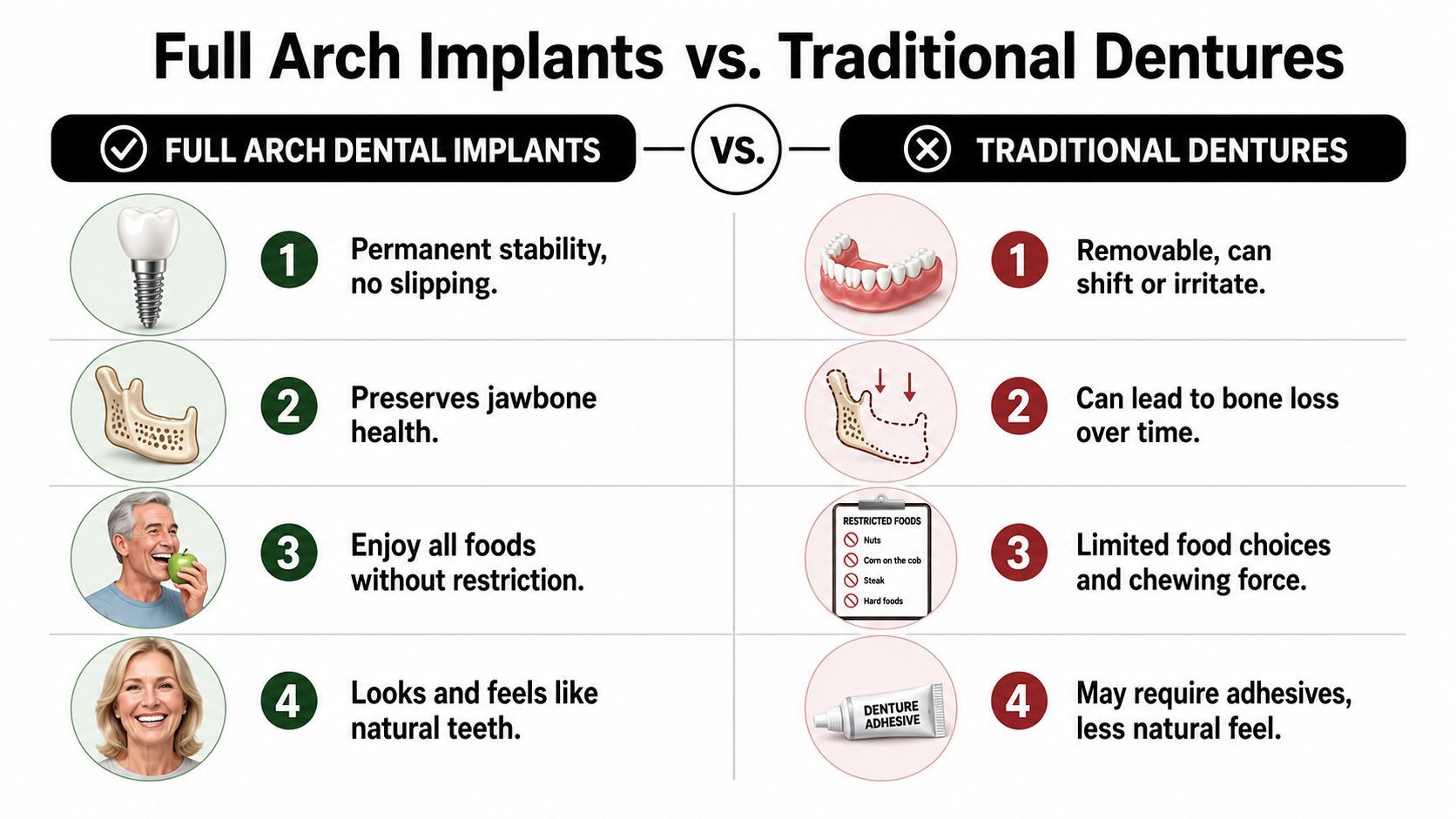
That difference becomes easier to understand when you compare full arch implants with traditional removable dentures.
What patients notice in daily life
With a removable denture, many people adapt by avoiding certain foods, chewing carefully, and staying aware of the appliance. With a fixed implant-supported arch, the goal is a more stable day-to-day experience.
Here are the benefits patients care about most:
- Stable chewing. A fixed restoration doesn't rely on suction or adhesive in the way a conventional denture does.
- More confidence in conversation. Patients often value the security of teeth that stay in place when they laugh and speak.
- A more natural feel. Full arch implants are designed as a fixed solution, not something you remove at night.
- Support for facial structure. Because implants are anchored in bone, they offer advantages that removable appliances do not.
Durability matters because this is a long-term treatment
Patients should know this isn't a short-term cosmetic patch. Modern evidence shows full arch treatment can be highly durable when it's planned and maintained properly.
A summary of long-term data reported 94.1% cumulative survival at 10 years at the patient level, with contemporary full-arch rehabilitation typically delivering about 94% to 97% survival at 10 years, as described in this review of full arch dental implant success rates.
That level of durability is one reason full arch implants have moved into the mainstream for people with complete tooth loss or a terminal dentition.
The real benefit isn't just replacing teeth. It's reducing the daily compromises that come with not trusting them.
What works better than removable dentures, and what doesn't
Fixed full arch treatment often works better for patients who want a secure bite and don't want the limitations of a removable prosthesis. It can be a strong solution for people with extensive tooth loss, multiple failing teeth, or long-term denture frustration.
What doesn't work is treating it like a cosmetic shortcut. If a case is poorly planned, hard to clean, or built without regard for force distribution, the patient may still face frustration later. The better path is to choose a solution that matches both the patient's goals and their anatomy.
Your Treatment Journey at The Dental Retreat
The process feels much more manageable when you know what happens at each stage. Full arch treatment isn't one appointment. It's a sequence of decisions, healing, and refinement that leads to a stable final result.

Step one starts with diagnosis, not pressure
A consultation should begin with a thorough exam, a discussion of symptoms and goals, and a clear look at the current condition of the teeth and gums. Some patients come in because they're missing many teeth already. Others still have teeth present, but those teeth are cracked, loose, infected, or no longer predictable.
This early phase is where questions about tooth extraction, bone support, bite, and smile design are answered. It should also be the time to discuss sedation options for anxious patients and whether a fixed full arch is the right fit.
Planning is where many long-term outcomes are decided
Precision matters in these cases. A prosthetically driven workflow often starts with a diagnostic denture or digital wax-up, followed by CBCT-based planning. When a diagnostic denture is used, the dual-scan protocol requires two CBCT scans and five to six fiducial markers, with a minimum of three, to merge the prosthesis and anatomy accurately, according to this article on precision planning in full-arch implant rehabilitation.
That same review also notes that shorter abutments of 1.5 mm or less are associated with greater marginal bone loss, and recommends at least 2 mm to reduce crestal bone remodeling risk in these workflows. Those details are easy to overlook, but they shape how the restoration performs later.
Surgery day and the provisional phase
Once planning is complete, the implants are placed according to the surgical design. If remaining failing teeth need to be removed, that can be coordinated as part of the treatment plan. Many patients receive a temporary prosthesis during healing so they aren't left without teeth while the implants integrate.
At this stage, comfort and expectations matter. Patients need to know what they'll eat, how they'll clean, and what normal healing feels like during the first phase.
The final smile is delivered after healing and refinement
After the implants have integrated and the tissues have matured, records are taken for the final prosthesis. During this stage, bite, appearance, speech, and hygiene access are refined in a more permanent way.
For patients researching the pace of care, The Dental Retreat has a page covering the timeline for full arch dental implant treatment. That's useful if you're trying to understand how the consultation, surgery, healing period, and final delivery fit together.
The best full arch cases don't feel rushed. They feel organized.
What patients can expect at visits in Katy
A full arch process usually involves several appointments rather than one dramatic day alone. At visits, patients can expect communication about healing, temporary restoration use, hygiene, and next milestones. If you're also looking for a dentist near me in Katy who can coordinate restorative and surgical care under one roof, that continuity often makes treatment less stressful.
The day you receive the final prosthesis is exciting, but it isn't the finish line in the broader sense. The ultimate goal is a smile that still works well years later.
Recovery and Long-Term Implant Aftercare
Recovery after full arch implant treatment has two parts. The first is immediate healing after surgery. The second is long-term maintenance, which matters just as much.
In the early stage, patients usually need a softer diet, careful home hygiene, and close attention to the instructions given for cleaning around the provisional restoration. Even a strong treatment plan can be compromised if healing tissues are overloaded or neglected.
The first phase of recovery
The first few weeks are about protecting the surgical sites and allowing the implants to stabilize in the jaw. That usually means being disciplined, even if you're feeling better quickly.
A few habits make a real difference:
- Choose foods that don't overload the new work. Healing implants need time before they handle full function.
- Keep the mouth clean without being aggressive. Gentle cleaning is still essential.
- Show up for follow-up visits. Small pressure spots, bite issues, or hygiene concerns are easier to address early.
Long-term success is not the same as simple survival
An implant can remain in place while the surrounding tissues still develop problems. That's why long-term care has to focus on biologic health as well as mechanical stability.
A review of full-arch implant prostheses reported long-term survival of 90% to 98% over 10 to 15 years, but also found biologic complications at meaningful rates, including peri-implant mucositis in 30% to 50% of cases and peri-implantitis in 10% to 20% at 10 years, as discussed in this PMC review of full-arch rehabilitation outcomes.
Those numbers don't mean full arch treatment is a poor option. They mean maintenance is part of the treatment, not an extra.
What long-term care usually involves
Patients do best when they think of their new smile the same way they should think about natural teeth. It needs daily care and professional oversight.
That partnership usually includes:
- Consistent home cleaning around the prosthesis and gumline
- Professional maintenance visits to check tissue health, prosthetic stability, and hygiene access
- Early attention to soreness, bleeding, odor, or looseness, because those signs shouldn't be ignored
If you're looking for dental implants near me in Katy, ask not only how the implants will be placed, but how they will be maintained for years afterward. That's often the difference between a result that only looks good at delivery and one that stays healthy.
Your Katy Consultation and Patient Experience
A full arch decision is significant. Patients usually want straight answers about candidacy, treatment sequence, comfort, and cost. They should.
The financial side depends on the complexity of the case, whether tooth extraction or additional treatment is needed, and what kind of prosthesis is being planned. A responsible consultation should walk through those factors clearly and discuss payment and financing options in plain language, without pressure.
Comfort matters for patients who feel anxious
Many adults who need extensive restorative care have delayed treatment because of fear, embarrassment, or previous difficult experiences. That's why the environment matters. A calmer setting can make it much easier to move forward with care that may have felt overwhelming before.
At The Dental Retreat in Katy, patients can ask about sedation along with comfort-focused amenities such as aromatherapy, massage and heated chairs, noise-cancelling headphones, and TVs in treatment rooms. For someone searching for an emergency dentist, a cosmetic dentist near me, or a long-term restorative home, that kind of setting can reduce a lot of stress.
Local care should feel personal and practical
Patients in Katy, Sunterra, Cane Island, Katy Lakes, Elyson, Ventanna Lakes, The Grange, and Anniston often want one thing above all else. They want to feel heard. They want a team that explains what works, what may not work, and what the process will realistically require.
If you're dealing with extensive tooth loss, failing dental work, or dentures that no longer fit your life, the next step is a personalized consultation in Katy, TX. That's where you can find out whether full arch dental implants are the right fit for your mouth, your goals, and your timeline.
Frequently Asked Questions About Full Arch Implants
Why does implant angle matter so much
Angle affects how force travels through the implant and the final prosthesis. In full arch cases, clinicians may angle posterior implants to avoid important anatomy and improve the spread of support across the arch. But poor angulation can create side-loading and contribute to bone loss.
Independent implant discussion has emphasized that angulation is a real planning constraint, and that implant-abutment systems are designed to correct degrees of angulation. That is why one of the smartest patient questions is how implant angle will affect long-term success and hygiene, as explained in this article on a new angle in full-arch implantology.
Will the prosthesis ever need maintenance or repairs
Yes. Patients should expect the restoration to need professional monitoring over time. The implants may be stable, but the prosthesis still experiences chewing forces and daily wear. Good planning reduces problems, but it doesn't eliminate the need for maintenance.
What matters is access. The prosthesis should be designed so it can be cleaned properly, evaluated professionally, and serviced when needed.
Are full arch implants only for people with no teeth left
No. Many candidates still have teeth when they begin the process. Sometimes those teeth are failing, heavily restored, mobile, or no longer predictable. In those situations, full arch treatment may be considered because rebuilding tooth by tooth won't create a reliable long-term result.
Is the first year the whole story
No. The first year tells you how the surgery and initial healing went. It doesn't tell the whole story about hygiene, tissue health, prosthetic wear, or how well the design handles long-term function.
Ask any provider how they plan for the years after delivery, not only the day the teeth go in.
What should I ask at a consultation
A useful consultation question list includes:
- How many implants are being recommended, and why
- How will the implant angle affect the final teeth and cleaning access
- Whether extractions or other preparatory care are needed
- What type of temporary prosthesis is expected during healing
- What long-term maintenance schedule is recommended
If you're ready to talk through your options for full arch dental implants in Katy, TX, schedule a consultation with The Dental Retreat. You'll get a clear evaluation, a practical discussion of what your treatment may involve, and guidance that focuses on long-term function as much as the final smile.