When you need a dentist near me because your tooth hurts, your gums are bothering you, or you know you've delayed care longer than you wanted to, fear may be part of the reason. A lot of people in Katy put off cleanings and exams, tooth extraction, cosmetic dentistry, or even needed restorative dentistry because the idea of sitting in the chair makes their body tense up before the visit even starts.
That's where oral sedation for dental work can change the experience. Instead of forcing yourself through an appointment while anxious, you can receive care in a calmer, more manageable state. For many families in Katy, TX, that means finally moving forward with treatment, whether they need an emergency dentist, new patient exams, dental X-rays, dental implants near me, or a cosmetic dentist near me.
Your Dentist Near Me for Anxiety-Free Care in Katy TX
Maybe this sounds familiar. You've been meaning to schedule dental care for months. A cracked tooth needs attention. A missing tooth has you thinking about dental implants near me. You want cleaning and exams, or maybe teeth whitening, but every time you get close to booking, the worry kicks in.
That anxiety is real, and it doesn't mean you're difficult or overreacting. Many adults feel uneasy about sound, pressure, loss of control, or not knowing what will happen during the visit. Families in Katy, TX, including Sunterra and Cane Island, often want a dental office that understands that fear instead of brushing it aside.

When fear gets in the way of treatment
Dental anxiety can affect more than comfort. It can lead people to postpone care until a small issue becomes a bigger one. What could have been handled during a routine visit may turn into pain, swelling, or the need for more involved treatment later.
Common reasons patients start asking about sedation include:
- Past difficult experiences that made them dread returning to the dentist
- Longer procedures such as restorative dentistry or implant planning
- Strong nerves around urgent care when they need an emergency dentist
- Embarrassment about delayed care after skipping visits for years
You don't have to earn comfort by being brave enough to suffer through an appointment.
In a community like Katy, trust matters. People want care that feels respectful, local, and personal. They also want answers in plain language. Oral sedation for dental work offers one of the gentlest ways to help anxious patients receive needed treatment without feeling overwhelmed.
A more comfortable path to care
If you live in Katy Manor, Kingscrossing, or nearby neighborhoods, you don't have to choose between avoiding treatment and enduring a stressful visit. Sedation can make room for a better experience, one where your comfort is part of the treatment plan, not an afterthought.
That can matter whether you're coming in for a routine exam, a tooth extraction, cosmetic dentistry, or a more involved restorative visit. The goal is simple. Help you get healthy dental care in a way that feels manageable.
What Is Oral Sedation for Dental Work
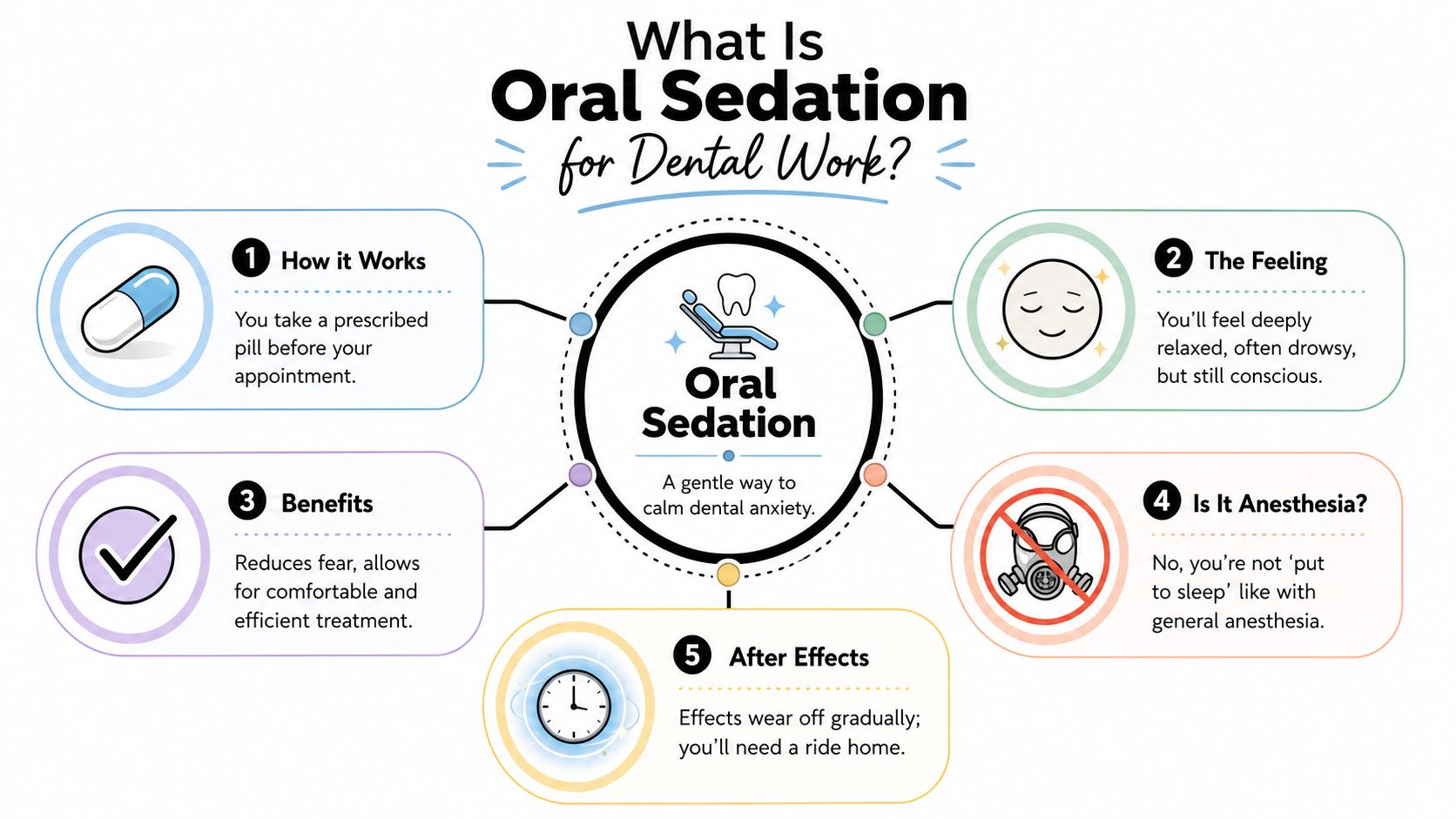
Oral sedation is a form of conscious sedation that usually involves taking a prescribed pill before your appointment. You stay awake, but you feel much more relaxed and less focused on the sights, sounds, and stress of treatment. Many patients describe it as feeling very calm, sleepy, or detached from the usual dental tension.
The medications used most often for adult dental patients are benzodiazepines. In research on adult dental sedation, midazolam was the single most frequently administered agent in randomized controlled trials evaluating effectiveness and safety, as noted in this review of oral sedation in adult dental patients.
What it feels like
A simple way to think about oral sedation is this: it doesn't knock you out like general anesthesia. It turns the volume down on fear.
You can still respond to the dental team. You can still breathe on your own. But the appointment usually feels easier to tolerate because your body isn't staying on high alert the whole time.
Patients often expect one of two extremes. Either they'll feel nothing at all, or they'll feel fully aware and scared. Oral sedation usually sits in the middle. It's designed to help you remain conscious while relaxed.
How it's different from being put to sleep
This is one of the biggest points of confusion. Oral sedation for dental work is not the same as general anesthesia. You aren't fully unconscious. Instead, you're in a calmer, drowsier state that can make treatment feel shorter and less stressful.
That's one reason it can be a good fit for people who need help with anxiety but don't necessarily need the deepest level of sedation. It can also support care for people considering treatment they've put off, such as fillings, crowns, tooth extraction, cosmetic work, or implant-related visits.
If you'd like a simple overview of how different forms of sedation work in dentistry, this guide on how dental sedation works is a helpful next read.
Here's a quick visual overview before moving on:
Why patients choose it
People usually ask about oral sedation because they want the appointment to feel more doable. That can mean less dread beforehand, more comfort during the procedure, and a better chance of following through with care they've been postponing.
Practical rule: Oral sedation is about reducing fear while keeping you conscious and able to cooperate during treatment.
Who Can Benefit from Oral Sedation
Oral sedation can help more people than many assume. It's often associated with severe dental fear, but anxiety is only one reason someone may benefit. In day-to-day practice, the best candidates are often people who want necessary care and know they'll struggle to get through the visit comfortably without extra support.
In neighborhoods like Lakehouse, Marisol, and The Grange, that can include busy adults trying to complete a lot of dental work efficiently, parents helping a family member with special needs, or someone who feels panicky the moment they smell a dental office.
Common situations where it helps
Some patients benefit from oral sedation because of emotion. Others benefit because of comfort, reflexes, timing, or medical history. Here are several situations where it may be worth discussing:
- High dental anxiety that makes it hard to keep appointments
- Longer visits for restorative dentistry or cosmetic dentistry
- Strong gag reflex that makes treatment hard to tolerate
- Low tolerance for dental stimulation such as sounds, pressure, or prolonged mouth opening
- Multiple procedures in one visit when comfort and cooperation matter
- Needle-related fear when the idea of treatment starts stress early
A patient searching for dentist in Katy, TX may not even realize sedation is relevant to their situation until they describe what they're feeling. "I just can't sit through it" is often enough to start the conversation.
Dosing is personal, not one-size-fits-all
A safe sedation plan should match the individual. The strength of an oral sedative is influenced by the patient's size and weight, which is why dentists tailor the dose to the person rather than using a generic approach, as explained in this overview of oral sedation considerations.
That matters because two people can have very different responses to the same medication. The right plan considers your health history, the kind of procedure being done, and how much relaxation support you need.
The safest sedation experience starts long before the appointment. It starts with careful screening and individualized planning.
An important topic many articles skip
One of the most overlooked parts of oral sedation education is what happens when a patient can't swallow pills. That issue comes up with some children, some older adults, and some patients with special needs or swallowing difficulties.
The gap is real. A review of this topic notes that many patient guides don't offer meaningful guidance on liquid alternatives, even though midazolam is clinically proven to be the most safe and frequently used drug for moderate sedation and is relevant to liquid or alternative administration discussions in dentistry. You can read that discussion in this clinical review of sedation approaches and liquid formulation gaps.
For families in Anniston, Katy Lakes, Elyson, and Ventanna Lakes, that matters. If swallowing a pill is the barrier, it shouldn't end the conversation. It should open the door to a more personalized discussion about whether a different formulation or another sedation option makes sense.
Your Oral Sedation Visit at The Dental Retreat
Knowing what the day looks like often lowers anxiety almost as much as the medication itself. Patients often feel calmer once they understand the order of events, what they'll need to do beforehand, and what recovery will look like afterward.
At a patient-centered Katy practice with a spa-like atmosphere, oral sedation fits into a comfort-focused visit rather than feeling like something mysterious or intimidating. Amenities such as aromatherapy, heated or massage chairs, noise-canceling headphones, and TVs in treatment rooms can help the environment feel gentler from the start.

Before the appointment
The first step is a consultation. The dentist reviews your health history, the procedure you need, your anxiety level, and whether oral sedation is an appropriate option. This is also when you can be honest about fears that might feel embarrassing, like gagging, panic, or a bad prior experience.
You'll also receive instructions to follow before the visit. Patients receiving oral sedation should avoid eating or drinking for at least six hours before the appointment, and they must arrange for a responsible adult to drive them home afterward, as described in this patient guidance on oral sedation precautions.
During the visit
Oral sedation starts working gradually, not instantly. The onset of action occurs within approximately 60 minutes after ingestion, and recovery generally takes up to 24 hours, during which patients must not drive. The same clinical review also notes that ADA guidelines require dentists providing minimal sedation to complete competency training and maintain current Basic Life Support certification for safety, according to this review of oral sedation pharmacology and ADA guidance.
That timeline helps explain why the visit is organized carefully. The medication needs time to take effect, and the team monitors the patient experience closely while treatment is performed. People are often surprised by how ordinary the appointment can feel once the anxiety softens.
What the appointment often feels like
Instead of focusing on every sound or counting every minute, many patients describe the experience as hazy, calm, and much easier than they expected. They're still awake, but they aren't white-knuckling their way through the procedure.
A comfort-focused visit often includes:
- A calm arrival process so you don't feel rushed
- Clear reminders about what will happen next
- Physical comfort amenities like heated seating and noise reduction
- Simple communication during treatment, without overwhelming detail
Going home and recovering
After treatment, you'll head home with your escort and rest. You should plan for a quiet day because the medication can continue affecting alertness, coordination, and decision-making well after the appointment ends.
That's why pre-planning matters. If you're arranging childcare, time off work, or transportation from Sunterra, Cane Island, or anywhere in the Katy area, build your schedule around a low-key recovery day.
Bring your questions to the consultation. Patients usually feel much better when they know exactly what to expect before, during, and after sedation.
Comparing Sedation Options Oral vs Nitrous vs IV
A simple way to compare sedation is to ask three questions. How relaxed do you want to feel, how quickly do you need to recover, and how much support does the procedure call for? Those answers usually point patients in the right direction faster than any technical description.
At our Katy practice, we also look at the full experience, not just the medication. A patient getting oral sedation in a calm room with comfort amenities, clear communication, and a team that moves at a steady pace may have a very different visit than a patient receiving the same medicine in a rushed setting. That patient-centered approach is part of what makes The Dental Retreat feel less clinical and more manageable for anxious patients.
A simple side-by-side comparison
| Sedation option | How it's given | Recovery | Typical use | Best fit |
|---|---|---|---|---|
| Nitrous oxide | Inhaled through a mask | Wears off quickly, and many patients can resume normal activities soon after, based on this Cleveland Clinic overview of sedation dentistry | Mild, adjustable relaxation during the visit | Short visits, mild anxiety, patients who want to drive themselves |
| Oral sedation | Medication taken before treatment, usually as a pill and sometimes in a liquid form for patients who cannot swallow pills | Slower recovery than nitrous. You need someone to drive you home and should plan for the rest of the day to be quiet | Moderate relaxation without an IV | Moderate anxiety, longer appointments, patients who want more help settling down |
| IV sedation | Medication delivered through an IV | Recovery planning is more involved than with nitrous, and patients still need an escort home | Deeper relaxation with dose adjustments during treatment | Higher anxiety, more complex procedures, patients who want a stronger effect |
| General anesthesia | Full anesthetic approach | The most intensive recovery and monitoring needs | Limited dental situations that require a surgical setting or deeper level of control | Specific surgical or medically complex cases |
The difference many patients notice first
Nitrous is a little like a dimmer switch. It can take the edge off while still allowing a faster return to your day. Oral sedation is more like settling into a recliner before the appointment begins. You are still awake and able to respond, but the whole experience often feels softer and less overwhelming.
That recovery difference is important if you're hoping to get back to work, school pickup, or errands right away. Patients in Katy who choose oral sedation usually do so because comfort during treatment matters more than having a quick turnaround afterward.
How dentists choose between them
Oral sedation often fits the middle ground well. It gives more support than nitrous for many anxious adults, but it does not require the IV setup some patients would rather avoid. It can be a strong option for restorative work, treatment after a long delay, or appointments where fear has become the hardest part.
IV sedation may make more sense if a patient wants a deeper level of relaxation or if the treatment is especially involved. Nitrous can be enough for lighter anxiety or shorter visits. If you're comparing the two stronger options, this guide on oral sedation vs IV sedation explains the differences in more detail.
One detail many offices skip over is medication form. For some patients, swallowing a pill is stressful on its own. In those cases, dentists may discuss whether a liquid oral sedative is appropriate, depending on the medication selected, the patient's health history, and the treatment plan. That extra flexibility can make sedation accessible to more adults who want help relaxing but do not want nitrous or IV care.
The best sedation choice is the one that matches your anxiety level, medical history, procedure, and recovery needs, while helping you feel safe from the moment you arrive in Katy to the moment you head home.
Cost of Oral Sedation and Insurance in Katy
A lot of patients ask about price right after they ask, "Will this help me stay calm?" That makes sense. Peace of mind is hard to plan for if the cost feels unclear.
Oral sedation usually sits in the middle of the sedation price range. It generally costs more than nitrous oxide and less than IV sedation, though the exact fee depends on your treatment plan, the medication selected, and the level of monitoring your dentist recommends. In a patient-centered office, cost should be explained as clearly as the procedure itself.
At The Dental Retreat in Katy, that conversation is part of the comfort-first approach. A spa-like setting, a caring team, and sedation options only help if you also know what to expect financially before your visit.
What affects the final price
The sedation fee can change based on a few practical details:
- The medication and dose chosen for your visit
- The length and complexity of treatment
- The monitoring and clinical support needed during the appointment
- Whether a standard tablet or a liquid formulation is more appropriate for the patient
That last point matters more than many people realize. Some patients feel anxious about swallowing pills, have trouble doing so, or need another formulation for comfort and safety. In those cases, your dentist may discuss a liquid oral sedative if it fits your health history and treatment plan. That extra planning can affect the overall fee, but it can also make sedation possible for patients who might otherwise avoid care.
Ask for a written estimate that separates the dental procedure from the sedation charge. It works like seeing the itemized parts of a repair before you approve the work. You can understand what you are paying for, what is optional, and what is tied to safety protocols.
Insurance and affordability questions
Insurance coverage for oral sedation varies quite a bit. Some plans may help with sedation tied to a specific procedure or documented anxiety-related need. Others treat it as an out-of-pocket service. The safest approach is to have the office check your benefits before the appointment so there are fewer surprises.
For those seeking a dentist in Katy, TX, financial clarity is part of good care. You should know the expected cost, your insurance estimate, and your payment options before sedation day arrives.
Patients without insurance often ask about ways to make treatment easier to budget. Membership plans, phased treatment, or office payment options may help with the overall cost of care, even if sedation is billed separately. A good dental team will walk you through those details with the same calm, respectful tone they use during treatment.
Frequently Asked Questions About Sedation Dentistry
Is oral sedation safe
For healthy adults, oral sedation is generally considered a safe and effective option when proper protocols are followed and the dentist has the appropriate training. Safety begins with medical review, medication selection, and careful instructions before the appointment.
Will I be completely asleep
No. With oral sedation, you remain conscious. You're relaxed and often drowsy, but you can still respond to the dental team during treatment.
How long will I feel the effects
Most patients should expect the effects to last well beyond the appointment itself. Plan for a full recovery day, arrange a ride, and keep your schedule light.
Do I need to fast beforehand
Yes. Follow the instructions from your dental office closely. Fasting guidance is important for safety, and your team will tell you exactly what to do before your visit.
Can oral sedation help with procedures besides extractions
Yes. It can be considered for many types of care, including restorative dentistry, cosmetic dentistry, and longer treatment visits, if the dentist determines it's appropriate for your health history and needs.
What if I can't swallow pills
That's an important issue to raise early. Patients who have difficulty swallowing pills, including some children, older adults, or people with special needs, may need a different formulation or a different sedation approach. A thoughtful consultation can help identify the best option.
If dental anxiety has kept you from getting the care you need, The Dental Retreat offers a calm, judgment-free approach for patients in Katy, TX, including Sunterra, Cane Island, Katy Manor, Kingscrossing, Lakehouse, Marisol, The Grange, Anniston, Katy Lakes, Elyson, and Ventanna Lakes. Whether you're looking for a dentist near me, an emergency dentist, help with tooth extraction, or guidance on dental implants near me and cosmetic care, you can schedule a consultation to talk through your concerns and create a more comfortable plan for treatment.