Full arch restoration replaces an entire upper or lower arch with one prosthesis for 10 to 14 teeth, typically supported by four to six implants. In simple terms, it's a long-term way to replace a full set of missing or failing teeth with a smile that feels far more stable than traditional dentures.
If you're reading this in Katy because you're tired of loose dentures, broken-down teeth, or avoiding certain foods, you're not alone. Many people reach this point. They start chewing on one side, smiling less in photos, or wondering if their dental problems have become too big to fix.
That's where this treatment changes the conversation. Instead of repairing one tooth at a time when the whole arch is compromised, full arch restoration gives you a more complete solution. For many people, it restores comfort, function, confidence, and a sense of normal life.
Your Guide to Full Arch Restoration in Katy TX
For patients searching for a dentist near me in Katy, TX or looking into dental implants near me, the biggest question is usually simple. What is full arch restoration, and is it meant for someone like me?
Full arch restoration is a way to replace all the teeth in the upper jaw, lower jaw, or both with one implant-supported prosthesis. It's used for people with complete tooth loss or teeth that are so damaged, loose, or infected that saving them isn't the most predictable path forward. According to Avadent's overview of full arch restoration, it's a mainstream solution for total tooth replacement, typically supported by four to six implants, and approximately 3 million dental implants are placed annually in the U.S.
Why people start looking into it
Some patients come in because they already wear dentures and never felt comfortable with them. Others still have teeth, but they're dealing with repeated infections, severe breakdown, or advanced gum disease that's affecting daily life.
Common reasons people begin exploring full arch treatment include:
- Missing most or all teeth and wanting more stability than a removable denture can offer
- Failing dental work that keeps needing repairs
- Pain or embarrassment from loose, broken, or worn-down teeth
- Difficulty eating foods they used to enjoy
- Loss of confidence in work, family, or social settings
Full arch restoration isn't just about appearance. It's about being able to eat, speak, and live without constantly thinking about your teeth.
A local option for Katy families
Patients in Katy, Sunterra, and Cane Island often want care that feels close to home and easy to understand. That matters when you're making a big decision. You want clear answers, not pressure.
If you're also comparing options like tooth extraction, restorative dentistry, cosmetic dentistry, or even trying to find an emergency dentist because things have gotten urgent, full arch treatment may be part of a larger plan to rebuild your oral health. The right next step is usually a careful exam, imaging, and a conversation about what will work for your mouth, your comfort, and your goals.
Understanding Full Arch Dental Implants
A full arch restoration may sound complex, but the idea behind it is straightforward. It uses a few carefully placed parts that work together to replace a full row of teeth.
The three main parts

Here's the simplest explanation:
Titanium implant
This is the part placed into the jawbone. It acts like an artificial root and provides the foundation.Abutment
This is the connector piece. It joins the implant to the final restoration.Prosthetic arch
This is the visible row of teeth. It's custom-designed to look natural and restore your bite and smile.
If you've wondered how a small number of implants can support a full set of teeth, the answer is planning and position. The implants are placed strategically to support the arch in a stable way, not one implant for every missing tooth. If you'd like a deeper explanation, this page on how many implants are needed for a full arch restoration breaks that down further.
How the implants become secure
The healing process is called osseointegration, but you don't need to remember the term to understand what happens. Imagine it as setting fence posts into the ground. At first, the post is placed carefully. Over time, the surrounding material firms up around it and helps hold it steady.
Your bone does something similar with the implant. As healing happens, the implant and bone form a strong connection that helps support the new teeth.
Practical rule: The strength of a full arch implant case doesn't come from rushing. It comes from careful planning, precise placement, and proper healing.
Fixed and removable options
People also get confused about whether all full arch restorations are “permanent” in the same way. There are two broad categories.
Fixed implant-supported restoration
This is attached to the implants and isn't something you take out at home. It's the option many people picture when they think of “teeth in a day” or a full implant bridge.Removable implant-supported overdenture
This still connects to implants, but it can be removed. It usually offers more stability than a traditional denture while remaining removable.
Both options can improve chewing and comfort compared with conventional dentures. The best fit depends on anatomy, goals, hygiene habits, and the kind of daily experience you want.
Are You a Candidate for a New Smile in Katy
Not everyone who asks about full arch restoration has no teeth. Many candidates still have teeth, but those teeth may be failing in ways that make a full rebuild the more sensible path.
When this treatment makes sense
You may be a candidate if you're dealing with one or more of these situations:
- Complete tooth loss in the upper or lower jaw
- Teeth that are beyond repair because of extensive damage or decay
- Severe periodontitis with a poor outlook for keeping the remaining teeth
- Bone loss or anatomy challenges that call for strategic implant positioning
- Frustration with dentures that move, rub, or make eating difficult
For patients who want a concise clinical summary, this explanation of full arch dental implants notes that treatment typically uses four to six strategically placed implants, with the exact number based on anatomy, bite forces, and restorative goals.
A simple way to compare the main options
| Feature | Fixed Implant Bridge (e.g., All-on-4) | Removable Implant Overdenture |
|---|---|---|
| Daily wear | Stays in place | Removed for cleaning |
| Feel in the mouth | More like non-removable teeth | More denture-like, but more secure than traditional dentures |
| Stability while eating | High | Improved over standard dentures |
| Cleaning routine | Clean around the bridge carefully at home | Remove and clean the denture and attachments |
| Who may prefer it | Patients who want a more fixed solution | Patients who want implant support with a removable design |
Questions worth asking yourself
A consultation is especially helpful if you've been thinking things like:
- “I'm tired of patching things.”
- “I can still chew, but it's getting harder every year.”
- “My dentures work, but I don't trust them.”
- “I don't know if my remaining teeth are worth saving.”
Patients from Katy Manor, Kingscrossing, and nearby neighborhoods often arrive feeling unsure whether their problems are “bad enough” for treatment. Candidacy isn't based on frustration alone, but frustration does matter. If your teeth are affecting nutrition, comfort, speech, confidence, or your willingness to smile, that's important.
Many people wait because they think they have to lose every tooth first. They don't. Sometimes the real question is whether the remaining teeth are healthy enough to support a comfortable future.
Your Full Arch Treatment Journey at The Dental Retreat
A lot of patients in Katy ask the same quiet question before treatment begins. “If I choose a fixed full arch, will it stay in place, or am I going to be taking it in and out all the time?” That concern makes sense. If you are investing in a new smile, you want to know what “fixed” really means.
The short answer is reassuring. A fixed full arch restoration is designed to stay in place for daily life. You do not remove it at home like a denture. Your dentist may remove it during scheduled professional care if needed, but routine patient removal for maintenance is not the standard expectation. For many people, that clarity brings a real sense of relief before the clinical details even begin.
What the first visits usually involve
The first phase is about getting a clear map before any treatment starts. Your dentist studies the teeth, gums, bite, jawbone, and overall health, then compares that information with what you want your future smile to do well. Some patients care most about chewing comfortably. Others want to speak more clearly, stop worrying about failing teeth, or feel confident smiling again.
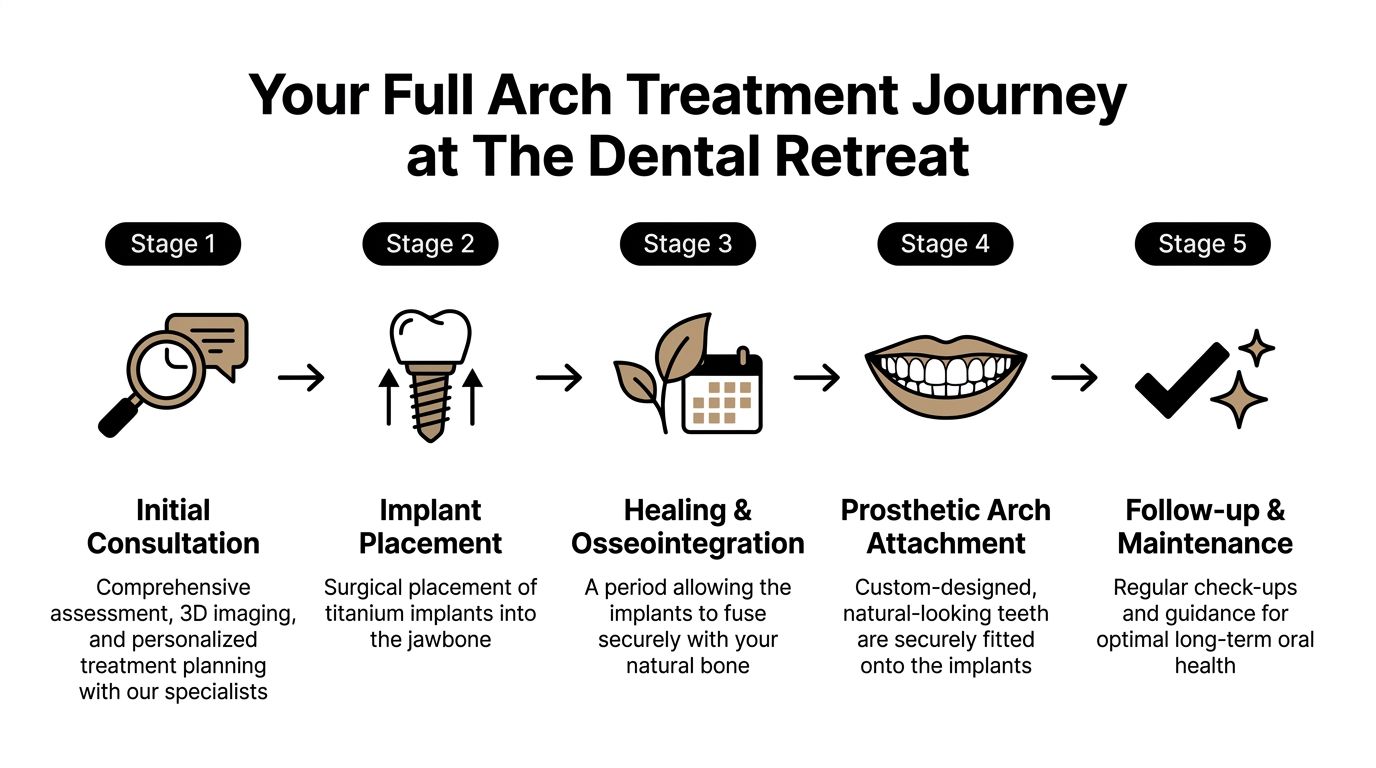
A typical treatment path often includes these stages:
Consultation and planning
Your dentist reviews the condition of the teeth, gums, bite, and bone support, then builds a treatment plan around those findings.Preparatory care if needed
Some patients need extractions or treatment for active infection or gum disease before implants are placed.Implant surgery
The implants are placed in carefully selected positions in the jaw.Temporary teeth
Many patients receive a temporary prosthesis on the same day as surgery, which means they do not spend the healing phase without teeth.Healing period
Over time, the implants bond with the bone. This is the foundation-building stage, similar to setting posts firmly before attaching the final structure.Final restoration
Once healing is stable, the long-term arch is crafted and secured.
If you want a closer look at how visits are commonly spaced, this guide to the timeline for full arch dental implant treatment explains the process in more detail.
Timing and cost in plain language
According to this clinical review in the National Library of Medicine, the total treatment timeline typically spans 3 to 6 months, though patients often receive immediate temporary prosthetics on the same day as surgery. The same review reports that final costs can range from $20,000 to $50,000 per arch, depending on materials, complexity, and related procedures.
Those numbers can feel heavy at first. That reaction is normal.
Full arch restoration is a major rebuild, not a small repair. Many patients find it helpful to compare the investment with the pattern they have already been living through. Repeated patchwork dentistry, broken teeth, extractions, loose dentures, and ongoing discomfort can carry their own financial and emotional cost over time.
This short video gives another helpful visual overview of how treatment comes together over time.
What many patients want to know most
For many people, the biggest emotional shift happens on surgery day. They realize they are not expected to leave with an empty smile. A temporary set of teeth helps carry them through healing while the implants stabilize and the final restoration is being prepared.
Patients also want to know what support surrounds the procedure itself. That support may include sedation for comfort, follow-up visits, cleaning instructions, and clear guidance about what to expect at each stage. These conversations can include financing pathways and membership plan details alongside the clinical plan, so the process feels organized, realistic, and easier to say yes to with confidence.
Benefits and Considerations of Full Arch Implants
The biggest benefit of full arch implants is that they help many people get back to normal daily life. Not perfect life. Normal life. Eating with less worry, speaking more clearly, laughing without covering the mouth, and not planning every meal around dental limitations.
Benefits patients often notice

Patients often value these improvements most:
- Better chewing stability so meals feel easier and more enjoyable
- More confidence in conversation because the teeth feel more secure
- A natural-looking smile designed around facial appearance and bite
- A more complete restorative solution when the whole arch is compromised
Long-term outcomes are one reason this treatment has become so widely discussed. According to this review of full-arch implant success data, 10-year implant survival is approximately 96.4%, and 84% of patients reported at least 80% satisfaction at the 10-year mark.
A good full arch result doesn't just change a smile. It often changes what a patient feels comfortable ordering at dinner, saying in public, and doing in photos.
The considerations that matter
A balanced decision also means acknowledging what this treatment asks of you.
| Benefit | Consideration |
|---|---|
| Stable implant support | It involves surgery and healing |
| A long-term replacement option | It requires a meaningful financial investment |
| Improved daily function | Home care and regular maintenance still matter |
| A more fixed feel than dentures | The process takes time from planning to final teeth |
Some patients in Lakehouse or Marisol are mostly concerned about appearance. Others are more focused on whether they'll be comfortable during treatment, whether healing will interrupt work, or whether the investment fits their priorities. All of those concerns are valid.
How to think about the choice
If you compare full arch implants with doing nothing, the decision usually becomes clearer. Ongoing tooth loss, repeated dental breakdown, and poorly fitting dentures don't stay emotionally neutral. They tend to affect diet, speech, confidence, and oral health over time.
That doesn't mean full arch implants are right for everyone. It means the choice deserves an honest discussion, not guesswork.
Life With Your New Smile and Patient-Centered Care
The day you receive your new smile is important. The months and years after that matter just as much. A full arch restoration works best when patients know how to care for it and what to expect long term.
What daily life usually feels like

Most patients settle into a routine that feels far simpler than they feared. You still clean your mouth every day. You still attend checkups. But the goal is to make care practical, not overwhelming.
Helpful habits usually include:
- Careful brushing around the restoration and gumline
- Interdental cleaning tools recommended by your dental team
- Water irrigation if advised for your case
- Regular professional maintenance to monitor hygiene and bite
The fear patients don't always say out loud
A common concern sounds like this: “If these are my permanent teeth, will someone have to remove them every year for cleaning?”
That fear is understandable, especially when people hear mixed messages online. The reassuring answer is that routine removal is not the standard expectation for an intact full arch prosthesis. The American College of Prosthodontists position statement on maintenance of full-arch implant restorations explicitly discourages the routine professional removal of intact, screw-retained restorations at maintenance visits unless hygiene is impossible or complications arise.
Your “permanent” teeth aren't supposed to be taken out as a routine yearly event just for cleaning if everything is healthy and accessible.
That distinction matters. There's a difference between maintenance visits and removal of the full arch prosthesis. Patients do need regular follow-up care. They don't usually need the bridge routinely removed if home care is working and the restoration is stable.
Comfort still matters after treatment
Long-term care shouldn't feel stressful. Follow-up visits are part of protecting your investment, checking your oral health, and making sure the restoration continues to function well. For anxious patients in Elyson, Ventanna Lakes, and across Katy, comfort features can make those visits feel much easier. Amenities like massage chairs, sedation options, and a calmer environment can help patients stay consistent with maintenance instead of postponing it.
That's one of the most overlooked parts of success. A strong restoration is important, but so is a care setting where patients feel comfortable enough to return.
Frequently Asked Questions About Full Arch Restoration
A lot of patients ask the practical questions first, then pause on the one they were almost embarrassed to say out loud. Will these teeth really stay in place, or will someone be taking them out all the time? That concern is understandable. Full arch restoration is meant to give you back stability, and routine removal for maintenance is not the standard approach when the prosthesis is healthy and cleanable.
Does full arch implant surgery hurt
Many patients expect the procedure to feel harder than it is. During surgery, your dental team keeps the area numb with anesthesia, and sedation is available for patients who want a calmer experience. Afterward, soreness and swelling can happen, but your instructions will be clear and specific so you know how to eat, clean, rest, and recover with confidence.
How do I pay for full arch restoration
Full arch care is usually planned carefully, both medically and financially. Patients often ask about financing, staged treatment, and membership options when other care, such as exams, extractions, or restorative work, is part of the process. When seeking a dentist in Katy, TX, ask for a consultation that explains the treatment steps and the cost breakdown in plain language.
What are the new teeth made of
Your new arch can be made from different materials, and the choice is not just about looks. It also affects strength, bite feel, weight, and long-term wear. A good way to picture it is like choosing flooring for a busy home. Two options may both look beautiful, but one may fit your daily function, bite pressure, and maintenance needs better than the other.
How long will my new smile last
Full arch restorations are built to be long-lasting, but they still need care. Their lifespan depends on daily cleaning, regular checkups, bite forces, general health, and whether problems such as wear or inflammation develop over time.
Patients often get stuck on the word "permanent." In everyday conversation, that word usually means secure and not meant to come in and out like a denture. It does not mean the restoration can be ignored forever. It means the teeth are designed to stay in place in normal function, and if everything is healthy, routine removal for cleaning is generally not part of standard maintenance.
Will I need dentures first
Some patients move from failing teeth straight into a full arch implant plan. Others have worn dentures for years and decide they want something that feels more stable and closer to natural teeth. Your starting point, bone support, healing needs, and treatment goals will shape that decision.
Can this help if I also need extractions or urgent care
Yes. Full arch treatment is often part of a larger plan to get your mouth healthy, comfortable, and functional again. In cases involving pain, infection, broken teeth, or major dental breakdown, care often begins with tooth extraction, imaging, and stabilization before the implant phase. Patients searching for an emergency dentist, cosmetic dentist near me, or long-term restorative dentistry are often describing different parts of the same solution.
What should I do next if I think I'm a candidate
Start with an exam and an honest conversation. You do not need to arrive with all the answers. A strong consultation should clarify whether your teeth can be saved, whether implants make sense for your anatomy, and what kind of timeline fits your health, budget, and daily life.
If you're ready to talk through your options for full arch restoration, dental implants, or related care in Katy, the next step is to schedule a consultation with The Dental Retreat. Patients from Katy, Sunterra, Cane Island, Katy Manor, Kingscrossing, Lakehouse, Marisol, The Grange, Anniston, Katy Lakes, Elyson, and Ventanna Lakes can expect a clear exam, straightforward answers, and a treatment plan centered on comfort, function, and confidence.