A sore tooth has a way of taking over a week. Eating on one side, waking up with a throbbing ache, worrying that the tooth might break, and trying to decode what “root canal success rates” means can leave anyone feeling stuck. In Katy, TX, that uncertainty is common, especially when the answer online seems to change from one page to the next.
The numbers do look inconsistent at first glance, but that doesn't mean the treatment is unpredictable. It usually means people are comparing different teeth, different levels of infection, and different definitions of success. For a patient in Katy, TX, including families in Sunterra, Cane Island, Katy Manor, Kingscrossing, Lakehouse, Marisol, The Grange, Anniston, Katy Lakes, Elyson, and Ventanna Lakes, the more useful question isn't “Is a root canal good or bad?” It's “What makes this tooth more likely to do well, and what can I do to protect it?”
Why the Root Canal Success Rate Question Is Harder Than It Sounds
A patient sits down after hearing they need a root canal, opens a phone, and finds one article promising near-perfect results while another makes the procedure sound shaky. That mismatch is frustrating, but it is also the right place to start. Root canal success rates are not one fixed number, because the outcome depends on the tooth, the infection already present, the follow-up period, and the way the result is measured.
The broad pattern is still encouraging. The same procedure can look very different on paper depending on whether a study is using a strict or lenient definition of success, so a single headline percentage rarely tells the full story. A tooth with deep decay, a larger infection, or a more complicated anatomy is not being measured on the same playing field as a straightforward case.
Practical rule: if two websites quote different success rates, they may both be telling the truth, just using different definitions.
Time also changes the picture. A tooth can look fine right after treatment and still need attention later, so a short follow-up window does not always reflect long-term durability. A clinic visit in Katy and a long research follow-up will not always produce the same headline figure, because they are answering slightly different questions.
For patients, that is useful. The better question is not whether a root canal has one universal percentage attached to it, but whether your specific tooth has the features that make healing more likely, and whether it will be restored well enough to stay that way.
What Success and Survival Mean in Endodontic Research
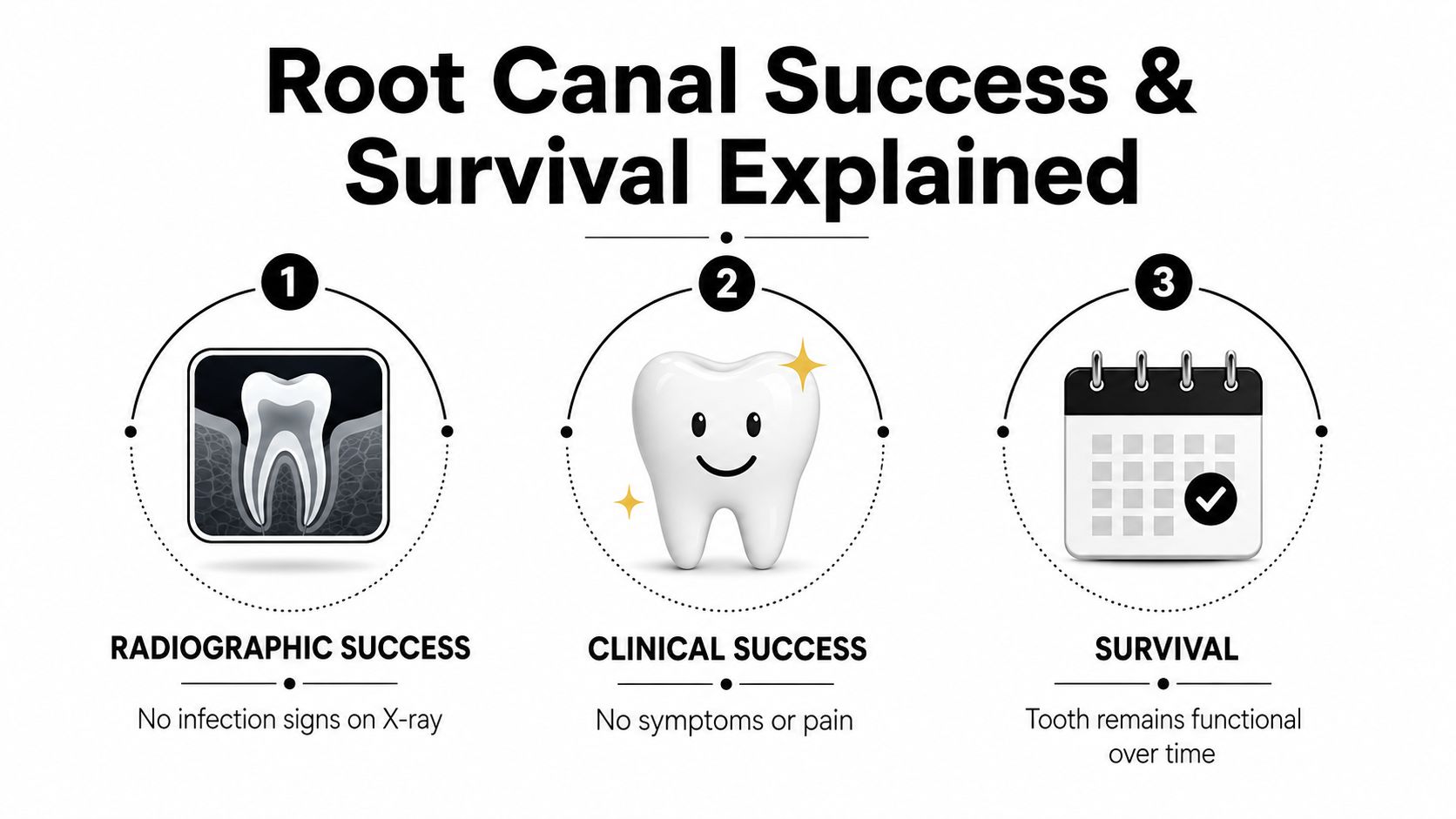
Three terms get mixed together constantly, yet they measure different things: radiographic success, clinical success, and survival. Radiographic success means the X-ray shows healing or clear improvement. Clinical success means the tooth feels normal, without pain, swelling, or tenderness. Survival means the tooth is still present in the mouth and functioning.
That distinction changes how the numbers are read. A strict study may only count a tooth as successful if the X-ray looks completely healed, while a looser study may count clear improvement even if a small area is still resolving. In the 2022 systematic review, that difference produced a wide spread in results, with 92.6% under loose criteria and 82.0% under strict criteria, and some strict definitions pushing the range much lower (systematic review).
For a patient, the most useful question is simple. Ask which definition the dentist is using and what they are counting. A tooth that is comfortable, functional, and showing stable healing can be called a success in one study and still be watched more carefully in another.
Follow-up time also changes the meaning of the result. A tooth checked early may still be in the healing phase, while a tooth observed for years gives a better picture of durability. Survival and success overlap, but they are not the same endpoint.
A root canal can be doing well clinically even when an X-ray still shows a slow-healing area.
The Headline Numbers Behind Root Canal Success Rates
A single root canal percentage only makes sense if you know how long the tooth was followed. A 2023 long-term cohort analysis reported cumulative success of 93% at 10 years, 85% at 20 years, 81% at 30 years, and 81% at 37 years, with overall tooth-level success of 87.8% and patient-level success of 80.8%. That is the profile I want patients to see, because it shows a treatment that holds up well and then levels into a durable long-term range.
The first year and second year tell a different part of the story. A meta-analysis found primary treatments achieved 87.2% success at 12 months and 83.5% at 24 months, with no significant differences among filling techniques at 12 months. Early prognosis is already strong, but a short follow-up does not describe the full life of the tooth.
A table helps organize the common numbers people see online.
| Study Type | Success Rate | Timeframe | Definition Used |
|---|---|---|---|
| Systematic review of primary treatment | 92.6% | Pooled across studies | Loose criteria |
| Systematic review of primary treatment | 82.0% | Pooled across studies | Strict criteria |
| Long-term cohort analysis | 93% | 10 years | Cumulative success |
| Long-term cohort analysis | 85% | 20 years | Cumulative success |
| Long-term cohort analysis | 81% | 30 to 37 years | Cumulative success |
| Meta-analysis of primary treatment | 87.2% | 12 months | Primary treatment success |
| Meta-analysis of primary treatment | 83.5% | 24 months | Primary treatment success |
Those figures still do not answer the practical question patients care about most, which is whether the tooth keeps working in real life. A real-world dental practice study found that about 95% of teeth remained functional after five years, while radiographic success was about 82% over the same period. That gap matters, because a tooth can stay useful even when the X-ray still shows some healing in progress.
The most useful headline is the one matched to the case in front of you. A recently treated tooth with a solid restoration and routine follow-up usually carries a favorable outlook. A tooth with more complex anatomy or a larger infection starts from a different place, and the percentage should reflect that reality.
Why Your Tooth and Your Starting Condition Change the Odds
A front tooth and a molar do not face the same job, and the prognosis discussion should reflect that. In a general dental practice study, success was 76.8% for anterior teeth, 69.7% for premolars, and 55.6% for molars (general practice study). That gap is not random. Molars usually have more canals, more curvature, and more difficult access, so treatment is more demanding from the start.
The tooth's starting condition matters just as much. In one prospective cohort, overall success was 88.6% per tooth and 90.3% per root canal, but success dropped to 82.7% for teeth with necrotic pulp complicated by apical periodontitis (prospective cohort). Lesion size changed the outlook further, with lesions under 5 mm succeeding at 86.6% versus 78.2% when lesions were 5 mm or larger.
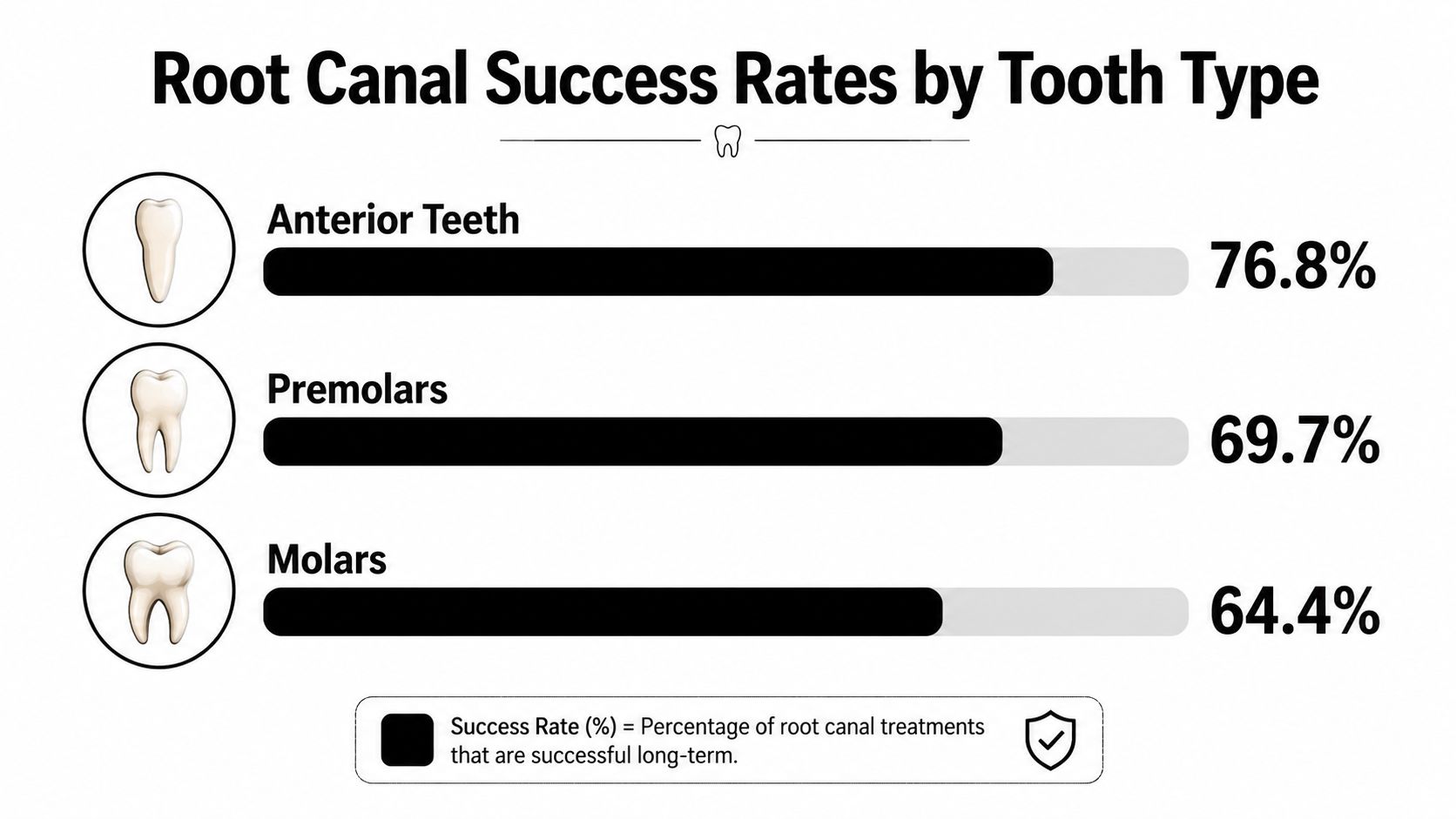
That is why a personal prognosis is never just “yes or no” on root canal treatment. It depends on the type of tooth, how far the infection has progressed, and whether the canals are straightforward or hard to reach. In Katy, I would rather explain those trade-offs clearly than give a flat percentage that sounds reassuring but leaves out the details that matter most.
A front tooth with a smaller, earlier infection usually has a different outlook than a heavily infected molar with deeper disease. The tooth can still be treatable in both situations, but the expected result is not the same.
The useful question is where your tooth sits on that spectrum of complexity. That is what shifts the odds up or down.
Factors That Improve or Reduce Your Personal Prognosis
A good prognosis starts before the first file goes into the canal. If I can reach the apical constriction cleanly, control the working length, and keep the canal system dry and visible, the odds are usually better. In a general practice study, success was 94.7% when the apical constriction was accessible versus 75.4% when it was not (study on accessibility). That gap is why anatomy matters so much before treatment even begins.
The restoration matters just as much after the canals are cleaned and sealed. A root canal by itself does not finish the repair, the tooth still needs a durable top seal to keep out bacteria and resist fracture. In practical terms, that means the filling or crown has to fit well, protect the remaining tooth structure, and hold up under chewing forces.
Long-term follow-up shows why that top seal cannot be an afterthought. A 25-year cohort showed about 85% success at 5 years dropping to 60% at 20 years (25-year cohort). That decline usually reflects slow breakdown over time, not an immediate problem right after treatment. Once a treated tooth is exposed to leakage, cracks, or delayed repair, the prognosis can change even if the root canal itself was done well.
A few points consistently shape the outlook in the chair:
- Accessible canals: Easier access usually gives the clinician better control, better cleaning, and better filling.
- Strong final restoration: A well-sealed crown or filling helps protect the tooth after treatment.
- Early follow-up: Small issues are easier to correct before they become reinfection.
- Good home care: Brushing, flossing, and avoiding hard chewing on a temporary restoration help protect the result.
Delays in definitive restoration create real risk. Even a technically solid root canal can lose ground if the tooth sits too long without the right final repair. I see this most often in teeth that already had major decay, large fillings, or missing tooth structure, because those teeth need more support from the start. Signs you may need a root canal often overlap with the same structural problems that make long-term protection harder.
For patients in Katy, the better question is not whether the procedure looked successful on the day it was done. The better question is what keeps the tooth stable six months from now, and what keeps it stable years later. That depends on access, the starting condition of the tooth, and how well the final restoration protects the work inside the roots.
Retreatment, Failure Signs, and How Alternatives Compare
A tooth that flares up after root canal treatment usually needs a clear next step, not guesswork. In retreatment cases, outcomes are more variable than they are with a first-time procedure, and published results can look very different depending on how strictly success is defined. That matters in real practice, because a tooth that looks acceptable on a basic x-ray may still show signs of lingering disease when examined more closely, including with CBCT-based review.
The warning signs are the ones I take seriously in the chair. Persistent pain, swelling, a recurrent abscess, or a crown that suddenly feels different can point to a problem that needs attention. A tooth that had settled down and then starts to ache again is usually telling us that something changed, whether that is leakage, reinfection, or a crack that was not obvious before.
If a patient comes in worried about a tooth that has become sore again, I start with a clinical exam and updated imaging, then decide whether the tooth is a retreatment candidate, needs apical surgery, or is beyond repair. Extraction is sometimes the cleanest answer, but it is not a stand-alone decision. The plan after removal may include an implant or another replacement option, and that choice depends on bone support, gum health, bite forces, and how much tooth structure is left to work with.
Signs you may need a root canal
Long-term follow-up also has to stay part of the conversation. Real-world practice data from a Dental PBRN study found that composite failure reached about 27% over a mean follow-up of more than eight years (Dental PBRN study). That figure does not mean a treated tooth is doomed. It means the restoration above the roots, and the tooth around it, keep mattering long after the initial treatment is finished.
The practical question is where the problem sits. Sometimes it is inside the canal system, sometimes at the root tip, and sometimes in the crown or filling above it. Early evaluation gives the best chance of saving the tooth or choosing the right alternative before the remaining tooth structure becomes harder to restore.
What Root Canal Treatment Feels Like at The Dental Retreat

A lot of patients delay care because they're more afraid of the visit than the tooth. A calm environment changes that, and so does a team that explains each step before it happens. At The Dental Retreat on Stockdick School Rd. in Katy, the comfort details are designed to help anxious patients stay relaxed enough to get the treatment done well.
The practice offers a spa-inspired setting with aromatherapy, massage or heated chairs, noise-cancelling headphones, and TVs in every room. For families across Sunterra, Cane Island, Kingscrossing, Elyson, and nearby neighborhoods, extended hours and bilingual care also make it easier to keep appointments on track. That matters, because root canal outcomes depend not only on what happens in the chair, but also on whether the patient comes back for follow-up and restoration.
The entry point is practical, too. New patients without insurance can choose a $99 exam with cleaning and X-rays, a $49 problem-focused visit, or membership plans that start at $299 per year. For a patient trying to move from pain and uncertainty to a plan, that lower barrier can be the difference between waiting and getting answers.
A second look at the process helps with the fear factor.
Root canal procedure explained
When patients feel safe, they ask better questions, sit still longer, and finish treatment sooner. That combination supports a better experience and a more predictable result.
Your Next Step Toward a Confident Decision
Root canal success rates are strong overall, but the number that matters most is the one tied to your tooth. Tooth type, infection severity, access, and restoration quality can move the prognosis meaningfully in either direction, which is why a personalized exam matters more than another round of searching.
If you're in Katy, TX, or nearby in Sunterra, Cane Island, Katy Manor, Kingscrossing, Lakehouse, Marisol, The Grange, Anniston, Katy Lakes, Elyson, or Ventanna Lakes, the best next step is a careful evaluation and a clear plan. A good visit should answer whether the tooth can be saved, what the restoration needs to be, and how to protect the result long term.
The Dental Retreat keeps that process patient-friendly, with a calm setting, comfort-focused care, and affordable entry options for new patients and members. If your tooth is hurting, swelled up, or just not settling right, it's time to get a real answer instead of guessing.
If you're weighing a root canal, retreatment, or even whether extraction and a future implant make more sense, The Dental Retreat can help you sort out the trade-offs with a clear, judgment-free exam. Visit The Dental Retreat to schedule a visit in Katy and get a treatment plan built around your tooth, your comfort, and your long-term health.