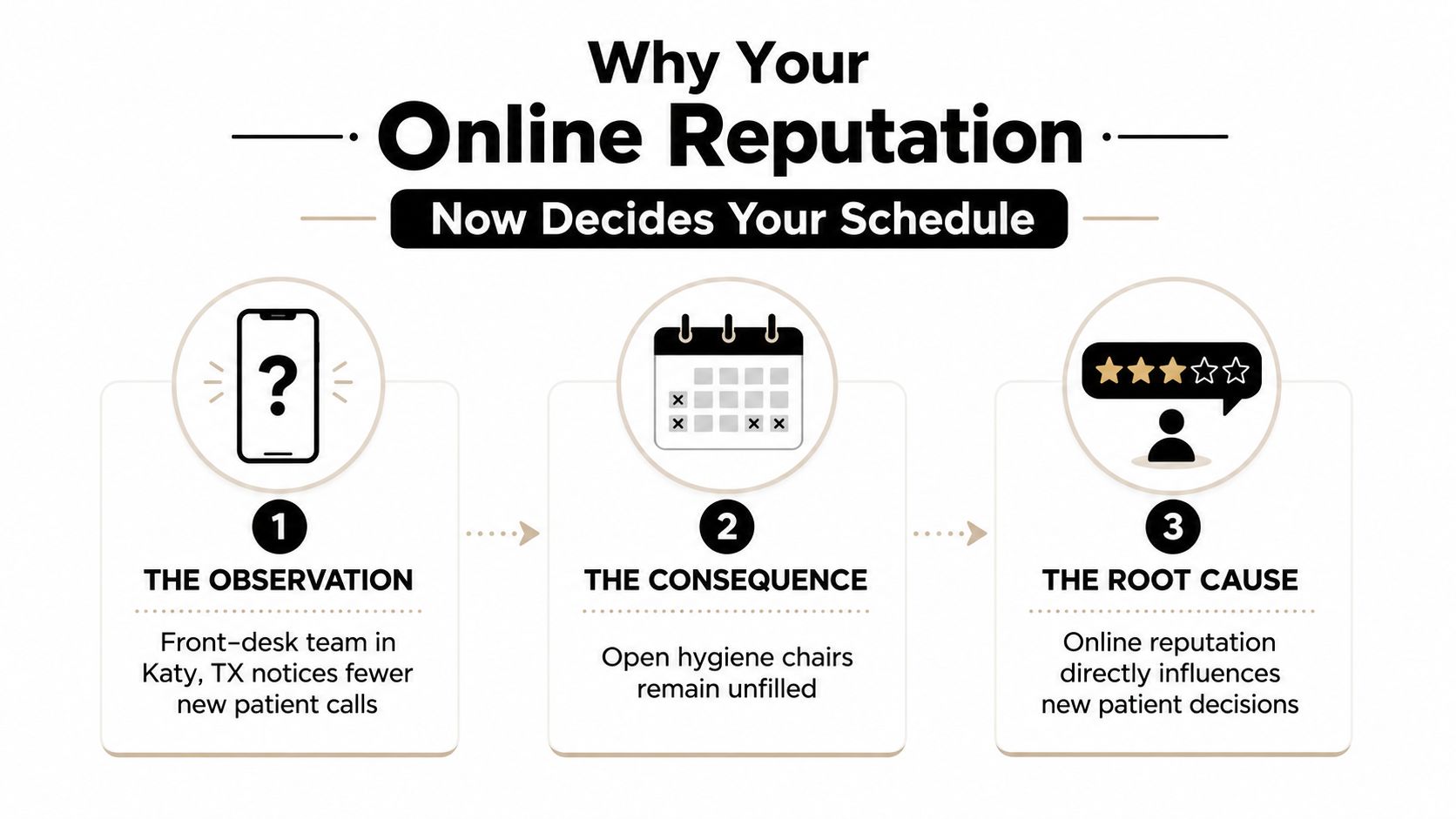
You've probably seen this happen in a Katy office more than once. The schedule looks healthy on paper, but the front desk still feels the squeeze of quieter new patient volume, fewer calls from families in Sunterra or Elyson, and more people comparing providers online before they ever pick up the phone. In that moment, dental practice reputation management stops being a branding exercise and becomes part of how a practice fills the schedule, earns trust, and keeps hygiene chairs from sitting empty.
For patients searching dentist near me Katy TX, the decision often starts with a quick scan of Google reviews, star ratings, and how recently the practice has been active online. That's not a soft signal. 72% of patients check online reviews before choosing a dentist, and moving from a 4.2 to a 4.8-star average can increase new patient inquiries by 25% to 30% according to the dental reputation management data in the brief (Rework on online reputation management for dentists). Review depth matters too, because practices with 50+ Google reviews convert 35% more profile visitors into calls than practices with fewer than 20 reviews (Rework on online reputation management for dentists).
That's why reputation can't be treated like a quarterly marketing project. It's a daily operating system that ties together listing accuracy, review velocity, response coverage, and the patient experience that happens at check-in, checkout, billing, and follow-up. In fast-growing Katy neighborhoods like Cane Island, Katy Manor, Kingscrossing, Lakehouse, Marisol, The Grange, Anniston, Katy Lakes, and Ventanna Lakes, patients are comparing a lot of details at once, and the practice that looks current, calm, and responsive usually gets the call.
A solid system starts with the right structure. If you want a broader view of how this fits into local growth, see the practice's approach to dental practice marketing strategies.
Why Your Online Reputation Now Decides Your Schedule
A Katy practice can feel full on the inside and still look quiet online. That gap shows up when the front desk sees fewer new patient calls even though hygiene chairs are open, and the pattern usually traces back to what prospective patients see in search results, not what the team already knows about the care. For a family comparing providers from Cane Island to Sunterra, the first impression often happens on Google Maps, not in the operatory.
Reputation is more than a star rating
The mistake I see most often is reducing reputation to a single number. Patients do look at the stars, but they also notice whether reviews are recent, whether the practice replies, and whether comments consistently mention smooth scheduling, friendly check-in, or a calm visit. That mix of signals is what makes a practice feel active and trustworthy.
Practical rule: if the review profile looks stale, prospects assume the patient experience is stale too.
That matters in local search because Google reviews surface directly in search and Maps results, where people are trying to choose quickly. The ADA now explicitly advises practices to monitor their online reputation, check Google, Yelp, and Facebook regularly, and respond carefully to avoid privacy violations (ADA guidance on managing dental practice online reviews). In practice, that means the reputation workflow needs an owner, a schedule, and a response standard.
For patients searching dentist in Katy, TX, reputation also shapes whether they book cosmetic dentistry, restorative dentistry, or a new patient exam. The right mix of recent reviews, visible responses, and current business details makes the practice feel ready for action instead of merely present online. A quiet profile, even with strong clinical care behind it, tends to lose to a more active one.
What the patient actually sees
A patient does not see your internal effort. They see whether the office looks open, whether the hours are current, whether the service list matches what they need, and whether the practice sounds attentive in its replies. That is why reputation management works best when it connects the front desk, clinical team, and office manager around one consistent message.
The best way to think about it is simple. Reputation is the public version of the patient experience, and the schedule follows the version patients believe.
Building the Foundation Before You Ask for a Single Review
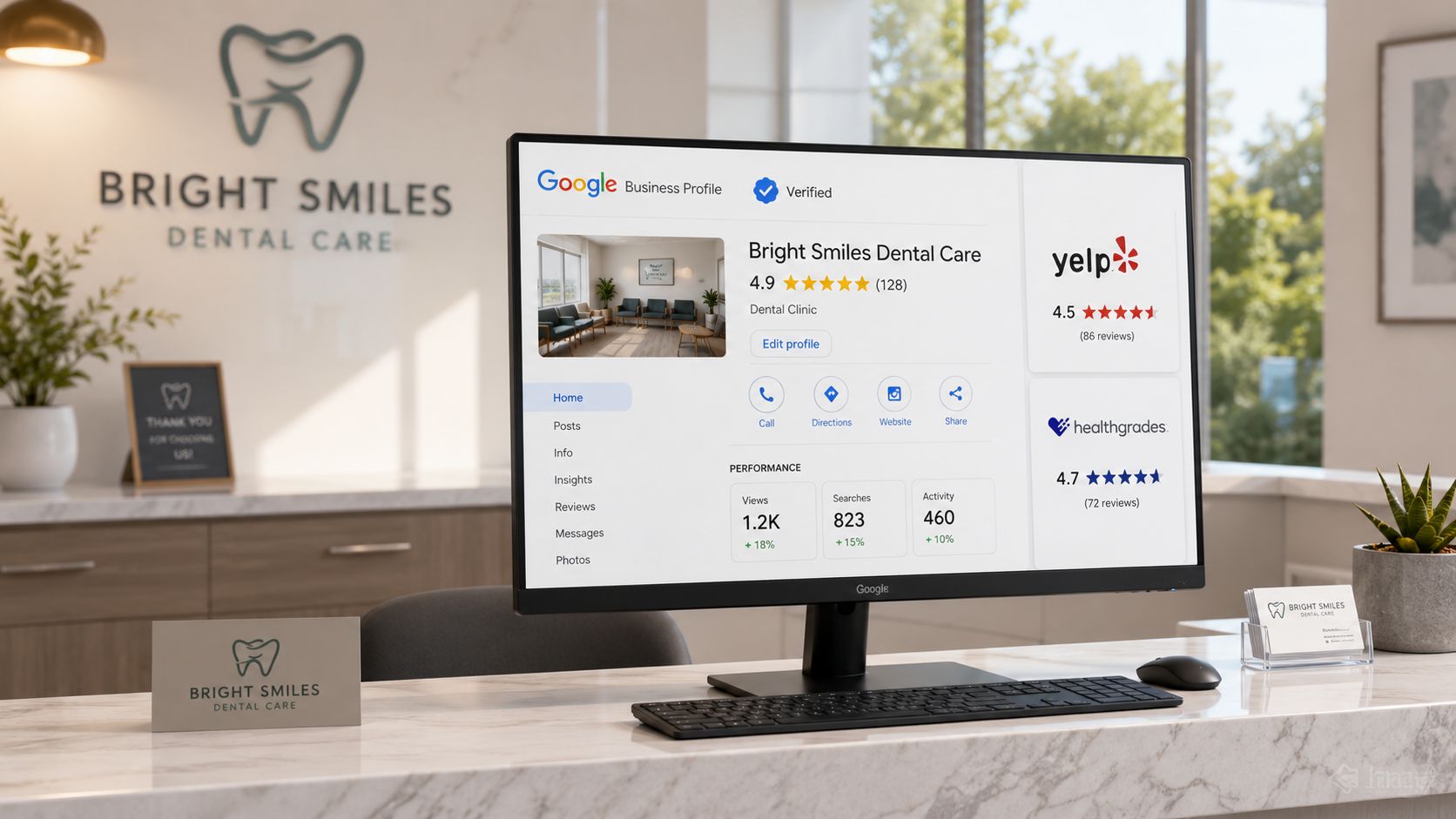
Before anyone asks for more reviews, the practice's online listings need to be clean and aligned. If the Google Business Profile says one thing, Yelp says another, and the website still shows outdated hours, patients feel friction before they ever call. That friction is avoidable, and it usually belongs on the office manager's checklist, not on the marketing team's wish list.
Claim every major profile and make the details match
Start with the profiles patients use, then verify them one by one. The practice should own the Google Business Profile, Yelp, Healthgrades, Facebook, and the website's location pages, with the same name, address, phone, hours, and service list on every listing. The ADA specifically advises practices to keep hours, services, and other information current online (ADA guidance on managing dental practice online reviews).
That matters even more for a practice on Stockdick School Rd. serving Katy families who may be looking for cleanings and exams, dental x-rays, new patient exams, teeth whitening, cosmetic dentistry, restorative dentistry, dental implants, All-on-4, sedation, and emergency visits. If the profile leaves out a service, it creates doubt. If the hours are wrong, it creates missed calls. If the bilingual care note is missing, it creates unnecessary hesitation.
Here's the operational rule I use with offices:
- Assign one owner: usually the office manager.
- Set one deadline: complete the cleanup as a one-time project, then audit monthly.
- Standardize one source of truth: the website should match every profile.
- Keep the service list current: include general dentistry, cosmetic work, clear aligners, implants, sedation, and emergency care.
- Double-check accessibility details: bilingual care and extended hours should be visible where patients search.
A reputation system cannot repair inaccurate listings. It only amplifies what patients already see.
Make the foundation easy to maintain
The point of this first pass is not perfection, it's consistency. Once the profiles are aligned, every future review request has a better chance of converting because the patient sees a practice that looks organized and current. That protects the value of every review campaign, every response, and every local SEO effort that comes after it.
If the foundation is clean, reputation becomes much easier to manage week after week.
Generating a Steady Stream of Authentic Reviews
A lot of practices ask for reviews in bursts, then go quiet for weeks. That pattern usually produces a spike, then a flat line, which is exactly the wrong shape for a local profile. A steadier system works better, especially in neighborhoods like Katy Manor, Kingscrossing, and Lakehouse, where patients are comparing options in real time.
Build the ask into checkout, not into memory
The easiest way to increase review velocity is to make the request automatic. Send an SMS within two hours of checkout, follow with an email the next morning, and keep a QR code on the exit card and at the front desk for patients who'd rather scan in person. The ADA's guidance supports consistent review generation rather than one-time campaigns, and established practices are often advised to sustain 8 to 12 new reviews per month (ADA guidance on managing dental practice online reviews).
The front desk also needs a human script for the right moment. Keep it warm and brief.
“We're glad your visit went well. If you have a moment, your feedback helps other Katy families feel confident choosing a dentist here.”
That line works because it sounds like service, not pressure. It also ties the ask to community trust, which matters when someone in Marisol or Ventanna Lakes is deciding whether to try the office for a cleaning, tooth extraction, or emergency dental visit.
Use a simple message sequence
The message itself should feel personal and easy to act on. A practical sequence looks like this:
- SMS after checkout: thank the patient and include one direct review link.
- Email the next morning: repeat the thank-you and keep the ask short.
- QR code at the front desk: give the patient a no-hassle option if they prefer scanning in office.
- Daily logging: track who was asked, who responded, and which channel produced the review.
For offices that already have strong service culture, the best review requests often come from patients who just experienced a smooth visit, a clear explanation, or a painless checkout. That's why review generation belongs to the daily workflow, not a quarterly project. When the team treats it that way, the profile builds the kind of steady momentum patients trust.
Knowing What Good Looks Like
A healthy reputation profile has a shape, and it helps to measure that shape instead of chasing a perfect 5.0. A perfect score can look suspicious to patients, especially if the reviews all arrive at once or lack detail. A strong profile feels active, balanced, and recent.
Use a monthly scorecard
A credible profile usually sits in a healthy middle range, not at the extremes. The key signals are a solid star average, enough review volume to feel established, recent reviews that show the practice is active now, and replies that show the team is paying attention. Practices should also watch negative review patterns, response speed, sentiment themes, and how their profile compares with nearby offices. That monthly view is what turns reputation from a vague concern into something the office manager can run.
| Monthly Reputation Scorecard for a Dental Practice | ||
|---|---|---|
| Metric | Healthy Target | Why It Matters |
| Average star rating | 4.6 to 4.9 | Signals trust without looking artificially perfect |
| Google review count | 100+ reviews | Adds depth and improves confidence |
| Review recency | Reviews from the past 30 days | Shows the practice is active now |
| Response rate | 100% within 24 to 48 hours | Shows attentiveness and accountability |
| Negative-review ratio | Under 5% | Keeps the profile balanced and credible |
| Monthly tracking | Star rating, volume, response time, sentiment themes, competitor comparison | Helps the team spot patterns early |
That scorecard works because it gives leadership something concrete to review every month. A quiet profile with plenty of older reviews can feel weaker than a lively one with current feedback and thoughtful replies. Patients notice recency because it suggests current care, not old momentum. For a practice serving Katy neighborhoods like Sunterra, Cane Island, and Elyson, that freshness matters when families are comparing options close to home.
Track the metrics that influence calls
The biggest mistake is focusing only on rating. The better question is whether the profile feels current enough to make a family in Katy click, call, or request a consultation. Review depth matters, but so do recent comments and fast, professional responses.
If you want a practical benchmark for what patients look for before they book, the practice's how to choose a dentist resource can help frame those expectations. The scorecard should reflect that same decision process, not just internal vanity metrics.
A profile with steady activity, clear replies, and recent patient feedback supports both trust and local visibility. That is the standard worth aiming for, because it matches how real patients judge whether a practice feels established, responsive, and worth calling.
Responding to Reviews Without Crossing the Privacy Line
A reply to a review is public, so it does two jobs at once. It answers the person who posted it, and it shows every future patient how the office handles praise, frustration, and conflict. In a dental practice, that public record matters because patients are judging both care and judgment.
Keep the tone warm and short
For positive reviews, thank the patient, reflect the specific compliment, and invite them back. For neutral or mixed reviews, acknowledge the experience without arguing. For negative reviews, keep the response to 3 to 4 sentences, stay HIPAA-safe, and move the conversation offline rather than trying to settle the issue in public.
Here are ready-to-adapt templates:
Positive review: “Thank you for sharing this. We're glad our team made your visit comfortable, and we appreciate you trusting us with your care. We look forward to seeing you again.”
Mixed review: “Thank you for the feedback. We're sorry your experience didn't fully meet expectations, and we take that seriously. We'd appreciate the chance to talk with you directly and learn more.”
Negative review: “We're sorry to hear this and appreciate you bringing it to our attention. We take concerns like this seriously and want to understand what happened. Please contact our office so we can address this with you directly.”
The public reply should never include treatment details, even if the review mentions them. That boundary protects privacy and keeps the response useful to future readers.
Use one calm pattern every time
The best response pattern is simple. Acknowledge, show care, invite offline follow-up. That consistency helps readers see the practice as steady and professional, especially when the office already presents a calm, patient-centered brand.
Don't try to win the thread. Win the next patient's trust.
In day-to-day operations, the office manager or another designated lead should approve the response language, keep it respectful, and avoid reactive wording. A fast but composed reply does more for trust than a defensive paragraph ever will.
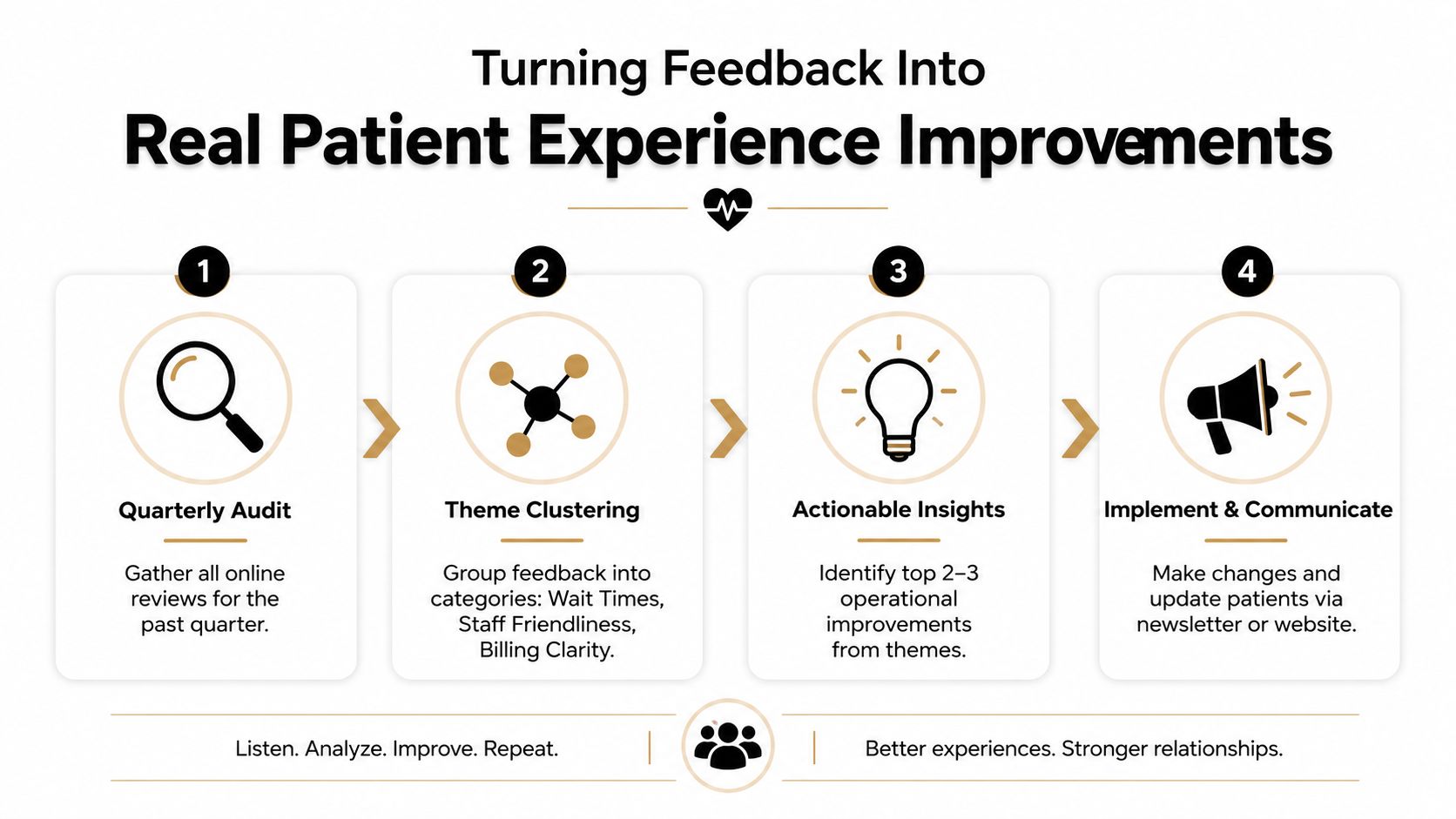
Turning Feedback Into Real Patient Experience Improvements
Reviews become more valuable when they change the visit itself. A quarter of feedback might sound like reputation work, but in practice it's operations data. If patients keep mentioning wait times, billing confusion, or unclear post-op instructions, those themes should be handled as workflow problems, not just as comments online.
Cluster the comments into operational themes
A quarterly audit gives the team something concrete to fix. Gather the reviews from the past quarter, then group them into buckets like wait times, billing clarity, post-op communication, anxiety and sedation comfort, front-desk warmth, and insurance confusion. Those are the issues that often shape the review more than the clinical procedure itself.
The audit should assign each theme to a real owner. Billing confusion goes to the person who handles benefits verification. Wait-time complaints go to the scheduling lead. Post-op comments go to the clinical team that writes the aftercare instructions for tooth extraction, dental implants, or All-on-4. Front-desk warmth belongs with the team members who greet patients first.
The practice should also look at what patients praise. If people mention aromatherapy, massage chairs, noise-cancelling headphones, TVs in every room, or bilingual staff, those details need to be reflected in the review request language and the website copy. Compliments are often the easiest way to strengthen the next wave of reviews because they remind patients why the visit felt different.
Fix the workflow, not just the wording
A reputation plan fails when it only improves how the office talks about itself. The gains come from the operational changes behind the comments. Clearer insurance scripts reduce confusion. Better post-op handouts reduce anxiety after treatment. A smoother intake flow lowers friction before the first chair time.
That's especially important for a spa-inspired practice serving families across Katy, because comfort is part of the product. If the experience already feels calm and accessible, the reviews tend to reflect that. If the experience is inconsistent, no amount of polished language can make up for it.
Handling a Reputation Crisis Before It Happens
The worst time to decide how to respond to a bad review is after it's already public. A written crisis playbook keeps the team from improvising under pressure, especially when a single review, a privacy concern, or a staffing incident starts drawing attention. In a community like Katy, where word spreads quickly through Marisol, Anniston, and Ventanna Lakes, calm matters.
Build a 24-hour response path
The playbook should name one decision-maker, one clinical contact, and one person responsible for documentation. The first move is to assess the post, then respond publicly within 24 to 48 hours, move the conversation offline, and document the issue internally so the practice can look for related patterns. That timing matches the review-response benchmarks already used in reputable guidance (ADA guidance on managing dental practice online reviews).
A simple crisis order works well:
- Review the post immediately.
- Assign the owner.
- Check for privacy or safety concerns.
- Post a short, calm public response.
- Call the patient offline if appropriate.
- Log the incident and related feedback.
- Brief the team on the next step.
The biggest mistake is emotional escalation. Deleting, ignoring, or arguing publicly usually makes the situation louder and less controllable. A measured response signals that the practice takes concerns seriously without turning the thread into a debate.
Keep the crisis plan on file, even if you never use it
A practice that monitors weekly, responds within two days, and improves operations each quarter usually won't need the playbook often. But every office should still have it ready, because the credibility of the entire reputation system depends on how the team behaves when something goes wrong.
That's the core value of dental practice reputation management in Katy. It connects the front desk, the clinical team, and the patient experience into one system patients can feel before they ever schedule.
If you're ready to make your online reputation work harder for your schedule, The Dental Retreat in Katy offers the patient-centered care, clear communication, and calm experience that help reviews turn into real trust. Visit The Dental Retreat to schedule a visit and see how a well-run dental practice can make every step, from check-in to follow-up, feel easier for your family.