A cracked molar on a Friday afternoon, a swelling gum that won't settle, or a treatment plan that suddenly feels too big for a family budget can leave people in Katy, TX, stuck between pain and paperwork. That's where payment plans for dental treatment matter most. At The Dental Retreat on Stockdick School Rd., the conversation is usually less about “Can I afford this today?” and more about “How do I get the care I need without making the month unmanageable?”
Patients in Katy, Sunterra, Cane Island, Katy Manor, Kingscrossing, Lakehouse, Marisol, The Grange, Anniston, Katy Lakes, Elyson, and Ventanna Lakes often want the same thing, a clear path forward for cleanings, exams, dental X-rays, restorative dentistry, emergency visits, tooth extraction, cosmetic dentistry, or even dental implants near me searches that turn into real treatment decisions. The right plan can turn hesitation into action, especially when the alternative is letting a small issue become a bigger one.
Introduction to Payment Plans for Dental Treatment
A lot of people do not walk in thinking about financing first. They come in worried about pain, embarrassment, or a tooth that has been sensitive for too long. Then the estimate arrives, and the question shifts from symptoms to affordability. That is a hard moment for families in Katy, especially when they are trying to balance routine care with groceries, school costs, and everything else that fills a normal month.
Payment plans for dental treatment are a practical way to help patients move from diagnosis to care without feeling pushed into an all-or-nothing choice. Delaying treatment can let a small problem become more complex, so the timing of payment matters as much as the treatment itself. The ADA also advises patients to read the terms carefully, understand disclosures, and make sure the plan fits their budget before they sign anything. For practices, clear written terms, staff training, and recordkeeping help keep the arrangement transparent and reduce avoidable confusion, which is why the strongest plans are spelled out in advance, not improvised at the front desk (ADA patient financing options).
At The Dental Retreat, the financial conversation should feel as steady as the clinical one. That means talking through the treatment, the timing, and the most sensible way to pay for it without adding unnecessary stress. For many patients, the right plan is the one that lets them keep moving while still protecting the monthly budget.
A simple rule helps here. If the payment plan is hard to understand before you sign, it will usually feel harder later. Clear terms should come first.
Understanding Types of Dental Payment Plans

A broken tooth, a gum problem, or a larger restorative plan can create the same question fast, how do you pay for care without putting it off? The answer depends on how much flexibility you need, how predictable your monthly budget is, and whether the treatment should begin now or can be phased over time.
In-House Financing
This is the arrangement the dental office manages directly. The practice sets the terms, collects the payments, and decides which treatments qualify. It often works well when care is split into stages, because the payment schedule can follow the treatment schedule instead of asking for the full amount at the start.
Third-Party Lenders
This option lets a patient borrow from an outside lender and repay the balance later. The ADA explains that these arrangements function like loans rather than insurance, meaning the patient borrows a lump sum or a credit line and repays it in fixed monthly installments over the agreed term. For patients comparing dentist near me options, that can feel familiar because it works much like other consumer credit products.
Membership Plans
A membership plan is closer to a subscription. You pay a set fee to access preventive care and, depending on the plan, discounts on other services. One industry analysis reports that 40% of practices now offer subscription-based membership plans, and that membership patients complete 5.9 procedures per year versus 2.4 for uninsured patients, with annual production of $1,276 compared with $469 for uninsured patients, plus above 90% new-patient retention versus roughly 50% without membership plans (Clerri membership statistics).
For uninsured patients, the trade-off is simple. A membership can make routine care easier to budget, but it does not replace financing for larger treatment.
Structured Payment Schedules
These are pre-set installment plans tied to a treatment plan. They work best when the office has a clear estimate, a defined timeline, and a payment calendar the patient can follow. The structure helps patients avoid waiting until a small problem becomes a larger and more expensive one.
Some patients do best with a subscription-style membership. Others need financing for restorative or implant care. The right choice depends on the treatment, the timeline, and how predictable the monthly payment needs to be.
Comparing Dental Payment Options
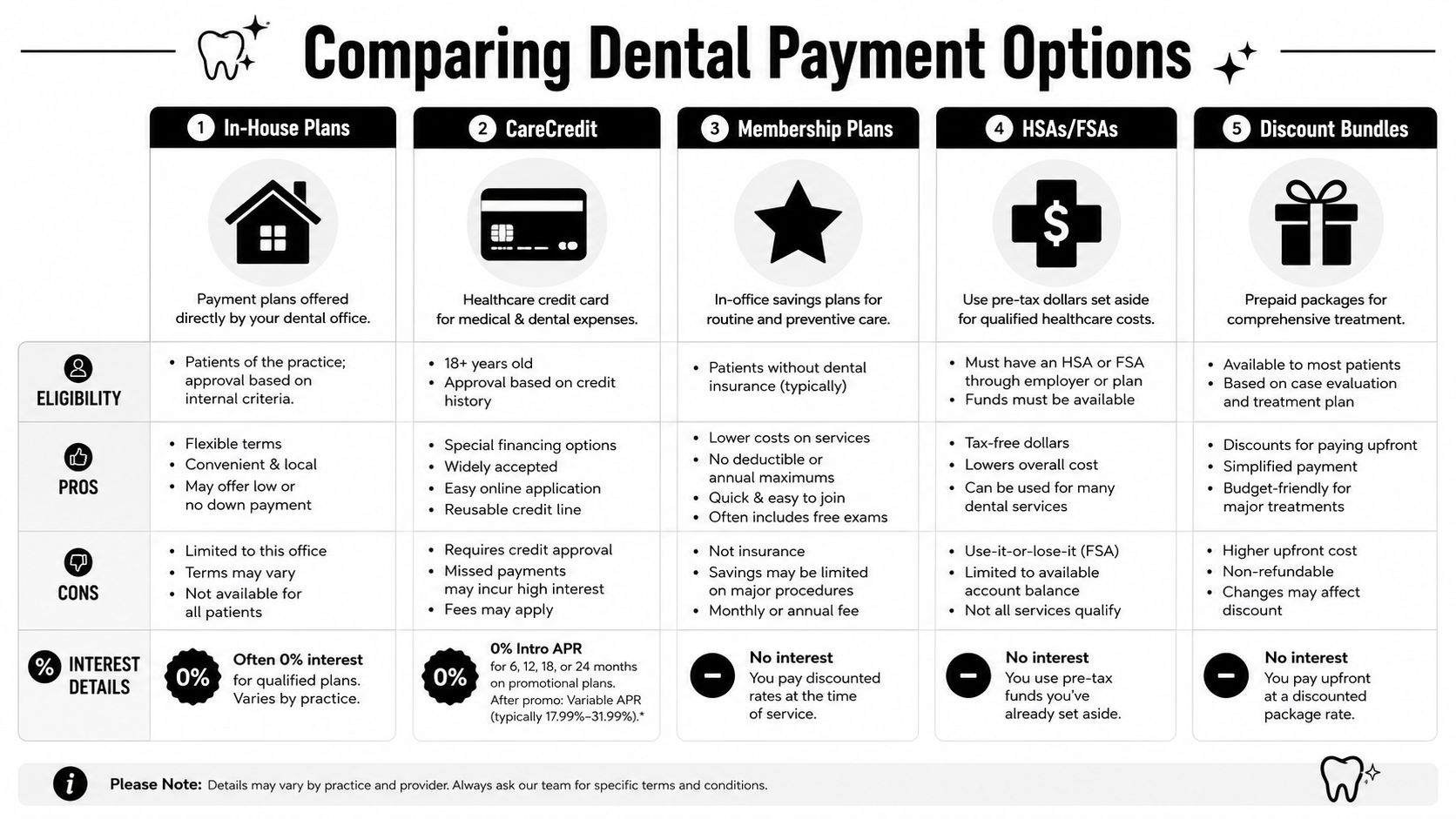
The simplest way to compare options is to ask three questions, who qualifies, what does it cost over time, and how quickly can it be set up? That's especially useful for uninsured patients deciding between a membership plan, an HSA or FSA, or third-party credit.
| Option | Best For | Main Trade-Off |
|---|---|---|
| In-House Plans | Patients who want office-managed monthly payments | Terms depend on the practice |
| Third-Party Financing | Larger treatment, multi-visit care, or higher-cost procedures | Interest may apply outside promotional periods |
| Membership Plans | Preventive care and predictable routine visits | Not the same as financing for major treatment |
| HSAs and FSAs | Patients with pre-tax healthcare funds | Funds must already be available |
| Discount Bundles | Preventive packages or planned treatment groups | Less flexible than financing |
A key detail for dental loans is the promotional window. One financing provider states that terms can include 0% APR periods of 6 to 24 months for qualified patients, with repayment terms from 1 to 60 months and loan amounts up to $50,000. The same industry guidance reports that balances 90+ days past due and $200+ saw collection rates improve by 19%, while payment velocity improved by 10.2 days across aging buckets (Dental Practice Insider payment-plan guidance). Those figures help explain why practices use payment plans to improve cash flow and why patients use them to avoid delaying care.
Here's the key decision point. If you're comparing Cosmetic dentist near me, Emergency dentist, or Dental implants near me treatment, the question isn't just “Can I split the bill?” It's “Which option keeps the treatment moving without creating a bigger bill later?” Memberships help with access, financing helps with larger treatment, and HSA or FSA funds can soften the upfront hit if you already have them available.
Applying for a Dental Payment Plan
A payment plan works best when the treatment decision is already clear. Start with the estimate, the total amount you want to finance, and whether you are asking for an in-house arrangement or a lender's credit decision. That keeps the conversation centered on the care itself and helps avoid surprises once the paperwork starts.

What the process usually looks like
- Review the treatment estimate. Confirm whether the plan covers a cleaning, a crown, a tooth extraction, or a larger restorative case.
- Gather basic information. Most applications ask for identity and financial details. Have those ready before you sit down to apply.
- Complete the form carefully. Small omissions can slow approval or create follow-up questions.
- Wait for review. Some third-party lenders respond quickly, while office-managed plans may require a more manual check.
- Check the terms. Monthly amount, due date, and interest details should be easy to read before you agree.
- Sign only after you understand the agreement. If the plan charges interest or extends beyond four payments, Regulation Z disclosure rules may apply, so the terms deserve a careful read.
The ADA advises practices to document payment-plan policies with written agreements, required disclosures, staff training, and recordkeeping controls so billing stays consistent and compliance risk stays lower (ADA patient financing options). That kind of structure also helps patients see exactly what they are agreeing to before treatment begins.
Uninsured patients should compare three paths side by side. A membership plan can lower the cost of routine care and make preventive visits easier to budget. An HSA or FSA can help if funds are already available, since those dollars can reduce the upfront hit. Third-party financing fits larger treatment plans better when the balance needs to be spread out over time.
The right choice often depends on urgency. A small preventive visit may fit better under a membership or existing HSA balance, while a crown, extraction, or implant case may justify financing if waiting would lead to more decay, more pain, or a bigger repair later. The Dental Retreat membership plans can also be part of that comparison for patients who want simpler routine-care costs.
Good financing feels specific. You should know the monthly amount, the payment date, and what happens if the balance is not paid on time.
Membership Specials at The Dental Retreat

For uninsured patients in Katy, a membership can be the most straightforward way to keep preventive care organized. The Dental Retreat offers membership options that start at $299 per year, with value centered on routine wellness visits and savings on select services. If you are weighing it against third-party financing, the distinction is straightforward. Financing spreads a treatment balance over time, while a membership lowers the day-to-day cost of staying on schedule with cleanings and maintenance.
That difference matters for nearby neighborhoods like Sunterra, Cane Island, and Elyson, where many families want predictable costs for cleanings, exams, X-rays, periodontal maintenance, and in-office whitening discounts without turning every visit into a loan. Public affordability guidance also points patients toward community health centers, dental schools, and public programs when cost is the barrier, but in a private-practice setting a membership can be a practical middle ground for patients who want steady care and fewer billing surprises (BillFlash affordability guidance).
The Dental Retreat's in-house dental membership plans give patients a cleaner path to preventive dentistry and a calmer financial rhythm. That can matter if you want a dentist in Katy, TX who can coordinate cleanings, new patient exams, and ongoing maintenance in one place without making every visit a separate financing decision.
A membership and a loan solve different problems. The ADA's patient guidance notes that third-party financing arrangements function like loans rather than insurance, so a membership is built for access and routine care, while a loan is built for larger treatment balances and installment repayment (Dentaly financing explanation).
Sample Payment Scenarios for Dental Procedures
A payment plan makes the most sense when you compare today's monthly payment with the cost of waiting. A large procedure can feel easier to start once it is spread out over time, but interest can raise the total bill. Delaying treatment can also create a separate cost problem. A small issue can become a more involved one, and that usually means more visits, more chair time, and a higher final balance. The ADA's patient guidance warns patients to weigh that trade-off carefully, especially with treatment such as implants, because untreated conditions can become more complex and expensive.
| Procedure | Total Cost | Monthly Payment |
|---|---|---|
| Routine cleaning bundle | Lower bundled visit cost | Smaller monthly amount if bundled through a plan |
| Dental implant treatment | Larger treatment balance | Monthly amount depends on term length and APR |
| Full-arch restoration | Highest treatment balance in this group | Monthly amount depends heavily on lender terms |
A short promotional period can help, but only if the balance is paid off before interest starts. If it is not, the monthly payment may stay manageable while the total cost rises. That is why patients considering restorative dentistry, dental implants, or treatment that takes several visits should ask how the plan changes after the promotional window ends. The answer matters as much as the first monthly quote.
For uninsured patients, the decision usually comes down to three paths. Membership plans can make preventive care and routine maintenance more predictable. HSA or FSA dollars can work well if funds are already available and the treatment qualifies under the plan rules. Third-party financing fits larger balances, but it adds repayment terms that need to match the household budget. If you want a broader framework for comparing those choices, how to afford dental care without insurance lays out the trade-offs in plain language.
Sometimes the right choice is to start treatment now and protect cash flow with financing. Sometimes a membership plan covers enough of the work that borrowing is unnecessary. The best option is the one that fits the procedure, the timeline, and the amount you can realistically pay without straining the rest of your finances.
Common Questions from Uninsured Patients
A lot of uninsured patients ask the same three questions. Will they qualify, will the interest make the plan too expensive, and can they combine payment options? Those are reasonable questions. The safest answer is the practical one, borrow only what you can repay on the schedule the office gives you, and make sure you understand what happens if a promotional period ends before the balance is paid off.
Can an HSA or FSA help? Yes, if you already have money in the account and the treatment fits the plan rules. Can financing make sense for a smaller procedure? Sometimes it can, but only if the added repayment cost is still lower than the strain of paying the full amount at once. If you are comparing options for the first time, ask for the monthly payment, the due date, the total amount you will repay, and whether deferred interest applies before you agree to anything.
Delaying treatment can also be expensive. A filling, crown, or replacement tooth that waits too long may turn into a larger procedure later, which usually means a higher balance and more pressure on the monthly budget. That is why I tell patients to compare the cost of starting now with the cost of waiting, not just the first payment quote.
If you want a broader way to compare those choices, this guide to how to afford dental care without insurance explains the trade-offs in plain language. Membership plans can help with routine care and predictable preventive visits, while HSA or FSA dollars may work well if the funds are already there. Third-party financing fits larger balances, but only when the payment term still leaves room in the household budget.
The right plan is the one that matches the treatment, the timeline, and what you can realistically pay without creating new problems at home.
Next Steps to Begin Your Dental Treatment
If you've been searching for a dentist in Katy, TX, the next step is straightforward, get a treatment review, ask for a written estimate, and compare the payment path that fits your budget. The Dental Retreat offers a calm, spa-inspired setting on Stockdick School Rd., along with financing conversations that stay clear and judgment-free. That makes it easier to move from worry to action without feeling rushed.
Call, book online, or reach out in English or Spanish to talk through membership, in-house payment plans, or treatment financing for cleanings, emergency dental care, cosmetic dentistry, or implant treatment. The right plan should make care feel possible, not stressful.
A CTA for The Dental Retreat.