You may be sitting at your kitchen table in Katy, scrolling through photos before a work event or family gathering, and noticing the same thing every time. Your teeth may have shifted. A bite may feel off. Maybe you've wanted a straighter smile for years, but adult braces still feel like something you missed your chance to do.
That hesitation is common, and it isn't a sign that you're too late. More than 1.5 million adults start orthodontic treatment each year, and nearly one in three orthodontic patients in the United States and Canada is now an adult, a figure that represents a 40% increase since 1989, according to adult orthodontic treatment trend data. Adults in Sunterra, Cane Island, Katy Manor, Elyson, and nearby Katy neighborhoods are asking the same practical questions. Will braces fit my schedule? Will they look obvious? Will they help my long-term dental health?
Adult orthodontics is no longer a one-size-fits-all decision. Some people need a discreet cosmetic option. Some need a stronger system for bite correction. Others need a plan that works around crowns, implants, gum issues, or a busy calendar filled with work, school pickups, and community life in Katy, TX.
If you've been searching for a dentist near me, a cosmetic dentist near me, or a dentist in Katy, TX who can help you sort through real adult braces options, the most important step is understanding the trade-offs clearly. A straighter smile can improve confidence, but it can also make cleaning easier, reduce uneven wear, and support better overall mouth health. That bigger picture matters.
Your Guide to Adult Braces in Katy TX
Adults usually don't walk into a consultation asking for “orthodontics.” They say things like, “My bottom teeth are getting crowded,” or “I hate how this one tooth sticks out in photos,” or “Food keeps getting trapped and I'm brushing constantly.” Those comments matter because they point to reasons adults finally decide to act.
In Katy, that often means a professional from Cane Island who wants a less noticeable option, a parent in Sunterra who's finally ready to invest in their own smile after years of prioritizing everyone else, or a longtime resident who never had braces growing up and now wants to fix shifting teeth before the problem gets worse. The emotional side is real, but so is the practical side. Crooked or crowded teeth can make daily hygiene more frustrating, and a misaligned bite can put extra pressure on certain teeth.
Why adults move forward now
Adult patients usually want answers to four questions:
- Will it look obvious when I'm at work, in meetings, or out with friends?
- Will it fit my routine without turning every meal and brushing session into a hassle?
- Will it solve the actual problem instead of just making my smile look a little better?
- Will the investment make sense once I understand the full treatment plan?
Practical rule: The right orthodontic option is the one that matches both your dental needs and your daily life. If either side gets ignored, treatment becomes harder than it needs to be.
A lot of people also worry they need a specialist immediately, when what they really need first is a thorough dental evaluation. If you've been looking up cleaning and exams, dental X-rays, new patient exams, or even emergency dentist services because something feels off in your bite or jaw, that first exam is often where the path becomes clear. Sometimes the issue is simple crowding. Sometimes it's part of a larger restorative or cosmetic plan.
What a good decision looks like
A good adult braces decision doesn't start with “What's the cheapest?” It starts with “What will work for my teeth, my schedule, and my long-term health?” For some adults in Kingscrossing, Lakehouse, Marisol, or Ventanna Lakes, clear aligners are a strong fit. For others, fixed braces provide more control and a more predictable correction.
That's why adult braces options should be discussed the same way any meaningful dental treatment is discussed. Carefully, candidly, and with your real life in mind.
Beyond a Straighter Smile Health Benefits of Adult Orthodontics
A straighter smile is often what gets adults interested. Better oral health is often what makes treatment worth it.

When teeth overlap, twist, or sit too tightly together, brushing and flossing become less effective. Even a very motivated patient can miss narrow areas where plaque and food collect. Over time, that can increase the chance of decay and gum irritation. Orthodontic treatment can create a setup that's easier to clean every day, which supports healthier gums and a more stable mouth overall.
Cleaning gets easier when alignment improves
This is one of the least glamorous reasons to get braces, but it's one of the most important. Adults often spend years adapting to difficult brushing patterns without realizing how much effort they're using just to maintain the status quo.
Better alignment can help with:
- Tighter hygiene routines: Flossing becomes more straightforward when teeth aren't overlapping heavily.
- Reduced plaque traps: Crowded areas often collect debris in places a toothbrush doesn't reach well.
- Healthier gum support: When gums stay cleaner, they're easier to manage as part of routine dental care.
Patients who also need ongoing preventive care, periodontal maintenance, or restorative dentistry often benefit from having teeth positioned in a way that supports those treatments. This is why orthodontics can be part of a bigger oral wellness plan, not just a cosmetic upgrade.
Bite problems affect more than appearance
A misaligned bite can create wear patterns you may not notice until a tooth chips, a filling breaks down, or jaw tension becomes a pattern. If certain teeth hit too early or carry too much force, they can wear unevenly. Some adults also describe clenching, soreness on waking, or headaches that seem unrelated until the bite is evaluated.
A beautiful smile matters, but a comfortable, functional bite matters just as much.
Orthodontic treatment can help distribute force more evenly across the teeth. That can support restorative work, reduce abnormal wear, and make the bite feel more stable. Adults with crowns, old dental work, or a history of fractured teeth often need this part of the conversation.
Orthodontics can support broader dental goals
Adult braces are often part of a larger care plan. You may also be thinking about teeth whitening, cosmetic dentistry, or replacing missing teeth with dental implants near me. In some cases, moving teeth first creates a healthier foundation for those next steps. In others, restorative concerns need to be addressed before orthodontics starts.
For patients in Elyson, Katy Lakes, or The Grange, all aspects of dental care matter. Your smile isn't just a cosmetic feature. It's part of how you chew, clean, speak, and protect your long-term oral health.
A Detailed Comparison of Adult Orthodontic Treatments
A lot of adults in Katy start this part of the process the same way. They look at photos, compare prices, and ask which option is least noticeable. Those questions matter, but they are only part of the decision. The better question is which treatment fits your bite, your dental history, your work and social routine, and the kind of maintenance you are realistically willing to keep up with after treatment ends.
That total picture matters more in adults than many people expect.
| Option | Best For | Visibility | Avg. Treatment Time | Avg. Cost Range |
|---|---|---|---|---|
| Traditional Metal Braces | Complex alignment and bite issues | Most visible | 24 to 36 months | $3,000 to $8,000 |
| Ceramic Braces | Adults who want fixed treatment with a subtler look | Less noticeable | Often similar to fixed braces timelines | Not separately listed in the verified pricing data |
| Lingual Braces | Adults who want hidden braces | Hidden behind teeth | Varies by case | $8,000 to $13,000 |
| Clear Aligners | Mild to moderate cases and lifestyle flexibility | Nearly invisible | 12 to 18 months for simple cases | $3,000 to $9,000 |
The pricing ranges above come from adult orthodontic cost data by appliance type.

Traditional metal braces
Metal braces still give the strongest control in many difficult cases. If teeth need significant rotation, vertical movement, space closure, or bite correction, fixed metal braces often give the most predictable mechanics.
The trade-off is easy to understand. They are the most visible option, food restrictions are stricter, and brushing takes more time around brackets and wires. Adults with crowns or older fillings sometimes do well with metal braces because the system gives close control, but the condition of that dental work still needs to be checked before planning starts.
In practice, metal braces are often the right choice when the case is more demanding and appearance is not the top concern every day.
Ceramic braces and lingual braces
Ceramic braces work much like metal braces, but the brackets blend in better with natural teeth. That makes them appealing for adults who want fixed treatment without the look of shiny metal across the smile. They still need careful cleaning, and the brackets can be more delicate than metal in some situations.
Lingual braces are attached behind the teeth, so they stay hidden in normal conversation and photos. Their biggest advantage is discretion. Their drawbacks are cost, technique sensitivity, and a harder adjustment period for speech and tongue comfort. They are also not ideal for every bite.
Cost is a real factor here. Lingual braces are typically the most expensive adult braces option.
Some adults also ask about self-ligating braces. These are fixed braces that use clips or doors instead of elastic ties. The American Association of Orthodontists explains that self-ligating brackets are one variation of braces design, but they are not automatically faster or better for every case. The orthodontist's plan and the patient's bite still matter more than bracket marketing, as noted in the AAO overview of braces types.
If hidden treatment is the top priority, lingual braces may be worth discussing. If the goal is a quieter appearance with fixed-braces control and fewer day-to-day compromises, ceramic braces are often the more practical middle ground.
Clear aligners
Clear aligners are the option many adults ask about first, and for good reason. They are discreet, removable for meals and brushing, and easier to fit around work meetings, social events, and professional settings. For the right case, they can be an excellent choice.
They also require more personal discipline than fixed braces. The trays only work if they are worn as directed. Adults who travel often, snack frequently, or know they are likely to leave trays out may not get the same result they would with brackets. That is one of the most important real-world trade-offs.
Case selection matters too. Mild to moderate crowding is often a good fit. More involved bite problems may still be treated with aligners in some cases, but attachments, elastics, refinements, and longer treatment are sometimes part of the plan. Adults with bridges, crowns, missing teeth, or future implant plans need that reviewed early because those details can affect what tooth movement is realistic.
For Katy patients who want to explore this route in more detail, our page on clear aligner treatment in Katy explains how the process works.
A short overview may help before you decide which questions to ask in person.
What works best for different priorities
Adults rarely choose orthodontics based on one factor alone. A teacher may want something discreet but still need fixed control. A patient with previous crowns may care less about appearance and more about protecting long-term function. Someone planning implants or cosmetic work may need tooth movement staged carefully so the final result is stable, not just straight on day one.
That is why the best option is not always the cheapest upfront or the least visible.
Traditional braces often make the most sense for difficult movement and bite correction. Ceramic braces offer a good balance between appearance and control. Lingual braces suit a smaller group of patients who want hidden treatment and accept the higher cost and adjustment period. Clear aligners give flexibility and a cleaner look, but they ask more of the patient every single day.
Retention should be part of this comparison too. Every orthodontic option comes with long-term follow-through. Teeth can shift back if retainers are not worn as instructed. The full cost of treatment includes finishing well and keeping the result.
Are You a Candidate for Adult Braces
Many adults assume braces are only realistic if they have otherwise perfect teeth and gums. In reality, candidacy is more nuanced than that. Existing dental work doesn't automatically rule you out, but it does change how treatment should be planned.
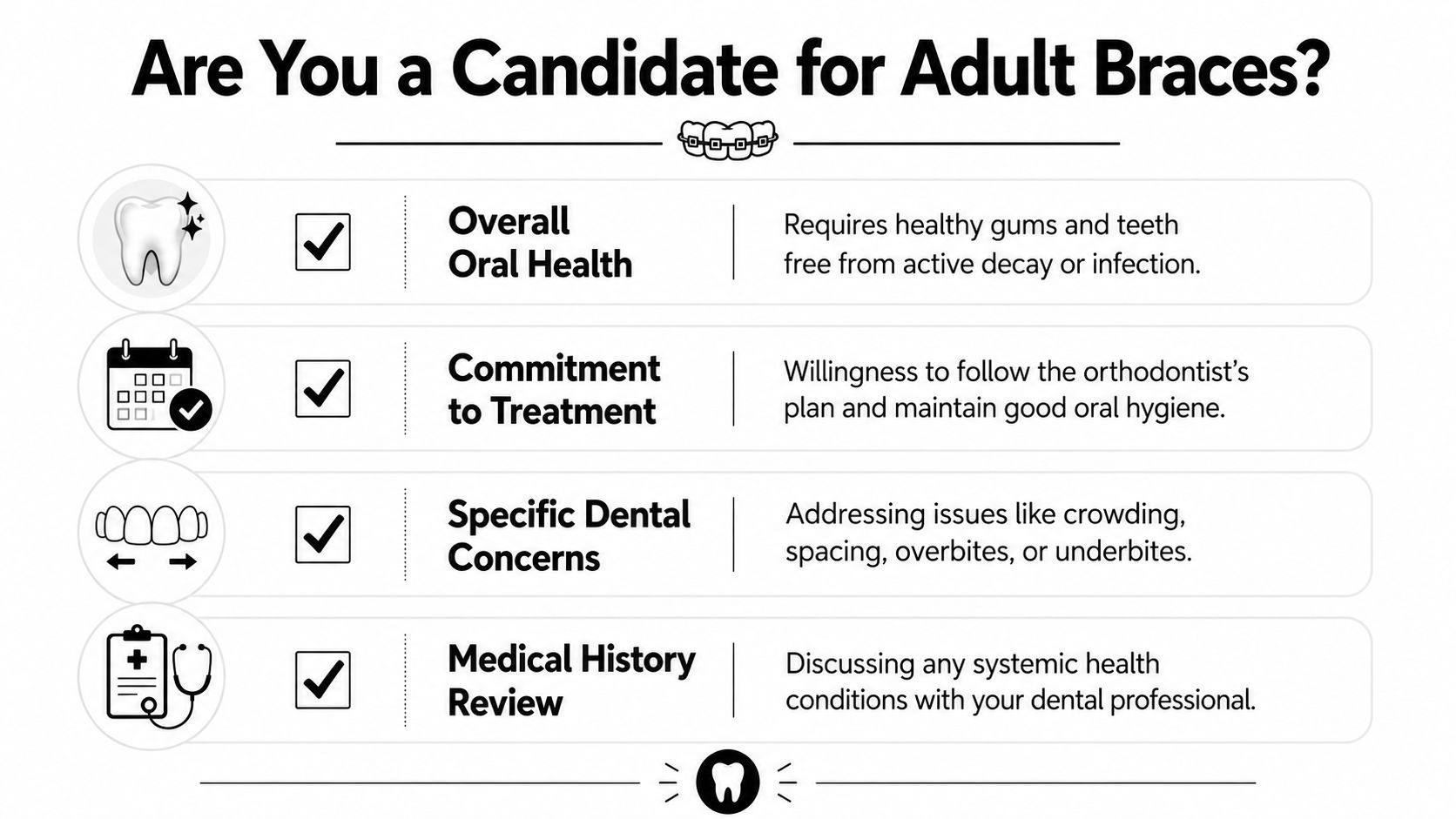
A patient's dental history significantly affects orthodontic planning. Existing implants can act as unmovable anchors to help facilitate tooth movement, while active gum disease must be treated before braces begin to prevent bone loss, according to adult braces planning considerations involving implants and gum disease. That single point is one of the biggest reasons adults need a thorough evaluation before choosing a system.
Existing crowns, implants, and gum concerns
Crowns and bridges don't always prevent orthodontic treatment, but they change force planning. Implants are different from natural teeth because they don't move with orthodontic pressure. That can be a limitation in one part of the mouth and an advantage in another, depending on the case.
Gum health matters just as much. If gums are inflamed or periodontal disease is active, braces can place stress on a foundation that needs treatment first. In those cases, the sequence matters more than the appliance. Stabilize the gums first. Then move teeth safely.
Adults who have searched for dental implants near me, restorative dentistry, or periodontal care often fall into this category. Their orthodontic plan needs to work with the dentistry they already have, not ignore it.
Mild, moderate, and complex cases
Not every appliance works equally well across every level of difficulty. For adult cases involving moderate crowding, clear aligners achieve treatment goals in only 65% to 75% of cases, while they succeed in 85% to 90% of mild cases, according to adult aligner success ranges by case difficulty. Fixed metal and ceramic braces generally provide better precision and long-term stability for complex malocclusions and severe bite correction.
That distinction matters. Adults often choose the least visible option first, then learn later that a more powerful system would provide a better result.
If your case is mild, aligners may be a strong fit. If your bite is more involved, fixed braces may give you a cleaner, more stable correction.
What makes someone a strong candidate
A strong adult braces candidate usually has a few things in place:
- Stable oral health: Active infection, untreated decay, or periodontal disease should be addressed first.
- Clear treatment goals: You don't need perfect terminology. You do need a clear sense of what's bothering you.
- Willingness to follow instructions: That means oral hygiene, appliance care, and consistent follow-up.
- A realistic plan: The right treatment has to fit your daily habits, not just your wish list.
For some adults, orthodontics is part of a bigger treatment plan that may also include cosmetic work, replacing missing teeth, or even a tooth extraction before alignment starts. That doesn't make treatment more intimidating. It means the planning needs to be more thoughtful.
Life with Adult Braces Comfort and Advanced Solutions
You have a work meeting in Katy at 8:30, coffee in one hand, phone in the other, and suddenly your new braces are rubbing your cheek or your aligners are still sitting on the bathroom counter. That is the part adults care about. Not just how teeth move, but how treatment fits into a real day.
The first week is usually the biggest adjustment. Expect pressure, some irritation, and slower meals while your mouth gets used to the appliance. After that, daily life usually settles down if the treatment plan matches your habits, schedule, and dental history.
Adults tend to do best when they set up for convenience early.
- Keep the basics with you: A travel toothbrush, floss aids, orthodontic wax, or an aligner case prevents small problems from turning into frustrating ones.
- Choose foods that will not fight the appliance: Fixed braces do better with softer, less sticky meals, especially after adjustments.
- Report problems early: A poking wire, loose bracket, cracked aligner, or sore area is easier to fix when you call promptly.
- Protect the result while you are in treatment: Missed visits, broken appliances, and inconsistent aligner wear can stretch treatment longer than expected.
Comfort is not only about soreness. It is also about how much effort treatment takes each day. Clear aligners are often easier for brushing and flossing, but they ask for steady wear and more self-discipline. Fixed braces remove that compliance issue, yet they usually require more care around food choices and cleaning. For many adults, the right option is the one they can follow reliably on a busy week, not the one that sounds best in theory.
Some adults also ask about advanced bracket systems such as self-ligating braces. These braces use built-in clips instead of small elastic ties, which can reduce plaque-trapping areas and may make wire changes more efficient, as described by the Cleveland Clinic overview of braces types. In practice, I tell patients not to choose a system based on marketing alone. The bracket design can help, but comfort also depends on the bite, the movement needed, and how inflamed the gums are when treatment starts.
That total picture matters more in adults than many people realize.
Crowns, bridges, implants, gum recession, and past dental work can all affect what feels comfortable and what moves safely. An implant, for example, does not move like a natural tooth. A heavily restored tooth may need a different approach than a healthy untouched tooth. If gum disease is active, orthodontic forces can make a bad situation worse until the gums are treated and stable. Adults usually need planning that accounts for the whole mouth, not just crooked teeth.
For patients with dental anxiety, comfort includes the appointment experience too. A calm setting, clear explanations, and support during more stressful visits often make the difference between starting treatment and avoiding it. The Dental Retreat provides clear aligner orthodontics alongside broader dental services, which helps adults who want one office coordinating orthodontics, hygiene, restorative work, and cosmetic planning in Katy.
A braces plan should work on an ordinary Tuesday. That standard leads to better follow-through, fewer interruptions, and a result that is easier to keep.
Understanding the Cost of Adult Braces in Katy TX
Most adults start with the same financial question. “What do braces cost?” That's reasonable, but it's also incomplete.
General price ranges are useful for comparing appliances, yet they often leave out the part that affects adults most after treatment ends. Most general price ranges for braces ignore the hidden long-term expenses of relapse and retention. Adults have a higher relapse rate and often require permanent retainers, which can become a significant post-treatment cost for patients without orthodontic insurance coverage, according to adult braces retention and relapse cost considerations.
The first price isn't the whole price
An appliance quote tells you what it costs to begin treatment. It doesn't always tell you what it may take to maintain the result. That matters for adults because teeth can keep shifting over time, especially if retainers aren't worn or maintained as recommended.
This is why the “cheapest” option on paper isn't always the lowest-cost option over the long term. If the appliance isn't right for the case, or if retention planning is weak, you may face added expense later.
Insurance, financing, and planning ahead
Insurance doesn't always make adult orthodontics simple. In the verified pricing data, only 58.8% of adult patients have a separate dental insurance plan, and many standard adult dental plans exclude orthodontic benefits, as noted in the earlier cost section source. That's why payment planning matters almost as much as appliance selection.
When adults in Katy Lakes, Marisol, or Ventanna Lakes compare treatment, a better question is often this:
- What is included in the treatment plan?
- What will retention look like after active movement ends?
- What happens if I need replacement retainers later?
- What financing or membership options can reduce strain on my monthly budget?
If you've also been looking for a dentist near me who can coordinate preventive care, restorative needs, cosmetic goals, and orthodontics in one place, that broader planning can help prevent surprises. The goal isn't just to start treatment. It's to choose a plan you can realistically complete and maintain.
Begin Your Smile Journey at The Dental Retreat
Starting is usually easier than people expect. The first visit should answer your questions, not pressure you into a decision.
At a consultation in Katy, the process typically begins with a full review of your teeth, gums, bite, and existing dental work. If you've had shifting teeth, crowding, old crowns, missing teeth, or concerns about gum health, those details need to be part of the conversation from the beginning. A complete exam may also connect orthodontics to other needs like preventive care, cosmetic treatment, restorative work, or urgent care if something painful has been ignored for too long.

What to expect at the first appointment
A useful consultation usually includes:
- A close evaluation of candidacy: Implants, crowns, gum status, and bite function are reviewed.
- Imaging and digital planning: Modern scans can help show tooth position clearly and support more precise planning.
- A treatment discussion in plain language: You should leave understanding which adult braces options fit your case and which don't.
- A financial conversation: Cost, retention, and payment options should be addressed without vague answers.
For adults who want to understand the role of different dental professionals during orthodontic care, this overview on what doctor handles braces treatment can be helpful.
A local path forward in Katy
If you live in Katy, TX, or in neighborhoods like Sunterra, Cane Island, Katy Manor, Kingscrossing, Lakehouse, Elyson, or Katy Lakes, the right next step is a personalized exam. That's how you find out whether clear aligners, traditional braces, or another approach makes the most sense for your smile, schedule, and dental history.
You don't need to have every answer before you book. You just need a starting point and a dental team willing to look at the full picture.
If you're ready to explore adult braces options with a clear plan and honest guidance, schedule a consultation with The Dental Retreat. Whether you're searching for a dentist in Katy, TX, a cosmetic dentist near me, help with dental care, or a practice that can coordinate orthodontics with implants, restorative work, and everyday preventive visits, the next step is simple. Reach out online or call to book your visit and get a treatment plan built around your teeth, your goals, and your life in Katy.