An apicoectomy is a minor surgery that removes the infected tip of a tooth's root and seals the end. Modern microsurgical treatment has reported success rates of 94%, compared with 59% for traditional root-end surgery. Most patients return to normal activity in a few days.
You may be reading this after a root canal that seemed finished, yet the tooth still feels tender when you bite. Perhaps there's a small bump near the gum, or the tooth treated months ago never feels normal. That situation can be frustrating, but it doesn't automatically mean extraction is your only choice.
An apicoectomy, also called root-end surgery, is typically considered when a prior root canal has failed or can't be retreated from inside the tooth. The procedure approaches the infection from the outside, removes the diseased root tip, and seals the cut end. For patients searching for a dentist near me or a dentist in Katy, TX, understanding that distinction can make the next consultation feel much less uncertain.
At The Dental Retreat in Katy, patients can discuss endodontic and oral surgery needs in a calm setting, including options for comfort and sedation. This guide explains what the apicoectomy procedure does, how it compares with retreatment or tooth extraction, what recovery can feel like, and how to arrange an evaluation near Sunterra, Cane Island, Katy Manor, Kingscrossing, Lakehouse, Marisol, The Grange, Anniston, Katy Lakes, Elyson, and Ventanna Lakes.
When a Tooth Still Hurts After a Root Canal
A tooth that remains sore after root canal treatment deserves an examination, especially if the discomfort persists, returns, or comes with swelling. You might notice tenderness while chewing, pressure around the gum, or a pimple-like bump that drains and then comes back. These signs don't identify the cause by themselves, but they tell you that the area needs careful evaluation rather than guesswork.
A root canal cleans and seals the inside of the tooth. Sometimes bacteria or inflamed tissue remains around the very end of the root, where the original treatment can't fully reach. A canal may also be unusually narrow, curved, blocked, or complicated by an existing post or restoration. In those situations, a tooth can continue to show disease even though the visible crown looks intact.
Practical rule: Persistent symptoms after a root canal should be assessed with an examination and dental imaging before anyone recommends another procedure.
An apicoectomy provides a second route to the problem. Instead of reopening the tooth through its crown and working down the canal, the dentist makes a small access point through the gum and bone to reach the root tip directly. The infected tip and nearby diseased tissue are removed, then the root end is sealed to reduce the chance of reinfection. The natural tooth remains in place if its overall structure and supporting tissues make preservation reasonable.
When an evaluation makes sense
An apicoectomy may enter the conversation when:
- Symptoms continue: Tenderness, swelling, or a gum bump remains after root canal treatment.
- Retreatment is difficult: The existing canal can't be safely accessed or cleaned because of its shape, blockage, or a post.
- Imaging shows a root-end problem: Dental X-rays or other imaging reveal disease concentrated around the apex.
- The tooth is structurally sound: The crown, root, and surrounding support may still offer a reasonable foundation for saving the tooth.
You can review the basics of the original treatment in this root canal procedure guide, then bring your questions to a Katy consultation. The important point is simple: a failed root canal calls for diagnosis, not an automatic leap to tooth extraction.
What an Apicoectomy Procedure Actually Does
The root is the part of the tooth anchored in the jawbone. Its tip, called the apex, contains the end of the root canal and sits beside the surrounding bone and soft tissue. If infection remains at that location, cleaning only from inside the tooth may not remove every source of inflammation.
The apicoectomy procedure reaches the area directly. After numbing the treatment site, the dentist opens the gum with a small incision, creates access through the bone, and removes the diseased root tip along with surrounding pathological tissue. A small filling is then placed at the cut root end to seal the canal from the outside. This is the core mechanical reason the procedure can address a root-end infection.
A simple way to picture the surgery
Think of a diseased garden stem that can't be treated from its base. The gardener trims the unhealthy end, removes damaged material around it, and seals the fresh cut so contamination can't enter. An apicoectomy follows a similar idea, but with dental instruments, magnification, and a biocompatible root-end filling.
The dentist generally follows this sequence:
- Examine and plan: Symptoms, tooth structure, and dental imaging help determine whether root-end surgery is appropriate.
- Create access: The gum is gently moved aside so the root tip and surrounding area can be reached.
- Remove the source: The infected apex and diseased tissue are excised.
- Seal the root end: A filling material closes the end of the canal from the surgical side.
- Close the tissue: The gum is repositioned and sutured so healing can begin.
Modern microsurgical techniques have changed how clinicians perform this treatment. A dental operating microscope improves visibility, while ultrasonic tips can help prepare the root end with controlled, precise movements. In a widely cited meta-analysis, traditional root-end surgery had a pooled success rate of 59% across 12 studies involving 925 teeth, while microsurgical endodontic surgery reached 94% across 9 studies involving 1,326 teeth (endodontic surgery meta-analysis).
The filling matters, too. A controlled clinical trial reported 96% clinical success with mineral trioxide aggregate, or MTA, compared with 90.8% with silver amalgam, and found that surgical technique was independently associated with healing (clinical trial on microsurgical technique and root-end materials). Those findings help explain why a consultation should include questions about magnification, root-end preparation, sealing material, and the specific anatomy of your tooth.
Apicoectomy vs Retreatment vs Extraction With Implant
A tooth that remains painful after a root canal can leave you weighing three different paths. Retreatment approaches the problem from inside the tooth. Apicoectomy reaches the root tip through the gum and nearby bone. Extraction with an implant removes the natural tooth and replaces it after the site is prepared and healed.
The right choice depends on the tooth's condition, not on one treatment being universally better. Your dentist will consider the quality of the existing root canal, the stability of the crown, the root's position and shape, the supporting bone, and whether enough healthy tooth structure remains for restoration.
| Factor | Root canal retreatment | Apicoectomy | Extraction with implant |
|---|---|---|---|
| Where treatment works | Through the existing crown and canal system | Through the gum and bone at the root tip | Removes the tooth, then replaces it with an implant restoration |
| When it may fit | The canal can be accessed, cleaned, and resealed | The infection is concentrated at the root end or the canal is difficult to reach | The tooth is cracked, unrestorable, or no longer a sensible candidate for preservation |
| Main advantage | Keeps the natural tooth while addressing the inside | Keeps the natural tooth without reopening a difficult canal | Provides a replacement when saving the tooth isn't predictable |
| Main trade-off | Existing crowns, posts, or blocked canals can complicate access | Requires a surgical incision and depends on root anatomy and technique | Removes the natural tooth and involves implant planning, healing, and restoration |
| Questions to ask | Can the entire canal be reached safely? | Is the crown stable and is the root tip accessible? | What will replace the tooth, and how will the bite be restored? |
Retreatment may be the more direct option when the original canal filling is incomplete or poorly sealed and the canal can be entered safely. Access becomes more difficult when a post blocks the canal, the canal curves sharply, or instruments cannot reach the suspected source of infection. In those situations, working from the root tip may provide a more focused route.
An apicoectomy can preserve a natural tooth when the crown is stable and the problem is concentrated near the root end. The procedure is not a promise that the tooth will never need care again. It removes a defined area of infection or inflammation while keeping the tooth available for chewing.
Extraction with an implant may make more sense when a crack extends through the root, too little tooth structure remains to support a crown, or preservation has a poor outlook. An implant replaces the missing tooth, but it does not preserve the original one. It also involves its own surgical planning, healing, and restoration. This guide to what to expect with dental implants explains that replacement pathway in more detail.
Long-term results vary by the tooth and the patient. A cohort of 93,797 teeth from 77,636 patients reported a 3-year cumulative survival rate of 81.6% after apicectomy (long-term apicectomy cohort). In that same cohort, survival was about 84.0% for anterior teeth, 80.0% for premolars, and 80.2% for molars (long-term apicectomy cohort). The results also varied by age, from 93.3% in patients under 18 to 75.6% in patients over 84 (long-term apicectomy cohort). These group findings cannot predict one person's outcome. At The Dental Retreat in Katy, a consultation can connect the clinical findings with your comfort needs, including questions about sedation, a calmer spa-like setting, and transparent specials when available.
Your Day at The Dental Retreat in Katy
A first visit should begin with information, not pressure. At The Dental Retreat on Stockdick School Rd. in Katy, the appointment can start with a discussion of your symptoms, previous root canal treatment, medical history, and concerns about surgery. Dental X-rays and other appropriate imaging help the clinician see the root, surrounding bone, and nearby anatomy before discussing whether an apicoectomy makes sense.

Before treatment, you'll receive instructions about eating, medications, transportation, and what to expect afterward. Tell the team about every medication, allergy, health condition, and previous sedation experience. Those details help the clinician choose a safe anesthetic and sedation plan.
Comfort is part of clinical planning
Some patients are comfortable with local anesthetic alone. Others feel calmer with oral sedation, while patients with substantial dental anxiety may ask about IV sedation. The appropriate level depends on your health history, the planned procedure, the clinician's assessment, and whether you have a responsible adult available to drive you when required.
The setting can influence how manageable the visit feels. Aromatherapy, massage and heated chairs, noise-cancelling headphones, and TVs in every operatory give anxious patients practical ways to reduce sensory stress while the team works. These amenities don't replace careful anesthesia or monitoring, but they can make it easier to remain relaxed and informed.
The procedure itself involves numbing, access to the root tip, removal of diseased tissue, root-end sealing, and closure of the gum. You shouldn't feel sharp pain while the area is properly anesthetized, though you may notice pressure, vibration, or movement. The team should explain each stage and give you a chance to pause if you feel overwhelmed.
A short video can help you visualize the consultation and treatment environment before arriving.
After checkout, you'll receive written recovery instructions and guidance about medications, food, oral hygiene, and follow-up. Extended hours can help families coordinate care around work and school, and bilingual support can make questions easier for patients and relatives in Sunterra, Cane Island, Katy Manor, Kingscrossing, Lakehouse, Marisol, The Grange, Anniston, Katy Lakes, Elyson, and Ventanna Lakes.
Recovery Timeline From Day One Through Full Healing
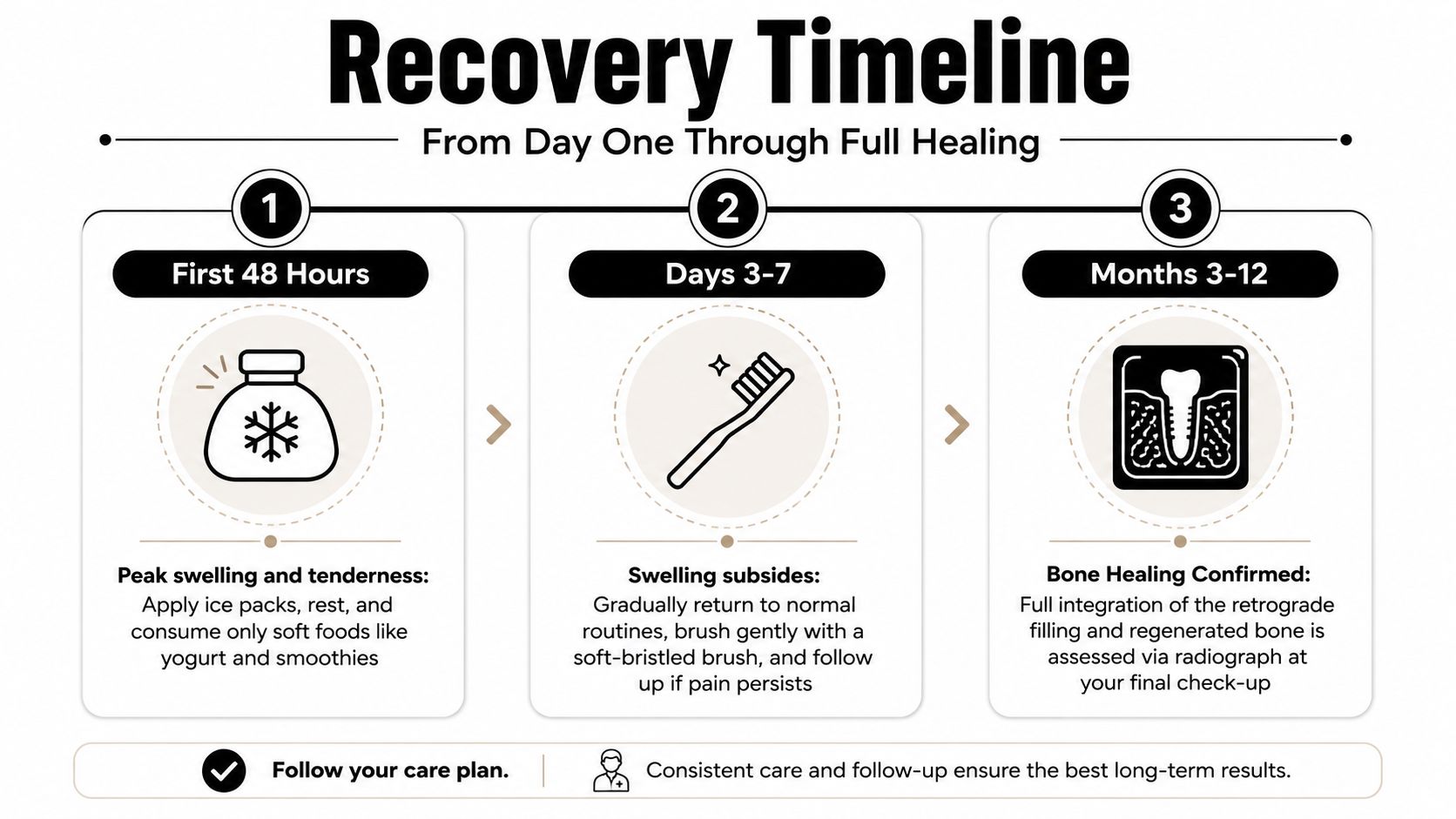
The first day is usually more noticeable than the procedure itself. Once the anesthetic fades, the gum may feel tender and the area can swell. Postoperative pain and swelling typically peak within the first 48 hours, according to clinical guidance on apicoectomy recovery (postoperative care and healing issues after apicoectomy).
Use an ice pack as directed, choose soft foods, rest, and take prescribed or recommended medication according to your dentist's instructions. Don't probe the incision with your tongue or fingers, and don't assume that more activity will speed healing.
What the first week can feel like
By days three through seven, many patients find that swelling and tenderness are settling, and ordinary routines become easier. Brush carefully with a soft-bristled brush, keep food away from the surgical area as advised, and follow the specific instructions for rinsing and suture care.
Contact the practice if pain is worsening rather than easing, swelling continues to increase, you develop concerning drainage or fever, or the wound appears to reopen. A small amount of soreness doesn't automatically signal failure, but a changing or escalating pattern deserves professional review.
Tooth location changes the risk discussion. Upper molars may sit close to the maxillary sinus, where sinus membrane perforation is a recognized surgical concern. Lower molar surgery can involve temporary nerve irritation or tingling, while wound dehiscence and root or bone fracture are recognized risks that depend on anatomy and flap design. Your clinician should explain which risks apply to your tooth, rather than giving you a generic warning.
What follow-up checks
Soft-tissue healing happens before the bone fully remodels. Follow-up dental X-rays help the dentist assess whether the area around the root is healing as expected. A major review reported that 95% to 97% of cases judged successful at 1 year remained successful at 5 years, although individual outcomes depend on diagnosis, tooth condition, technique, and follow-up (review of endodontic surgery outcomes).
Save this simple checklist:
- Do: Use cold therapy, rest, eat soft foods, and follow the medication plan.
- Do: Brush gently and attend the scheduled review.
- Don't: Smoke, disturb the incision, or chew hard foods on the treated side unless your dentist says it's safe.
- Don't: Ignore increasing pain, swelling, drainage, altered sensation, or sinus symptoms.
A 2025 meta-analysis found that guided regeneration didn't significantly improve healing or treatment success in through-and-through bone defects. That doesn't mean regenerative materials are never useful. It means adding a material isn't automatically better for every defect, so treatment should match the anatomy rather than follow a one-size-fits-all formula.
Cost, Insurance, and Payment Options in Katy
The price of an apicoectomy varies with the tooth's location, the difficulty of access, the imaging required, the restoration on top of the tooth, and whether microsurgical care is appropriate. Ask for a written estimate that separates the surgical procedure, imaging, anesthesia or sedation, follow-up, and any crown or restorative work.
Dental insurance may classify apicoectomy as an endodontic benefit, but coverage levels and exclusions differ by plan. Your benefits may also depend on deductibles, annual limits, waiting periods, network rules, and whether the tooth meets the insurer's clinical criteria. The dental office can help you request a pre-treatment estimate, but the insurer's explanation of benefits remains the final statement of coverage.
Ask before treatment: Which parts of the visit are included, what insurance is expected to pay, and what balance could remain after the claim is processed?
The Dental Retreat offers several ways to manage surrounding dental care for patients in Katy who are uninsured or comparing options. New patients without insurance can ask about the $99 exam with cleaning and X-rays, while a focused concern can qualify for a $49 problem-focused visit, subject to the practice's current terms. These visits may help establish the diagnosis, but they don't automatically include the apicoectomy itself.
Patients considering cosmetic care can also ask about $350 in-office Zoom whitening, while the membership plan starts at $299 per year and includes savings for periodontal maintenance. Those offers may be relevant if you need broader dental care, although they should be treated as separate services from root-end surgery.
A transparent conversation should also cover payment timing and available financing or membership arrangements. If you're comparing an apicoectomy with a tooth extraction, dental implants near me, or future restorative dentistry, request a complete treatment sequence rather than comparing one isolated procedure price with another.
Patient Questions and Booking the Next Step
Will the apicoectomy hurt?
The area is numbed during surgery, so patients generally feel pressure or vibration rather than sharp pain. Tenderness and swelling are common afterward, particularly during the early recovery period, and your dentist will explain medication and home-care instructions.
How long does the procedure take?
The appointment length depends on the tooth, root anatomy, imaging findings, surgical access, and sedation plan. Ask the team for an estimate after they examine your X-rays and medical history.
Is the tooth really saved?
The tooth remains in your mouth, but preservation isn't the same as a guarantee of lifelong success. Modern microsurgical outcomes are substantially stronger than older approaches, and long-term research shows that survival can decline over time. Your personal outlook depends on cracks, restorability, periodontal support, root shape, sealing, and the quality of the existing restoration.
What happens if it doesn't work?
Your dentist will reassess the symptoms and imaging. Depending on the cause, the next discussion may involve observation, another endodontic opinion, retreatment, or extraction followed by a replacement such as a dental implant. A failed apicoectomy doesn't mean you made the wrong decision. It means the tooth's response needs to be evaluated carefully.
If persistent pain, swelling, or a recurring gum bump is making you search for an emergency dentist, contact The Dental Retreat rather than waiting for symptoms to become harder to manage. The Katy practice offers extended hours, sedation options for anxious patients, and a spa-inspired environment designed to make advanced care feel more approachable.
The Dental Retreat provides endodontic evaluations and oral surgery in Katy, including consultations for patients considering an apicoectomy procedure after an unsuccessful root canal. Visit The Dental Retreat to request a consultation on Stockdick School Rd. and discuss imaging, sedation, recovery, and payment options with the team.