You can wake up with a sore jaw, tight temples, or teeth that feel unusually sensitive and still not know what's causing it. If a partner has mentioned grinding at night, or you've noticed that your jaw feels tired before breakfast, bruxism is a strong possibility. In Katy, TX, patients from Sunterra, Cane Island, Katy Manor, Kingscrossing, Lakehouse, Marisol, The Grange, Anniston, Katy Lakes, Elyson, and Ventanna Lakes often come in looking for a clear answer, not a lecture, and a good dental visit should give them exactly that.

Bruxism is common, but that doesn't make the pain feel routine. Adult sleep bruxism is commonly estimated around 8%, awake bruxism around 20%–31%, and a 2024 meta-analysis estimated a global pooled prevalence of 22.22% across sleep and awake forms (NCBI Bookshelf review). That's why so many patients need a practical plan, not just reassurance.
A calm exam can make a big difference. A trusted dentist in Katy, TX can look for worn teeth, jaw muscle tenderness, and signs that your bite is taking repeated stress, then match the treatment to what's happening. That's the heart of good bruxism treatment options, because protecting teeth, relieving pain, and reducing grinding are related, but they're not the same thing.
Waking Up to the Signs of Teeth Grinding
The first clue is often in the mirror, or in the way the jaw feels when the day starts. A patient may say their jaw feels tight before coffee, their temples ache, or their bite feels slightly different when they close down. Sometimes the only sign comes from a partner who notices the grinding at night.
What patients usually notice first
Bruxism does not always show up as one clear symptom. It may appear as morning soreness, tension headaches, jaw stiffness, or teeth that feel more sensitive than they used to. Because the grinding often happens during sleep, many people do not realize it is happening until pain or visible wear brings it to light.
Early care matters because repeated clenching and grinding can affect enamel, restorations, and the jaw muscles. Patients from Katy, TX and nearby neighborhoods often tell me they assumed they were just sleeping in a bad position, then later noticed the problem had been building for months.
Practical rule: If the jaw feels tired more than once in the morning, it should be checked before a cracked tooth becomes the first clear warning.
A calm, judgment-free visit helps. People who are already stressed about pain usually do better when symptoms are taken seriously and explained in plain language, instead of being dismissed as simple clenching.
Why the symptoms matter
Grinding and clenching can overload the teeth and the muscles that move the jaw. Over time, that repeated force can leave teeth looking shorter, flatter, or more worn, and it can keep the jaw sore long after waking up.
If you are in Sunterra, Cane Island, or Elyson, the next step is a professional evaluation so the cause, the severity, and the right kind of care can be sorted out with confidence.
Understanding Bruxism and How It Is Diagnosed
Bruxism is the involuntary clenching or grinding of the teeth. It can happen during sleep or while awake, and the two forms often behave differently. Sleep bruxism tends to be unconscious, while awake bruxism is more often tied to stress, concentration, or habit.
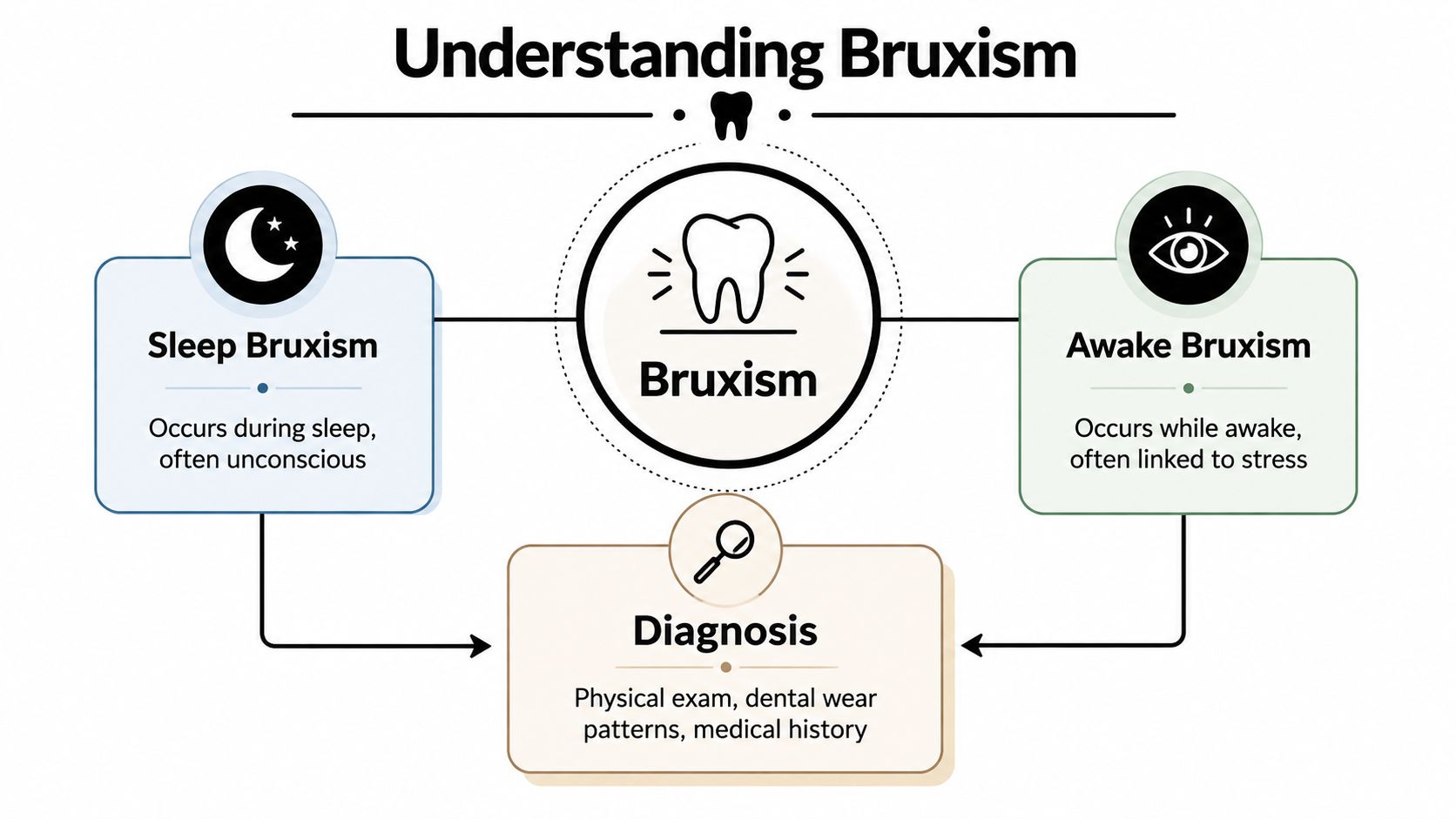
How a dental exam reveals the pattern
Diagnosis starts with the history you give the dentist. When does the pain happen? Do you wake with soreness? Has anyone heard you grind at night? Those details matter because a mouthguard can protect teeth without necessarily telling us why the grinding started.
A clinical exam then looks for signs like worn enamel, chipped or fractured restorations, and tenderness in the chewing muscles. Dental x-rays can help rule out other causes of pain and show whether the teeth or supporting structures have been affected in ways that aren't visible at a glance.
The process is a lot like looking for wear on a tire. One small patch might not mean much, but a consistent pattern across several teeth tells a clearer story about repeated force over time.
Why bruxism isn't just a bad habit
Bruxism isn't as simple as “stop doing that.” It can involve sleep, stress, jaw mechanics, and other health factors, which is why a proper new patient exam matters. A careful evaluation helps separate tooth wear from the broader picture, so treatment doesn't miss the driver.
A good diagnosis doesn't just name the problem, it tells you whether the goal is protection, pain relief, or behavior change.
The best dental care looks at the whole pattern, not just the symptom. That's especially important for patients in Katy Manor, Kingscrossing, and Lakehouse who want a clear answer before choosing a guard, a medication discussion, or a referral.
The Three Goals of Bruxism Treatment
A patient often sits down expecting one answer, then learns that bruxism treatment has to serve different jobs at once. A night guard may protect enamel and restorations, while pain relief, sleep support, and stress screening address what is driving the grinding in the first place. Botox can reduce muscle activity in selected cases, but it does not give a permanent cure. The right plan depends on which goal matters most right now.

Protecting teeth and restorations
The first goal is structural protection. Management is usually aimed at tooth and restoration protection, reducing bruxism activity, and pain relief, and there is currently no treatment proven to permanently stop sleep bruxism (NCBI Bookshelf review). That is why guards and splints are so common in everyday dentistry, especially in a teeth grinding night guard plan that is designed to absorb force before it reaches the enamel.
Protection matters even more for patients who already have crowns, fillings, veneers, or other dental work. Repeated grinding can shorten the life of those restorations and create a cycle of repairs if the force is not controlled. If the teeth are already damaged, restorative dentistry may still be part of the plan later, but the first step is usually to prevent more wear and fracture.
Relieving pain and muscle tension
The second goal is comfort. Some patients need help with jaw soreness, headaches, or facial tightness before the grinding pattern is fully addressed. Short-term pain control, muscle relaxation strategies, and sometimes physical therapy-style support can make daily function easier while the broader plan is taking shape.
Pain control and tooth protection are related, but they are not the same target. A patient can feel better while the muscles are still active, and a guard can protect the teeth without fully relieving soreness. That trade-off needs to be explained clearly so expectations stay realistic.
Reducing the grinding behavior
The third goal is behavior reduction, and it is usually the hardest one to achieve. For awake bruxism, habit reversal and relaxation can help more than a passive dental device alone because the patient can learn to notice clenching and interrupt it. For sleep bruxism, the behavior is harder to change directly, so treatment often focuses on reducing harm and checking for sleep or stress factors that may be keeping the pattern going.
I see the clearest progress when the plan matches the goal. Protect the teeth first if wear is active, treat pain if the jaw is sore, and look for sleep or stress contributors when the clenching keeps returning. A single approach rarely does all three jobs well.
Comparing Bruxism Treatment Options and Expected Outcomes
The cleanest way to compare bruxism treatments is to ask a practical question, what does each option change in the mouth, in the muscles, or in the sleep pattern? Some treatments mainly protect teeth. Some focus on soreness. A smaller group may reduce bite force, but even then, they do not reliably stop the grinding itself.
| Treatment Type | Best For | What It Actually Does | Typical Trade-Off |
|---|---|---|---|
| Occlusal guard or appliance | Patients with active wear, fractures, or sensitive restorations | Creates a physical barrier between the teeth and spreads force more safely | Helps protect teeth, but usually does not change the grinding habit on its own |
| Behavioral therapy and habit reversal | Awake clenching and daytime jaw tension | Trains awareness of triggers, posture, and clenching patterns so the patient can interrupt them | Works best when the patient can notice the habit during the day |
| Sleep hygiene and stress-focused care | Patients whose symptoms track with poor sleep or high stress | Addresses sleep quality, tension, and habits that keep the nervous system switched on | Often helps more when the cause is part of the problem, not the only treatment |
| Pharmacologic approaches | Selected patients with persistent symptoms | May ease discomfort in some cases, but does not consistently stop grinding | Needs careful review because results are limited, especially for sleep bruxism (PubMed consensus) |
| Botulinum toxin type A | Severe or stubborn cases with strong jaw activity | Lowers muscle activity in the masseter and/or temporalis, sometimes repeated every 3–6 months (USC overview) | Can help with pain and force, but the effect on grinding frequency is still uncertain (USC overview) |
| Restorative dentistry or replacement care | Teeth that have already worn down, chipped, or fractured | Repairs damage after the grinding pattern is better controlled | Restores function and appearance, but it is not a primary anti-grinding treatment |
A night guard is usually the first step because it is practical and conservative. It can protect enamel, crowns, and fillings from more damage while the rest of the plan is sorted out, which is why so many dentists start there. If you want a closer look at that option, the teeth grinding night guard treatment approach explains how it fits into care.
Why the first choice is often protection
In routine dental practice, a well-made guard is still the most common starting point because it is noninvasive and easy to fit into daily life. It does one job well. It shields the teeth from force while the dentist and patient decide whether the bigger issue is awake clenching, sleep-related grinding, or both.
That trade-off matters. A patient may feel more confident because the teeth are protected, yet still wake with jaw tightness if the muscles remain active. Another patient may have less soreness after a therapy-based plan, but still need a guard if the bite surfaces are already wearing down.
Where therapy, medication, and botox fit
Behavioral treatment makes the most sense when the clenching happens during the day. Patients can learn to catch themselves, relax the jaw, and change the pattern before the muscles stay loaded for hours. That kind of work is slower than putting in a guard, but it can change the habit itself in a way a passive appliance cannot.
Medication is a narrower tool. It may be used in selected situations for symptom relief, but the goal is not a dependable stop to the grinding pattern, especially at night. Botulinum toxin type A sits in a similar middle ground. It can reduce muscle force and may help patients who have persistent pain or strong jaw activity, yet it is usually reserved for cases where simpler measures have not been enough.
Restorative dentistry belongs later in the plan, once the active forces are under better control. Crowns, bonding, or replacement care can rebuild worn teeth, but those repairs can fail sooner if the clenching pattern is still heavy. In other words, repair can restore what was lost, while the guard, behavior work, or muscle treatment tries to limit more loss.
When Bruxism Connects to Sleep and Stress
A mouthguard can protect the teeth, but it will not stop every reason the grinding continues. If the jaw still feels tight after protection is in place, the next questions should be about sleep quality, stress load, stimulant use, and medications. Looking at the whole picture often changes the outcome more than adding another appliance.
What to look at next
Authoritative patient guidance emphasizes sleep hygiene, stress management, and evaluation for sleep problems rather than relying only on dental appliances (Mayo Clinic). That matters most when nighttime grinding continues even though the teeth are already protected. It also helps to read more about understanding what causes teeth grinding at night before deciding whether the problem is mainly dental, sleep-related, or stress-related.
If the pattern seems tied to daytime clenching, awake bruxism often responds better to habit reversal, relaxation techniques, and self-monitoring than sleep bruxism does. A patient who notices the jaw tightening during work, driving, or concentration can often make progress with awareness and retraining. If the pattern seems tied to nighttime awakenings, snoring, or unrestful sleep, a sleep medicine referral may be the right next step.
Here is a practical checklist for the visit when the guard alone is not enough:
- Sleep quality: Poor sleep can keep the nervous system primed for clenching.
- Stress and anxiety: Tension often shows up in the jaw first.
- Stimulant use: Caffeine, nicotine, and other stimulants can keep the body keyed up.
- Medication review: Some medications can be part of the conversation with a physician when grinding persists.
When a referral makes sense
A dental visit should not stop at the teeth if the symptoms point elsewhere. Snoring, interrupted sleep, or another sleep concern may make a sleep study more useful than another guard. If anxiety or chronic stress is driving the pattern, behavioral health support can be part of the overall plan.
The best care path is often collaborative. Dental protection, medical review, and stress screening can work together instead of competing with one another.
For patients in Katy, TX, including neighborhoods such as Katy Manor, Kingscrossing, Lakehouse, Marisol, and The Grange, that broader approach often turns a frustrating loop into a plan that feels manageable. It keeps the focus on protecting the mouth while also looking for the reasons the grinding keeps coming back.
Choosing a Trusted Dentist for Bruxism Care in Katy TX
A good bruxism visit should feel organized, calm, and personal. You want a dentist who can explain whether the main concern is protection, pain relief, or behavior reduction, then recommend care that fits your symptoms instead of handing you a one-size-fits-all answer.
What a strong visit should include
The best appointments usually start with a focused exam, a look at wear patterns, and a discussion of sleep, stress, and any medications or habits that could be contributing. If there's damage already, the plan may also connect bruxism care with restorative dentistry, emergency dentistry, or future cosmetic repair where needed.
For anxious patients, the setting matters too. A spa-inspired office with aromatherapy, massage or heated chairs, and noise-cancelling headphones can make a real difference when you're already dealing with jaw pain and poor sleep. That comfort doesn't replace clinical skill, but it does make care easier to accept and follow through on.
What to expect as a new patient in Katy
Patients coming from Katy, TX, including Katy Manor, Kingscrossing, Lakehouse, Marisol, The Grange, Anniston, Katy Lakes, and Ventanna Lakes, often want a simple path into care. Accessible options matter, especially for people who have been putting off treatment because they don't have insurance or aren't sure how serious the problem is.
A local practice should be ready to help you sort out whether you need a night guard, a deeper diagnostic visit, or follow-up care for worn teeth. If you're also thinking about cleaning and exams, dental x-rays, tooth extraction, dental implants near me, cosmetic dentist near me, or an emergency dentist, it helps to choose a team that can handle those services under one roof.
If you're searching for a dentist near me or a dentist in Katy, TX who takes grinding seriously, choose one that treats the whole problem, not just the symptoms.
If you're waking up with jaw pain, tooth sensitivity, or a partner's complaint about grinding, don't wait for the wear to get worse. Visit The Dental Retreat in Katy, TX for a focused bruxism evaluation, personalized treatment planning, and a calm setting that makes it easier to get the right care. If you've been looking for a trusted dentist near you, this is the time to schedule a consultation and protect your smile.