No-prep veneers are ultra-thin ceramic or composite shells, usually about 0.3 to 0.5 millimeters thick, bonded to teeth with little to no enamel removal. They offer a minimally invasive way to improve smile shape, spacing, and color, but only when adding a thin layer creates a natural result.
You may be searching “what is no prep veneers” after seeing photos of bright, even smiles and wondering whether you can improve your teeth without drilling away healthy enamel. That concern is understandable. Many people want cosmetic dentistry, but feel uneasy about irreversible changes, sensitivity, or ending up with teeth that look too large.
No-prep veneers can be a conservative option, not a universal shortcut. A careful dentist needs to assess your enamel, bite, tooth position, shade, gum health, and smile goals before recommending them. For patients in Katy, TX, including Sunterra, Cane Island, Katy Manor, Kingscrossing, Lakehouse, Marisol, The Grange, Anniston, Katy Lakes, Elyson, and Ventanna Lakes, The Dental Retreat provides cosmetic, restorative, orthodontic, implant, oral surgery, and emergency dental services in one practice.
Your Path to a Brighter Smile Without Drilling
A patient sits in the consultation chair and says, “I want to feel comfortable smiling, but I don't want healthy teeth shaved down.” That request comes up often in cosmetic dentistry. The patient may have small teeth, mild spacing, uneven edges, or a smile that looks dull in photographs. They're not necessarily asking for a dramatic transformation. They want a brighter, more balanced version of their own smile.
No-prep veneers answer that concern by adding a very thin shell to the visible tooth surface. The shell may be made from ceramic or composite and is bonded with little to no enamel removal. Clinical descriptions of the technique place many no-prep veneers at about 0.3 to 0.5 millimeters thick, which is why existing tooth size and spacing matter so much. A shell that looks delicate on a small tooth can feel bulky on a tooth that already fills its space.

A conservative option still needs a precise plan
The word “no-prep” can sound like a simple cosmetic application, but the dentist still has to plan the final contours carefully. Your bite determines how the upper and lower teeth meet. Your smile line affects how much tooth and gum show. Your enamel condition affects how reliably the veneer can bond.
That's why honest case selection matters more than the label on the treatment. If your teeth need significant movement, major shade masking, or substantial reshaping, another approach may look and function better. Clear aligners, minimal-prep veneers, composite bonding, traditional porcelain veneers, teeth whitening, or restorative dentistry may be more suitable depending on the diagnosis.
A useful question to ask: “Can my smile improve by adding a thin layer, or does the tooth need space created first?”
The Dental Retreat in Katy, TX, approaches cosmetic treatment through consultation and planning rather than assuming every patient needs the same veneer design. A calm visit can include a discussion of your concerns, dental cleaning and exams when appropriate, dental X-rays, digital planning, and an explanation of alternatives. If you're also looking for a cosmetic dentist near me, an emergency dentist, tooth extraction, or dental implants near me, the same practice can evaluate those needs as part of your broader oral health plan.
Understanding No Prep Veneers and Enamel Preservation
Think of a contact lens. It rests on the surface of the eye without changing the eye's shape. A no-prep veneer follows a similar idea, although teeth and eyes are very different tissues. The veneer sits over the visible enamel and bonds to it instead of requiring the dentist to remove a substantial layer first.
The shells may use feldspathic porcelain, other ceramic systems such as lithium disilicate, or composite material. The material choice depends on the tooth, the desired translucency, the amount of correction needed, and how the restoration will function in your bite. Ultra-thin fabrication helps preserve a natural profile, but thinness alone doesn't guarantee a natural result.
Why enamel matters
Enamel provides a valuable bonding surface. Adhesive dentistry can create a more predictable connection when the veneer bonds primarily to intact enamel rather than to dentin exposed through deeper preparation. Preserving that surface may support retention and reduce concerns related to debonding, although no restoration is risk-free.
A 9.06-year prospective comparison of 186 veneers, including 102 no-prep or minimally invasive veneers, reported a 100% survival rate for the no-prep group under the study's strict Kaplan–Meier analysis, while the conventional group showed 9.67% survival under those same criteria. The authors' analysis and discussion are available in this prospective veneer comparison. That result should be read in context. It comes from a specific study design and doesn't mean every no-prep veneer will last indefinitely.
The phrase “no prep” also doesn't always mean that nothing changes. A dentist may perform minor contouring, polish a small area, or adjust gum tissue when necessary to create a clean margin. Those details should be explained before treatment so you know whether your proposed plan is additive or minimally modified.
What the bond can and cannot do
The bond holds the veneer against the tooth, but it can't correct every underlying problem. A veneer can add width or length. It can't reliably make a severely crowded tooth disappear behind a thin shell, and it may not hide a dark tooth without becoming too opaque or thick.
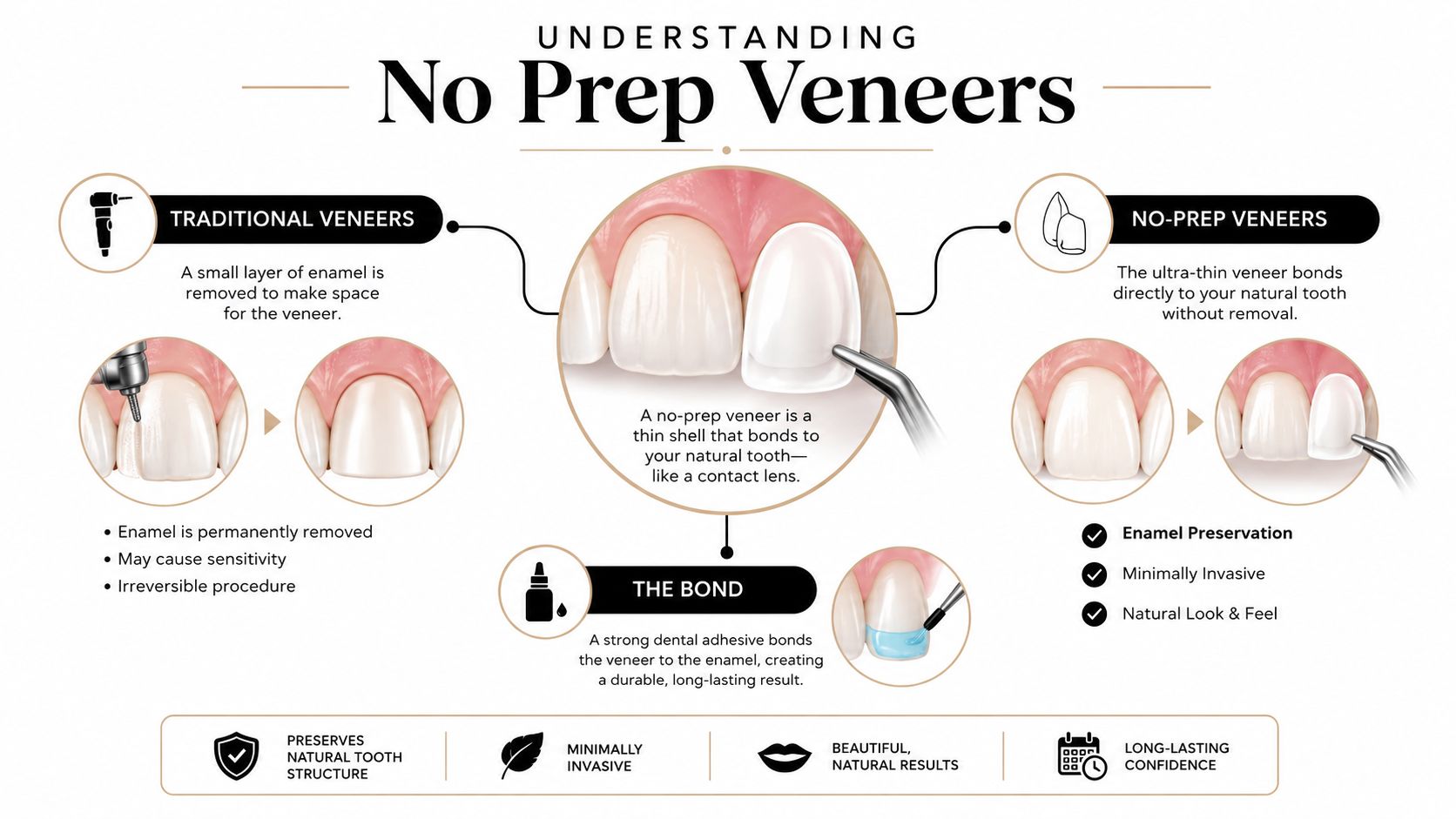
A short visual explanation can help patients understand the difference between adding a shell and creating space for a restoration.
No Prep Veneers vs Traditional Porcelain Veneers
The choice isn't simply between “less drilling” and “more drilling.” No-prep and traditional porcelain veneers solve different design problems. A no-prep veneer adds material to the tooth. A traditional veneer usually involves controlled enamel reduction so the dentist can place the restoration within a planned contour.
Published clinical guidance describes conventional veneer reduction as roughly 0.3 to 1.0 millimeters, depending on the area and treatment needs, while no-prep designs aim to preserve enamel when the case allows it. The clinical review of veneer preparation and case selection explains why this trade-off matters for contour, color masking, alignment, and bite management.
| Feature | No Prep Veneers | Traditional Porcelain Veneers |
|---|---|---|
| Typical design | Ultra-thin shell added to the tooth | Porcelain shell placed after planned enamel reduction |
| Enamel reduction | Little to none in suitable cases | Often requires controlled reduction for space and contour |
| Reversibility | May preserve more structure, but removal can still affect the surface | Enamel removal makes treatment irreversible |
| Anesthesia | Often unnecessary, depending on any contouring | More likely when preparation is required |
| Ideal use | Small teeth, mild spacing, slight shape changes, selected color refinement | More significant reshaping, alignment changes, or color masking |
| Main limitation | Added thickness can look or feel bulky | More invasive and requires a permanent commitment |
The transformation determines the technique
Suppose your teeth are narrow and slightly spaced. Adding thin shells may close the spaces while keeping the teeth proportionate. If your teeth are already prominent, adding the same thickness could push the smile outward or affect how your lips rest.
Traditional porcelain veneers can offer more room for contour control and shade masking. They may be appropriate when a patient needs a larger change in tooth position, shape, or color. That doesn't make them better for every smile. It means the dentist has more physical space to work with.
Some patients may benefit from a combined plan. A dentist might use minimal preparation on selected teeth and no-prep veneers on others so the final smile remains balanced. The right decision comes from examining the actual teeth, not from choosing the option with the most appealing advertising phrase.
Who Is a Good Candidate for No Prep Veneers
No-prep veneers work best when the desired improvement can come from adding volume rather than removing structure. The teeth generally need enough room for a thin shell to sit without creating an over-contoured appearance. The arches should also be reasonably aligned, and the enamel should provide a sound bonding surface.
Good candidates may include patients with:
- Small or narrow teeth: A thin shell can improve proportion without making the smile look oversized.
- Minor spacing: Small gaps may be reduced when the added width remains harmonious with the rest of the smile.
- Mild discoloration: Limited shade concerns may respond well when the veneer can remain thin and translucent.
- Minor shape irregularities: Uneven edges or small contour concerns may be refined without aggressive reduction.
- Healthy supporting tissues: Gum health, enamel condition, and bite stability all affect planning.
The underlying evidence supports caution. A retrospective evaluation of 108 no-prep porcelain laminate veneers in 21 patients reported 97.4% survival over a mean observation period of 43.1 months, with an overall success rate of 91.0% and 7 total failures. The published evaluation is available in this no-prep porcelain veneer study. Those results are favorable, but they apply to a selected treatment group, not to every person who wants veneers.
When another option may fit better
No-prep veneers may be a poor match when teeth are severely crowded, already large, heavily restored, significantly darkened, or affected by an unstable bite. Heavy bruxism can also increase stress on veneers. In those situations, clear aligners may improve tooth position first, minimal-prep or traditional veneers may provide better contour control, or composite bonding may offer a different balance of repairability and aesthetics.
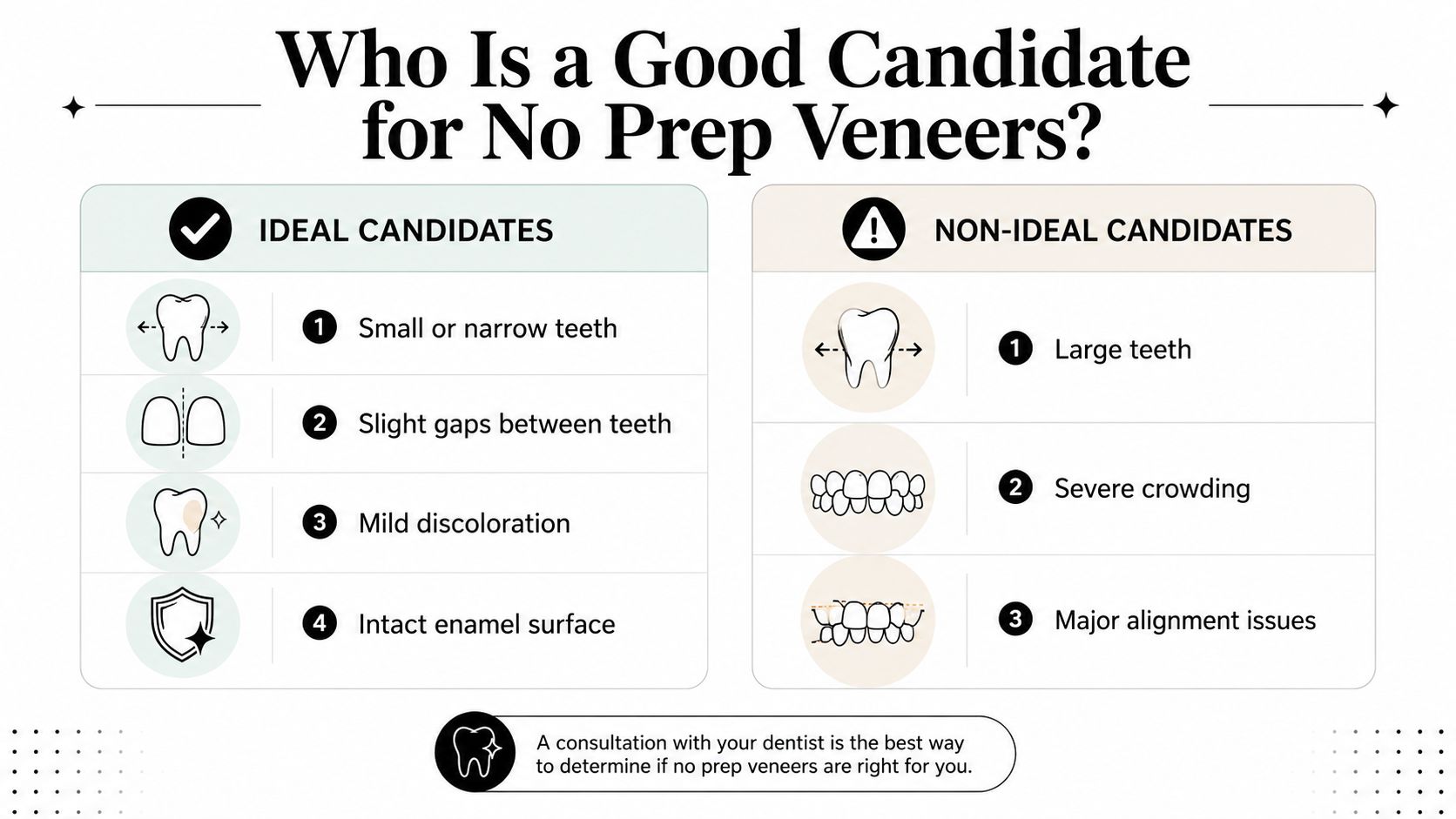
A consultation should answer three practical questions:
- Can the planned result be achieved without making the teeth look too wide or forward?
- Will the veneer bond mainly to healthy enamel?
- Can your bite and daily habits support the restoration?
If the answer to any of these is uncertain, a responsible dentist should discuss alternatives rather than rush to bonding.
Benefits and Limitations You Should Know
The strongest argument for no-prep veneers is enamel preservation. Keeping more natural tooth structure can reduce the biological impact of cosmetic treatment and may make the bonding surface more favorable. Patients may also experience a less intensive appointment, with little or no anesthesia when no meaningful preparation is required.
A 7-year study of indirect composite no-prep veneers reported 91.3% overall survival, while a 24-month study of ultra-thin no-prep veneers reported 99.5% survival, a 0.5% fracture rate, and 100% patient satisfaction. These figures appear in the clinical outcomes literature on no-prep veneers. The studies differ in material, follow-up, and patient selection, so they shouldn't be treated as a promise for an individual case.
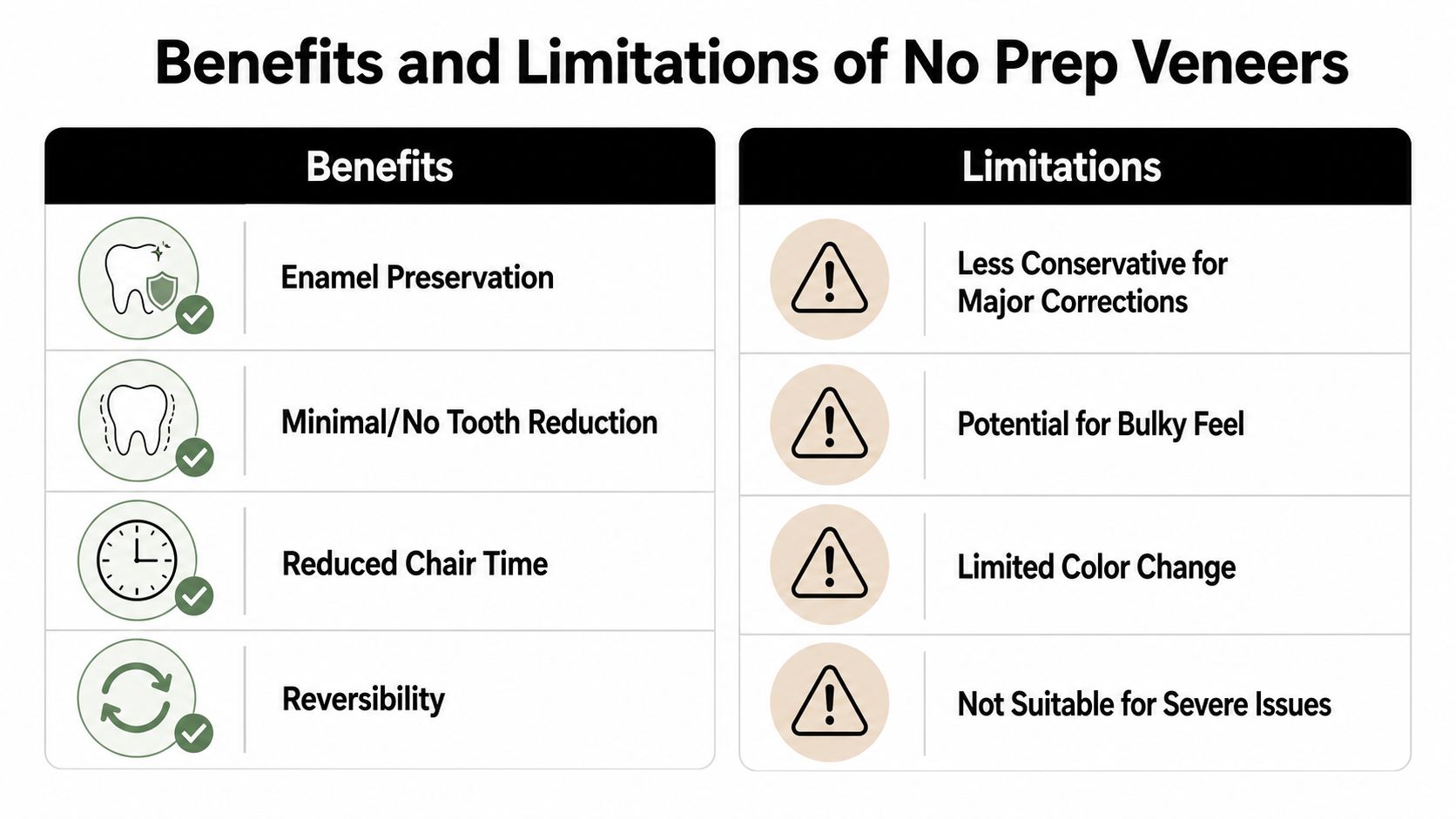
The trade-offs deserve equal attention
The veneer still adds material. If the teeth don't have enough room, you may notice a fuller lip feel or a less natural appearance. A very thin veneer also has limits when a patient needs major color change, substantial alignment correction, or significant reshaping.
“Reversible” requires careful wording. A veneer may be removable without the same type of reduction used for a traditional preparation, but the bonding process can alter the enamel surface microscopically. Adhesive residue, surface changes, or the need for polishing may remain after removal. You should view treatment as a long-term commitment, even when it preserves more enamel.
Common failure concerns include fracture, debonding, marginal discoloration, and color change. A systematic review notes that the evidence base for no-prep veneers remains insufficient for a definitive universal clinical statement, while conventional veneers have longer-term reported survival ranges of 87% to 94% over 5 to 20 years in the reviewed literature. The review is available through the Journal of Osseointegration article.
The honest benefit: No-prep veneers can be excellent when the teeth already provide the right foundation. They're not automatically the safest choice when the desired result requires major correction.
What to Expect During Your Veneer Journey in Katy TX
Your first appointment should feel like a conversation, not a sales presentation. At The Dental Retreat in Katy, TX, the team can review your smile goals, examine your teeth and gums, assess your bite, and use diagnostic records such as digital images, scans, and X-rays when clinically appropriate. Shade selection and a preview of the proposed design help you discuss whether you want a subtle refinement or a more noticeable change.
The planning stage
After the examination, the dentist may take impressions or complete a digital scan. The laboratory then uses the records to design custom veneers that match the planned shape, surface texture, and shade. The practice's non-prep veneers cost guide can help you understand why consultation, planning, fabrication, bonding, and final adjustments all belong in the treatment conversation.
Before final bonding, you should have an opportunity to review the proposed appearance. Ask about tooth thickness, the effect on your bite, the material selected, and what happens if you later want a different restoration.
Bonding and follow-up
At the bonding visit, the teeth are cleaned and prepared for adhesive placement. Any necessary enamel etching or minor contour adjustment should be conservative and discussed with you. The dentist positions each veneer carefully, checks the margins and bite, and uses curing light to set the bonding material.
You may notice temporary sensitivity or need a short period to adapt to the new contours. A follow-up appointment allows the dentist to check how your teeth meet, inspect the gum margins, and make small adjustments if needed. Patients who feel anxious can also ask about comfort measures, sedation options, noise-cancelling headphones, or other ways to make the visit easier.
Longevity Care and Next Steps for Your Smile
No-prep veneers can provide a durable cosmetic result, but longevity depends on the material, bonding surface, bite, habits, and follow-up care. Clinical reports include 97.4% survival over a mean 43.1-month observation period, 91.3% survival at 7 years for indirect composite no-prep veneers, and 100% survival in the no-prep group of a 9.06-year prospective comparison. These findings support careful treatment planning, not a guaranteed lifespan for every patient.
Protect the restorations with practical habits:
- Choose gentle products: Use a non-abrasive toothpaste and clean around the gumline and between teeth.
- Avoid damaging habits: Don't bite ice, pens, packaging, or other hard objects with veneered teeth.
- Address grinding: A nightguard may help protect veneers when bruxism places excessive force on them.
- Keep preventive visits: Regular hygiene appointments at The Dental Retreat in Katy, TX help the team monitor the margins, gums, bite, and surrounding teeth.
- Manage staining habits: Porcelain generally resists discoloration better than composite, but coffee, red wine, and tobacco can still affect the surrounding smile and oral health.
You can learn more about daily maintenance in this guide to caring for veneers. A consultation can also determine whether whitening, clear aligners, composite bonding, minimal-prep veneers, restorative dentistry, or another service would better match your goals.
Schedule a personalized consultation with The Dental Retreat in Katy, TX to find out whether no-prep veneers suit your enamel, bite, and smile design. The team can discuss conservative cosmetic options alongside preventive, restorative, orthodontic, implant, and emergency dental care, so you can move forward with a plan that feels comfortable and realistic.