You're in a Katy school kitchen, helping your teenager choose a portrait for the yearbook, when they cover their mouth and ask whether their crowded front teeth are noticeable. Or perhaps you're an adult who has started avoiding photos because shifting teeth, a gap, or an uncomfortable bite feels more obvious before an important meeting or event. Searching for smile orthodontics Katy can lead you toward clear aligners, braces, or other solutions, but the right starting point isn't an appliance advertisement. It's a careful assessment of your teeth, bite, goals, and daily routine.
At The Dental Retreat, patients can discuss orthodontic options in a comfortable local setting designed around clear explanations and individualized planning. Whether you're looking for a dentist near me, a cosmetic dentist near me, or clear aligner treatment in Katy, the consultation should answer a practical question: can your specific teeth and bite be corrected predictably with aligners, or would another approach protect your result more effectively?
Starting Your Smile Orthodontic Journey in Katy
A Katy parent may notice a teen hesitating before a school photo because several front teeth overlap. An adult may find that an old space has reopened or that crowded teeth make brushing and flossing more frustrating. These concerns can affect confidence, but they can also point to alignment or bite issues that deserve more than a cosmetic glance.

Start with diagnosis, not the tray
At a consultation, the team should examine how your teeth fit together, not just how they look from the front. The Dental Retreat can use an exam, photographs, digital imaging, and bite records to understand crowding, spacing, rotation, tooth position, and jaw relationships. Your dental history, oral hygiene, lifestyle, budget, and timing also belong in the conversation.
A clear aligner may be appealing because it's discreet and removable. Conventional braces may offer stronger control for selected movements. Neither option is automatically right for every patient, and a treatment plan should explain the likely movements, anticipated duration, financial considerations, insurance questions, and what happens after active treatment ends.
Practical rule: Choose the correction your smile needs first, then choose the appliance that can deliver it reliably.
What to bring to the conversation
Think about whether you can wear removable trays consistently during school, work, travel, meals, and social events. Ask how retainers will protect the final result, whether refinements might be needed, and how appointments will fit your schedule. Patients from Sunterra, Cane Island, Katy Manor, Kingscrossing, Lakehouse, Marisol, The Grange, Anniston, Katy Lakes, Elyson, and Ventanna Lakes can use a local consultation to replace online guesswork with a plan based on their own mouth.
Understanding How Orthodontics Moves Teeth
Orthodontics treats malocclusion, a term for teeth that are crowded, spaced, rotated, or positioned so the upper and lower teeth don't meet properly. Some alignment concerns are mainly cosmetic. Others can make certain areas harder to clean, create uneven tooth wear, or place extra demand on the bite.
Teeth aren't fused directly to the jawbone. Each tooth sits in a socket and connects to surrounding bone through a thin network of fibers called the periodontal ligament. When a brace, wire, or aligner applies controlled pressure, that ligament responds and the supporting bone gradually remodels around the tooth.
A gradual biological process
Think of guiding a small object across a surface with steady pressure rather than trying to force it into place in one motion. On one side of the tooth, bone changes to create room. On the other side, new bone helps support the tooth as it settles into its planned position. The process takes time because the tissues need to adapt.
Clear aligners guide teeth through a sequence of custom trays, with each tray designed for measured movement. Braces use brackets and wires to apply force in a different way and may provide more continuous control for certain corrections. Excessive force doesn't make treatment faster or safer, which is why an exam and diagnostic records matter before anyone promises a particular result.

For a patient-friendly explanation of the biology, review how clear aligners move teeth and the science behind treatment. Your tooth roots, bone support, bite, and the direction of the planned movement all affect how predictable treatment can be.
A short visual overview can also help clarify the process:
Comparing Clear Aligners and Other Choices
Clear aligners are popular because they're nearly invisible, removable for eating and brushing, and free from the brackets and wires associated with conventional braces. They can work very well for appropriately selected mild to moderate cases. A 2024 comparative study reported a 75% PAR index reduction after 12 months with clear aligners, compared with 80% for conventional braces, with average treatment times of 14.5 months for aligners and 16.2 months for braces in that study (peer-reviewed comparative research).
The same study reported higher patient satisfaction with aligners, 85% compared with 65% for braces, and lower discomfort scores, 2.3 out of 10 compared with 5.6 (study details). Those findings help explain the appeal, but they don't mean aligners will outperform braces for every movement or every patient.
The comparison that matters
| Consideration | Clear aligners | Conventional braces |
|---|---|---|
| Appearance | Discreet during daily activities | More visible, with ceramic options available in some cases |
| Removal | Taken out for meals and cleaning | Fixed during active treatment |
| Daily responsibility | Requires consistent wear and safe storage | Requires careful brushing around brackets and wires |
| Complex movement | May need attachments, elastics, or refinements | Often offers dependable control for selected difficult movements |
| Comfort | No brackets, though trays may create pressure or edge irritation | Brackets and wires can temporarily irritate cheeks or lips |
| Retention | Retainers remain important after treatment | Retainers also remain important after treatment |
Severe crowding, large gaps, complex rotations, substantial bite correction, or impacted teeth may require braces or another approach. Reviews of adult aligner treatment report that overall outcomes can be clinically comparable to fixed appliances for mild to moderate malocclusions, but movement predictability varies by tooth and direction. Rotational accuracy has ranged from 36% to 85%, averaging about 65%, which is why attachments, staging refinements, and planned overcorrection may be needed (adult clear-aligner review).
The decision isn't clear versus noticeable. It includes predictability, comfort, appearance, appointment demands, hygiene, treatment duration, and long-term retention. A Katy consultation should connect those factors to your diagnosis rather than treating aligners as the default.
Determining Whether Clear Aligners Fit Your Smile
If your concern is a crowded front tooth, a gap, a rotated tooth, or an uneven bite, clear aligners may seem like the obvious starting point. Candidacy depends on how far each tooth must move, how much control the roots and bite require, and whether removable trays fit your daily routine.
Clear aligners can address many mild to moderate concerns, including selected crowding, spacing, rotations, and bite discrepancies. They become less predictable when treatment involves major root movement, difficult vertical correction, large rotations, substantial intrusion or extrusion, or a skeletal jaw discrepancy.
A detailed orthodontic biomechanics review found that aligners can be effective for anterior intrusion, posterior buccolingual inclination, and upper molar bodily movement of about 1.5 millimeters. Anterior extrusion and rotation of rounded teeth are more difficult. Attachments, interproximal reduction, elastics, and mini-screws can help direct forces and improve predictability in selected cases.
The three questions behind candidacy
What needs to move? A dentist or orthodontic provider assesses crowding, spacing, rotation, bite contacts, root position, and jaw relationships. A front-view smile cannot show every factor, so records and bite evaluation matter.
How much control is required? Trays apply planned forces, but tooth shape, root position, bone support, and tissue response influence whether actual movement follows the digital plan closely. A preview shows the intended route, not a guarantee.
Can you follow the plan? Removable treatment requires consistent wear, cleaning, tray changes, and progress visits. If those tasks do not suit your routine, fixed braces may provide a more dependable option.

Digital impressions, photographs, bite records, and a three-dimensional movement preview can clarify the proposed plan. Attachments may help trays grip selected teeth, while interproximal reduction can create planned space when clinically appropriate. Elastics or other auxiliaries may assist with bite correction.
The American Association of Orthodontists explains that aligners are not always viable or optimal, and braces may be recommended instead (AAO patient FAQ). At The Dental Retreat, a Katy consultation should connect diagnostics with realistic expectations for treatment demands, cost, and long-term retention, rather than assuming every smile follows the same plan.
What Happens During Clear Aligner Treatment
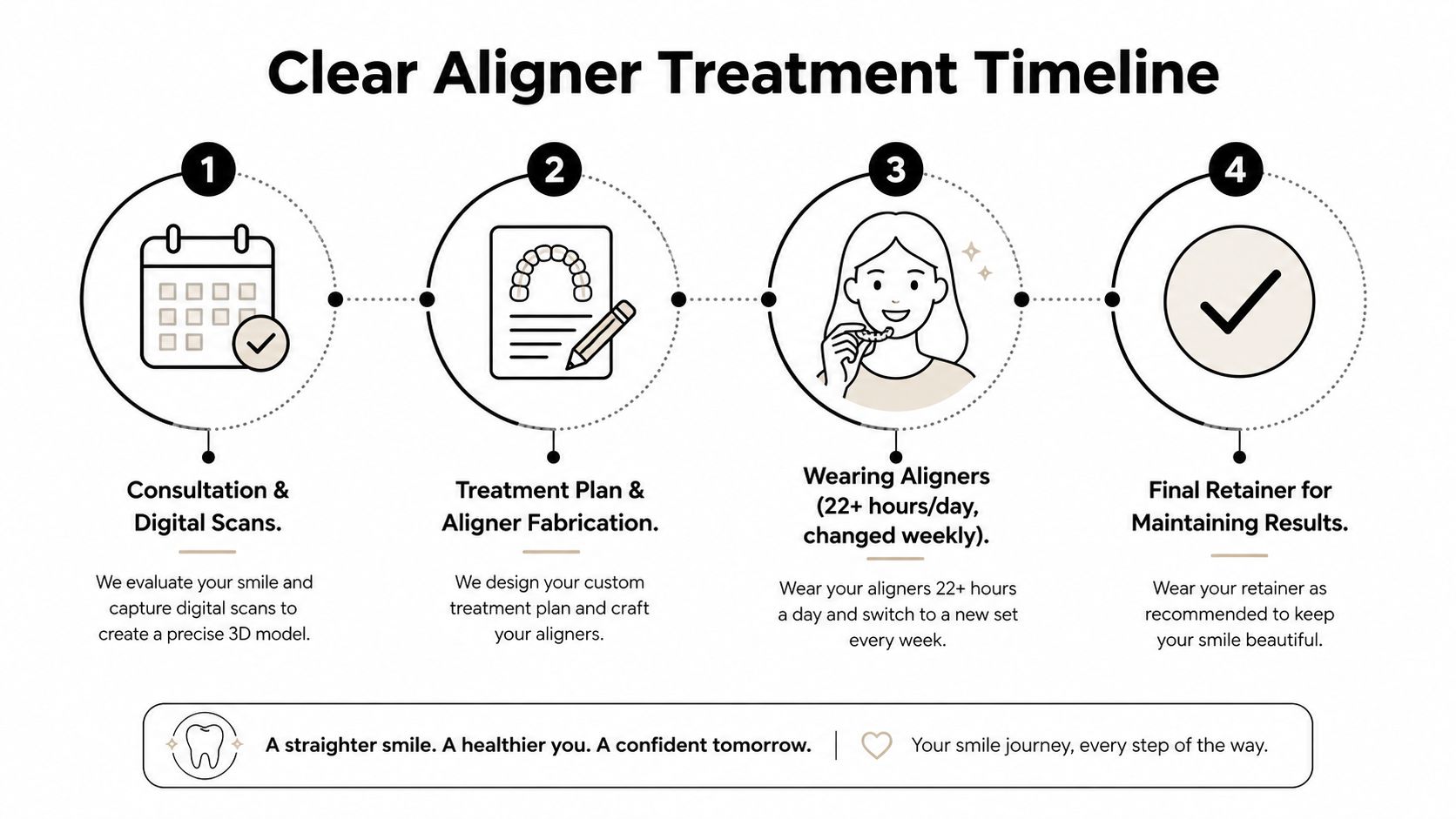
Clear aligner treatment follows a sequence, and understanding each stage makes the process easier to manage. The first visit is a planning appointment, not just a tray pickup.
Begin with records and goals
The initial assessment may include digital scans, photographs, dental x-rays when indicated, and bite records. You'll discuss what you want to change, whether you have an important event ahead, and how treatment fits around work, school, sports, travel, or frequent speaking.
The provider then reviews the planned movements and may show a three-dimensional preview. This preview can make the proposed direction easier to understand, but it's still a treatment plan, not a guarantee that every tooth will move exactly as displayed.
Wear, change, and monitor
When your first trays arrive, the team reviews insertion, removal, cleaning, and storage. Clear aligners are commonly worn 20 to 22 hours per day, and many treatment plans change trays about weekly (aligner treatment duration guidance). You'll generally remove them for meals, avoid exposing them to unsuitable hot liquids, and brush your teeth before placing them back when possible.
Progress visits allow the provider to check attachments, fit, bite changes, and hygiene. If a tooth lags behind the planned movement, the treatment may need refinement aligners or a revised sequence. Keeping every tray, following instructions, and reporting a poor fit early can help the team respond before a small issue becomes a larger delay.
Finish with retention
Active tooth movement ends when the planned alignment and bite have been achieved, but the teeth still need support. Retainers hold the new positions while the surrounding tissues adapt, and many patients need ongoing night-time retainer use to protect the result.
Daily habit: Treat your aligners and retainers as part of your routine, not as accessories you can safely skip whenever the day gets busy.
Planning Treatment Time and Affordability
A crowded smile, a rotated tooth, or a bite that feels uneven can make treatment length difficult to predict. Clear aligner therapy commonly takes 12 to 18 months for adults. Mild cases may finish in 3 to 6 months, while complex movement can extend to 24 months or longer (consumer clear-aligner statistics review). The planned schedule is only part of the equation. Wearing trays as directed helps keep each stage on track, while missed wear time may add delays.
A treatment estimate should account for more than the trays. Case complexity, digital scans and other diagnostics, attachments, refinement aligners, retainers, and dental care needed before orthodontics can all affect the total. National U.S. clear aligner costs typically range from $3,000 to $8,000, so a Katy consultation is the right setting to determine what applies to your smile.
Ask for the complete financial picture
Request a written estimate that separates the orthodontic fee from related dental services. Ask how PPO benefits apply, whether HSA or FSA funds are accepted, which financing choices are available, and whether refinements or retainers are included. These details help you compare plans by their full commitment rather than by an advertised starting fee.
The Dental Retreat lists a New Patient Special with a $99 cleaning, exam, and X-rays, plus a VIP Membership Plan for uninsured patients. Discuss these as separate dental-care options, not as automatic coverage for clear aligner treatment. Ask how payment timing, appointments, and retention fit into the plan, and review this clear aligner treatment timeline before your consultation.
Experiencing Comfortable Local Orthodontic Care
Orthodontic visits should feel manageable for teens, adults, and parents who may already feel nervous about dental care. The Dental Retreat provides a calm, spa-inspired setting with consultation rooms, modern imaging equipment, blankets, beverages, and entertainment options intended to make appointments less stressful.
Scheduling also matters. Extended weekday hours and Saturday availability can help families coordinate visits around school, work, sports, and travel. A bilingual team can explain treatment plans, aligner wear, retainer use, and home care in English and Spanish, giving patients more room to ask questions before they commit.
Coordinate related dental needs locally
Clear aligner treatment works best when the mouth is healthy enough to support it. Cleanings and exams can identify issues that need attention, while restorative dentistry can address damaged teeth before alignment begins. Teeth whitening or other cosmetic dentistry may fit into a broader smile plan, but sequencing matters, especially when tooth positions change during orthodontic treatment.
The practice also provides broader services, including dental implants, periodontal care, endodontic treatment, oral surgery, sedation, and emergency dental services. Someone searching for a dentist in Katy, TX, dental implants near me, tooth extraction, or an emergency dentist may be able to coordinate those needs within the same practice, depending on the clinical plan.
Patients from Katy, Fulshear, Cinco Ranch, Richmond, Cypress, and Brookshire can ask for transparent treatment estimates and a clear explanation of each step. A supportive appointment should leave you knowing what happens next, what you're responsible for at home, and which questions still need answers.
Book Your Katy Orthodontic Consultation
Before your appointment, write down the changes you want to make. You may care most about crowded front teeth, a visible gap, rotated teeth, chewing comfort, or a bite that no longer feels balanced. Bring recent dental records if you have them, list current medications, and mention sports, travel, work presentations, musical activities, or other routines that could affect aligner wear.
Questions to take with you
- Candidacy: Can clear aligners correct my specific crowding, spacing, rotation, or bite concern?
- Predictability: Will I need attachments, interproximal reduction, elastics, braces, or refinements?
- Time: What treatment duration is realistic for my case, and what could extend it?
- Investment: What does the written estimate include, and how do insurance, HSA, FSA, or financing apply?
- Retention: Which retainer plan will protect the result after active treatment?
- Oral health: Do I need a cleaning, filling, periodontal care, tooth extraction, or other treatment first?
The consultation should include a clinical exam, imaging when indicated, and a personalized discussion rather than a one-size-fits-all recommendation. To reserve an appointment, contact The Dental Retreat's Katy team by phone or use the practice's online request form. Patients from Katy, Fulshear, Cinco Ranch, Richmond, Cypress, and Brookshire can start with a local conversation focused on a healthy, functional, well-aligned smile.
The Dental Retreat offers clear aligner consultations alongside dental care in a calm Katy setting, so you can discuss candidacy, treatment timing, affordability, and retention in one place. Visit The Dental Retreat to request your consultation and take the next step toward a smile plan that fits your teeth and your life.