A sinus lift is a dental surgery that adds bone to your upper jaw so dental implants can be placed safely, and estimated 3-year implant survival is 90.1% or higher, depending on the technique used. The procedure creates a stronger foundation beneath the sinus when the upper back jaw doesn't have enough bone for an implant.
You may be researching this after losing an upper molar, hearing that a dental implant needs more support, or searching for a dentist near me in Katy who can explain your options without rushing you. The words “sinus lift” can sound intimidating, but the basic idea is practical: your dentist creates space beneath the sinus floor so the jaw can support a replacement tooth.
At The Dental Retreat in Katy, patients can discuss implant planning, bone grafting, tooth extraction, sedation, and restorative care in one setting. This guide explains what the sinus lift procedure involves, how the surgical approaches differ, when graftless treatment may be appropriate, and what questions to bring to your consultation.
Why You Might Need a Sinus Lift Before Dental Implants
A patient in Katy may lose one or more upper back teeth and expect a straightforward implant. At the consultation, dental X-rays or three-dimensional imaging may show that the jawbone beneath the sinus is too short for the implant to sit securely. That news can feel discouraging, especially if the patient has already waited through tooth loss or a difficult extraction.
It isn't a dead end. The sinus lift procedure can serve as a bridge between the current bone structure and the stable foundation needed for dental implants. In the upper back jaw, the maxillary sinus sits above the molars and premolars. After tooth loss, the surrounding bone can shrink, while the sinus may extend downward into the space once occupied by tooth roots.
A Katy dentist may recommend a sinus lift when placing an implant directly would leave too little bone around the implant or bring the implant too close to the sinus cavity. The decision depends on your anatomy, the planned implant position, the health of your gums, and the condition of the sinus itself.
A practical point: Needing a sinus lift doesn't mean your implant plan has failed. It means the foundation needs additional planning before the replacement tooth is placed.
Your consultation should give you time to ask whether you need a graft, which surgical approach fits your anatomy, whether the implant can be placed at the same appointment, and how healing will be monitored. You can also review how to prepare for dental implants before making a decision.
Whether you're looking for Dental implants near me, a dentist in Katy, TX, or help after a tooth extraction, understanding the reason for the recommendation can make the next step feel much more manageable.
What Is a Sinus Lift Procedure and How Does It Work
The sinus lift, also called maxillary sinus floor elevation or sinus augmentation, raises the floor of the maxillary sinus to create more vertical bone support in the upper jaw. The maxillary sinuses are hollow spaces behind your cheekbones, positioned above the upper back teeth. A thin layer of bone and a delicate lining, called the Schneiderian membrane, separate the sinus space from the dental roots and jaw.
When an upper molar or premolar is missing, the jawbone may gradually lose height. The sinus can also become more prominent in the area, leaving less bone between the gum and the sinus floor. A common indication is residual upper-jaw bone height of 10 mm or less, although the exact treatment plan depends on imaging and the implant design. Guidance also notes that planning may require 1 to 2 mm of bone between the implant apex and sinus floor, depending on the case and surgical strategy. These clinical thresholds are discussed in guidance on sinus elevation and implant planning.
Think of an implant as a small support post for a house. If the ground is too shallow, placing the post immediately may not provide a dependable foundation. During a sinus lift, the surgeon carefully moves the sinus lining upward and uses the newly created space to support bone formation. Some cases use graft material as a scaffold, while selected cases may rely on the body's natural bone formation without added graft.
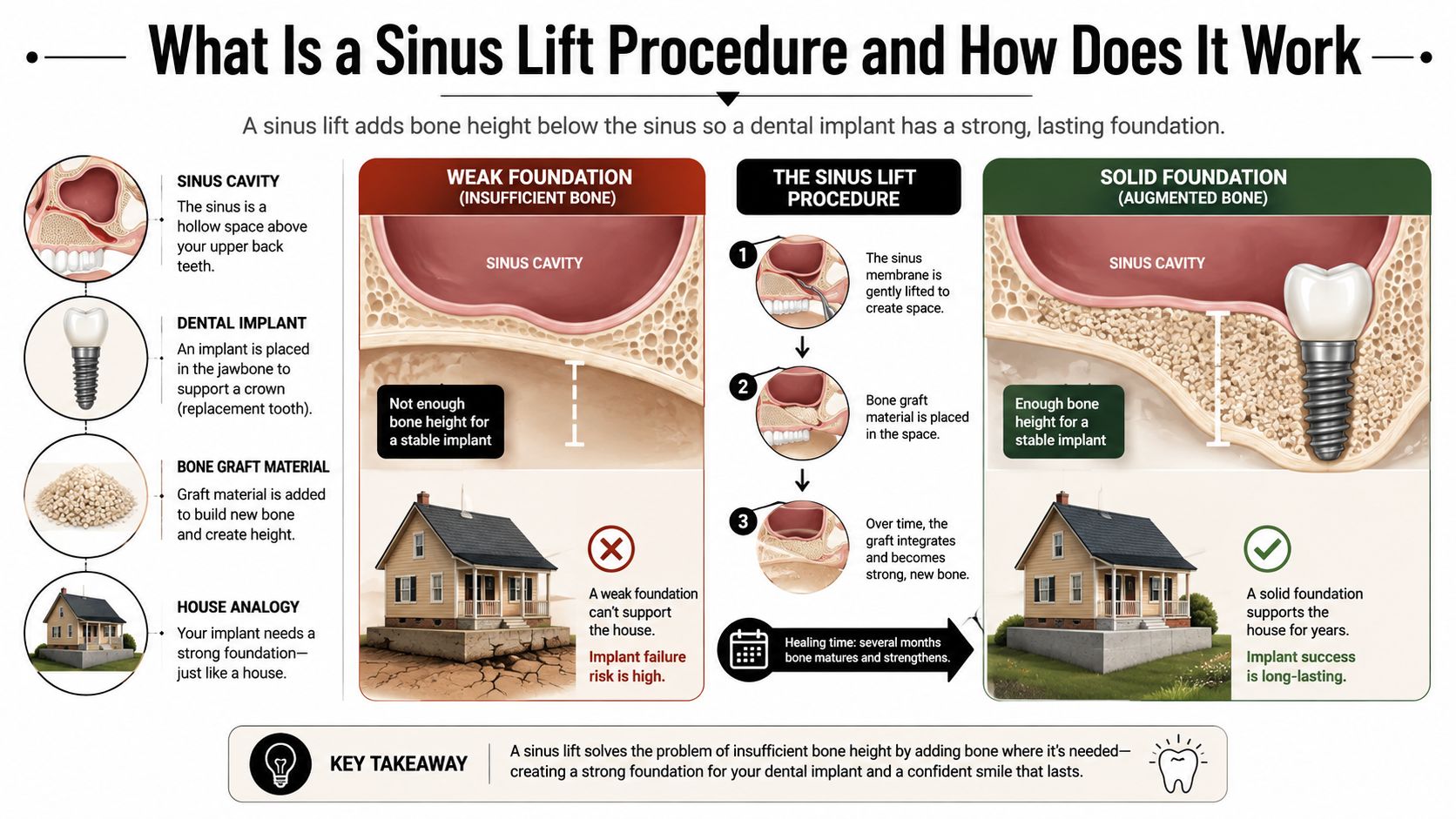
The procedure usually involves numbing the area, accessing the bone through the gum, gently elevating the membrane, placing graft material when indicated, and closing the site. The approach changes according to how much bone remains and how much additional height the implant requires. That leads to the two main options, the lateral window and transcrestal approaches.
For a plain-language explanation of the material sometimes used to create implant support, you can review what bone grafting for dental implants involves.
Lateral Window Versus Transcrestal Sinus Lift Approaches
If an upper back tooth needs an implant but the jawbone is too shallow, your dentist has more than one way to create support. Both principal approaches address the same problem, but they reach the sinus floor from different directions.
A lateral window sinus lift creates an opening in the side wall of the upper jaw. This gives the surgeon direct access to the sinus membrane and a wider view of the treatment area. A transcrestal sinus lift works through the implant site at the top of the jaw, so it uses a smaller access point and is generally considered when only a modest lift is needed.
The choice depends on more than the procedure's name. Your CBCT scan, remaining bone, sinus anatomy, implant size, and treatment sequence all affect the recommendation. The lateral approach may be appropriate when more bone height is missing or the surgeon needs greater visibility. The transcrestal approach may fit a case with more existing bone and a smaller vertical change.
Comparing sinus lift approaches
| Approach | Typical situation | Access and healing considerations |
|---|---|---|
| Lateral window | More substantial bone loss | Opens the side wall and may allow graft material to mature before delayed implant placement |
| Transcrestal | A modest increase in height is needed | Uses the implant site and may allow implant placement during the same surgery in selected cases |
| Graftless approach | Residual bone and sinus anatomy are favorable | Avoids added graft material, with timing based on implant stability and the individual plan |
These are broad patterns, not a prediction of your surgery. Implant placement may happen during the same operation in selected cases, while other plans allow the area to heal before the implant is placed. Your surgeon will base that decision on the stability available at surgery and the condition of the sinus and surrounding bone. Published treatment-planning guidance is available in this review of sinus lift treatment planning.

A graft is not required in every sinus lift. In carefully selected cases, the lifted sinus membrane and the patient's own healing response may provide enough support for bone formation without added graft material. Recent evidence on graftless lateral sinus elevation is discussed in recent evidence on graftless lateral sinus elevation.
Graftless treatment is not automatically simpler or safer for everyone. Ask whether your residual bone, sinus shape, membrane condition, and planned implant stability make it reasonable for you. This conversation can also clarify whether treatment is staged and what healing milestones your dentist will use before placing the implant.
What to Expect During Your Sinus Lift Procedure
Your experience begins with planning rather than surgery. At The Dental Retreat in Katy, the team reviews your dental history, examines the gums and remaining teeth, and uses dental imaging to understand the bone and sinus anatomy. A three-dimensional scan can help identify sinus septa, thin bone, and other features that may affect the surgical approach.
The consultation is also the time to discuss tooth replacement choices. Depending on your needs, the plan may include tooth extraction, a sinus lift, an implant, and a final crown. Patients who feel anxious can ask about sedation and comfort features such as aromatherapy, heated or massage chairs, noise-cancelling headphones, and televisions in treatment rooms.
The appointment sequence
Planning comes first. Your dentist explains the imaging, identifies the available bone, and discusses whether treatment will be grafted or graftless.
You receive numbing and sedation as planned. Local anesthetic prevents pain in the treatment area. Sedation can help reduce anxiety, although the exact option depends on your health history and the procedure.
The surgeon reaches the sinus floor. With a lateral approach, access is made through the side of the jaw. With a transcrestal approach, access is made through the implant site.
The membrane is lifted carefully. The sinus lining is moved upward to create room. Graft material may be placed beneath it when the treatment plan calls for additional support.
The site heals under supervision. Follow-up visits help the dental team confirm that the area is healing properly and that the bone is developing as planned.
The implant and crown complete the restoration. Once the foundation is ready, the implant can be placed or uncovered, followed by the final tooth-shaped crown.

Healing time varies because the amount of bone needed and the implant timing vary. Some patients may receive an implant during the same procedure, while others need a separate healing period. A careful schedule is more important than rushing to the next stage.
Am I a Good Candidate for a Sinus Lift
You may be a candidate if you're missing an upper premolar or molar and the bone beneath the maxillary sinus doesn't provide enough height for the planned implant. A commonly used indicator is residual bone height of 10 mm or less in the upper jaw, but that number doesn't decide treatment by itself. The implant's length, width, position, and required stability all influence the recommendation.
Your dentist also needs to evaluate the sinus and the surrounding tissues. A CBCT scan may show a sinus septum, a thin lateral wall, unusual sinus contours, or signs that require additional medical evaluation. Existing sinus disease or nasal obstruction deserves attention before surgery, particularly if you have ongoing congestion, facial pressure, drainage, or a history of chronic sinus problems.
Factors that shape candidacy
- Bone availability: The remaining height and width determine whether an implant can be stabilized immediately or needs staged treatment.
- Sinus health: Active or unresolved sinonasal concerns may require coordination with a medical provider before dental surgery.
- Gum condition: Healthy, maintainable gums support better implant planning than untreated periodontal disease.
- Treatment goals: A single implant, several implants, and full-arch treatment may require different surgical designs.
- Medical history: Medications, healing conditions, and smoking habits should be discussed openly with the dental team.
The long-term data can provide perspective. One systematic review estimated an annual implant failure rate of 3.48%, corresponding to 90.1% implant survival at 3 years on a per-implant basis. At the subject level, the estimated annual failure rate was 6.04%, with 16.6% of subjects experiencing implant loss over 3 years. These findings are reported in a systematic review of sinus lift assisted implant therapy.
Other pooled reviews have reported more favorable outcomes, including a weighted annual implant loss of 0.43%, overall survival of 97.9% after osteotome sinus floor elevation, and implant success of 98.3% in included studies. A separate review of lateral sinus floor elevation without grafting pooled 660 implants and 17 failures, producing 97.5% survival, with individual-data 5-year survival of 93.1%. These ranges show why technique, anatomy, follow-up, and patient selection matter. They don't guarantee an individual result, but they support a calm, informed conversation rather than an assumption that a sinus lift is an experimental treatment.
Risks, Complications, and Recovery After a Sinus Lift
Every surgical procedure carries risks, and the most frequently reported technical complication of a sinus lift is Schneiderian membrane perforation. Open lateral-window cases report perforation in about 20% to 25% of procedures, while a meta-analysis of 2,168 procedures reported an overall rate of around 19%. The risk was 39.76% when sinus septa were present, compared with 12.33% without septa, which explains why detailed CBCT review matters. These findings are available in a meta-analysis of membrane perforation risk.
A perforation doesn't automatically mean the entire treatment must be abandoned. The surgeon may repair the membrane with a patch, modify the access, change the grafting plan, or postpone implant placement, depending on the size and location of the injury. Other reported concerns include bleeding, graft displacement, sinusitis, ostiomeatal obstruction, wound problems, vertigo, and implant displacement. A review of sinonasal complications describes this broader range in its discussion of sinus lift complications.
What recovery may feel like
During the first couple of days, mild swelling, pressure, or soreness can occur. Your instructions may include soft foods, prescribed medication, gentle oral hygiene, and avoiding pressure changes in the sinus.
During the first week, avoid blowing your nose forcefully, sneezing with your mouth closed, smoking, and strenuous activity unless your surgeon gives different guidance. Use saline spray only as directed, and don't probe the surgical area or disturb the sutures.
Call the office if pain or swelling worsens instead of settling, if you develop fever or drainage, if bleeding doesn't slow, or if you notice persistent sinus pressure or breathing changes. A Cochrane review found increased complications at treated sites compared with controls, with an odds ratio of 4.77, and a 200-case series reported a 14.9% postoperative complication rate. The evidence is summarized in the Cochrane review of sinus lift procedures.
Aftercare matters: Protecting the sinus from pressure and following the surgical instructions gives the membrane, graft, and surrounding tissues the best opportunity to heal.
Frequently Asked Questions About Sinus Lifts in Katy
Does a sinus lift hurt?
The area is numbed before surgery, and sedation may help you stay comfortable and relaxed. During the procedure, many patients notice pressure, movement, or vibration rather than sharp pain. Mild soreness or swelling afterward is possible, and your dental team will explain how to manage it.
A nervous patient can also ask about the type of sedation offered, how the office monitors comfort, and what to expect when the numbness fades. Knowing the plan ahead of time often makes the appointment feel more manageable.
How long do implants last after a sinus lift?
Implant longevity depends on the implant position, bone integration, gum health, cleaning, bite forces, medical history, and regular maintenance. Published evidence is generally encouraging, but implant survival is not a lifetime guarantee. Daily brushing, cleaning between teeth, professional examinations, and prompt treatment of gum inflammation all help protect the result.
Your implant is more like a long-term home project than a one-time repair. The foundation matters, and regular care helps keep the surrounding gums and bone healthy.
Will I need a graft?
Not necessarily. Selected patients may qualify for a graftless sinus lift, especially when the anatomy provides enough stability and the sinus floor can be raised predictably. Imaging and the implant plan determine whether this approach fits. A graft is not automatically required for every sinus lift, and a graftless approach is not suitable for every patient.
Can the implant be placed at the same time?
Sometimes. The decision depends on the remaining bone, primary stability, the implant position, and what the surgeon finds during treatment. If the implant cannot be supported securely, the graft and sinus area may need time to mature before placement. The earlier discussion of implant timing explains the relevant bone-height range and healing window in more detail, with clinical guidance on implant timing after sinus elevation available for further reading.
How much does a sinus lift cost?
The price depends on the surgical approach, graft material, imaging, sedation, implant timing, number of teeth, and whether extraction or other restorative care is needed. Ask for a written treatment plan that separates the sinus lift, implant, abutment, crown, imaging, and follow-up costs. The Dental Retreat also lists value specials and membership options for eligible patients, which you can discuss during your consultation.
Transparent pricing should make clear what is included and what might be added later. That lets you compare treatment plans without guessing which parts of care the quoted fee covers.
What if I don't have dental insurance?
Ask about payment arrangements, membership plans, and value-focused visits. The practice lists a $99 exam with cleaning and X-rays for new patients without insurance, a $49 problem-focused visit, and a $350 in-office Zoom whitening special. Offers may change, so confirm current eligibility and pricing directly with the office.
Why choose a Katy practice for this treatment?
A local office can make consultations, imaging, follow-up appointments, and restorative visits easier to coordinate. The Dental Retreat provides implant, periodontal, oral surgery, sedation, emergency, cosmetic, and general dental services at its Katy location, with comfort amenities and bilingual care available. Patients from Sunterra, Cane Island, Katy Manor, Kingscrossing, Lakehouse, Marisol, The Grange, Anniston, Katy Lakes, Elyson, and Ventanna Lakes can ask the team to explain each stage before committing.
For an emergency dentist, a cosmetic dentist near me, or a Katy provider who can coordinate dental implants after a sinus lift, start with an evaluation rather than relying on online information. A consultation lets you review your scan, compare grafted and graftless options, ask about sedation, and understand transparent pricing.
The Dental Retreat offers implant planning, sinus lift coordination, sedation amenities, and restorative care for patients in Katy, TX. Visit The Dental Retreat to request a consultation and discuss the safest path toward a stable dental implant.