You've finished scaling and root planing in Katy, your gums feel calmer, and you're relieved to be past the hardest part. Then someone mentions another appointment in a few months, and you wonder, “Why do I need another deep cleaning if the treatment worked?”
That follow-up is periodontal maintenance, and it's different from an ordinary cleaning. It's the continuing-care phase that helps control gum disease, protect natural teeth, and monitor dental implants after active treatment. At The Dental Retreat in Katy, TX, the visit can also fit into a broader plan that includes restorative dentistry, cosmetic dentistry, emergency dental services, and implant care.
What Periodontal Maintenance Means After Gum Disease Treatment
A Katy patient named Maria recently completed treatment for periodontitis. Her first question was practical: “Am I finished now?” The answer was reassuring but important. Active therapy had addressed the disease activity that was present, but her gums still needed regular observation and professional care.
Periodontal maintenance begins after active periodontal therapy and continues for the life of the natural dentition or implant replacements. The ADA description of periodontal maintenance explains that the interval should be based on risk rather than set identically for every patient.
The purpose changes after scaling and root planing. During active treatment, the dental team is working to reduce infection, calculus, inflammation, and pocket activity. During maintenance, the focus becomes long-term control. Your hygienist checks whether inflammation is returning, removes new deposits, and helps you keep the areas around previously affected teeth clean.
Why treatment doesn't end after scaling and root planing
Gum disease is managed over time because the bacteria associated with it can return beneath the gums. The American Dental Association's periodontitis guidance describes maintenance as including homecare review, risk-factor assessment, professional plaque removal, subgingival debridement when needed, and monitoring of pocket depth, attachment, bleeding, exudation, and mobility.
That means maintenance isn't “another deep cleaning.” It's a recurring assessment of whether your gums remain stable. A patient with shallow, quiet areas and reliable homecare may follow a different schedule from someone with residual pockets, persistent bleeding, tobacco exposure, diabetes, or a history of rapid progression.
Practical rule: Maintenance protects the results of treatment, but it can't recreate bone or gum support that has already been lost.
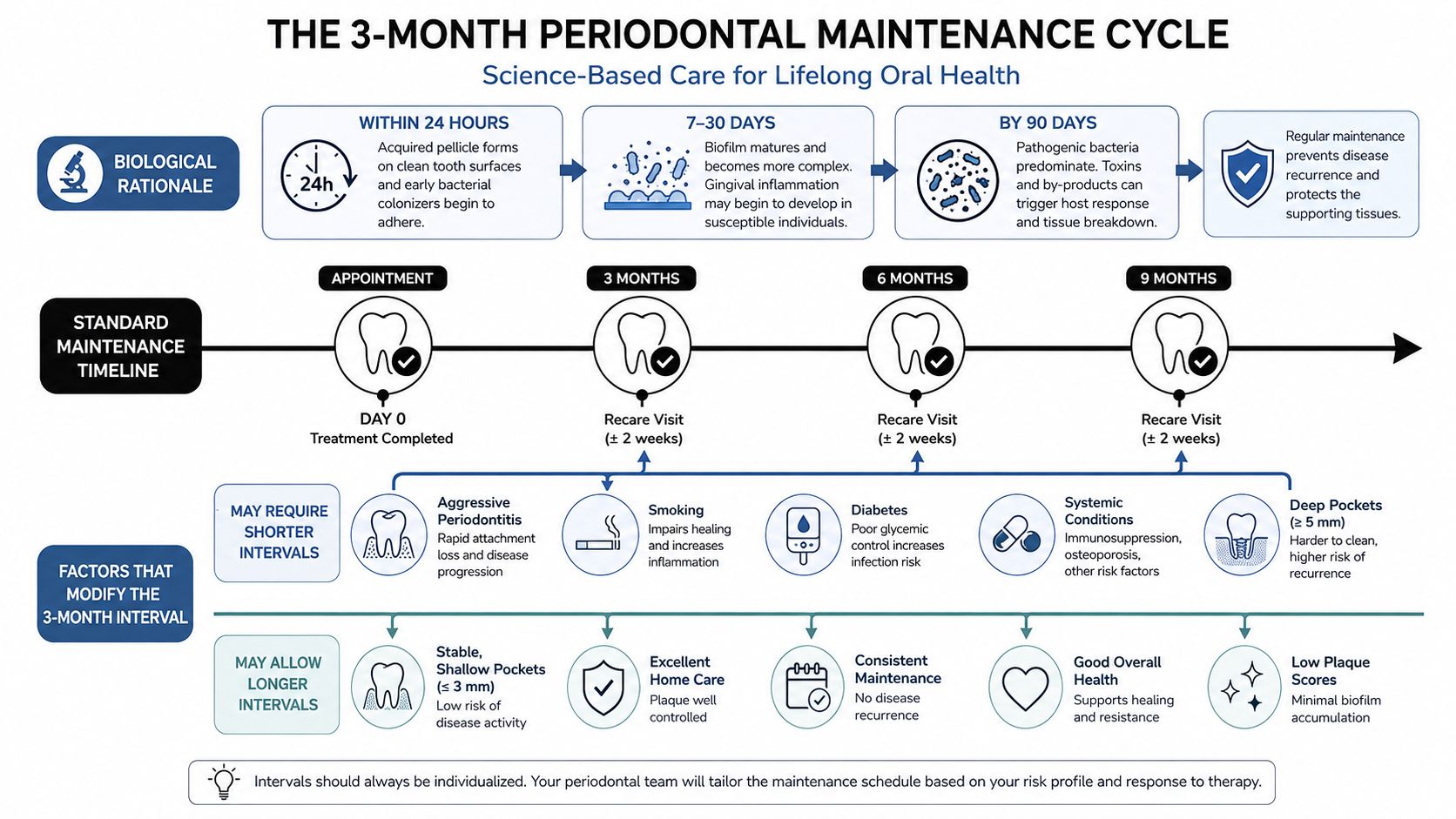
Professional guidance commonly places supportive care somewhere between 3 and 12 months, depending on recurrence risk. Some guidance indicates that patients with attachment loss may need visits at least four times per year, while pathogen levels can rebound to baseline in about 9 to 11 weeks after debridement, as summarized in the ADA periodontal maintenance coding guidance.
How Periodontal Maintenance Procedures Differ From a Routine Cleaning
A patient at The Dental Retreat in Katy may schedule a routine cleaning for prevention, while someone with treated periodontitis needs a different kind of appointment. Both visits can include instruments and polishing, but their goals, examination, and cleaning areas differ.
A routine cleaning generally suits a mouth without a history of treated periodontitis or continuing periodontal concerns. Periodontal maintenance supports gum stability after disease has affected the tissues holding the teeth in place. It is ongoing, risk-based care, not a one-time follow-up to deep cleaning.
A plain-language comparison
| Aspect | Routine Cleaning | Periodontal Maintenance |
|---|---|---|
| Main purpose | Preventive plaque and stain removal | Control treated periodontal disease and watch for recurrence |
| Patient history | Generally healthy gum support | History of periodontitis or completed periodontal therapy |
| Evaluation | Basic review of teeth and gums | Periodontal chart review, pocket checks, bleeding and mobility monitoring |
| Cleaning area | Primarily above the gumline | Above and below the gumline, including active or previously affected sites |
| Homecare discussion | General brushing and flossing advice | Personalized plaque-control coaching based on clinical findings |
| Follow-up | Preventive schedule | Risk-based schedule, commonly within a broader 3 to 12 month range according to European Federation of Periodontology guidance |
What makes maintenance more detailed
The visit may include several connected services:
- Periodontal evaluation: The dental team reviews gum condition, pocket depths, bleeding, recession, attachment changes, and mobility.
- Subgingival debridement: Instruments remove plaque and calculus from crevices and pockets below the gumline.
- Biofilm disruption: The hygienist cleans root surfaces and previously affected sites where bacteria can collect.
- Polishing: Tooth surfaces are polished after deposits are removed.
- Plaque-control review: Homecare is adjusted for the spaces that need more attention.
The ADA code description summarized by Registered Dental Hygienists' Magazine describes periodontal maintenance as a defined service after periodontal treatment. Its purpose includes disease management and monitoring, rather than focusing only on stain removal.
That distinction can matter for implants and cosmetic dentistry, too. An implant may need careful cleaning around its crown and supporting tissues, while cosmetic restorations require attention to margins and surfaces without unnecessary abrasion. The team matches the approach to your mouth, treatment history, and current findings.
Insurance may classify maintenance differently because the appointment relates to periodontal disease. Benefits, frequency limits, and patient responsibility vary by plan, so The Dental Retreat team can review expected coverage before care begins. A membership plan may also be worth comparing if your maintenance schedule is not fully covered.
What Happens During a Maintenance Visit Step by Step
Most patients feel more comfortable when they know what will happen before they sit back in the chair. A periodontal maintenance appointment usually follows a logical sequence, and your hygienist will explain anything that changes based on your findings.
1. Your health history is updated
The appointment begins with questions about changes since your last visit. New medications, blood pressure changes, diabetes management, tobacco use, pregnancy, or other health updates may affect inflammation, bleeding, healing, or treatment planning.
Bring an updated medication list if anything has changed. Your dental team uses this information to provide safer, more individualized care.
2. Your gums are measured and compared
The hygienist reviews your periodontal chart and records findings such as pocket depth, recession, bleeding points, and tooth mobility. These measurements help show whether the tissue is stable, improving, or developing signs that require closer attention.
A single number doesn't tell the whole story. The team also considers bleeding patterns, plaque levels, your homecare routine, and whether the same area continues to show activity.
3. Deposits are removed below the gumline
The hygienist may use an ultrasonic instrument to loosen and flush away deposits, followed by hand instruments for detailed work around roots, tight contacts, and sensitive areas. The goal is to disrupt bacterial biofilm and remove new calculus without treating every appointment as a repeat of the original full-mouth scaling and root planing.
Comfort matters. Tell the hygienist if you feel sensitivity, and they can adjust technique, water temperature, pacing, or anesthetic options when indicated.
4. Teeth are polished and additional care is considered
After instrumentation, the teeth may be polished to remove remaining surface deposits and stains. Fluoride or an antibacterial rinse may be recommended when it fits your needs and the findings from the visit.
5. Homecare and the next interval are reviewed
You should leave knowing what to improve at home and when you're due back. Your hygienist may demonstrate an interdental brush, show you how to angle a power toothbrush, or recommend a water flosser for areas that are difficult to reach.
The ADA's overview of periodontitis and maintenance care identifies review of home oral hygiene, risk factors, professional plaque removal, and monitoring of periodontal findings as important parts of this service.
How Often You Should Schedule Maintenance Visits
At The Dental Retreat in Katy, your maintenance schedule is based on how your gums are behaving now, not on the date of your last deep cleaning. The team considers remaining pocket depths, bleeding, smoking, diabetes control, genetic risk, hormonal changes, and how easily you can clean around crowded teeth, implants, or cosmetic and restorative work.
A shorter interval may be appropriate when inflammation remains active or a particular site keeps showing trouble. Stable tissue, shallow pockets, and reliable homecare may support more time between visits. The goal is lifelong, risk-based care that adjusts as your mouth changes.
Why the three-month pattern is common
A three-month schedule is common because periodontal disease can return between appointments. A systematic review of periodontal maintenance intervals found that evidence does not establish one perfect interval, although limited research favors more frequent maintenance over less frequent care. The review also includes a 2024 cohort finding: patients attending every three months had a 40% lower disease recurrence rate than those returning every six months.
That finding does not mean every patient needs the same calendar. It shows why a shorter interval may be discussed when your gums have a history of recurrence or your risk factors make daily control harder.
How the interval may change
Patients with active or higher-risk findings may return about every 8 to 12 weeks. Patients with stable tissue and dependable homecare may eventually move to 4- or 6-month recalls. Broader guidance allows intervals from 3 to 12 months, but a longer gap should follow documented stability rather than convenience alone, as explained in this periodontal maintenance frequency guidance.
At your next visit in Katy, bring up your last pocket readings and ask which sites the team is monitoring. You and your hygienist can then adjust the interval together, including considerations related to implants, cosmetic restorations, or care through a membership plan.
Why Maintenance Matters for Long-Term Gum and Implant Health
Regular maintenance gives your dental team repeated opportunities to identify renewed inflammation before it becomes a larger problem. It also gives you a practical way to protect the results of previous treatment, whether you have natural teeth, implants, or both.
Long-term data support that approach. A systematic review and meta-analysis of treated molars receiving long-term periodontal maintenance found a pooled survival rate of 82%, with a 95% confidence interval of 80% to 84%, and average molar loss of 0.05 teeth per patient per year. These figures appear in the systematic review and meta-analysis of treated molars.
Another review found that tooth loss from periodontal reasons ranged from 1.5% to 9.8%, while the proportion of patients with no tooth loss ranged from 36.0% to 88.5%. The variation reflects differences in adherence, disease severity, and patient risk, rather than proving that every patient will have the same outcome.
Natural teeth and implants need surveillance
An implant doesn't develop cavities, but the gum and bone around it can become inflamed. Full-arch restorations, All-on-4 treatment, individual implants, and mixed natural-tooth and implant mouths all need site-specific cleaning and evaluation.
Current guidance supports supportive care at individualized intervals from 3 to 12 months, and a 2026 review reported that frequent recalls improve stability while ultrasonic scaling, air-polishing, guided biofilm therapy, and conventional methods can all be used without one clearly superior long-term protocol. The European Federation of Periodontology periodontitis guidance explains why implant and periodontal maintenance should reflect the person's clinical and prosthetic risk.
| Outcome | Regular Maintenance | Inconsistent or No Maintenance |
|---|---|---|
| Inflammation | Repeated monitoring and professional disruption can help control active areas | Returning bleeding or pocket activity may go unnoticed longer |
| Natural teeth | Supports long-term observation and preservation of treated teeth | Previously affected sites may require additional therapy |
| Implants | Allows the team to inspect implant tissues and prosthetic access areas | Peri-implant inflammation may progress without early attention |
| Treatment planning | Changes can be addressed while they're localized | Delayed findings can make care more involved |
Maintenance can reduce inflammation and pocket depth, but it won't reverse structural problems such as furcation involvement or tooth mobility. That's why a maintenance visit may lead to localized treatment, periodontal referral, restorative dentistry, or implant evaluation rather than another routine appointment.
Homecare Habits That Support Your Maintenance Plan
Professional care removes deposits you can't safely reach on your own, but daily plaque control determines how quickly those deposits return. Your regular toothbrush cleans exposed tooth surfaces well, yet it can't fully clean the spaces between teeth or the contours around bridges, implants, and gum pockets.
Interdental cleaning deserves priority. Use floss where contacts are tight, and use an interdental brush when the space allows it. The correct size should fit snugly without forcing the brush through or injuring the tissue.
A workable daily routine
- Brush gently: Choose a soft-bristled manual brush or a power toothbrush and clean along the gumline with controlled pressure.
- Clean between teeth: Use floss, interdental brushes, or both according to the spaces your hygienist identifies.
- Reach difficult areas: A water flosser can help around implants, bridges, orthodontic appliances, and deeper or awkward sites.
- Use rinses selectively: Antimicrobial rinses may help in specific situations, but use them when your dental professional recommends them.
- Support healing: Avoid tobacco, manage blood sugar with your medical team, drink water regularly, and keep your maintenance appointments.
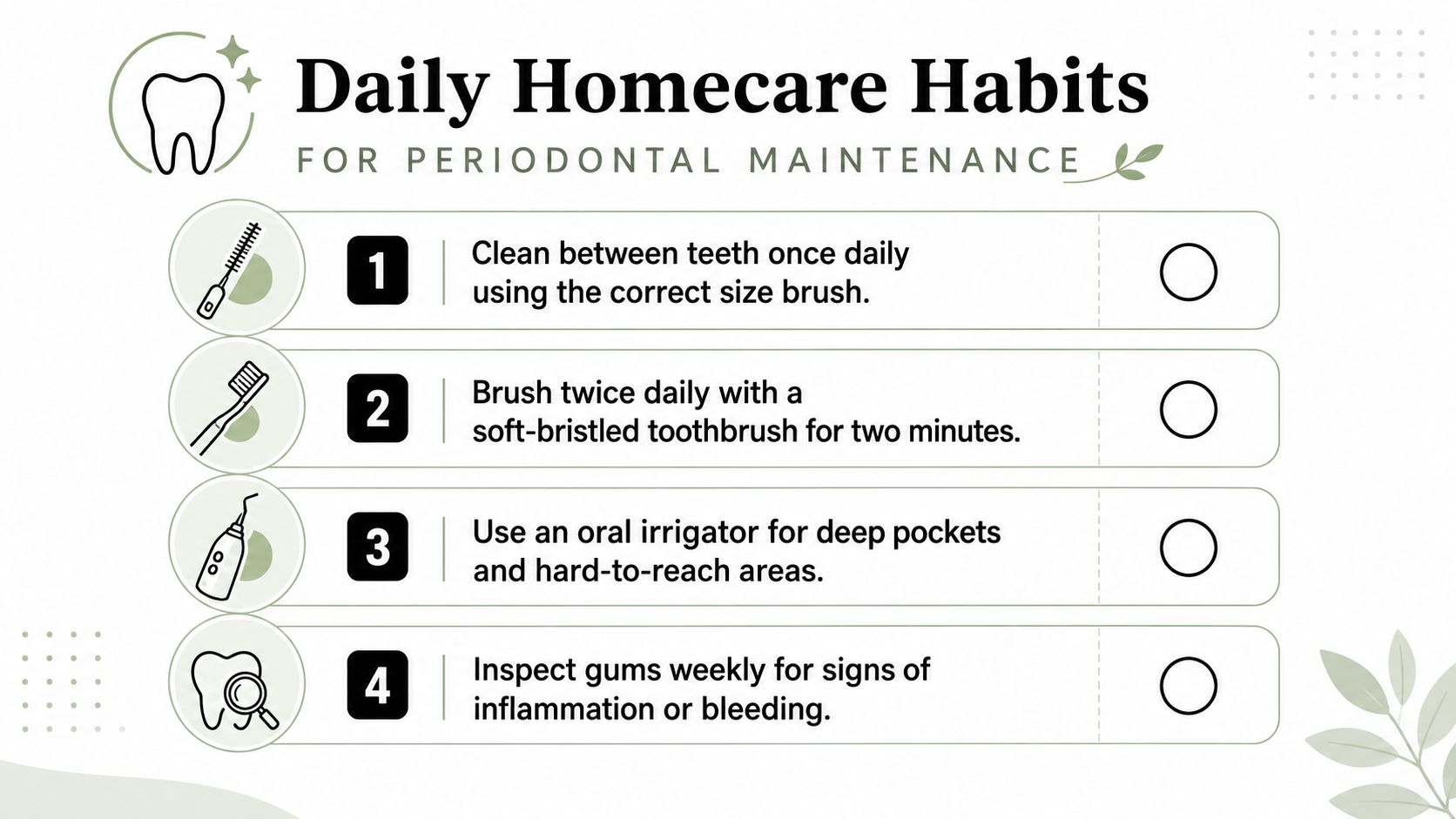
Watch for changes between visits. Bleeding that continues beyond the first few days of improving your routine, new recession, a persistent bad taste, swelling, or a loose tooth deserves a call to the office rather than waiting for the next scheduled cleaning.
The same applies to implants. Bleeding, tenderness, drainage, or difficulty cleaning around an implant crown should be evaluated, especially if the area feels different from neighboring teeth.
This short video can help you review the basics of daily plaque removal before your next visit:
Insurance, Membership Plans, and Cost Considerations
Patients often delay periodontal maintenance because they expect a routine cleaning benefit to apply automatically. Insurance usually treats periodontal maintenance as a separate service, and the plan may apply different coverage rules, deductibles, annual maximums, or frequency limits.
The exact amount depends on your policy and whether the provider is in network. If your plan doesn't include The Dental Retreat, out-of-network benefits may still exist, but your estimated responsibility can differ. The office team should confirm eligibility, remaining benefits, and frequency rules before the appointment.
Coverage depends on the visit and the plan
| Visit Type | Common Insurance Code | Typical Coverage Level | Frequency Limits |
|---|---|---|---|
| Routine prophylaxis | Preventive cleaning code selected by the plan | Often handled under preventive benefits | Plan-specific |
| Periodontal maintenance | D4910 | Often classified separately from prevention | Plan-specific |
| Implant maintenance | May be billed under a separate applicable service | Varies by policy and prosthetic details | Plan-specific |
| Periodontal treatment | Treatment code based on the procedure performed | Varies by policy and clinical need | Plan-specific |
The ADA code information for D4910 identifies periodontal maintenance as care performed after surgical or nonsurgical periodontal treatment and includes evaluation, scaling, polishing, plaque-control review, and removal of bacterial flora from pocket areas.
Options for patients without insurance
The Dental Retreat offers an in-house membership plan starting at $299 per year, with savings for periodontal maintenance. The plan includes three periodontal cleanings, along with preventive visits and X-rays according to the stated membership structure. Patients can review the plan details and compare them with the periodontal maintenance cost information.
Implant maintenance may be billed separately because the team may need to assess implant tissues, prosthetic contours, and access for cleaning. Larger treatment phases, such as restorative work, oral surgery, or implant rehabilitation, may also involve financing options such as CareCredit. Ask for a written estimate so the maintenance schedule stays predictable rather than becoming an unexpected expense.
Schedule Your Next Maintenance Visit in Katy TX
Periodontal maintenance is lifelong, risk-based care, not a one-time deep-cleaning follow-up. Your gum condition, homecare, smoking history, dental work, and implant status all help determine what your next visit should include. The dental team checks for changes, removes deposits from areas you cannot reach, and adjusts the plan as needed. Your role is daily cleaning and calling when something feels different.
A steady recall schedule helps catch renewed bleeding, deeper pockets, gum recession, or irritation around an implant while these concerns are easier to address. Delaying visits can allow buildup to accumulate and make the next appointment more involved. Regular maintenance keeps the focus on monitoring and prevention.
At The Dental Retreat in Katy, TX, patients come from Sunterra, Cane Island, Katy Manor, Kingscrossing, Lakehouse, Marisol, The Grange, Anniston, Katy Lakes, Elyson, and Ventanna Lakes. Early-morning and family-friendly scheduling can make ongoing care easier to maintain. New patients may request records from a previous provider so the team can review earlier periodontal charts and X-rays.
Bring your questions to a consultation if you want gum care coordinated with implant, restorative, or cosmetic treatment. You can also call about bleeding, recession, a persistent bad taste, shifting teeth, or discomfort near an implant. The team can help determine whether periodontal maintenance, a routine cleaning and exam, implant care, cosmetic treatment, or urgent care fits your needs.
The Dental Retreat provides periodontal maintenance, gum-health evaluations, implant care, and dental treatment in Katy. Visit The Dental Retreat to request an appointment or consultation and build a plan for your natural teeth and implants over time.