You're sitting in the parking lot outside a dental office in Katy, looking at an estimate and deciding whether a cleaning, dental X-rays, and a filling can wait until the next paycheck. That's a common position for uninsured and underinsured households, especially when a single income also has to cover housing, transportation, groceries, and unexpected repairs.
Affordable dental membership plans can make routine care easier to budget, but they aren't automatically the cheapest choice for everyone. The smart question isn't, “Is the monthly payment low?” It's, “Based on the care I'm likely to use, will this plan cost less than paying cash or buying dental insurance?”
When Going to the Dentist Feels Like a Luxury
A self-employed Katy resident recently called a dental office on a Thursday evening to ask what a basic visit might cost. The front desk quoted cleaning, a full set of dental X-rays, and treatment for a couple of fillings. The estimate came close to $700 out of pocket. She sat in her car near the I-10 service road, listening to traffic move past, and reopened the estimate on her phone.
Her math wasn't complicated. She'd skipped her last two visits, set aside money for a high-deductible marketplace plan, and discovered that the plan hadn't paid anything toward prevention. On a single-income ledger, dental treatment had joined the same category as car repairs. Necessary, but easy to postpone when the amount isn't predictable.

The budgeting problem behind delayed care
Insurance can feel expensive when a family uses only occasional dental services. Networks may change from one plan year to the next, and a small balance after an exam can still be enough to move treatment into the “next paycheck” column. For a self-employed worker, retiree, or gig-economy household, the problem is often less about refusing care and more about not knowing what the next visit will cost.
That uncertainty affects prevention first. A missed cleaning can become a missed exam, and a small cavity may become a larger restorative appointment. The American Dental Association reports that in 2023, 16% of adults ages 19 to 64 without dental insurance had at least one dental visit, compared with 53% of adults with private dental insurance. You can review that utilization comparison in the ADA's in-office dental plan guidance.
A membership plan addresses that specific friction by replacing an unpredictable series of bills with a defined annual or monthly charge. The practice sets the included services and reduced fees before treatment begins.
Practical question: What would change if a Katy dental practice charged one flat fee for the year and reduced the prices inside the office?
What an In-House Dental Membership Plan Actually Is
An in-house dental membership plan is a direct agreement between you and one dental practice. You pay a monthly or annual membership fee, the office includes specific preventive services, and you receive a stated discount on eligible treatment.
You aren't buying an insurance policy. The dental office isn't submitting claims to a carrier, and you won't receive a benefit card that works at unrelated practices. The arrangement works because the practice manages the fee schedule directly and you pay the office when care is provided.
Five differences that matter
| Question | In-house membership plan | Traditional dental insurance |
|---|---|---|
| Who pays the practice? | The patient pays the practice directly | An insurance carrier pays its portion |
| Who sets the fees? | The dental practice | The carrier and network fee schedule |
| Do waiting periods apply? | Often no, but verify the agreement | They may apply to selected services |
| Is there an annual maximum? | Usually no plan maximum | Annual maximums may limit benefits |
| Can you use it at another office? | No, it's tied to the enrolled practice | Only at offices accepted by the plan |
The American Dental Association describes in-office plans as direct patient-care agreements. The ADA also notes that these arrangements don't require patients to give up existing dental insurance, Medicaid, or Medicare benefits. That legal structure can simplify administration, but the exact rules depend on the plan language and applicable state requirements.
Two details deserve special attention. First, the practice absorbs the discount as part of its patient-retention model. This isn't a regulated insurance benefit. Second, the reduction usually applies to the practice's published fees, not a separate negotiated PPO rate. Ask for the actual fee schedule before agreeing to treatment.
The plain-English summary is simple: a membership plan is a loyalty and prepayment program, not insurance. That distinction is why it can work well for Katy residents who want immediate access, predictable pricing, and no claim paperwork. It also explains why portability, exclusions, and the office's fee schedule deserve a close look.
What Most Plans Include and How the Discounts Work
For an uninsured Katy patient, the value of a membership plan depends on two questions: what preventive care is included, and how the office calculates treatment discounts. Most plans use three benefit buckets: included prevention, limited problem-focused services, and reduced fees for treatment that is not included.
Independent industry guidance commonly describes plans with two exams, two cleanings, and routine X-rays, followed by a discount on additional treatment. Annual pricing is often around $300 to $400, while monthly payments may be easier to budget. This overview of dental membership plans shows the general structure.
The three buckets
Included prevention usually carries the clearest value. A plan may cover two periodic exams, two cleanings, routine bitewing X-rays, and fluoride for children or selected adults. Ask whether periodontal maintenance is included or priced separately. Patients with gum disease should not assume a standard healthy-mouth cleaning covers their visits.
Limited problem-focused benefits may include an emergency exam, reduced diagnostic imaging, or a defined urgent-care visit. These provisions vary more than preventive services. Require them in the written agreement, including any limits on visits, imaging, or eligible providers.
Discounted treatment can apply to fillings, crowns, bridges, and root canals. Restorative discounts commonly range from 15% to 25%, while cosmetic and elective care may use a separate tier. Publicly posted plans include examples such as 100% off exams and X-rays, 30% off preventive hygiene, and 20% off major services such as crowns, bridges, implants, and periodontal treatment. The Aspen Dental savings plan pricing page demonstrates why you must review the actual schedule instead of relying on the headline discount.
| Category | What Is Typically Included | Typical Discount or Coverage |
|---|---|---|
| Preventive care | Exams, cleanings, routine X-rays, sometimes fluoride | Often included, or discounted |
| Diagnostic and urgent visits | Problem-focused exams and additional imaging may be included or reduced | Plan-specific |
| Restorative care | Fillings, crowns, bridges, root canals | About 15% to 25% off |
| Cosmetic and elective care | Whitening, veneers, and selected implant services | Often a separate 10% to 20% tier |
| Periodontal care | Maintenance visits for patients with gum disease | May require a dedicated tier |
| Exclusions | Orthodontics, specialist referrals, or selected procedures | Usually excluded or separately priced |
Read the fee mechanic, not just the headline discount
Suppose a crown is listed at $1,400 on the practice's published fee schedule. A 20% discount means you pay 80% of that published fee. It does not mean you pay 80% of an insurance company's negotiated PPO rate. Request the fee schedule before approving treatment, then compare the membership price with the office's cash price.
Family pricing needs the same review. Ask whether each spouse and dependent requires a separate membership, whether retirees have a senior option, and whether periodontal maintenance requires its own tier. Check exclusions for orthodontics, specialist referrals, and care performed outside the enrolling office. Those terms determine whether the plan breaks even for your expected use.
Membership Plan vs Dental Insurance vs Paying Cash
The break-even answer depends on how much care you'll use. A person who only wants routine cleanings may find cash competitive. A person who needs restorative care, periodontal maintenance, or an implant may benefit from a direct practice discount, provided the fee schedule is favorable.
Dental-benefit utilization remains modest. The 2026 NADP Benefit Utilization Report, based on 2025 claims data, uses Fluent's forecast of 3.35 services per year, a reminder that many households may not use every benefit they imagine when they enroll. The NADP utilization report is useful context, but your own treatment history is more important than a national average.
Three Katy budgeting profiles
For a low-use single adult, cash payment can stay competitive when the only expected care is two cleanings and bitewing X-rays. The membership becomes more defensible when a filling, crown, or another discounted service enters the year. Don't enroll based on prevention alone until you compare the membership fee with the office's cash prices.
For a moderate-use family, compare four separate items: the family membership fees, annual insurance premiums, waiting periods, and the patient share of restorative work. A DPPO may cover part of fillings or crowns after eligibility rules are met, while a DHMO may use a fixed copayment structure. The better choice depends on employer assistance, network access, and whether every family member uses the plan.
For a high-use patient, multiple periodontal maintenance visits, restorations, or implant treatment can make a membership discount more valuable than cash pricing. Insurance may still help when an employer subsidizes premiums and the patient uses enough covered care to reach the plan's benefits, but annual maximums can limit assistance once several procedures accumulate. Current market reporting says 65% of annual maximums were $1,500 or higher, while dental premiums rose 0.5%, below 3.4% CPI and 8.3% medical premium growth, according to the NADP dental benefits market summary.
| Patient Profile | Cash Pay Estimate | DPPO Insurance Estimate | Membership Plan Estimate |
|---|---|---|---|
| Low-use adult | Often competitive for prevention alone | May cost more if premiums exceed use | Worth testing against preventive fees |
| Moderate-use family | Can rise quickly when several people need treatment | May work well with employer support and in-network care | Predictable fees, with separate membership costs per person |
| High-use patient | Often the least predictable option | Can help until annual limits or exclusions apply | Discount schedule may become more valuable as treatment increases |
A direct comparison can help you evaluate dental insurance alternatives without treating every household as if it has the same dental needs. Membership plans generally suit self-employed, retired, and gig-economy patients who value predictable costs and no claims. Insurance often wins when someone else pays part of the premium and the patient uses the available benefits.
Who Gets the Most Value From a Membership Plan
The strongest candidates have two traits: they pay for dental care themselves, and they can reasonably predict that they'll return for prevention or planned treatment. Three Katy examples make the distinction clearer.
The self-employed young professional
A 28-year-old graphic designer dropped COBRA after six months and didn't want to keep paying a monthly premium for coverage she rarely used. She wanted two preventive visits, a clear price for a possible filling, and the freedom to schedule without waiting for an insurance benefit period.
For her, the plan's value comes from predictability plus a treatment discount. If she uses only the included prevention, cash might remain competitive. If the exam identifies restorative work, the discounted fee can move the membership ahead. She should request the office's cash prices and calculate both outcomes before joining.
The family catching up
A family of four in Cinco Ranch has postponed cleanings for several years, and one child needs sealants. A family membership tier can turn a large, uncertain catch-up bill into scheduled visits and defined discounts. The parents should still ask whether each person requires a separate tier and whether children's fluoride, sealants, or X-rays are included.
The plan doesn't create unlimited value. If only one family member attends, paying for every household member may be inefficient. If the whole family returns for prevention and one person needs fillings, the structure becomes more attractive.
The retiree with periodontal needs
A 64-year-old retiree on Medicare may have no dental benefit for routine care. If periodontal maintenance and a partial denture are on the horizon, a senior or periodontal tier could be worth reviewing. The key question is whether the plan discounts the services she needs, rather than only covering healthy-mouth cleanings.
The shared pattern: Membership plans work best when you expect to stay with the same Katy practice and use the care included in the agreement.
That portability issue matters. An in-house plan follows the office, not the patient. Someone who expects to move away from Katy or change dentists soon should calculate the break-even point conservatively.
How The Dental Retreat's Membership Plans Are Built
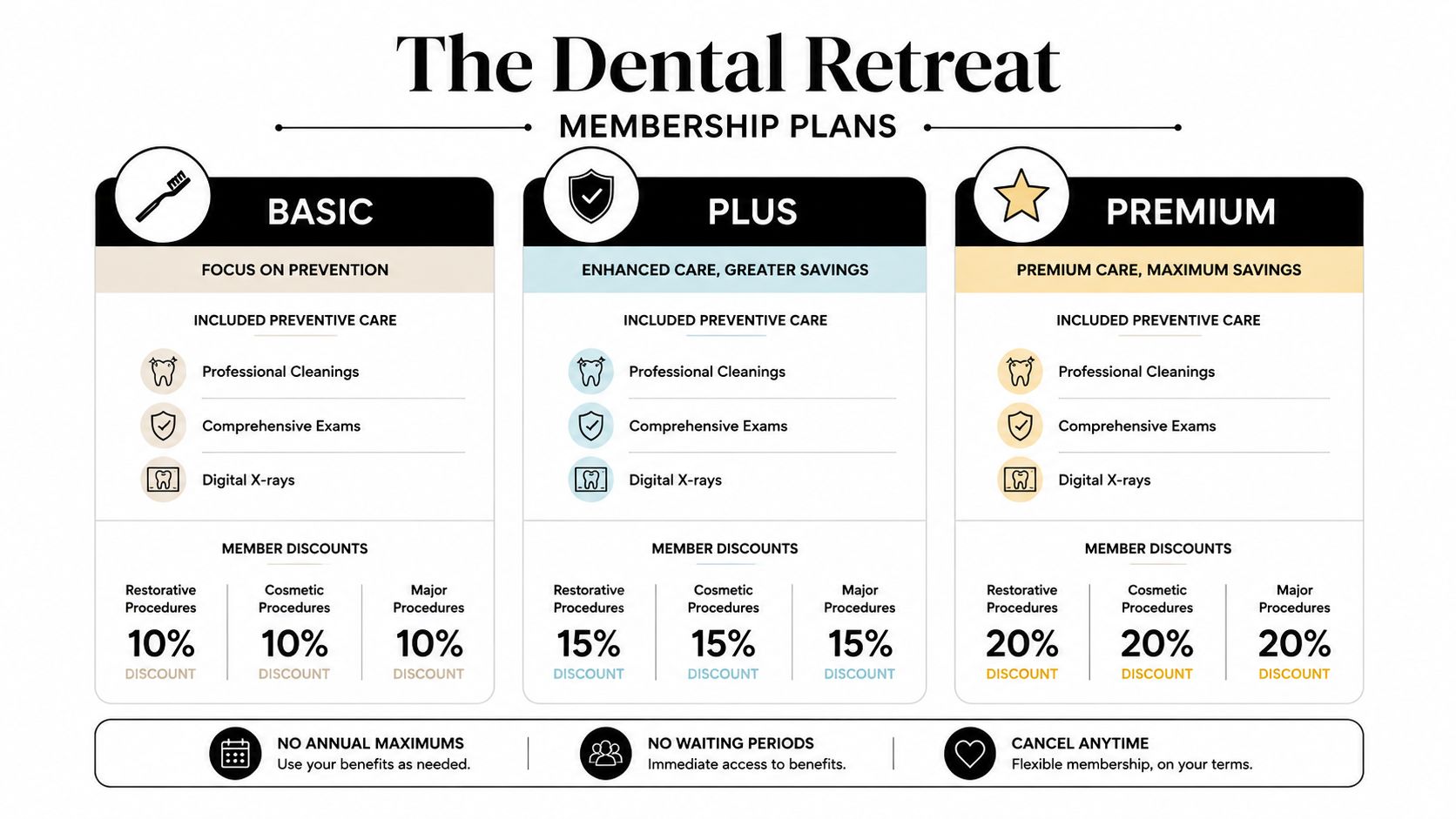
The Dental Retreat offers an in-house membership option for uninsured patients, with plans starting at $299 per year and savings for periodontal maintenance. The available structure includes preventive care and discounts on additional procedures, but you should confirm current pricing, eligibility, and exclusions with the Katy team before enrolling.
Choose the tier that matches your treatment
The plan information presents three discount levels:
- Basic: Preventive care such as cleanings, exams, and X-rays, with 10% off eligible restorative, cosmetic, and major procedures.
- Plus: The same core preventive structure, with 15% off eligible additional care.
- Premium: Preventive care with 20% off eligible restorative, cosmetic, and major procedures.
Those percentages describe the plan structure, not a promise that every service qualifies. Ask specifically about crowns, root canals, fillings, emergency visits, whitening, veneers, dental implants, clear aligners, periodontal treatment, sedation, and oral surgery. Specialist referrals may have a separate fee schedule or may fall outside the in-house discount.
The plan can be relevant to patients seeking a routine dentist near me, an emergency dentist, tooth extraction, cosmetic dentistry, or dental implants near me, but membership enrollment doesn't make every service preventive. A consultation is the right way to determine whether the discount applies to your proposed treatment.
Enrollment is straightforward
Call or speak with the front desk at The Dental Retreat, choose the appropriate tier, review the agreement, and schedule your first appointment. The plan is designed to avoid claim forms, and coverage activation and waiting-period rules should be confirmed before treatment.
Ask how the $99 new-patient special interacts with membership enrollment. Confirm whether the special and membership savings stack, which services the offer includes, and when your first cleaning, exam, and full X-ray series can be scheduled. Also ask whether membership payments may be eligible for HSA or FSA use in your situation, and request written guidance before assuming they are.
The practice also offers a $49 problem-focused visit and $350 in-office Zoom whitening as separate advertised options. Those promotions may have their own terms, so confirm eligibility and whether they combine with membership pricing.
The membership page provides the current plan details at The Dental Retreat's membership plan page.
A Simple Checklist Before You Sign Up
A membership plan should pass a practical test before you pay. Don't sign because the monthly figure sounds manageable. Sign only when the services, location, and likely treatment match your year.
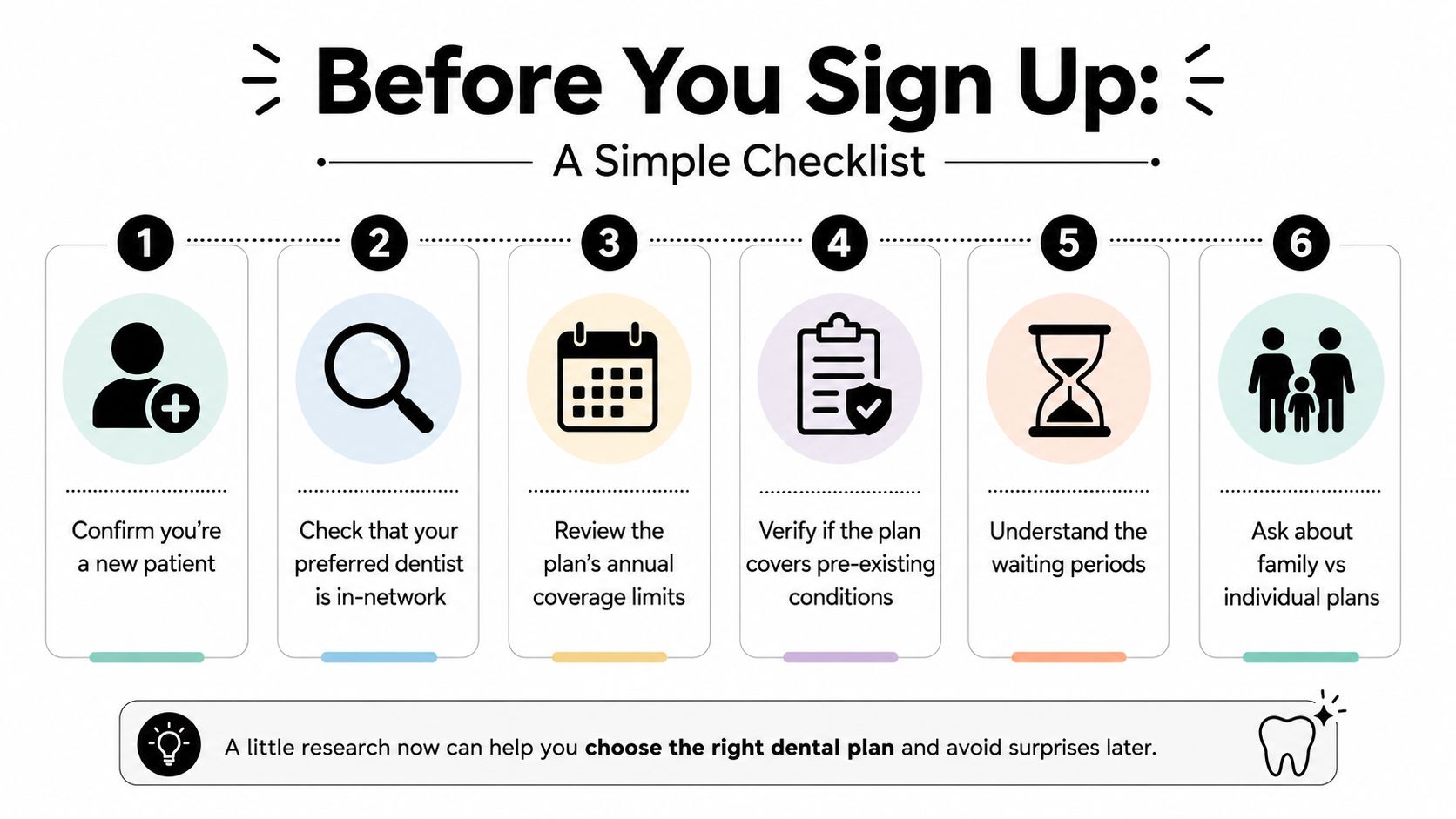
Use this office-manager checklist:
- Confirm your coverage status: Decide whether you're uninsured, underinsured, or already have benefits that may cover the same preventive services.
- Estimate your real visits: Count the cleanings and exams you'll likely attend, then add known needs such as fillings, periodontal maintenance, a tooth extraction, or a crown.
- Compare total dollars: Add the annual membership fee to the discounted treatment fees. Compare that total with the practice's cash estimate and any insurance premium, deductible, coinsurance, or annual maximum.
- Verify the services: Ask about cosmetic dentistry, orthodontics, whitening, dental implants, emergency care, specialist referrals, and procedures that aren't included.
- Check household rules: Find out whether each family member needs an individual tier, whether a senior option exists, and whether periodontal patients need a separate membership.
- Confirm convenience: Make sure the Katy office, hours, appointment availability, and location near your home or workplace fit your routine.
Your expected utilization is the deciding factor. Someone who only wants one visit may not recover the membership fee, while someone planning regular prevention and restorative treatment may gain meaningful value.
Call ahead before your first appointment. The team can confirm current pricing, promotional add-ons, enrollment timing, and the exact discount schedule so your estimate reflects the plan you're considering.
Common Questions Katy Patients Ask Before Joining
Can I use the plan if I move?
Usually not at another dental office. An in-house membership is tied to the enrolling practice, so ask about cancellation terms if you move away from Katy, Sunterra, Cane Island, Katy Manor, Kingscrossing, Lakehouse, Marisol, The Grange, Anniston, Katy Lakes, Elyson, or Ventanna Lakes.
Is there a waiting period for a crown or root canal?
Many in-house plans are designed for immediate use, but major-procedure eligibility depends on the written agreement. Ask whether a crown, root canal, implant, tooth extraction, or emergency service can receive the discount immediately.
Do specialist referrals receive the discount?
Not automatically. An oral surgeon, periodontist, or endodontist may bill separately, and the in-house fee schedule may not extend to that provider. Before accepting a referral, ask whether the discount applies before or after the referral and request the expected fee.
What happens to unused cleanings or exams?
Unused visits generally don't become cash credits or roll into the next membership term. Confirm the expiration rules, especially if travel, illness, or scheduling problems could prevent you from attending.
Can I cancel and receive a refund?
Cancellation and refund policies vary. Ask whether the agreement allows a prorated refund, whether using an included service changes refund eligibility, and how cancellation must be submitted.
Does the fee count toward an insurance deductible later?
An in-house membership fee usually isn't the same as an insurance premium or claim payment. If you later enroll in dental coverage, ask both the practice and the carrier whether any payment receives deductible credit. Don't assume it will.
The front desk can answer plan-specific questions in a short phone call. Have your expected services ready, including cleanings, dental X-rays, periodontal maintenance, fillings, emergency visits, cosmetic treatment, or dental implants, and ask for a written estimate.
The Dental Retreat offers in-house membership plans, preventive dental care, restorative dentistry, cosmetic services, emergency visits, and implant consultations for patients in Katy, TX. Visit The Dental Retreat to review your options and request an appointment based on the care you expect to need this year.