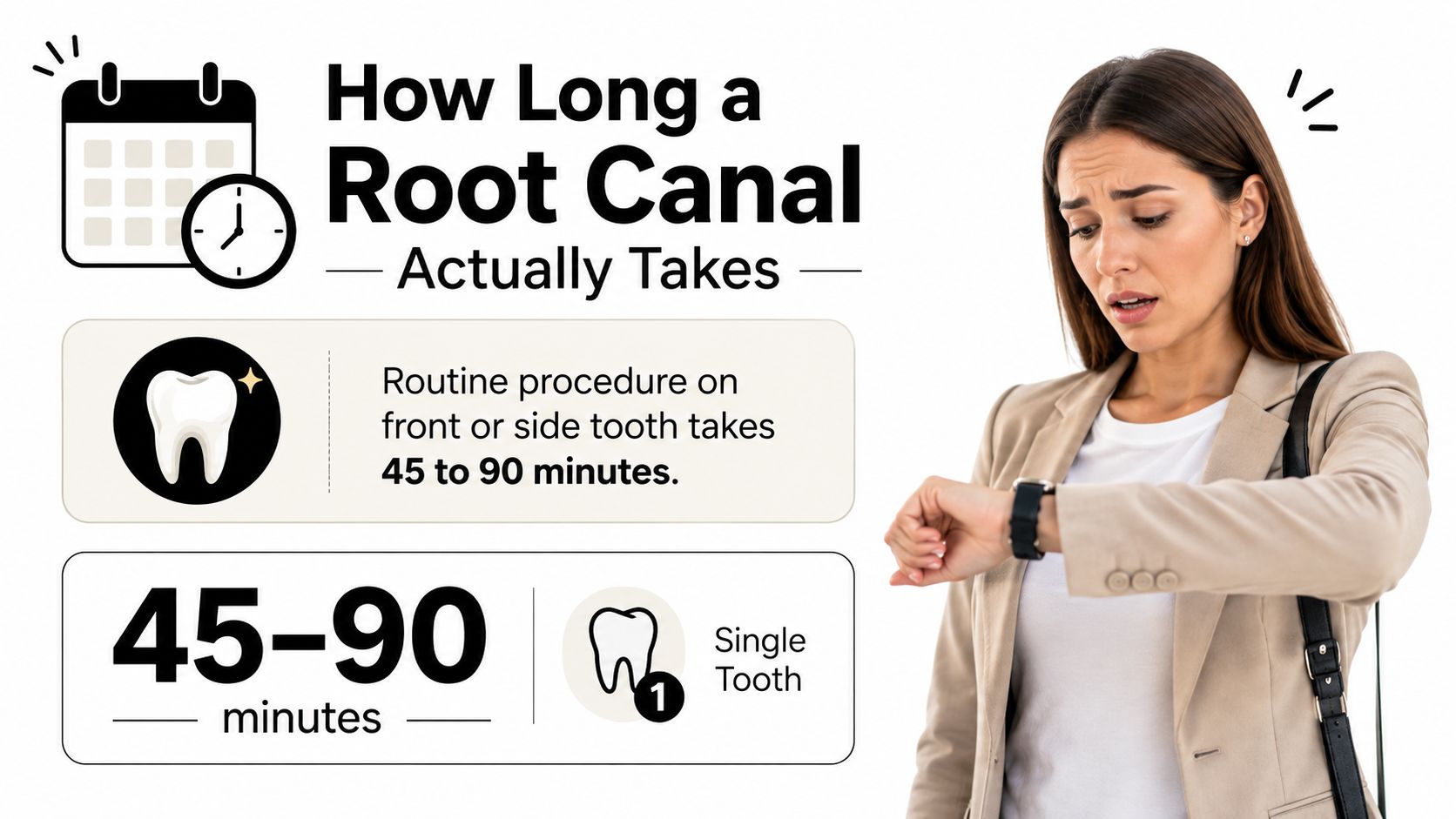
A routine root canal usually takes 45 to 90 minutes. Molars or infected teeth can extend to 90 minutes to 2 hours and may require a second visit.
You may be asking because you're trying to fit treatment between a work call, school pickup, or childcare. In Katy, TX, planning the whole appointment matters more than estimating drill time alone. Check-in, dental x-rays, numbing, treatment, discharge instructions, and the next restoration appointment all affect how your day will feel.
How Long a Root Canal Takes
Protect more time than the treatment itself. For a Katy appointment, plan around work, school pickup, childcare, and the drive home, rather than treating the dental chair as the whole schedule. Check-in, imaging, consent, numbing, discharge instructions, and arranging the next restoration can add 30 to 60 minutes around the procedure itself.
A straightforward front or side tooth often needs 45 to 90 minutes in the dental chair. The clinical time guidance on root canal appointments describes routine visits ranging from 30 to 90 minutes, while complex molars may take 90 minutes to 2 hours. If you need to return to work or collect a child, leave a buffer instead of booking the appointment tightly between commitments.
Four factors control the schedule
- Infection severity: Swelling, drainage, or significant inflammation can make cleaning and medication more involved.
- Tooth location: Front teeth are generally easier to access than molars at the back of the mouth.
- Root and canal anatomy: Curved, narrow, calcified, or unexpected canals take more time to locate and treat.
- Visit structure: Some teeth can be cleaned and sealed in one appointment. Others benefit from medication followed by a later sealing visit.
The technical portion can be shorter than the full appointment. A PubMed-indexed clinical report recorded average shaping times of 13.76 minutes for one-root teeth and 17.77 minutes for plural-root teeth. It also reported 17.35 minutes for long canals, compared with 14.29 minutes for short canals. These figures come from the clinical report on canal shaping time, so they describe canal preparation, not check-in, numbing, diagnosis, or recovery instructions.
The practical question is, “How much of my day should I protect?” For a Katy family, that may mean arranging childcare for the entire appointment window and keeping flexibility for a restoration visit, rather than planning around chair time alone.
What Happens Inside the Tooth and Why It Takes the Time It Does
A root canal removes infected or inflamed pulp from inside the tooth so the dentist can disinfect and seal the canals instead of extracting the entire tooth. The work follows a logical sequence, and each step protects the tooth from remaining bacteria.

The four clinical stages
- Opening the crown: The dentist makes a controlled opening through the top of the tooth to reach the pulp chamber.
- Cleaning each canal: Small instruments remove infected pulp, and irrigation helps wash out debris and bacteria.
- Shaping the canals: The dentist creates a shape that allows the canals to be disinfected thoroughly and sealed securely.
- Filling the canals: A material called gutta-percha fills the prepared spaces, limiting the chance that bacteria can re-enter.
A simple tooth with open, straight canals may move through these stages efficiently. A “cranky” tooth can slow the appointment. Swollen tissue may bleed more, the dentist may need additional irrigation, and severe infection may call for medication inside the tooth before the final filling is placed at another visit.
Calcified canals can be especially demanding because they may be hair-thin and difficult to find. Curved canals also require careful measurement and negotiation. Dentists may use an apex locator to estimate canal length, then clean, shape, and seal each canal individually.
Practical rule: The more canals the dentist must locate and the harder those canals are to reach, the more time your appointment needs.
Magnification can help with this work. A clinical study on magnifying loupes and endodontic treatment time found that nonsurgical endodontic treatment time was significantly reduced when a magnifying loupe was used. Better visualization can help the dentist identify canal entrances sooner and reduce time spent searching or correcting access.
You can also review The Dental Retreat's root canal procedure explanation before your visit.
How Tooth Location Changes the Clock
Tooth location gives you a useful starting point, but it doesn't determine the schedule by itself. Front teeth often have simpler access, while back teeth usually require the dentist to work farther into the mouth and manage more canals.
| Tooth Location | Number of Canals | Typical Chair Time | Likelihood of Second Visit |
|---|---|---|---|
| Front teeth, incisors and canines | Usually one | 45 to 60 minutes | Lower when infection is limited |
| Premolars | One or two | 60 to 90 minutes | Moderate when anatomy or infection is complex |
| Molars | Often three or four | 90 minutes to 2 hours | Higher when infection or curved roots are present |
Front teeth tend to be the most accessible. Their canal anatomy is often easier to see and negotiate, so many straightforward cases fit toward the shorter end of the range. That doesn't mean every front tooth is quick. A previous restoration, calcification, or extensive infection can still lengthen treatment.
Premolars sit between front teeth and molars. Some have one canal, while others have more than one, and the dentist must identify every canal before sealing the tooth. That extra anatomy can shift the visit toward the longer end of the usual range.
Molars are often the time-intensive cases because they sit at the back of the mouth and commonly contain several canals. Aspen Dental's patient guide to root canal timing notes that longer appointments are often associated with molars or teeth with multiple roots.
Second molars and teeth with previous crowns may take longer because the dentist must work through existing restoration material and limited visibility. For a dentist near me in Katy, ask whether the office expects your tooth to be treated in one appointment or whether the team is reserving time for a staged procedure.
Single Visit Versus Multiple Visits in Katy
A one-visit root canal can suit a straightforward tooth when the dentist can clean, shape, disinfect, and seal the canals during the same appointment. An anterior tooth without active swelling is often easier to schedule this way, especially for a patient trying to avoid a second injection or temporary restoration.
Two visits may be safer when the infection or anatomy needs more control. Examples include a molar with sharply curved roots, a tooth that has been aching for weeks, an abscess visible on an x-ray, or swelling that suggests the infection is still active. In those situations, the dentist may clean the canals, place medication such as calcium hydroxide, and return later to complete the seal.
The NHS takes a more conservative scheduling view, stating that root canal treatment usually requires two or more appointments, with each appointment lasting 1 to 2 hours or sometimes longer. NHS guidance on root canal treatment reinforces that the total timeline depends on the tooth and its complexity rather than one fixed appointment length.

How to plan around Katy life
For families in Sunterra, Cane Island, Katy Manor, Kingscrossing, Lakehouse, Marisol, The Grange, Anniston, Katy Lakes, Elyson, and Ventanna Lakes, the choice affects more than the dental calendar. A single appointment may reduce trips to the office, while staged care can give inflamed tissues time to settle before the final seal.
The Dental Retreat may have same-day care available, but same-day treatment shouldn't be forced when infection severity makes staged care more appropriate. A PubMed study on treatment duration found that higher-difficulty cases took significantly longer, with tooth position, crown morphology, root morphology, canal appearance, and periodontal condition among the important time factors. The study summary on root canal treatment duration also indicates that patient age and sex have little influence on duration compared with anatomy and clinical difficulty.
Your dentist's recommendation should be a comfort and safety decision, not a sales pitch. Ask what will happen at each appointment, how long each visit may take, and whether a temporary restoration will protect the tooth between visits.
What Your Appointment Looks Like at The Dental Retreat
A calm appointment starts before the handpiece is turned on. When you arrive at the Katy practice, the team reviews your medical history, current medications, symptoms, and treatment concerns. That conversation helps the dentist plan anesthesia, imaging, sedation, and the safest sequence for your tooth.
The dentist may take pre-operative x-rays or a 3D scan to understand the root shape and identify anatomy that isn't visible from the outside. A topical gel can prepare the area before local anesthetic is delivered. Patients with dental anxiety can ask about oral sedation options, including what transportation and aftercare arrangements are needed.
From isolation to the final bite check
A rubber dam isolates the tooth, keeping it clean and dry while protecting the rest of your mouth. The dentist then opens the crown, cleans and shapes each canal, rinses the spaces, and fills them with bioceramic material or gutta-percha when the case is ready for completion.
The appointment can feel easier when your attention has somewhere else to go. The Dental Retreat describes a spa-inspired setting with blankets, noise-canceling headphones, heated or massage chairs, aromatherapy, and ceiling TVs. These comfort features don't change the clinical steps, but they can make a long period of keeping your mouth open feel more manageable.
At the end, the dentist checks your bite so the temporary filling doesn't feel too high when you close your teeth. The front desk team should review care instructions, costs, and the next visit before you leave. That explanation matters because appointment time includes knowing what to do once you're back at work, home, or school pickup.
If you're comparing a dentist in Katy, TX, look for an office that explains the sequence clearly rather than giving you a single vague time estimate. A new patient exam, dental x-rays, and a focused evaluation can clarify whether you need endodontic treatment, a filling, a crown, a tooth extraction, or another form of restorative dentistry.
Why the Crown and Follow Up Matter Just as Much
The root canal removes infection, but the tooth still needs protection. Removing the pulp leaves a tooth more vulnerable to fracture, especially when decay or previous restorations have already weakened its structure. A back tooth often needs a permanent crown, while a front tooth with enough remaining structure may be restored with a smaller filling.
The complete care timeline can therefore extend beyond the cleaning and sealing appointment. The Dental Retreat's information about dental caps in Katy can help you understand how a crown or cap protects a treated tooth and why your dentist may recommend it.
Durability depends on the restoration
Indiana University summarized U.S. data showing a median tooth survival of 11.1 years after root canal treatment overall, about 20 years when both a filling and crown were placed, about 11 years when only one of those restorations was placed, and about 6.5 years with no restorative work. Indiana University's summary of tooth survival after root canal treatment connects those outcomes with the importance of definitive restoration.
Those figures shift the way you should think about root canal time. Saving a few minutes during the initial procedure matters less than completing the restoration plan that protects the tooth. Delaying or skipping the crown can allow cracks to develop, and a severely fractured tooth may eventually require extraction and replacement with a dental implant.
Ask when the permanent restoration should be placed, whether a temporary filling will be used, and how the office will check healing. Your dentist may recommend a follow-up x-ray to evaluate the bone around the root tip. The successful finish line isn't just leaving the chair. It's a sealed, protected tooth that you can maintain.
How to Prepare and What Recovery Looks Like
Preparation can make the appointment feel more predictable. Unless your dentist gives different instructions because of IV sedation or another medical concern, eat a light meal before treatment, arrange a driver if sedation is planned, bring an updated medication list, and avoid alcohol the day before.
A simple checklist helps:
- Food: Eat lightly beforehand unless your sedation instructions say otherwise.
- Transportation: Arrange a responsible driver when sedation may affect alertness.
- Medications: Tell the dental team about prescriptions, supplements, and allergies.
- Schedule: Leave room after the appointment so you aren't rushing while numb.
The first day in three phases
When numbness fades: Local numbness commonly wears off within 2 to 4 hours, according to the recovery guidance provided for this care plan. Avoid chewing until you can feel your lips and cheek normally, since accidental biting is easier while numb.
During the first few days: Choose softer foods and chew away from the treated tooth. Use an over-the-counter pain reliever only as directed and only if it's appropriate for your health history. The temporary filling needs protection until the dentist places the final restoration.
As the temporary settles: Return to normal eating according to your dentist's instructions, but avoid hard or sticky foods on the treated side while the tooth remains temporarily restored. Many Katy patients can return to work the same day or the next day, though comfort varies and sedation changes that plan.
Call the office if throbbing persists instead of easing, swelling continues beyond 48 hours, or your bite feels uneven. A high temporary filling can make the tooth feel sore when you close, and the dental team can check it rather than asking you to tolerate the problem.
Planning Your Visit and Booking With Confidence
Start with the tooth, not the appointment slot. A routine front-tooth case may fit into a shorter clinical block, while a molar or infected tooth deserves more room. If the dentist expects staged care, place both visits on your calendar before the first appointment so work, childcare, and transportation don't become last-minute problems.
Katy households can use a simple scheduling approach:
- Early morning: A good choice if anxiety grows while you wait or if you want the appointment completed before the day becomes busy.
- Mid-morning: Useful if you prefer time afterward to rest, monitor numbness, and follow soft-food instructions.
- Friday: Convenient for patients who want the weekend available for a quieter recovery.
- Before school pickup: Only practical when the office confirms the expected treatment and you have enough buffer for check-in and discharge.
The full timeline may include diagnosis, the root canal itself, a temporary restoration, a crown or permanent filling, and follow-up. Cleveland Clinic's root canal treatment overview notes that treatment commonly takes one or two visits, while a crown may require an additional appointment of about 60 minutes.
When you call a dentist near me in Katy, ask whether the practice provides emergency evaluations, sedation options, dental x-rays, restorative dentistry, and crown planning in one coordinated location. The same conversation can also help if your concern turns out to need an emergency dentist, tooth extraction, a dental implant consultation, or treatment for another problem.
The Dental Retreat serves Katy, TX, including families near Sunterra, Cane Island, Katy Manor, Kingscrossing, Lakehouse, Marisol, The Grange, Anniston, Katy Lakes, Elyson, and Ventanna Lakes. Its spa-style amenities, sedation options, and same-day crown capability may help eligible patients reduce the number of trips, although the dentist should still choose the treatment sequence based on infection and anatomy.
For patients also searching for Dental implants near me or a cosmetic dentist near me, a root canal consultation can be the right place to discuss whether saving the natural tooth is realistic before considering extraction and replacement. The priority is a clear diagnosis and a restoration plan that fits your health, comfort, and schedule.
If tooth pain, swelling, or sensitivity is disrupting your day, schedule a root canal evaluation with The Dental Retreat in Katy, TX. The team can review your symptoms, take the necessary images, discuss comfort and sedation options, and build a realistic treatment timeline around your work and family commitments.