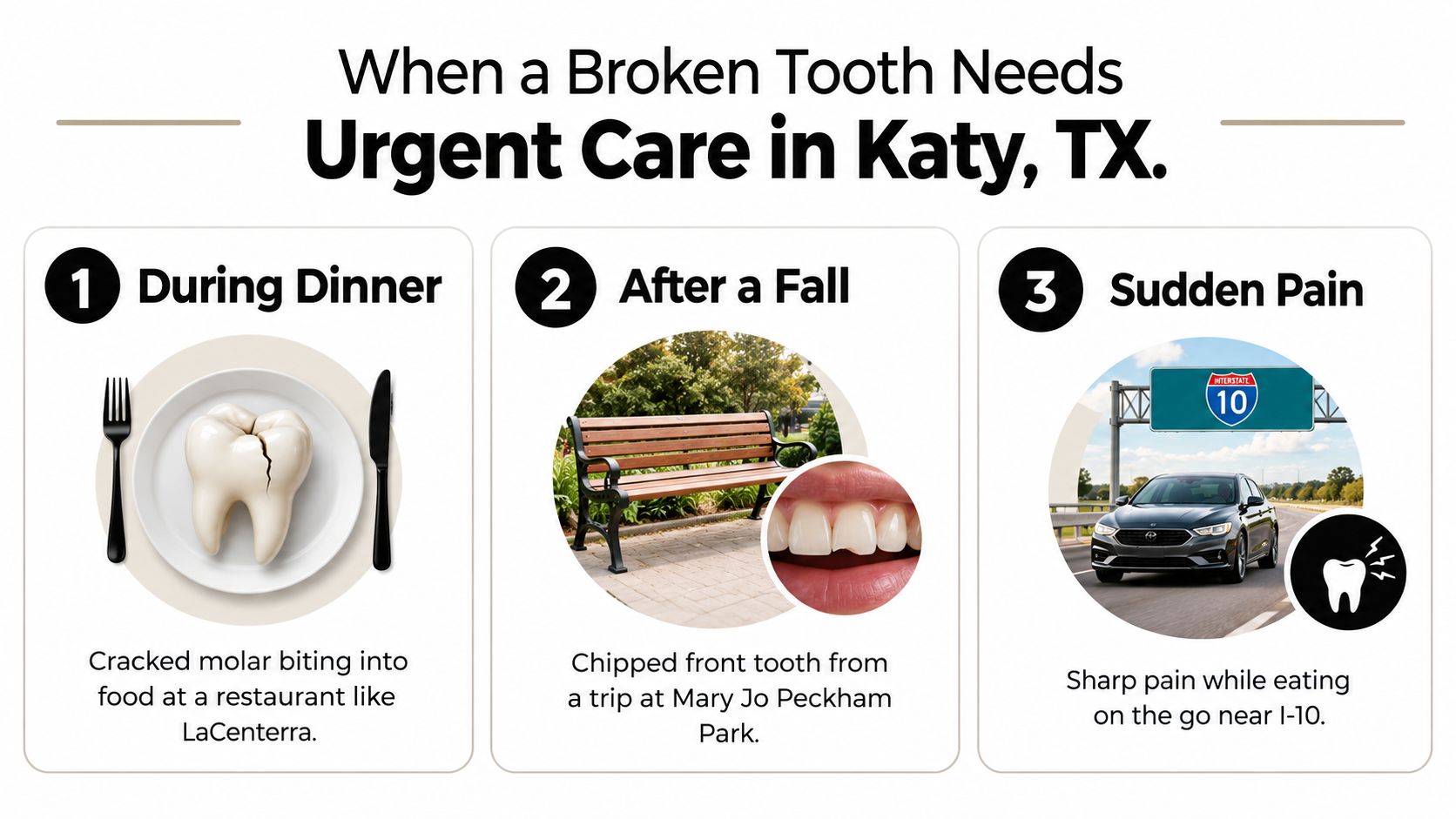
You bite into dinner and feel a sharp edge where your tooth used to be smooth. Maybe a molar cracked at LaCenterra, a front tooth chipped after a fall at Mary Jo Peckham Park, or sudden pain started while you were eating near I-10. You're not alone, and you don't need to guess your next move. Broken tooth emergency repair in Katy, TX, works best when the first response protects the tooth and the dentist matches treatment to the actual depth of the break.
The Dental Retreat serves patients throughout Katy, including Sunterra, Cane Island, Katy Manor, Kingscrossing, Lakehouse, Marisol, The Grange, Anniston, Katy Lakes, Elyson, and Ventanna Lakes. Whether you're searching for an emergency dentist, a dentist near me, or a dentist in Katy, TX, the priority is simple: control the immediate problem, preserve every possible treatment option, and create a clear plan for the final repair.
When a Broken Tooth Needs Urgent Care in Katy, TX
A broken tooth isn't one single type of emergency. A tiny enamel chip without pain may be suitable for a prompt scheduled visit, while a fracture with bleeding, swelling, or severe pain needs same-day attention.
Consider three common Katy situations. A cracked molar during dinner at LaCenterra may hurt only when you bite, but that pressure can signal a deeper structural fracture. A chipped front tooth after a fall at Mary Jo Peckham Park may look minor while the surrounding tooth-supporting tissues have also been injured. Sudden, sharp pain while eating on the go near I-10 may indicate exposed dentin or pulp, especially if cold air or drinks trigger a strong response.
Call for same-day care when these signs appear
- Severe or throbbing pain: Strong, persistent pain can mean the inner pulp is inflamed or exposed.
- Bleeding that won't slow: Ongoing bleeding may involve the gum, lip, or deeper facial trauma.
- A loose or displaced tooth: A tooth that moves after an injury needs urgent evaluation.
- Visible nerve tissue: A pink or red area in the center of the broken tooth requires protection.
- Facial swelling: Swelling can accompany infection or significant injury and shouldn't be watched casually.
If you have a small chip, no pain, no swelling, and no loose tooth, you may be able to schedule a visit within 24 to 48 hours. Still, don't use the absence of pain as proof that the tooth is safe. A fracture can weaken the tooth even when the nerve hasn't reacted yet.
Broken and fractured teeth account for 199,061 emergency department visits in the United States, and males represented 63% of those cases. The mean charge per visit was $1,441, with total national charges of $241.8 million, according to the PubMed dataset on emergency visits for broken and fractured teeth. Quick dental triage can help separate a tooth-focused problem from facial trauma that belongs in an emergency department.
Triage at Home in the First Few Minutes
Stay calm and protect the area. Your actions during the first few minutes can reduce contamination, limit swelling, and help the dental team understand what happened.
Follow this immediate sequence
- Rinse gently with warm water. Let the water clear food and loose debris. Don't swish aggressively, because forceful rinsing can irritate injured gum tissue.
- Check for bleeding. Place clean gauze over the area and hold steady pressure for 10 minutes. Avoid repeatedly lifting the gauze to check, since that can disturb the clot.
- Look without probing. Use a mirror and good light to see whether a fragment is loose, whether the tooth looks displaced, or whether a pink area is visible. Don't poke the fracture with a fingernail, toothpick, or instrument.
- Use a cold compress. Apply a cold pack to the outside of the cheek in 15-minute intervals. This can help limit swelling and make the ride to a Katy emergency dentist more manageable.
- Choose the right destination. An emergency dentist is appropriate for the tooth itself. Go to an emergency department for a major facial injury, uncontrolled bleeding, loss of consciousness, breathing difficulty, or trauma that extends beyond the tooth and mouth.
Don't place aspirin directly on the gum. It can irritate or burn soft tissue. Avoid hot foods and drinks, which may increase discomfort when the dentin or pulp is exposed.

For broader first-aid guidance before you leave home, review what to do if you have a dental emergency, then contact the practice rather than waiting for symptoms to declare themselves.
The reason for acting promptly is practical. Traumatic dental injuries represent 15.4% of emergency dental-service visits overall, rising to 24% among patients under 21 and 29% in pediatric emergency dental services, according to a systematic review of emergency dental care and traumatic dental injury. Children and adults can both need careful assessment after a fall, sports injury, or impact.
Saving the Broken Piece and Controlling Pain
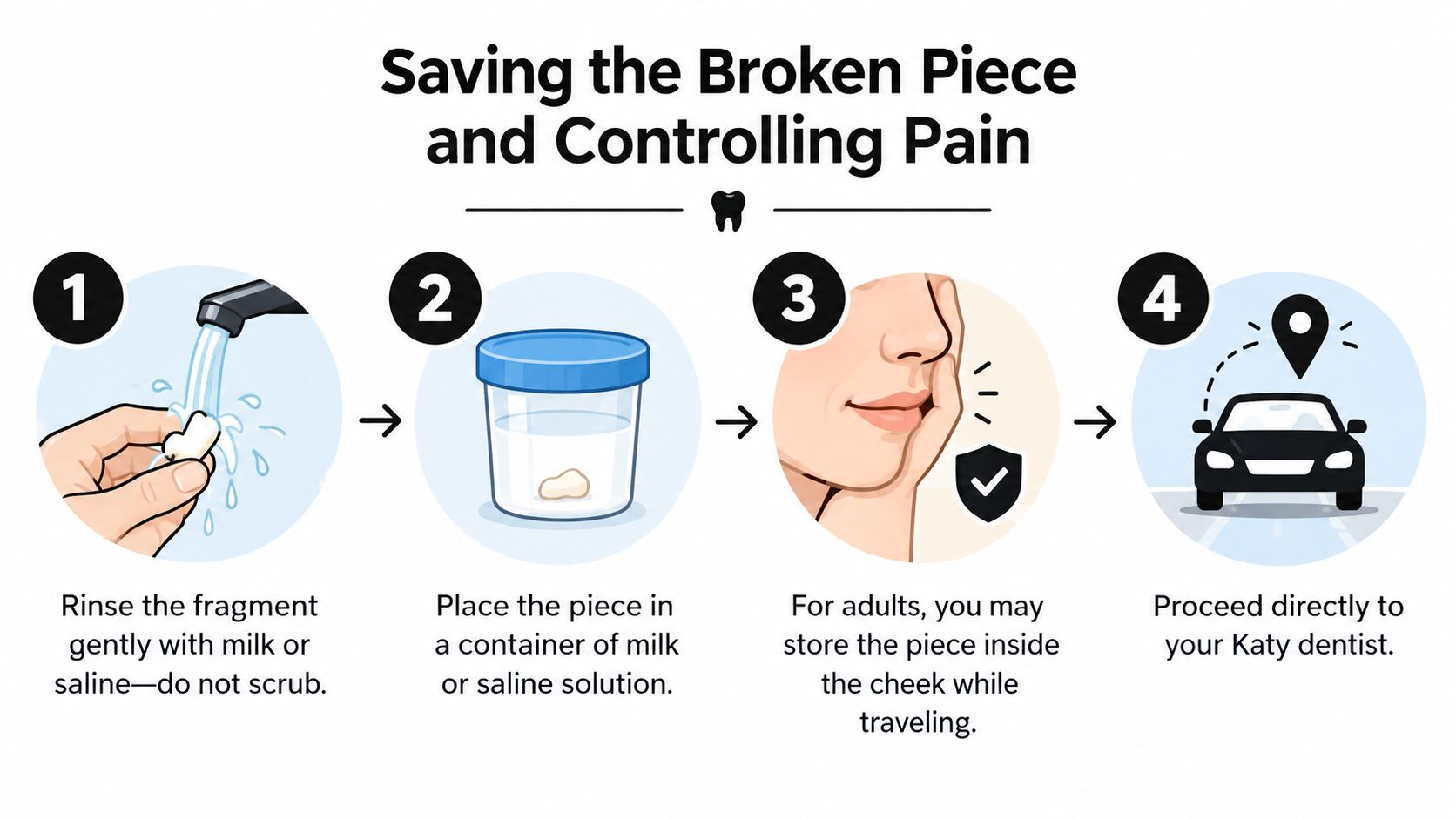
Find the fragment before you clean the room, car, or dinner table. A dentist may be able to reattach it, but the condition of the fragment matters. Don't scrub it, dry it out, or wrap it in tissue where it can stick and lose moisture.
Handle the fragment carefully
Rinse the piece gently with milk or saline. Place it in a clean container filled with milk or saline solution. Adults traveling directly to a Katy dentist may hold the piece inside the cheek, but don't use that method for a child who could swallow it.
For a larger fragment, wrap it in cling film and place it inside a sealed container. Keep it protected during the drive, and call The Dental Retreat before leaving so the team can prepare for your arrival and reduce unnecessary chair time.
Pain control should be sensible, not improvised. Over-the-counter ibuprofen can help with pain and inflammation when it's appropriate for you and a doctor hasn't advised against it. Follow the product label and your own medical guidance. A benzocaine numbing gel may provide short-term relief, but it won't repair the fracture or protect an exposed pulp.
Practical rule: Never use superglue, household adhesive, wax, or a do-it-yourself filling kit on a broken tooth.
Those products can contaminate the surface and make professional bonding harder. They can also trap debris against the fracture or injure the gum. If the edge is cutting your tongue, cover it temporarily with clean dental wax only if a dental professional recommends that approach, and don't push material into the broken area.
Fragment reattachment isn't merely cosmetic. Clinical guidance recognizes it as a possible interim or permanent treatment when the piece is suitable and the tooth can support it. The dentist will consider whether the fragment is intact, how long it has been dry, whether dentin is exposed, and whether the pulp remains healthy. Save the piece even if you're unsure it can be reused.
What Happens During an Emergency Dental Visit
An emergency appointment starts with a focused conversation, not an automatic drill. The dentist needs to know when the break happened, what caused it, whether the tooth was previously repaired, and whether pain changes with biting, cold, heat, or pressure.
The examination includes the tooth, nearby teeth, gums, lips, cheeks, and jaw. The dentist may gently tap the tooth, check whether it moves, inspect the fracture under magnification, and look for cracks that extend below the visible surface. Soft-tissue injuries matter because a broken tooth can occur alongside a cut lip, jaw injury, or facial trauma.
Imaging and pulp testing guide the decision
A periapical dental X-ray can show the root, surrounding bone, and areas hidden beneath the gum line. A small CBCT scan may be useful when the dentist needs a three-dimensional view of a suspected root fracture, complex crack, or bone injury.
Vitality testing helps determine how the pulp is responding. The dentist may use cold or electric stimuli and compare the response with nearby teeth. That information helps distinguish a tooth that may recover after protection from one that needs root canal treatment or a different surgical plan.
The first repair may be temporary
Chairside care depends on what the examination reveals. The dentist may:
- Smooth a sharp enamel edge.
- Isolate the tooth with a rubber dam.
- Seal exposed dentin with a protective material.
- Recontour a minor chip.
- Reattach a clean, suitable fragment.
- Place a temporary restoration while the tooth settles.
The clinical findings usually lead to one of three paths for a Katy patient. A minor fracture may receive same-day composite repair. A larger but restorable break may need root canal treatment and a crown, sometimes in one extended visit. A tooth with a non-restorable fracture may require extraction followed by replacement planning.
The aim isn't to perform the most extensive procedure immediately. It's to control pain, protect the remaining tooth, and choose a sequence that gives the tooth the strongest reasonable prognosis.
Repair Options That Match the Type of Break
The right repair depends on the location and depth of the fracture, not only on how much tooth appears to be missing. A front tooth with a clean enamel chip and a back tooth with a split cusp may both look “broken,” but they place very different demands on the restoration.
| Break Type | Recommended Repair | Typical Visits | Best For |
|---|---|---|---|
| Small enamel chip | Direct composite bonding or smoothing | Often one visit | Minor front-tooth chips with healthy underlying structure |
| Larger structural break with sound pulp | Crown, sometimes ceramic or zirconia | One extended visit or staged care | Cuspal or back-tooth fractures where substantial structure remains |
| Pulp exposure or infection | Root canal treatment followed by a crown | One extended visit or multiple visits | Teeth that can be restored after the inner tissue is treated |
| Non-restorable fracture | Tooth extraction and replacement planning | Staged | Teeth with severe root or structural damage |
Bonding works best for limited damage
Direct composite bonding can restore shape and protect a small fracture, especially on a front tooth. The dentist matches the shade, bonds tooth-colored resin to the enamel, and adjusts the bite so the repair doesn't receive excessive force.
A crown becomes more appropriate when the tooth has lost a substantial portion of its structure or a cusp has fractured. Same-day ceramic or zirconia treatment may be possible in selected cases, while other patients need a temporary restoration before final crown delivery.
Pulp treatment changes the sequence
When the pulp is exposed or infected, bonding alone won't solve the problem. Root canal therapy removes the compromised inner tissue, disinfects the canal system, and prepares the tooth for a crown that protects what remains.
For complicated crown fractures without luxation, one clinical review reported 82.3% overall treatment success, or 345 of 419 teeth, compared with 72.3%, or 73 of 101 teeth, for complicated crown fractures without luxation in the reported comparison. The source is the clinical review of treatment outcomes after crown fracture. The figures reinforce one point: depth, pulp involvement, and follow-up change the outlook.
If the tooth can't be predictably restored, extraction may be the safest choice. Replacement options can include dental implants, fixed bridges, or partial dentures. Patients searching for dental implants near me should understand that implant planning usually follows healing and a careful review of bone, gum health, bite forces, and overall medical history.
Treatment cost depends on the procedure, materials, insurance benefits, and whether care is completed in one visit or staged. Ask for a written estimate before treatment begins, including temporary care, imaging, final restoration, and replacement planning when relevant.
Sedation and Comfort Options at The Dental Retreat
An emergency visit becomes easier when you know what comfort support is available. Local anesthesia is the baseline for broken tooth repair, and the dental team confirms that the area is numb before treatment begins.
For mild to moderate anxiety, nitrous oxide, commonly called laughing gas, can help you stay relaxed during a focused repair or single-visit procedure. It wears off quickly for many patients, but the team will still review your individual situation and instructions before you leave.
Oral conscious sedation may suit someone with stronger dental fear or a longer appointment. It requires screening because medications, medical conditions, and the planned procedure all affect safety. You'll need a responsible driver, and the practice may give you specific instructions about eating and drinking beforehand.
IV sedation is considered for selected surgical treatment, such as extraction or implant placement. It offers a deeper level of relaxation and requires more detailed preparation, including transportation and fasting instructions when prescribed. The dental team monitors vital signs throughout the appointment.
Comfort continues in the treatment room
The Dental Retreat in Katy provides a calm, spa-inspired environment with comfort features such as warm blankets, neck pillows, noise-cancelling headphones, and streaming entertainment. Those details matter during longer visits, especially when a broken tooth requires imaging, temporary protection, or more than one procedure.
Sedation isn't a standard add-on applied to every patient. The team chooses it based on your anxiety level, medical history, treatment length, and safety requirements. You can review the differences between approaches in oral sedation versus IV sedation before your appointment.
Tell the office about medications, allergies, pregnancy, sleep conditions, and previous reactions to sedation. Arriving with accurate information helps the dentist select appropriate anesthesia and avoid preventable delays.
Book Same-Day Broken Tooth Repair in Katy, TX
A broken tooth can begin as a sharp edge and become a much larger treatment problem if you leave it exposed. Open dentin can allow bacteria to move inward, and a damaged pulp may eventually require root canal treatment instead of a simpler protective repair. The longer you wait, the fewer straightforward options the dentist may have.
Same-day emergency appointments in Katy can address the full sequence, from triage and fragment preservation through bonding, crown treatment, root canal therapy, extraction, and replacement planning. If anxiety is part of the reason you're delaying care, ask about nitrous oxide, oral sedation, or IV sedation during the first call.
What to bring to your appointment
Bring the broken fragment in milk or saline if you recovered it. Also bring a list of medications, insurance information if available, and details about when the injury occurred. New-patient paperwork is minimal, and the team can guide you through insurance and financing questions when you arrive.
The practice is located on Stockdick School Rd. in Katy, with access convenient for patients traveling from Sunterra, Cane Island, Katy Manor, Kingscrossing, Lakehouse, Marisol, The Grange, Anniston, Katy Lakes, Elyson, and Ventanna Lakes. Proximity to I-10, flexible morning hours, and weekend availability can make urgent care easier to reach when a tooth breaks outside a routine schedule.
Don't wait for the pain to become severe, and don't schedule an online appointment days out if you have swelling, bleeding, a loose tooth, or visible pulp. Call the office, explain what happened, and ask for a same-day broken tooth assessment.
If your immediate concern is a cracked tooth, you can still return later for comprehensive dental care, including cleaning and exams, dental X-rays, new-patient exams, teeth whitening, cosmetic dentistry, restorative dentistry, tooth extraction, and dental implants. The correct starting point is an examination that identifies what can be saved and what needs protection now.
Schedule same-day emergency dental care in Katy, TX or call The Dental Retreat directly for immediate guidance and appointment availability.
The Dental Retreat offers same-day broken tooth assessments, fragment preservation guidance, bonding, crowns, root canal therapy, extraction, replacement planning, and sedation options for anxious patients in Katy, TX. Visit The Dental Retreat to request care and get your broken tooth evaluated before a manageable repair becomes a larger emergency.