You're on a video call in Katy, notice your lower teeth crowding when you speak, and start searching for the best clear aligners. Within minutes, you'll see polished promises about invisible treatment, quick results, and low prices. The difficult part isn't finding an option. It's figuring out which option can safely handle your bite, your teeth, and your ability to wear trays consistently.
As a local dental advisor, I'll give you the candid answer: there isn't one universal winner. The right clear aligner system depends on the movements your teeth need, the health of your gums, the condition of existing dental work, and how much professional supervision you want. If you're searching for a dentist near me, a cosmetic dentist near me, or a dentist in Katy, TX, use this guide to compare the care model, not just the brand name.
Why Choosing the Right Clear Aligner Matters in 2025
Clear aligners aren't just whitening trays that happen to fit over your teeth. Each set applies planned pressure to specific teeth, and the plan must account for your bite, roots, gum health, and the movements required. A tray can look perfect on a computer screen while still needing attachments, polishing between teeth, refinements, or another type of orthodontic treatment to achieve the intended result.
That's why small differences in clinical oversight and fit matter. A local dentist can evaluate whether a tooth is tracking, identify a gum concern, and adjust the plan when your teeth don't respond exactly as predicted. Remote treatment may feel easier at the start, but convenience becomes less attractive if a tray stops fitting or a bite begins to feel uneven.
Practical rule: Choose the treatment model that can manage the hardest movement your case requires, not the model with the most appealing advertisement.
The clear aligner category has expanded far beyond its early days. Align Technology commercially established the modern clear aligner category in 1999, after FDA clearance in 1998. By 2025, the company reported more than 22 million Invisalign patients worldwide, including over 6.5 million teens and children, more than 295,000 Invisalign-trained doctors, and over 2.4 billion clear aligners manufactured worldwide. Those figures come from Align Technology's company profile, and they show how aligners moved from a novel concept to a large orthodontic system.
The advertising environment makes careful comparison more important. A brand can market a simple process because it accepts only certain cases, while a dentist must assess the cases that don't fit a simple template. Your best answer may be supervised clear aligners, traditional braces, or a hybrid plan. The practical next step in Katy is an examination that connects your goals with the movements your teeth need.
Understanding Clear Aligner Options
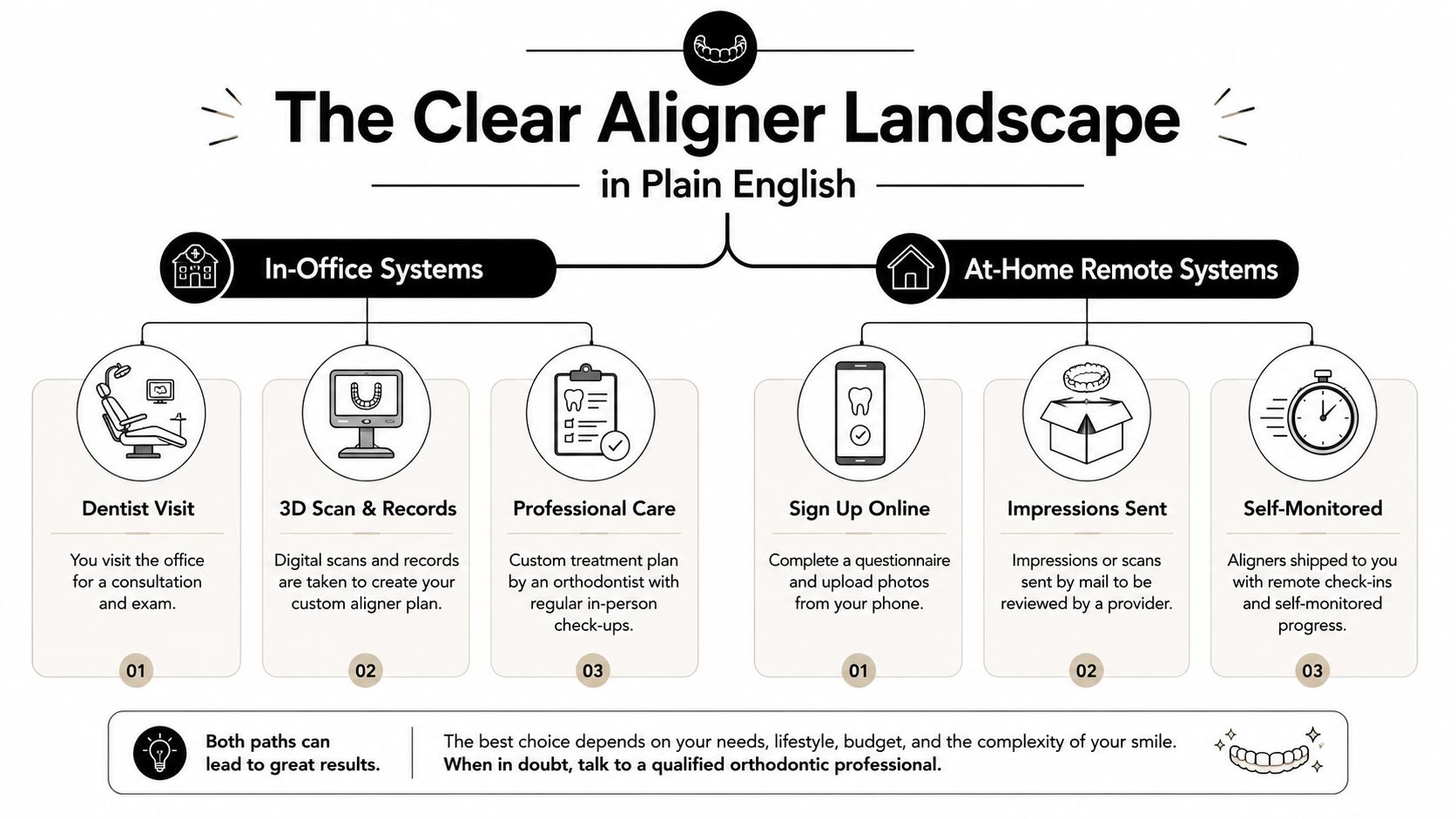
Choosing among clear aligners starts with the care model, not the brand name. In-office systems, including Invisalign, 3M Clarity, SureSmile, and aligners produced through an in-house laboratory, are prescribed and monitored by a Katy dentist or orthodontist. Direct-to-consumer systems ship trays to your home and depend more on impressions, scans, photographs, apps, and self-monitoring.
The two main care channels
In-office treatment generally begins with a complete examination. The clinician may review dental X-rays, photographs, and a digital scan to assess tooth position, roots, bone support, gum health, fillings, crowns, and bite relationships. The provider can approve or modify the digital plan, place attachments when needed, monitor progress, and order refinements if your teeth stop tracking as planned.
At-home treatment limits or removes routine chairside visits. You complete an impression or scan process, receive trays by mail, and communicate through an online platform. This model can suit a narrow group of adults with mild, well-screened cosmetic concerns. It becomes a weaker choice when treatment requires precise rotation, vertical movement, bite correction, or coordination with other dental care.
Within in-office care, ask whether the plan is limited or full. Limited treatment may address minor front-tooth crowding or relapse after braces. Full orthodontic treatment evaluates the entire bite and may include attachments, enamel reduction between selected teeth, elastics, and several refinement stages.
What the laboratory does
The laboratory converts the approved digital plan into a series of trays. It controls each aligner's material, shape, trimming, and staging. Some systems use multilayer plastic, while others use single-layer plastic. Those differences can affect comfort and performance, but the tray material does not replace diagnosis or clinical oversight.
The clinician determines whether the proposed movements make biological and functional sense. That is the practical way to judge the best clear aligners. Compare the complete process, including examination, planning, monitoring, and correction. For many Katy patients, supervised care offers the convenience of clear trays while keeping local clinical support available when the plan needs adjustment.
In-Office Versus Direct-to-Consumer Clear Aligners
Price and convenience matter, but they're only two parts of the decision. The more useful comparison asks what happens before treatment, during treatment, and when the teeth don't follow the original digital plan.
| Factor | In-Office, Dentist or Orthodontist Supervised | Direct-to-Consumer, Remote |
|---|---|---|
| Effectiveness | Can address mild to moderate alignment concerns and selected bite problems, with attachments and other mechanics when indicated | Best suited to carefully screened, simpler cases |
| Clinical oversight | Examination, dental X-rays or 3D scans, progress checks, attachments, enamel reduction when indicated, and refinements | Primarily impressions or scans, shipped trays, photographs, apps, and remote communication |
| Treatment length | Commonly planned around 9 to 18 months in the described Katy market | Often marketed around 6 to 12 months |
| Cost | Commonly presented around $3,500 to $7,500 in the described Katy market | Commonly presented around $1,800 to $2,500 |
| Problem solving | A local provider can assess tracking, sore spots, broken trays, and bite changes chairside | Problems may require remote review, replacement trays, or additional communication |
The treatment-length and price ranges above are market descriptions supplied for this comparison, not guarantees for an individual case. A provider should confirm your fee and timeline after examining your teeth.
Effectiveness depends on the case
In-office care has a wider toolkit. A dentist can bond an attachment to help a tooth rotate, create carefully planned space, add elastics, change the staging, or request a refinement when the original sequence no longer fits the clinical reality. Direct-to-consumer care generally has fewer opportunities for hands-on intervention.
Remote aligners can make sense for a small amount of tipping or straightforward cosmetic alignment. They become less convincing when the treatment involves rotations, vertical changes, significant bite correction, extractions, or jaw-related discrepancies. Those cases need diagnosis, not just a tray delivery schedule.
The cost of convenience
The lower upfront price of remote care can be meaningful for some households. But a stalled plan can create another expense, especially if you later need in-person orthodontic treatment, restorative dentistry, a tooth extraction, or treatment for a bite problem that wasn't identified at the beginning.
A local dentist in Katy, TX can also coordinate aligners with cleaning and exams, dental X-rays, fillings, crowns, gum care, or emergency dental services. That broader view matters because orthodontic treatment takes place in a living mouth, not an isolated row of teeth.
What the Evidence Says About Aligner Effectiveness
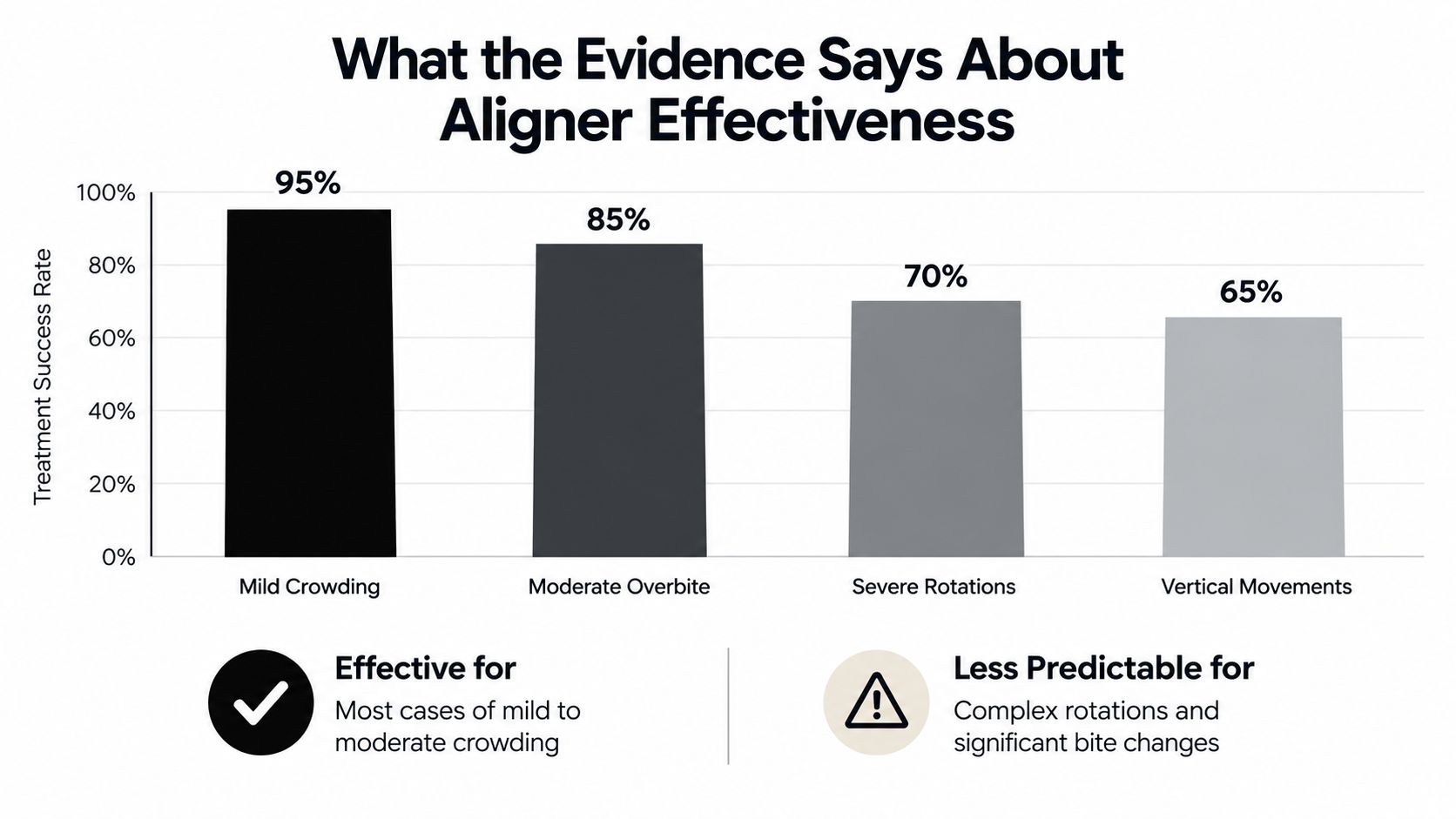
Clear aligners work best when the planned movement is one plastic trays can express predictably. Mild crowding, spacing, and some arch development generally suit aligner therapy. Rounded-tooth rotations, intrusion, extrusion, and complex bite changes need closer planning because trays may not grip or move teeth as fully as a digital setup predicts.
A retrospective Invisalign study found horizontal incisor movements stayed close to the plan, with differences of 0.20 to 0.25 millimeters. Vertical movements were less reliable. The study reported a median 1.5-millimeter discrepancy for maxillary central incisor intrusion and a maximum 3.05-degree difference for canine rotation. Review the PubMed record for the movement-accuracy study for those findings.
Movement type matters more than the label
A later systematic review of adult rotational movements reported accuracy ranging from 36% to 85%, with an average around 65%. The evidence supports a more useful question than whether aligners “work”: how predictable is the specific movement your teeth require?
For in-house and digitally planned aligners, one retrospective study reported overall accuracy of 56.18%, with mesiodistal movement at 72.33% and intrusion at 43.28%. Another large retrospective analysis found 48% of mandibular cases and 50% of maxillary cases achieved overall clinically acceptable movement at the case level. At the individual-landmark level, 91% and 95%, respectively, were acceptable. These findings appear in the retrospective aligner accuracy analysis.
A tooth can track well while the completed case still needs refinement. That difference should shape your provider choice. Supervised care at a local Katy practice gives the dentist a chance to monitor progress, adjust the plan, and address a bite that does not match the original simulation. The right aligner is therefore case-specific, not a universal brand winner.
Daily Wear, Compliance, and What Really Drives Results
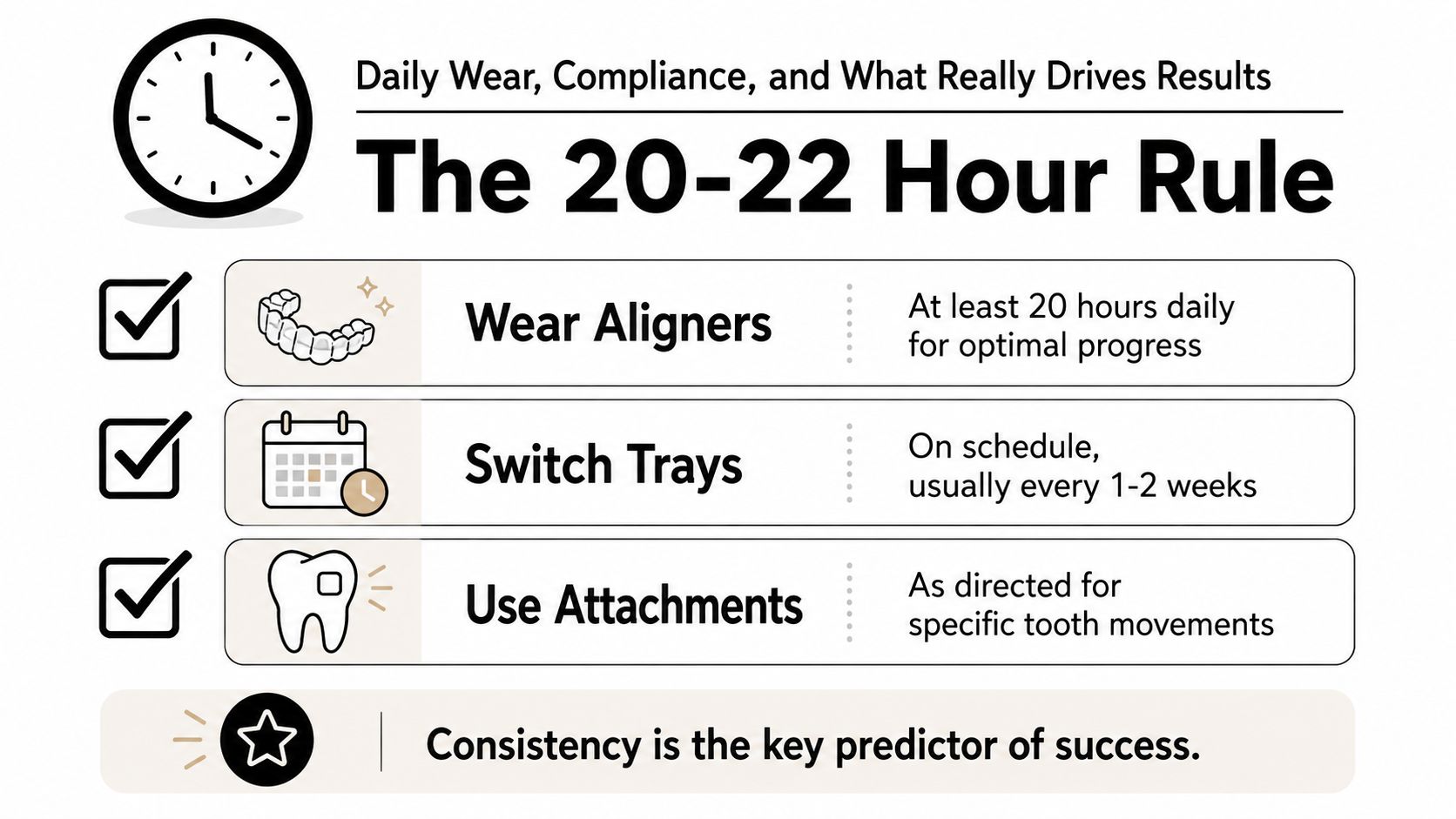
The best aligner brand can't compensate for trays left on the bathroom counter. Clear aligner therapy is typically prescribed for 20 to 22 hours per day, leaving about 2 to 4 hours for meals, drinks other than water, and oral hygiene, according to guidance on aligner treatment duration.
Wear the trays during work, errands, and sleep. Remove them for meals and anything besides water, brush and floss before putting them back, and switch trays only according to the schedule your provider gives you. Attachments, elastics, and chewies aren't decorative extras. They help the system express particular movements, so use them as directed.
Research summarized in a compliance review found only 36% of patients were fully compliant and 25% were poorly compliant during clear aligner therapy. The same review describes compliance as influenced by factors including education, demographics, the doctor-patient relationship, and personality, while reminders and digital feedback continue to be studied. Read the compliance and adherence review for the broader context.
What happens when wear slips
Missing occasional wear may cause tightness when you reinsert a tray. Repeatedly falling short can produce poor tracking, longer treatment, extra refinements, or a movement that stalls. A clinical timeline source describes reducing wear from 22 hours to 20 hours daily as roughly a 9% decrease in wear time, associated with about a 10% to 12% reduction in tooth movement velocity. That relationship is described in clinical guidance on aligner wear schedules.
In-office visits provide another layer of accountability. A Katy provider can see whether attachments remain in place, whether the tray seats fully, and whether your bite is changing as intended. Remote systems depend more on photos, app check-ins, and your own reporting, which means you must notice and communicate problems early.
Matching Aligner Options to Common Situations
A useful recommendation starts with your case, not a brand ranking. The following guide gives you a practical starting point, but an examination still determines whether your teeth, gums, bite, and restorations can support the proposed movement.
| Case Situation | Best-Fit Option | Why It Fits |
|---|---|---|
| Mild lower crowding | Remote or in-office aligners may fit | Simple cosmetic alignment can require fewer mechanics, provided the case is properly screened |
| Small relapse after old braces | Remote or in-office aligners may fit | Limited movement may be manageable, but the bite should still be checked |
| Moderate spacing or bite adjustments | Supervised in-office aligners, such as Invisalign | The provider can use attachments, adjustments, and refinements when the movement needs more control |
| Complex bite work or extractions | Fixed braces or hybrid treatment | Fixed appliances may provide more reliable control for difficult movements |
| Significant jaw discrepancies | Orthodontic evaluation for comprehensive treatment | Aligners alone may not address the underlying skeletal relationship |
| Teen treatment | In-office care with compliance indicators and parental oversight | A provider can monitor wear, tooth eruption, hygiene, and developing bite changes |
The evidence supports this case-specific approach. A 2025 consensus reported success rates of 86% for molar distalization and 80% for expansion, compared with 52% for torque control and 30% for extrusion, as reported in coverage of the consensus on clear aligner treatment. The same source describes aligners as more suitable for predictable movement and notes that fixed appliances showed better treatment quality in a 2025 systematic review for extraction cases.
If you're comparing clear aligners with traditional braces, focus on the hardest part of your plan. A small cosmetic relapse is a different clinical problem from a rotated canine, an open bite, or a tooth that must move vertically. Match the channel to the case, rather than choosing the channel first and hoping it can handle the case.
Why Supervised Clear Aligner Care in Katy Stands Out
For many adults and families, supervised care offers the strongest balance of convenience and clinical control. At The Dental Retreat, clear aligner treatment is one of the orthodontic services available within a broader dental practice in Katy, TX. That means the aligner plan can be considered alongside gum health, existing restorations, dental hygiene, and other oral health needs.

Local oversight changes the experience
A local appointment gives the provider a chance to identify a tracking problem before it becomes a larger setback. The team can evaluate a loose attachment, a sharp tray edge, unexpected soreness, or a bite that feels different. Chairside care also makes it possible to address attachments, enamel reduction between selected teeth, refinements, and bite adjustments within the treatment process.
That access matters if life interrupts your plan. A broken tray, lost aligner, or sudden sore spot is easier to discuss with a nearby dental office than through a distant support channel. Patients in Sunterra, Cane Island, Katy Manor, Kingscrossing, Lakehouse, Marisol, The Grange, Anniston, Katy Lakes, Elyson, and Ventanna Lakes can look for a practice that fits their normal schedule instead of treating every issue as a shipping problem.
A broader dental safety net
Aligners don't replace preventive dental care. Before and during treatment, patients may need cleaning and exams, dental X-rays, restorative dentistry, periodontal care, or treatment for an urgent concern. A local emergency dentist can also help when pain, swelling, a damaged tooth, or a broken restoration needs attention while you're wearing aligners.
Remote aligners can work for simple, carefully selected cases. The closer your treatment is to moderate crowding, spacing, or bite correction, the more valuable in-person monitoring becomes. The best choice isn't the most heavily advertised tray. It's the plan that gives you a realistic diagnosis, an appropriate movement strategy, and a clear way to handle problems.
Your Next Step Toward a Straighter Smile
Start with an examination, not a purchase. At The Dental Retreat, a first aligner consultation can include a 60-minute visit with a full exam, photographs, a digital scan, and a direct conversation about what you want to change. The provider should explain whether your goal is limited cosmetic alignment, broader bite correction, or a different treatment altogether.
Candidacy depends on more than crowding. The evaluation should consider gum health, existing fillings or crowns, bite stability, tooth shape, missing teeth, and your willingness to wear trays 20 to 22 hours per day. If a tooth needs a filling, a crown needs attention, or gum inflammation needs treatment, handling that first can make the orthodontic plan safer and more predictable.
Ask for a written plan that explains the recommended system, expected refinements, attachments or other mechanics, retention after treatment, and total fees. Transparent pricing may include different treatment tiers, financing options, and an explanation of what dental insurance contributes, if anything. For a practical overview of fees, review clear aligner treatment costs, then confirm the current details directly with the Katy office.
You don't need to commit during the first conversation. You should leave knowing what is moving, why that approach fits your bite, what responsibilities you'll have at home, and what alternatives deserve consideration. That's a much better decision than choosing a mail-order plan because the checkout page looked simple.
The Dental Retreat offers supervised clear aligner consultations, digital treatment planning, and complete dental care in Katy, TX, including cosmetic, restorative, implant, periodontal, and emergency services. If you're ready to find the right fit for your smile, visit The Dental Retreat to request an appointment and discuss your options with a local care team.