In the U.S. in 2026, porcelain veneers commonly cost about $900 to $2,500 per tooth, while composite veneers usually cost about $250 to $1,500 per tooth. A six-to-eight-tooth smile makeover is often budgeted at roughly $9,712 to $24,046, with an average near $13,954.CareCredit's 2026 veneer pricing guide
You may be sitting at home in Katy, comparing a whitening special, a veneer advertisement, and a consultation offer that promises a brighter smile without explaining the final bill. The important question isn't, “How much is one veneer?” It's what will I budget for the teeth people see when I smile?
At The Dental Retreat, patients from Katy, Sunterra, Cane Island, Katy Manor, Kingscrossing, Lakehouse, Marisol, The Grange, Anniston, Katy Lakes, Elyson, and Ventanna Lakes can discuss cosmetic dentistry alongside general, restorative, orthodontic, implant, and emergency dental services. This guide translates the cosmetic dentistry veneers cost into practical planning numbers, explains what changes the quote, and shows when whitening, bonding, clear aligners, or another treatment may make better financial sense.
What Most Katy Patients Are Really Paying for Veneers
A Katy patient can receive a smile makeover estimate near $15,000 and still have unanswered questions. Does the plan cover six teeth or eight? Are digital scans, temporary veneers, laboratory work, and follow-up visits included? A per-tooth advertisement often leaves those details unclear.
As noted above, porcelain veneers run $900 to $2,500 per tooth, while composite veneers commonly range from $250 to $1,500 per tooth in U.S. pricing summaries. The practical budgeting question is how many teeth will show when you smile, not what one veneer costs.
Why the written plan matters
Local pricing depends on the treatment design. A Katy practice may recommend treating only the most visible teeth, or extending the smile zone so the veneers match across the arch. Custom porcelain also brings laboratory design and fabrication charges that a basic online promotion may not show. Historical pricing summaries place full-arch or smile-zone treatment around $6,000 to $25,000, depending on material and tooth count.Historical and current veneer pricing context
Your written Katy estimate should identify:
- The number of teeth treated, including teeth added for a balanced smile.
- The veneer material and laboratory process, especially for custom porcelain.
- Diagnostic planning, such as photographs, bite records, and digital scanning.
- Temporary restorations, when permanent veneers are made by a laboratory.
- Preliminary dental work, including care for decay, gum concerns, or an unstable bite.
- Follow-up visits and adjustments, so you know whether they are part of the quoted fee.
The number worth comparing is the complete treatment-plan total. Ask The Dental Retreat or any Katy cosmetic dentist to separate the veneer fee from diagnostics, temporaries, laboratory charges, and recommended preliminary care. Then compare plans based on the same tooth count and inclusions.
Bring the advertisement to your consultation and ask the practice to convert its per-tooth offer into your actual total. That prevents a low sticker price from masking the cost of the smile you are planning. Material still affects the bill, but tooth count, laboratory work, and required dental preparation often determine whether the final estimate fits your budget.
Understanding Veneers and the Main Material Options
A dental veneer is a thin, custom-made shell bonded to the front surface of a tooth. It can change the tooth's color, shape, size, or length while preserving the basic structure behind it. Veneers are most often considered for front teeth with deep discoloration, worn edges, chips, small gaps, or mild rotation and irregular shape.
The first step is determining whether the tooth is healthy enough for cosmetic treatment. Active decay, untreated gum disease, significant bite problems, or a tooth that needs extensive structural repair may require restorative dentistry before a veneer makes sense. A cleaning and exam, dental x-rays when indicated, and a new patient exam can help identify those issues before cosmetic planning begins.
Porcelain veneers
Porcelain veneers are custom restorations fabricated by a dental laboratory. A Katy dentist may discuss feldspathic porcelain or pressed ceramic, depending on the desired translucency, strength, shape, and laboratory design.
Porcelain generally suits patients who want a highly customized result for several visible teeth. It can address discoloration that doesn't respond well to teeth whitening, worn or chipped edges, small spaces, and mildly misshapen incisors. The dentist usually removes a controlled amount of enamel so the restoration can sit naturally rather than appearing bulky.
Composite resin veneers
Composite resin is a tooth-colored filling material shaped directly on the tooth, or sometimes fabricated indirectly. A dentist can often complete chairside composite treatment in one visit, making it useful for a limited repair, a single dark tooth, a small chip, or a patient who wants a lower initial investment.
Composite is also easier to repair than porcelain because the dentist can add or reshape resin. The tradeoff is that composite is more vulnerable to surface wear, staining, and chipping over time, especially on front teeth exposed to biting forces.
Minimal-prep and no-prep options
Minimal-prep or no-prep veneers use ultra-thin porcelain or composite overlays and preserve more natural enamel in carefully selected cases. They may work well when teeth are small, worn, or positioned in a way that allows added material without creating excess thickness.
They aren't a universal substitute for traditional veneers. If teeth are already prominent, crowded, heavily rotated, or dark beneath the restoration, placing material without enough space can produce an unnatural result. Because veneers are elective cosmetic treatment, dental insurance rarely contributes meaningfully. The consultation should cover durability, stain resistance, preparation, repair, and reversibility before any enamel is shaped.
Porcelain vs Composite vs No-Prep Veneers Compared
A lower per-tooth quote does not automatically produce the better value. Compare what each material can correct, how much tooth preparation it needs, and how its expected service life fits your plans.
| Material | Cost per Tooth | Lifespan | Tooth Prep | Best For |
|---|---|---|---|---|
| Porcelain | About $900 to $2,500 | Generally 10 to 15 years | Usually requires conservative enamel preparation | Multiple visible teeth, deep discoloration, refined shape and shade |
| Composite | About $250 to $1,500 | Commonly 5 to 8 years | Often little or no reduction | Lower entry cost, small chips, single-tooth corrections, trial treatment |
| No-prep or minimal-prep | Commonly about $800 to $2,000 | Varies by material and case | Little or no preparation in selected cases | Small or worn teeth when added thickness will remain natural |
These national ranges are summarized in The Dental Retreat's composite and porcelain comparison and supported by technical and market information on composite veneer costs. Use them to plan, not to predict your final Katy quote. Tooth count, case design, preparation, and supporting treatment can change the total.
Choose by clinical goal
Porcelain is the clear recommendation for a coordinated six-to-eight-tooth smile zone and a long planning horizon. Laboratory customization supports refined shape, shade, and symmetry, while porcelain generally resists staining better than composite. The tradeoff is more appointments and enamel preparation, so treat it as a committed cosmetic restoration rather than a temporary experiment.
Composite fits a limited correction, a lower initial budget, or a patient who wants to test a shape before choosing a larger porcelain case. A dentist can usually repair or reshape resin efficiently. Plan for possible repairs and replacement, because those costs can affect the long-term budget.
No-prep or minimal-prep veneers preserve more enamel only when tooth size, position, color, and bite support the design. The dentist should decline this option if added material would make the teeth look bulky, worsen crowding, or interfere with function. Thin veneers cannot hide every underlying color or position problem.
Choose the lower quote only when the material can correct the problem without creating a new one.
For a Katy patient, the per-tooth figure is only the starting point. Porcelain may carry greater laboratory and appointment costs, while composite may appear cheaper upfront but require more maintenance over time. Ask for the recommended tooth count and the reason for that number before comparing estimates.
The Real All-In Cost Beyond the Per-Tooth Quote
A veneer estimate should answer more than “How much per tooth?” It should show what happens before bonding and what happens if a tooth needs treatment first.
A typical cosmetic consultation may include a dental exam, intraoral photographs, bite records, and either traditional impressions or a digital iTero scan. Some patients also need a wax-up or digital smile design mock-up so the proposed length, width, shade, and tooth display can be evaluated before preparation.
Line items to ask about
| Line Item | Porcelain per tooth | Composite per tooth | Notes |
|---|---|---|---|
| Consultation and diagnostics | Varies by treatment plan | Varies by treatment plan | Exam, photographs, bite records, x-rays or digital scan when indicated |
| Smile design or wax-up | Varies by case | Varies by case | Confirms shape and proportions before treatment |
| Tooth preparation | Included or itemized by practice | Often included in chairside fee | Porcelain usually involves more preparation |
| Laboratory fabrication | Often a major cost component | May be absent for direct composite | Lab fees depend on the restoration and laboratory |
| Temporaries | May be included or itemized | Often not needed for same-day treatment | Protect prepared teeth during the laboratory phase |
| Try-in and final bonding | Included or itemized | Usually completed chairside | Includes fit, shade, cementation, and bite checks |
| Gum contouring or bite adjustment | Only when clinically indicated | Only when clinically indicated | Extra treatment can increase the final bill |
A six-, eight-, or ten-tooth case multiplies the per-tooth fee before these service items are considered. The 2026 full-cost discussion from Dr. John Patterson specifically highlights consultation and imaging, temporaries, laboratory fees, replacement cycles, and financing as costs patients often overlook.
Think in treatment phases, not one invoice
The first phase is diagnosis and design. The second is preparation and temporary protection. The third is laboratory fabrication, try-in, and permanent bonding. If gum contouring, bite equilibration, fillings, or other restorative treatment is needed, those services should appear as separate line items in the written plan.
Long-term planning matters, too. Technical summaries commonly place composite veneer survival around 5 to 8 years and porcelain around 10 to 15 years.Composite and porcelain longevity comparison Replacement isn't automatic on a fixed date, but patients should ask how the material, bite, hygiene, grinding habits, and maintenance affect future repairs or remakes.
Cheaper Alternatives Worth Considering First
Veneers can solve several concerns at once, but they aren't automatically the best value. A patient with surface discoloration may need professional teeth whitening, while someone with a small chip may need only direct composite bonding.
| Option | Avg Katy Cost | Durability | Best For |
|---|---|---|---|
| Professional in-office whitening | Practice-specific | Maintenance varies | Color improvement when tooth shape is acceptable |
| Direct composite bonding | Practice-specific | Maintenance varies | Small chips, narrow gaps, or a single dark tooth |
| All-ceramic crown | Practice-specific | Case-dependent | Heavily restored or structurally compromised teeth |
| Clear aligners followed by whitening or bonding | Practice-specific | Depends on retention and finishing | Spacing, mild rotation, and edge concerns caused by position |
| Veneers | Based on material and tooth count | Material and case-dependent | Multi-tooth changes in color, shape, size, or length |
When whitening is the smarter first move
If your teeth are healthy and your only complaint is color, whitening usually deserves consideration before reshaping the teeth. It won't change tooth size, close gaps, or repair chips, but it can improve the smile without committing to a bonded shell.
A whitening consultation should also consider existing fillings, crowns, and other restorations because those materials may not lighten in the same way as natural enamel.
When bonding beats a veneer
Direct composite bonding is often the practical answer for a small chip, a limited gap, or one tooth that looks slightly shorter. It can preserve more tooth structure and allow straightforward repair. The esthetic ceiling is lower for complex multi-tooth transformations, especially when the patient wants significant changes in translucency, symmetry, and shade.
When crowns or aligners make more sense
A heavily restored, cracked, or root-canaled tooth may need a crown because a veneer only covers the front surface. A crown decision belongs in restorative dentistry, not in a cosmetic price comparison alone.
Clear aligners can be more appropriate when spacing or mild rotation is the main concern. Moving the teeth first may create a healthier foundation for later whitening or limited bonding, rather than using veneers to camouflage a position problem.
Insurance, Memberships, and Local Specials in Katy TX
Most dental insurance plans don't cover veneers because insurers generally classify them as cosmetic treatment. Some plans may offer partial coverage when a veneer is medically necessary for restorative reasons, but preauthorization and plan-specific review are important.Insurance information from My Glow Up Dentistry
That means a Katy patient should assume the cosmetic portion is an out-of-pocket investment unless the insurance carrier confirms otherwise in writing. HSA and FSA funds may be worth discussing with your plan administrator, but eligibility depends on the account rules and the nature of the expense.
The Dental Retreat offers an in-house membership option for patients without insurance, with plans starting at $299 per year and savings for periodontal maintenance, as described in the practice's in-house dental membership plans. Membership terms should be reviewed before treatment because discounts, exclusions, and cosmetic eligibility can vary by plan.

How to make the budget concrete
Ask the practice to apply any current new-patient promotion, veneer promotion, bundled smile makeover pricing, or same-day composite offer to your written treatment plan. The Dental Retreat lists new-patient options including a $139 exam with cleaning and x-rays, a $79 problem-focused visit, and $450 in-office Zoom whitening. These are separate services and shouldn't be assumed to reduce a veneer fee unless the office confirms the offer applies.
CareCredit and Cherry may also be available for third-party financing, subject to approval and the terms presented at the time of application. Promotional interest-free periods and extended-term structures can differ, so ask for the total repayment amount, promotional deadline, and consequences of missed payments.
A precise monthly payment can't be calculated without the approved treatment total, down payment, promotion, and financing terms. The responsible approach is to request two written scenarios, one for six teeth and one for eight, with discounts and financing shown separately rather than blended into a vague monthly estimate.
What to Expect at The Dental Retreat in Katy
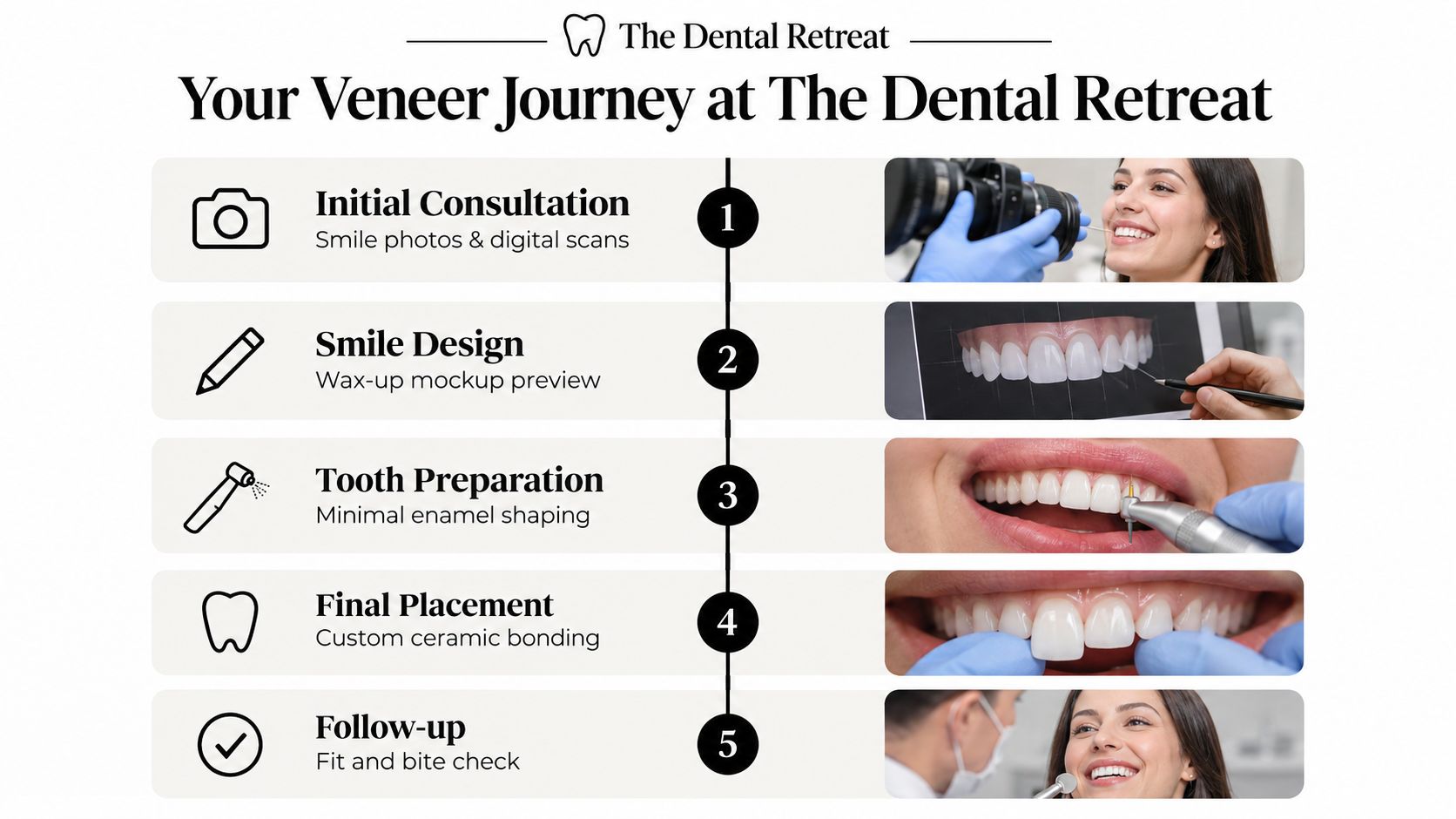
Your veneer process should start with a conversation, not a drill. At The Dental Retreat, the cosmetic consultation can include smile photographs, digital scans, and a wax-up mock-up that helps you review tooth length, contour, shade, and overall balance before treatment begins.
The dentist also checks your bite and existing dental health. If a tooth needs a filling, gum treatment, an extraction, or another restorative procedure, that issue should be addressed before the cosmetic phase. Patients searching for an emergency dentist, a tooth extraction, or dental implants near me may need a different sequence than someone pursuing elective veneers.
Preparation and temporary veneers
For porcelain, the dentist uses local anesthesia and conservatively shapes the enamel so the final restoration can fit naturally. The exact amount depends on the tooth and design. Temporary veneers protect the prepared teeth while the laboratory creates the permanent restorations, and they also let you assess how the proposed smile feels during normal speaking and eating.
At the try-in appointment, the dentist checks the fit, shade, tooth proportions, and contact points. You should speak up if the shape or length doesn't look right before final bonding.
The final appointment includes surface conditioning, resin cement, light curing, and bite adjustment as needed. Follow-up visits can confirm comfort and function, while a nightguard may be recommended for patients who clench or grind.
Watch this overview before your consultation:
Which Veneer Option Fits Your Smile and Budget
The right veneer material depends on the problem you're fixing, the number of teeth involved, and how much future maintenance you're prepared to accept. I wouldn't recommend choosing porcelain just because it sounds premium, or composite just because it has the lowest entry price.
| Veneer Type | Best For | Budget Tier | Expected Lifespan |
|---|---|---|---|
| Composite | Single-tooth corrections, small chips, limited gaps, lower initial investment | Lower | Commonly 5 to 8 years |
| Porcelain | Coordinated smile-zone changes, deep discoloration, refined long-term esthetics | Higher | Generally 10 to 15 years |
| No-prep or minimal-prep | Small or worn teeth, enamel preservation when anatomy allows | Middle to higher | Varies by material and case |
| Bonding or whitening first | Minor chips or color-only concerns | Often lower than veneers | Maintenance depends on treatment and habits |
Choose composite when you need a conservative starting point, a single visible repair, or a lower upfront commitment. It can be particularly sensible when your bite is still changing or when you want to evaluate a new shape before moving to laboratory-made restorations.
Choose porcelain when you want a coordinated six-to-eight-tooth smile and expect the result to serve you over a longer horizon. The higher initial fee may be reasonable when shade stability, laboratory customization, and longevity matter more than same-day completion.
Choose no-prep or minimal-prep only when the dentist confirms that your tooth size and position can accept the added material naturally. Preserving enamel is valuable, but an enamel-sparing technique isn't a bargain if it creates bulky contours or an unstable bite.
For minor discoloration, start with whitening. For a small chip or gap, ask about bonding. A personalized consultation at The Dental Retreat can compare those options with veneers, discuss your dental health, and give you a written plan based on the teeth you want to change.
The Dental Retreat provides cosmetic consultations, veneers, whitening, clear aligners, restorative dentistry, dental implants, and emergency dental services in Katy, TX. Visit The Dental Retreat to request a consultation, review your six- or eight-tooth options, and receive a treatment plan that separates the true costs before you commit.