All-on-4 dental implants typically cost $11,640 to $27,500 per arch in 2026, while full-mouth treatment often ranges from $25,000 to $50,000 or more, depending on materials and clinical complexity. The number you see online is only a starting point, because the final dental implants all-on-four cost depends on your scans, extractions, restoration material, and whether you're treating one arch or both.
If you're searching for “dental implants near me” after years of loose dentures, failing teeth, or difficulty eating, you've probably found wildly different prices. One advertisement may show a surprisingly low figure, while another quote looks more like a major home renovation. That gap is frustrating, especially when you're trying to find a trusted dentist in Katy, TX who will explain the full financial picture.
At The Dental Retreat, patients from Katy, Sunterra, Cane Island, Katy Manor, Kingscrossing, Lakehouse, Marisol, The Grange, Anniston, Katy Lakes, Elyson, and Ventanna Lakes can discuss full-arch treatment alongside tooth extraction, restorative dentistry, dental x-rays, sedation, and other dental care. The right first step isn't choosing the lowest online price. It's finding out exactly what your mouth needs and what the quoted fee includes.
Why All-on-4 Pricing Feels So Confusing
A patient may spend an evening comparing All-on-4 offers and find advertised prices ranging from $1,500 to $7,000 per arch internationally to more than $50,000 for treatment involving both arches. Those figures can all appear legitimate while describing very different procedures, materials, locations, and levels of follow-up care. International Clinics describes the broad differences between advertised international and U.S. pricing, but a headline number still doesn't tell you what's included.
One quote may cover four implants and a temporary bridge. Another may include diagnostic imaging, extractions, sedation, a final zirconia restoration, laboratory work, adjustments, and future maintenance. If you compare those two prices as though they're identical packages, the cheaper quote may only look like a bargain because important parts of treatment haven't been listed.
Practical rule: Compare written treatment plans, not promotional prices.
Why online estimates vary
The phrase All-on-4 cost describes a treatment category, not a single standardized product. The price changes according to:
- Treatment scope: One upper or lower arch costs less than restoring both arches.
- Prosthesis material: Acrylic and PMMA hybrids generally cost less than zirconia.
- Preparation: Tooth extraction, infection treatment, periodontal care, or grafting may be necessary.
- Provider and laboratory: Surgical planning, clinician experience, and the dental laboratory all influence the fee.
- Aftercare: Temporary teeth, follow-up appointments, adjustments, and corrective care may or may not be included.
A national U.S. estimate places the average at $15,176, with a reported range of $11,640 to $27,500 per arch in 2026. Those figures are useful for orientation, but they can't predict your personal quote because they don't account for every clinical detail in your mouth. The CareCredit pricing guide explains the national range and the variables that influence it.
What a realistic comparison looks like
Suppose one patient needs an upper arch, has teeth that require extraction, and chooses an acrylic/PMMA hybrid restoration. Another needs both arches, requires more complex preparation, and selects zirconia. They aren't receiving the same treatment, even if both providers use the words “All-on-4.”
That's why a consultation matters. A dentist must evaluate your remaining teeth, gum health, bone structure, bite, medical history, and cosmetic goals before giving you a dependable figure. A careful quote should identify what you'll pay now, what may be added later, and what happens if the provisional or final prosthesis needs adjustment.
What All-on-4 Implants Actually Are
All-on-4 implants use four strategically placed implants to support one fixed full-arch prosthesis. Instead of replacing every missing tooth with a separate implant and crown, the implants act as anchors for a connected bridge. The result is designed to remain in place rather than being removed like a conventional denture.
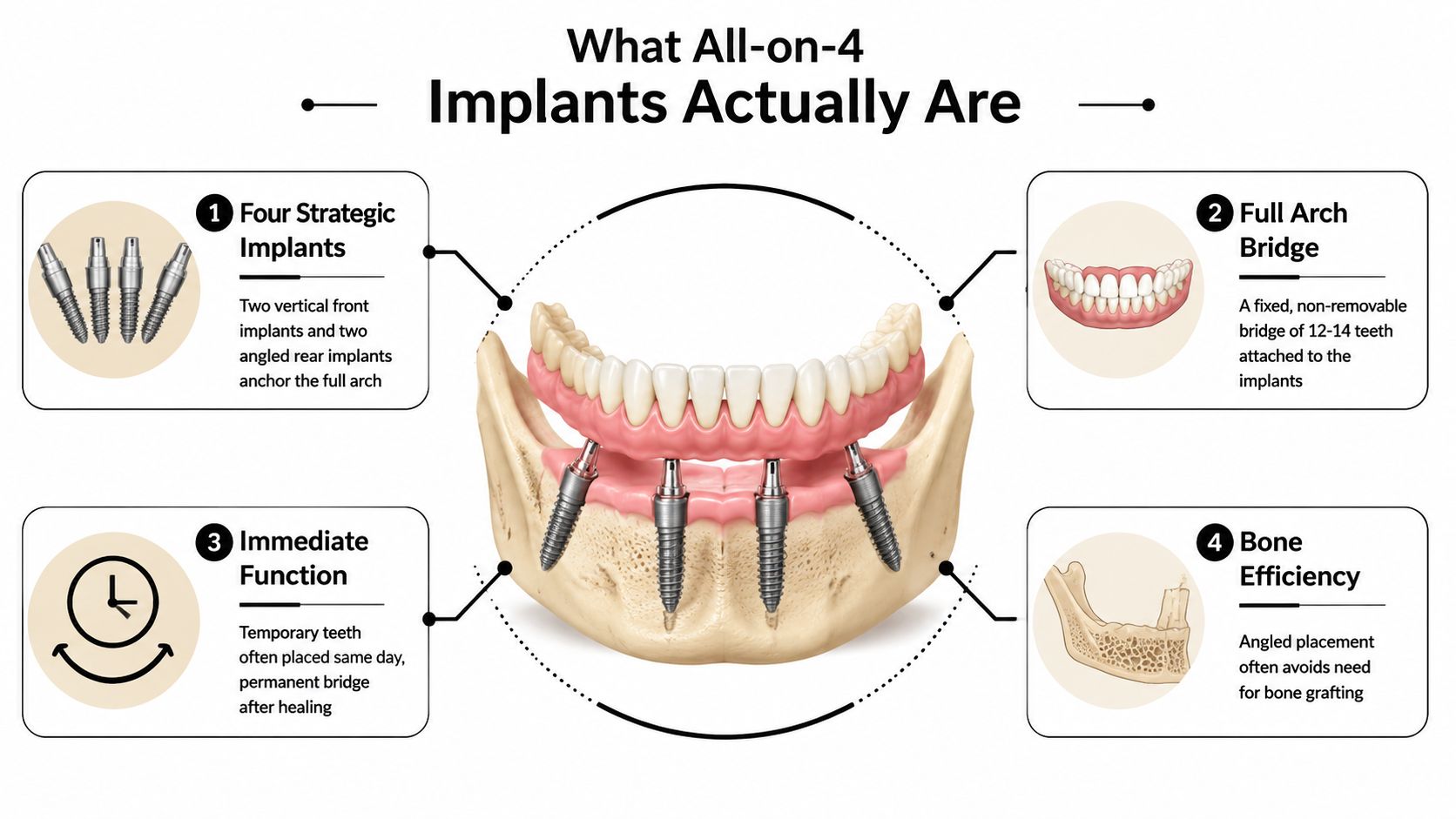
The concept became a distinct fixed full-arch treatment approach in the late 1990s. Its appeal comes from using a smaller number of implants to stabilize a complete arch, rather than placing an individual implant for every missing tooth. It can serve as a fixed alternative to removable dentures and may be less costly than extensive individual implant rehabilitation.
How the treatment works
The process generally follows these stages:
- Evaluation and planning: Your dentist performs an examination and uses dental x-rays or other diagnostic imaging to assess the jaw, remaining teeth, gums, and bite.
- Preparation: Teeth that can't be predictably restored may need tooth extraction. Active gum or dental infection must also be addressed.
- Implant placement: Four implants are placed in the arch. The rear implants may be angled to use available bone efficiently.
- Temporary teeth: If the implants achieve sufficient primary stability, a provisional fixed bridge may be attached on the day of surgery.
- Healing and final restoration: The implants heal and integrate with the jawbone while you wear the provisional teeth. A permanent bridge is then designed and attached after healing.
A same-day provisional bridge doesn't mean the entire treatment is finished that day. You may leave surgery with fixed temporary teeth, but the final restoration comes later, after the implants and jaw have had time to heal.
How it differs from individual implants
Traditional implant treatment replaces missing teeth one at a time. That can be an excellent solution when only a few teeth are absent, but replacing an entire arch individually requires more implants, more prosthetic components, and often more extensive planning. All-on-4 combines the replacement teeth into one connected structure.
The fixed design also differs from an overdenture, which clips onto implants but can be removed. All-on-4 is intended to stay in place and is cleaned around the bridge with instructions and tools provided by your dental team.
The procedure isn't suitable for everyone. Bone volume, gum health, existing teeth, systemic health, oral hygiene, and your ability to maintain regular dental visits all affect candidacy. A cosmetic dentist near me search may help you find aesthetic services, but full-arch treatment also requires surgical and restorative planning.
This video offers another visual explanation of the treatment concept:
Breaking Down the Real Cost Drivers
The most important cost question isn't “What's the average price?” It's “What work does this quote include?” Current U.S. guides commonly place acrylic/PMMA hybrid treatment at $15,000 to $25,000 per arch and zirconia at $25,000 to $38,000 per arch. Full-mouth treatment may reach $30,000 to $70,000 or more, depending on the materials, number of arches, and additional procedures. The Real Dental Costs guide details these material and scope ranges.
| Treatment type | Material | Price range |
|---|---|---|
| One arch | Acrylic or PMMA hybrid | $15,000 to $25,000 |
| One arch | Zirconia | $25,000 to $38,000 |
| Both arches | Acrylic, PMMA, zirconia, or mixed materials | $30,000 to $70,000 or more |
Material choices
Acrylic or PMMA hybrid prostheses are often the lower-cost option. They can provide a practical provisional or definitive restoration, depending on the treatment plan, but the dentist should explain how the selected material fits your bite, habits, appearance goals, and maintenance expectations.
Zirconia generally carries a higher price because it's a premium restorative material with different strength, appearance, laboratory, and fabrication requirements. Choosing zirconia isn't automatically the right decision for every patient. The useful question is whether its characteristics justify the additional expense for your specific bite and long-term plan.
One arch versus both
A quote for one arch shouldn't be compared with a full-mouth quote. National pricing references commonly report $11,640 to $27,500 per arch, with an average of $15,176, while full-mouth cases frequently move into the $25,000 to $50,000 or more range. Dental Roundup explains how arches, materials, extractions, grafting, and provider experience affect the total.
Preparation and clinical complexity
Remaining teeth may need extraction before implant placement. Some patients also need treatment for infection or gum disease. All-on-4 planning can reduce the need for extensive grafting in selected cases, but it doesn't guarantee that grafting will be unnecessary.
Read the practice's explanation of bone grafting for dental implants before assuming your treatment will avoid additional procedures. The diagnostic scan determines whether your available bone can support the planned implants.
The hidden line items
Ask whether your written proposal includes:
- Diagnostics: Examination, dental x-rays, three-dimensional imaging, and digital planning.
- Surgery: Implant placement, anesthesia, sedation, and tooth extraction when needed.
- Provisional teeth: The temporary bridge you'll wear during healing.
- Final prosthesis: Material, laboratory fabrication, try-ins, and attachment.
- Follow-up: Adjustments, repairs, and management of healing concerns.
Clinician experience, laboratory quality, and local operating costs also shape the quote. Major markets often carry higher fees, but a lower local price can exclude services that another practice has bundled into its fee. Look for transparency rather than assuming that the highest or lowest quote is automatically superior.
How All-on-4 Compares to Alternative Options
All-on-4 makes sense for some patients, but it isn't the only way to replace missing teeth. The best option depends on how many teeth are failing, the condition of your bone and gums, your preference for fixed or removable teeth, and your budget.
Four common approaches
Individual implants replace missing teeth separately. They can feel natural and preserve a more tooth-by-tooth design, but replacing a whole arch this way may require more implants, more crowns or bridges, and more surgical planning. A 2014 comparative analysis found average patient costs of $42,422 ± 3,860 for All-on-4 versus $57,944 ± 20,198 for conventional full-arch implant rehabilitation, with mean savings of about $7,307 per jaw for All-on-4. The PubMed-indexed cost analysis compares the defined treatment approaches.
Implant-retained overdentures use implants to improve the stability of a removable denture. Patients can remove the appliance for cleaning, which some people prefer. Others dislike the movement, removable design, or need for adhesives associated with conventional dentures.
Conventional removable dentures usually have the lowest initial price. They can restore a basic set of teeth without implant surgery, but they may move during eating or speaking and require ongoing adjustments as the mouth changes.
| Option | Design | Main trade-off |
|---|---|---|
| All-on-4 | Fixed full arch supported by four implants | Higher investment, with surgical treatment and ongoing hygiene requirements |
| Individual implants | Separate implant-supported teeth | Natural tooth-by-tooth design, often more involved for a full arch |
| Implant overdenture | Removable teeth attached to implants | Easier to remove, but not fixed |
| Conventional dentures | Removable acrylic prosthesis | Lower initial cost, but less stability and different maintenance needs |
Choosing based on priorities
If your remaining teeth are failing throughout an arch and you want teeth that stay in place, All-on-4 may offer a practical middle path. If only a few teeth are missing, individual implants or another restorative solution may preserve more of your natural dentition. If surgery or the full-arch investment isn't appropriate, an overdenture or conventional denture may be more suitable.
No option eliminates maintenance. Fixed implant teeth still require careful brushing, cleaning under the bridge, professional examinations, and attention to gum health. Removable options require cleaning outside the mouth and periodic evaluation of fit.
The right decision should reflect function, appearance, health, timeline, and affordability together. A responsible dentist near me won't recommend a full-arch procedure solely because it's available. The dentist should explain why it fits your clinical situation and what alternatives remain reasonable.
The Truth About Low-Cost and International Offers
An overseas quote deserves the same clinical scrutiny as a local one. Before booking, verify the treating dentist's license, implant training, facility standards, and experience with full-arch cases. Ask which implant manufacturer and prosthetic materials will be used, and request the treatment plan in writing. International Clinics outlines why these cross-market figures are difficult to compare directly.
Questions to settle before traveling
A low-cost offer is easier to assess when the provider answers specific questions:
- What is included: Does the fee cover examinations, scans, extractions, temporary teeth, the final bridge, and required adjustments?
- Who provides each stage: Will the same clinic handle surgery, provisional teeth, final restoration, and repairs?
- What records will you receive: Request copies of scans, implant details, laboratory prescriptions, and the final restoration design.
- What warranty applies: Confirm what the warranty covers, how long it lasts, and whether you must return to the clinic for correction.
- What happens if treatment changes: Ask about additional bone procedures, healing delays, replacement components, and extra visits.
- How will follow-up work: Identify who will examine you after returning home and whether the overseas dentist will communicate with that provider.
Do not rely on verbal assurances. A written plan should identify the number and type of implants, the provisional and final prostheses, excluded services, revision terms, and the records you will take home.
The cost of distance
Implant care continues after surgery. Healing checks, bite adjustments, hygiene instruction, and management of sore areas can require several appointments. If a problem develops at home, a local dentist may be unable to repair it without the original scans, implant system information, laboratory records, or compatible components.
Travel also adds practical exposure. Delayed healing may require a longer stay, while a loose bridge or bite problem may mean another trip. Travel, lodging, missed work, local consultations, and corrective treatment can change the final expense substantially.
International care can be appropriate when the provider, documentation, aftercare, and revision arrangements are clear. Judge the offer by the full treatment pathway, not the advertised starting price. A cheaper procedure may cost more overall if follow-up is difficult or corrective care becomes necessary.
Financing Options and Insurance Considerations
Most patients need to combine several resources rather than rely on one payment source. Start by asking for a written estimate that separates covered dental services, non-covered services, estimated insurance benefits, and your expected balance. Don't assume a plan covers All-on-4 because it covers exams, fillings, or routine restorative dentistry.
Original Medicare generally doesn't cover routine dental care or dental implants. Coverage may be possible in narrow circumstances when dental treatment is medically connected to a covered procedure, such as jaw reconstruction after trauma or cancer-related surgery. This Medicare guidance explains the limited circumstances in which dental implant-related care may qualify.
Ways patients plan for treatment
Private dental insurance may contribute to associated services depending on the policy, exclusions, waiting periods, annual maximums, and medical necessity rules. Ask the insurer for a pre-treatment estimate, but remember that an estimate isn't a guarantee of payment.
Other options may include:
- Practice payment plans: Ask whether the office allows staged payments tied to treatment milestones.
- Third-party healthcare financing: Review interest, promotional terms, monthly obligations, and what happens if treatment takes longer than expected.
- Dental savings plans: These may provide negotiated fees, but they aren't insurance and don't pay claims.
- Membership plans: Patients without insurance may find value in an annual plan that supports preventive care and periodontal maintenance.
- Staged treatment: In some cases, treating one arch first may make the financial commitment more manageable, if clinically appropriate.
Review payment plans for dental treatment and ask the financial coordinator to explain the complete repayment obligation in plain language. A lower monthly payment can still cost more overall if interest accumulates.
The Dental Retreat offers membership plans beginning at $299 per year, along with new-patient options such as a $139 exam with cleaning and x-rays, but those services should be discussed separately from the cost of full-arch implant treatment. They can help patients establish a baseline and understand their broader dental needs before making a major decision.
Getting Your Personalized Quote in Katy TX
An online estimate can help you plan, but it can't tell you whether your remaining teeth are restorable, whether your gums are healthy enough for implants, or which prosthesis material will suit your bite. A personalized quote begins with an examination and diagnostic imaging, followed by a discussion of your goals. The dentist should then explain whether one arch or both arches need treatment and which preliminary procedures are necessary.
At a consultation in Katy, you can expect questions about:
- Your dental history: Previous dentures, extractions, implants, gum treatment, and dental anxiety.
- Your current symptoms: Pain, loose teeth, difficulty chewing, speech concerns, or denture movement.
- Your health history: Conditions and medications that may affect healing or surgery.
- Your preferences: Fixed versus removable teeth, appearance, timing, and material priorities.
- Your budget: Financing preferences and the parts of care you need clearly itemized.
A thorough plan should show the estimated fee for diagnostics, surgery, extractions, temporary teeth, final restoration, sedation, follow-up, and possible additional care. It should also explain what isn't included. That level of detail makes it easier to compare quotes from different providers without confusing a partial package with complete treatment.
The Dental Retreat is a Katy, TX practice with general, cosmetic, restorative, implant, periodontal, endodontic, oral surgery, sedation, and emergency dental services. Its calm, spa-inspired setting includes amenities such as heated massage chairs, aromatherapy, noise-canceling headphones, and televisions, which may help patients who feel anxious about dental care. Extended hours and bilingual care can also make appointments more convenient for patients across Katy and nearby neighborhoods.
If you're also dealing with sudden pain, a damaged tooth, or an infection while considering implants, ask about emergency dental services and tooth extraction rather than delaying care. A new patient exam, dental x-rays, or a problem-focused visit may clarify whether immediate treatment is needed before full-arch planning.
The most useful appointment is one that leaves you with answers, not pressure. Bring your insurance information, a list of medications, and any previous implant or denture records you have. Ask the dentist to explain the recommended plan, alternatives, risks, material choices, aftercare, and total expected investment before you commit.
If you're comparing dental implants near me and want a clear explanation of your All-on-4 options, visit The Dental Retreat in Katy, TX for a personalized consultation. The team can evaluate your smile, discuss tooth extraction or restorative needs, review fixed full-arch solutions, and help you understand the complete cost before treatment begins.