You've lost a front tooth, or you're facing an extraction, and the thought of leaving a visible gap while an implant heals feels almost as stressful as the procedure itself. You may be searching for a dentist near me, dental implants near me, or an emergency dentist in Katy, TX who can protect both your smile and your comfort.
At The Dental Retreat in Katy, implant planning starts with the long-term result in mind. In suitable cases, temporary teeth implants, also called immediate provisionalization, can give you a natural-looking temporary tooth on the day of implant placement. The temporary restoration supports appearance and speech, but it also helps shape the gumline that will frame your permanent crown.
Restoring Your Smile Without the Wait in Katy TX
A missing tooth affects more than your smile. You may notice air passing through the space when you speak, avoid photos, or chew on one side of your mouth. If the gap is near the front, even a short conversation can make you feel self-conscious. Patients in Katy, Sunterra, Cane Island, Katy Manor, Kingscrossing, Lakehouse, Marisol, The Grange, Anniston, Katy Lakes, Elyson, and Ventanna Lakes often want to know one thing first: Will I have to go without a tooth while the implant heals?
In many appropriate cases, the answer is no. Immediate provisionalization allows a dentist to attach a temporary crown or bridge when the implant is placed, so you can leave the office with a tooth-shaped restoration while the implant integrates with the jawbone. The temporary is designed for healing, not for unrestricted chewing, and it must be protected from heavy forces.
A reassuring distinction: same-day teeth don't mean same-day permanent teeth. They mean a carefully planned provisional restoration protects your appearance while biology takes the time it needs.
Implant treatment has been studied as an immediate-restoration approach for more than two decades. An early clinical report followed 28 immediately restored maxillary implants for 15.7 to 27 months and reported a 96.4% survival rate, with mean marginal bone loss of 0.40 mm after 1 year. The report also recorded treatment needs during temporization, including replacements and re-cementations, which is an important reminder that a temporary restoration requires follow-up care. The original clinical report is available through PubMed.
The right plan may involve tooth extraction, bone evaluation, dental X-rays, implant placement, and a temporary crown. In other cases, a removable flipper or temporary denture is safer until the site is ready. A cosmetic dentist near you should explain why a particular option fits your bone, bite, gum condition, and smile goals rather than promising the same solution for everyone.
Understanding Temporary Teeth Implants and Tissue Shaping
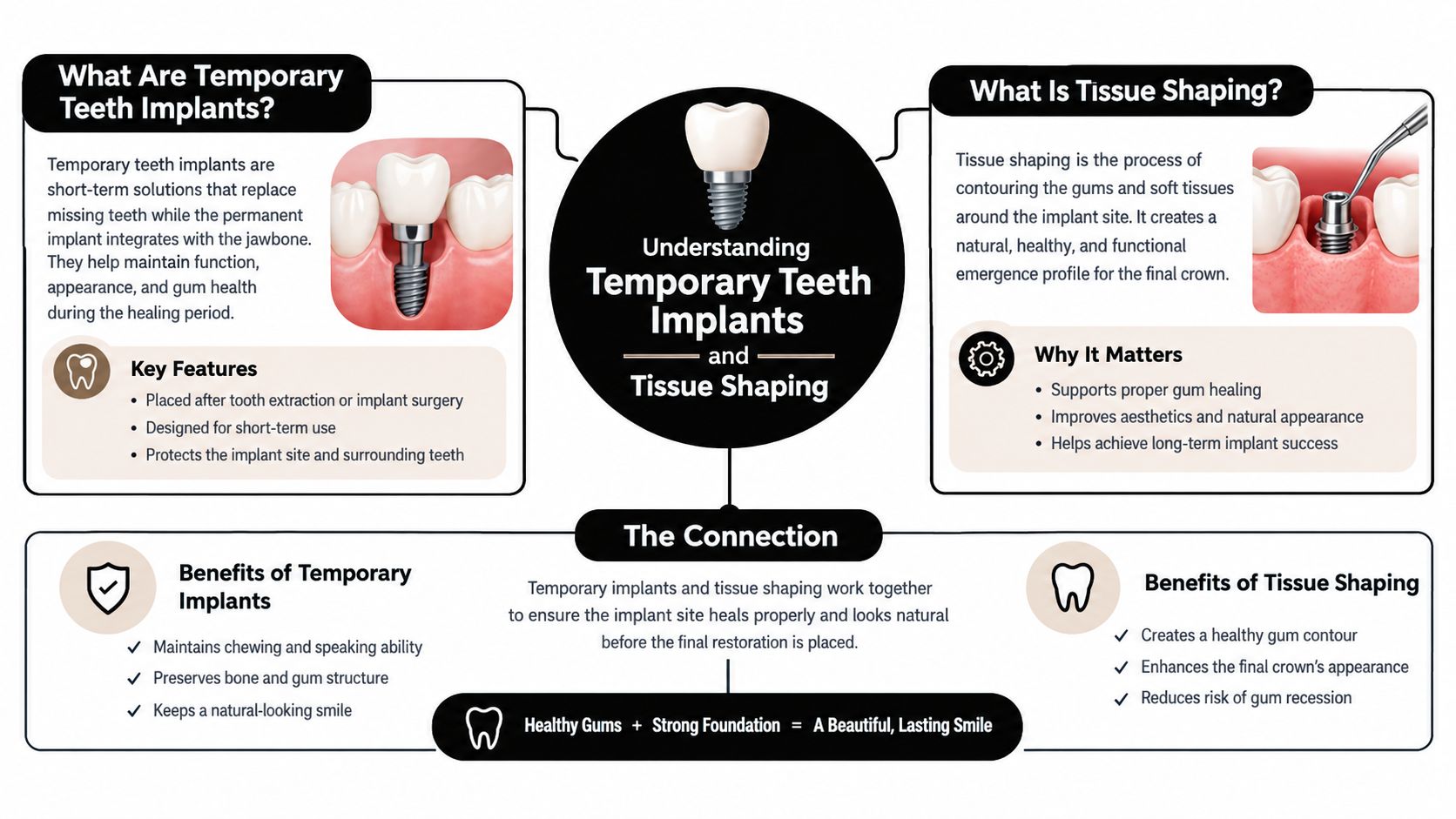
A temporary implant tooth has several parts, and knowing the difference makes the process easier to understand.
The components have different jobs
A healing cap is a temporary component used during soft-tissue healing. FDA documentation describes it as separate from the temporary abutment, with the healing cap helping protect the area and prepare the tissue for later restoration. FDA documentation distinguishes healing caps from temporary abutments.
A temporary abutment connects to the implant fixture with an abutment screw and supports the provisional crown or bridge. It can be made from plastic or metal and may support a cemented provisional or a screw-retained restoration. Peer-reviewed literature describes temporary abutments as diagnostic and tissue-healing components.
The provisional crown or bridge is the visible tooth replacement. It restores the outline of your smile, helps guide speech, and gives the dental team a chance to assess the bite and appearance before the final restoration is made.
The temporary shapes the healing gumline
The most important clinical idea is that a provisional tooth isn't merely a cosmetic placeholder. Its contours can support and guide the soft tissue around the implant, especially in the anterior esthetic zone where the gumline is visible whenever you smile.
The dentist adjusts the emergence profile, the way the restoration appears to come out of the gum, so the healing tissue develops a natural transition around the future crown. This shaping process can help the final restoration look less like an object placed on top of the gum and more like a tooth emerging from it.
Temporary restorations also act as a communication tool. The surgeon, restorative dentist, dental laboratory, and patient can evaluate tooth length, contour, phonetics, and occlusion before the permanent crown or bridge is fabricated. Expert guidance describes provisional restorations as tools for esthetic evaluation, tissue management, and communication.
The temporary phase generally continues through the 3- to 6-month osseointegration period, although the exact schedule depends on the implant site and healing response. During that time, the provisional must be kept clean and protected from excessive force.
Types of Provisional Restorations for Implant Patients
The best temporary restoration depends on how many teeth are missing, where the gap is located, whether the implant is stable at placement, and how much force your bite generates. A single front-tooth replacement has different demands from a full-arch restoration.
Immediate provisional crowns
For one missing tooth, the preferred option in a qualifying case may be a fixed temporary crown attached directly to the implant. It can be screw-retained or secured to a temporary abutment with cement. A screw-retained design may simplify removal during follow-up, while a cemented design can offer flexibility in shaping the provisional.
The temporary crown is usually adjusted to reduce heavy biting contact. It should look natural, but the healing implant underneath must not be treated like a fully integrated natural tooth.
Removable flippers
A flipper is a removable acrylic tooth that replaces the visible gap without loading the implant. It may be useful when the implant doesn't achieve enough primary stability for immediate loading, when bone grafting is involved, or when a dentist wants the site to heal before attaching a fixed provisional.
A flipper can preserve appearance, but it may feel less secure than a fixed restoration. Patients also need to remove it and clean both the appliance and the surrounding tissues as directed.
Implant-retained provisional dentures
For several missing teeth or a full arch, an implant-retained provisional denture or bridge may provide broader support. Full-arch cases, including All-on-4 treatment, can involve a temporary bridge attached soon after implant placement when the clinical conditions support it.
This option can improve stability compared with a conventional removable denture, but it still requires careful chewing habits, hygiene, and scheduled adjustments. The dentist must confirm that the implants can tolerate the planned provisional load.
The evidence supports thoughtful selection rather than automatic same-day treatment. A clinical series reported 70 successful immediate provisional restorations out of 74, or 94.6%, at follow-up of up to 2 years. The clinical report is indexed by PubMed.
The Clinical Timeline and Immediate Loading Requirements
Same-day temporary teeth begin with diagnosis, not with the crown. A dentist evaluates the missing tooth, surrounding roots, gum tissues, bone volume, bite, smile display, and overall health. Dental X-rays and, when appropriate, three-dimensional imaging help guide tooth extraction and implant planning.
Primary stability determines the plan
The key question at implant placement is whether the fixture has enough primary stability, meaning mechanical stability in the bone before biological integration occurs. This is different from the later stability created by osseointegration.
Guidance on immediate provisionalization reports that an insertion torque of 30 to 40 Ncm should be achieved when the abutment and provisional crown are seated at implant placement. If primary stability is lower, the recommended approach is a custom healing abutment without an immediate provisional restoration. Clinical guidance explains the torque threshold and the alternative healing-abutment approach.
That decision isn't a failure or a setback. It means the clinician is protecting the implant from movement during the early healing phase. A temporary crown can be attractive and convenient, but loading an unstable implant can interfere with integration.
What the appointment may involve
A typical plan may include:
- Evaluation and imaging: The dentist reviews the tooth, bone, gumline, bite, and esthetic requirements.
- Extraction when needed: The damaged tooth is removed, with site preservation or grafting considered when appropriate.
- Implant placement: The fixture is placed and its stability is assessed during surgery.
- Provisional decision: If stability and occlusion support immediate loading, a temporary crown, bridge, or full-arch provisional may be attached.
- Protective adjustment: The provisional is shaped to support the tissue while limiting heavy functional forces.
- Follow-up visits: The team checks hygiene, tissue healing, comfort, retention, and the developing gum contour before moving to the final restoration.
A randomized clinical trial with 5-year follow-up found 100% implant survival for immediate loading compared with 95.8% for delayed loading in the studied single-tooth groups. Implant success rates were 91.7% and 83.3%, respectively, while mean marginal bone loss remained close to half a millimeter in both groups. The five-year trial is available through the National Library of Medicine.
For a more detailed patient-oriented explanation of the healing stages, review the dental implant healing timeline.
Navigating Risks, Aftercare, and Maintenance Burdens
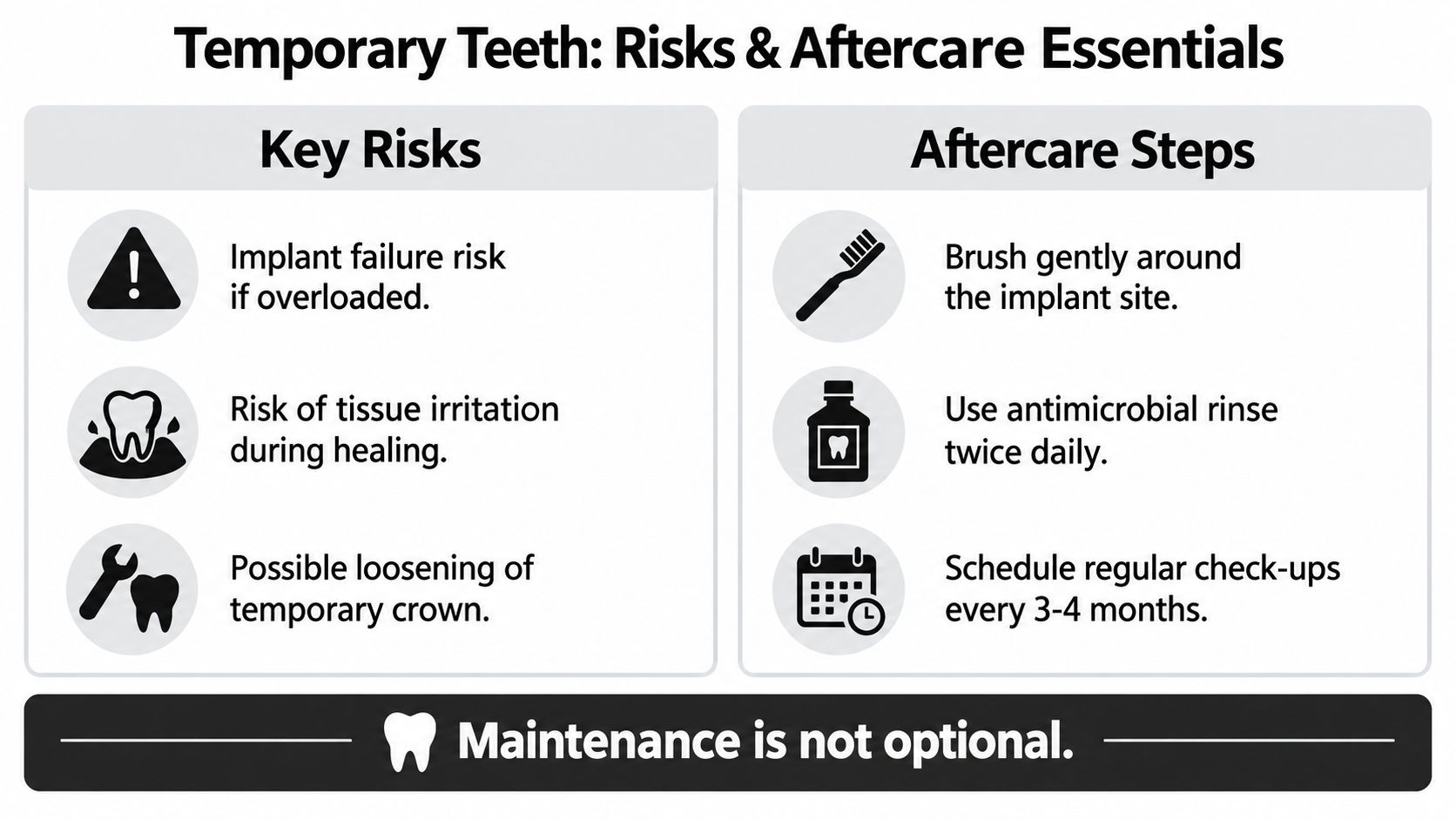
“Temporary” describes the planned duration, not the amount of care required. A provisional crown can loosen, debond, chip, or irritate the surrounding tissue. Acrylic materials are also less resistant to wear than the final restoration, so a small repair or replacement may be necessary during healing.
A 2025 systematic review of interim tooth replacement with mini-implants reported complications in 21.4% of cases, including repeated debonding, infraocclusion, soft-tissue irritation, plaque-related gingival inflammation, and rare osseointegration when the devices were intended to remain temporary. The review is discussed in the supplied clinical source.
That evidence matters because patients commonly ask whether a temporary tooth will stay in place or affect nearby teeth and gums. The answer depends on the restoration design, implant stability, bite, hygiene, and how closely you follow the dietary and cleaning instructions.
Protect the provisional while the implant heals
Your dentist may recommend softer foods and avoiding hard, sticky, or chewy items. Don't bite ice, caramel, hard candy, or tough foods with the provisional. If the restoration is in the front, chew on the opposite side when possible and avoid using the temporary tooth to tear food.
Clean around the restoration gently. Depending on the design, you may need a soft toothbrush, an interdental brush, a floss threader, or a water flosser once the surgical area is ready. Removable appliances should be taken out and cleaned as directed.
Call promptly if: the temporary feels loose, shifts, clicks, causes increasing irritation, or changes your bite. A loose screw or cement failure may be simple to correct, but movement should never be ignored during osseointegration.
Follow-up appointments let the dentist adjust the bite, remove excess cement, evaluate plaque control, and refine the tissue contour. The temporary crown care guide can provide additional practical reminders, but your own dentist's instructions take priority.

Long-term implant restorations also need maintenance. Consensus data reported connection-related complications, such as screw loosening or fracture, in 7.3% of patients at 5 years, while loss of retention in cemented restorations reached 16.2% by 10 years. The consensus evidence is indexed by PubMed. These figures don't predict what will happen to you, but they reinforce a practical truth: implant dentistry doesn't end when the final crown is seated.
Comparing Costs and Alternatives for Katy TX Patients
The cost of temporary teeth implants depends on the number of implants, the restoration type, extraction needs, bone grafting, imaging, sedation, and the final prosthesis. A responsible treatment plan should separate the surgical fee, provisional restoration, laboratory work, follow-up care, and definitive crown or bridge so you can understand what you're paying for.
Insurance may contribute differently to extraction, implant surgery, crowns, and provisional restorations. Cosmetic portions may have limited coverage, while medically necessary restorative services may be reviewed under a separate benefit. Ask for a written estimate and confirm plan details before treatment.
Patients in Katy, Sunterra, Cane Island, Katy Manor, Kingscrossing, Lakehouse, Marisol, The Grange, Anniston, Katy Lakes, Elyson, and Ventanna Lakes may compare these options:
| Option | Esthetic Quality | Maintenance Level | Impact on Adjacent Teeth |
|---|---|---|---|
| Immediate implant provisional | Natural-looking and shaped to the healing gumline | Requires careful diet, hygiene, and follow-up | Usually avoids preparing neighboring teeth |
| Bonded bridge | Can fill a visible gap quickly | May debond and needs cleaning beneath the pontic | Usually relies on nearby teeth for support |
| Removable partial denture or flipper | Can restore the appearance of a missing tooth | Must be removed and cleaned, may feel less stable | Often uses clasps or contact with adjacent teeth |
| Implant-retained provisional denture | Can provide stable full-arch support in qualifying cases | Requires hygiene around implants and prosthetic attachments | Reduces reliance on natural adjacent teeth |
An implant may require a larger initial investment than a flipper or bonded bridge, but the decision isn't purely financial. An implant-supported restoration can replace the root structure without using neighboring teeth as bridge supports, while a removable option may be less invasive during uncertain healing.
The right choice also depends on timing. If bone quality or primary stability doesn't support immediate loading, a removable temporary may protect the result better than forcing a fixed option. A consultation with a restorative dentist near you should compare comfort, appearance, maintenance, biological risk, and the expected path to the final restoration.
Your Next Steps with The Dental Retreat
If you're anxious about surgery, a missing front tooth, or the possibility of discomfort, tell the dental team before treatment begins. The Dental Retreat in Katy, TX, combines implant and restorative dentistry with a calm environment that includes aromatherapy, massage and heated chairs, noise-cancelling headphones, and TVs in every room.
Sedation dentistry may be available for appropriate patients, and bilingual care and extended hours can make appointments easier for busy families in Elyson, Marisol, and Katy Lakes. The practice also provides general dental care, cleanings and exams, dental X-rays, cosmetic dentistry, restorative dentistry, tooth extraction, clear aligners, and emergency dental services.
New patients without insurance can ask about the $139 exam with cleaning and X-rays or the $79 problem-focused visit. The practice also lists $450 in-office Zoom whitening, while membership plans start at $299 per year and include savings for periodontal maintenance. Details about services and patient options are available from The Dental Retreat.
At your implant consultation, expect a discussion about the missing tooth, gum and bone condition, your bite, the temporary restoration choices, expected maintenance, and the final esthetic goal. You should leave with a clear explanation of what can happen on the day of surgery and what changes if immediate loading isn't biologically appropriate.
Don't let fear of a visible gap delay the care you need. Whether you're searching for a cosmetic dentist near me, an emergency dentist, or dental implants near me in Katy, an individualized evaluation is the safest starting point.
The Dental Retreat offers implant consultations, tooth extraction, provisional restorations, and restorative care in a calm Katy, TX setting designed for anxious patients. Visit The Dental Retreat to request an appointment and discuss a temporary implant tooth plan that protects your comfort, gumline, and final smile.