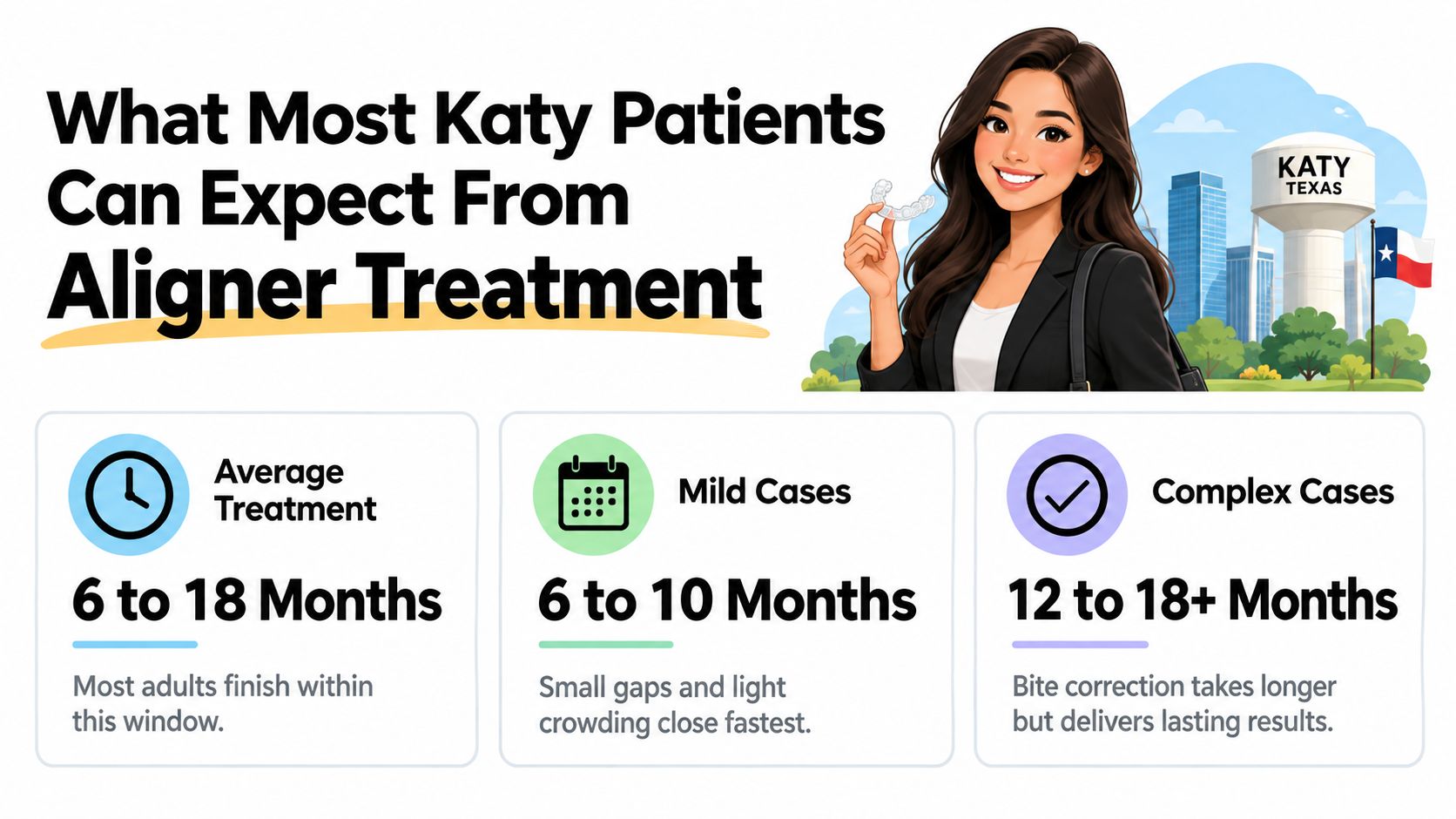
Most clear aligner cases finish in roughly 12 to 18 months, while mild cases may take 3 to 6 months and complex cases can take longer. Your personal timeline in Katy, TX, will depend on the movements your teeth need, how consistently you wear your trays, and whether refinements are needed.
You may be asking this after looking in the mirror before a wedding, reunion, new job, or another busy morning in Katy. Perhaps you live near Sunterra, Cane Island, Katy Manor, Kingscrossing, Lakehouse, Marisol, The Grange, Anniston, Katy Lakes, Elyson, or Ventanna Lakes and want a straighter smile without the appearance of braces.
The honest answer to “how long do clear aligners take” isn't one universal number. A small gap and mild crowding may respond relatively quickly, while rotated teeth, bite problems, extraction-related movement, or a previous orthodontic relapse can require more planning and more trays. Daily habits matter just as much as the aligner brand.
What Most Katy Patients Can Expect From Aligner Treatment
A patient with mild lower crowding may finish in 3 to 6 months, while clear aligner treatment commonly lasts 12 to 18 months overall, according to patient guidance from Dental Area's overview of aligner treatment duration. More involved cases can extend into the 18 to 24 month range when the bite needs substantial correction.
That range makes sense once you understand what the treatment is doing. Teeth aren't pushed across the mouth in a few weeks. They move gradually through living bone, and your dentist must protect the roots, gums, bite, and long-term stability of the result.
A major clinical review found that compliant aligner patients are typically seen every 10 to 12 weeks, compared with 4 to 6 weeks for patients wearing fixed appliances, reflecting the staged way aligner treatment is commonly delivered (clinical review). Fewer check-ins don't mean less oversight. Each visit is used to confirm that the teeth are tracking and that the next stage remains appropriate.
What changes the estimate
Your consultation should focus on four practical questions:
- How complex is the movement? Mild crowding or small spacing usually requires fewer stages than rotations or bite correction.
- Will you wear the trays consistently? Long periods without aligners can slow progress and increase the chance of refinements.
- How does your biology respond? Teeth move at different rates from person to person, and adult bone can respond differently from younger bone.
- Will attachments or refinements help? Small tooth-colored attachments, elastics, or additional trays may be needed to make difficult movements more predictable.
The brand name is only part of the conversation. Your case type, wear routine, biology, and response to treatment usually matter more than the logo printed on the packaging.
How Clear Aligners Actually Move Your Teeth
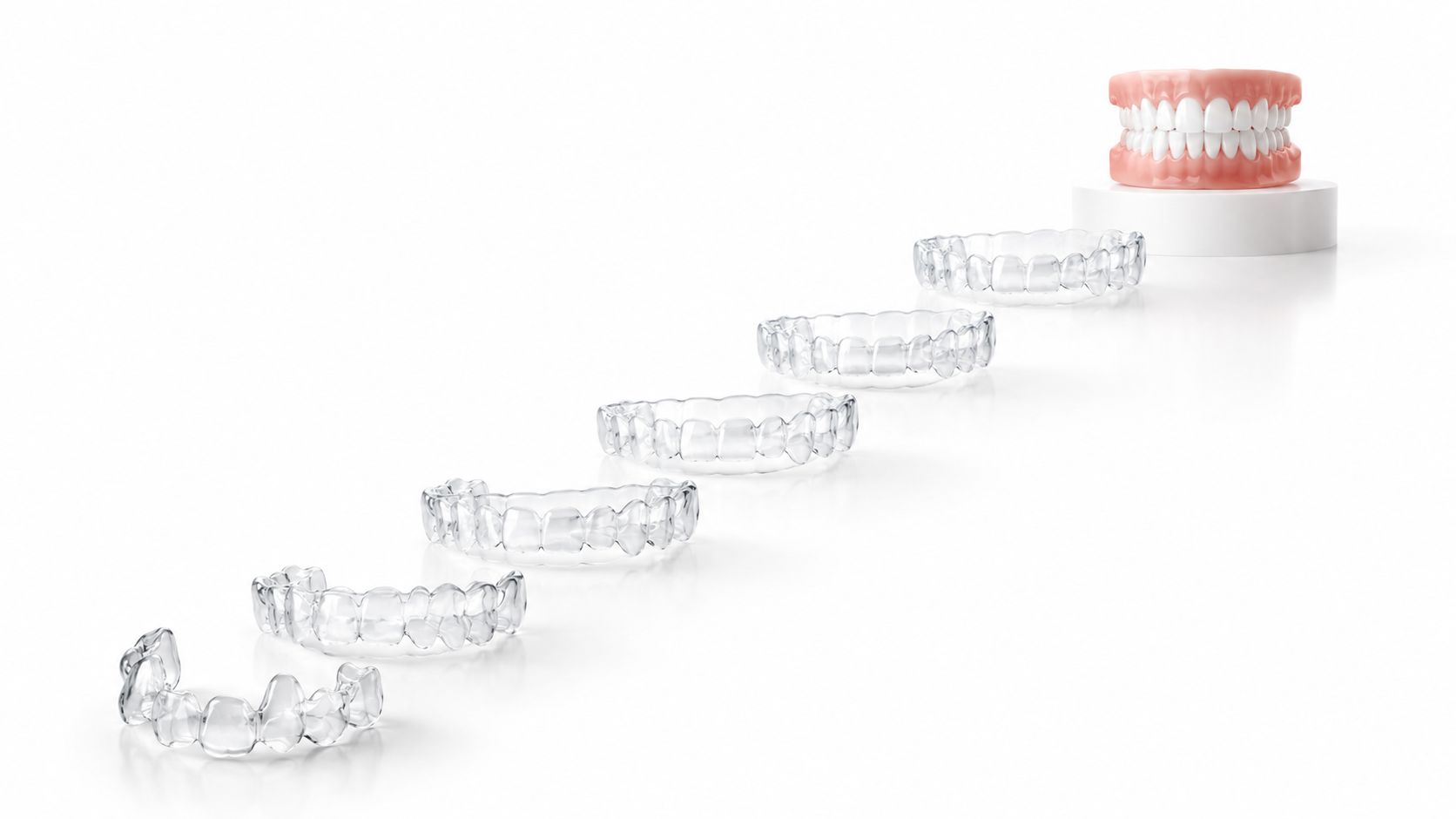
Think of each aligner as one step on a staircase. The first tray makes a small adjustment, the next tray builds on it, and the final tray is planned around the position your dentist wants your teeth to reach. No single tray is supposed to create the entire smile change.
At the first visit, the dental team may take photographs, dental X-rays when appropriate, and a digital scan or impressions. A digital plan maps the current position of your teeth and helps determine how they can move in stages. Your dentist then reviews the proposed sequence, checks your bite and oral health, and explains where attachments or other support may be useful.
Why trays are changed gradually
Each tray fits slightly differently. Its shape places controlled pressure on selected teeth, while the surrounding tissues adapt to that pressure. Most plans ask patients to wear an aligner for one to two weeks before changing to the next set, as described in The Dental Retreat's clear aligner information.
Under the gum, the supporting bone remodels as a tooth moves. Bone is removed in the direction of movement and new bone forms behind the tooth, allowing the tooth to settle into its new position. That process sets a biological floor for treatment, regardless of whether your trays come from Invisalign or another system.
The practical point: A tray can guide movement, but your body still needs time to make that movement stable.
Wear instructions can change the overall pace. In one clinical study, a 7-day change protocol produced a mean treatment duration of about 5 months, compared with about 9 months for a 14-day protocol in the initial set (wear-protocol study). That result doesn't mean every patient should change trays weekly. Your dentist must decide whether your teeth are ready for the next stage.
For a plain-language explanation of the mechanics, see how clear aligners move teeth. You can also watch the treatment overview below before your consultation.
The Four Factors That Shape Your Aligner Timeline
Two people can choose the same aligner system and finish at very different times. The difference usually comes from the movements required and the way treatment fits into daily life.

Case complexity comes first
A systematic review reported average clear aligner durations of 13.4 ± 5.28 months for mild crowding, 15.93 ± 5.17 months for moderate crowding, and 17.92 ± 4.07 months for severe crowding (systematic review data). The pattern is straightforward. More crowded teeth generally require more stages because each tooth must reach a safe, functional position.
Rotations, large spaces, crossbites, deep bites, and other bite corrections can add time. Extraction cases may also require a more involved sequence than a cosmetic adjustment affecting only the front teeth.
Your wear routine affects the finish date
Clear aligners only work while they're in your mouth. A review notes that patients generally need to wear them 22 to 23 hours per day, switching weekly or every two weeks as directed (aligner protocol review).
Removing trays for meals and cleaning is expected. Leaving them out for long stretches, forgetting to replace them, or advancing before a tray fits properly can interrupt the sequence. When a tooth doesn't track, your dentist may need to pause, repeat a tray, or order refinements.
Biology varies between patients
Age doesn't determine whether aligners can work, but it can influence how teeth respond. Younger patients may have more active bone remodeling, while adults can experience steadier or somewhat slower movement because bone density and tissue response differ.
Your overall dental health matters too. Active decay, gum inflammation, or untreated infection should be addressed before orthodontic movement. A thorough new patient exam, cleaning and exam, and dental X-rays when indicated help establish a healthy foundation.
Attachments and refinements add precision
Attachments are small composite shapes bonded to selected teeth. They give the aligner a more reliable surface for movements such as rotation or controlled pulling. Elastics may also support bite correction.
Refinement trays are not automatically a sign that treatment failed. Teeth don't always respond exactly as the computer predicts, so additional trays can fine-tune the result. A careful plan includes room for that possibility rather than promising an artificially short timeline.
Short, Medium and Long Case Examples
Examples can make the ranges easier to understand, but they aren't substitutes for an examination. The same visible crowding can arise from different tooth positions, jaw relationships, or bite patterns.
| Case Type | Typical Duration | Estimated Trays | Common Features |
|---|---|---|---|
| Short | 3 to 6 months | Limited series | Mild lower crowding, a small gap, or one rotated incisor |
| Medium | 12 to 18 months | 20 to 30 trays | Generalized crowding of 4 to 6 mm, deep bite, spacing, and several attachments |
| Long | 18 to 24 months | Varies by plan | Significant bite correction, crossbite, or previous orthodontic relapse |
A short case might involve an adult professional in their late 20s with mild lower crowding and one rotated front tooth. If the bite is healthy and the movement is limited, the plan may use a smaller series and few or no attachments.
A medium case has more moving parts. For example, a 35-year-old with generalized crowding, a deep bite, and some spacing may need a longer sequence, composite attachments, and careful monitoring as the bite changes.
A long case may involve a teen or adult with a crossbite, significant bite correction, or teeth that have shifted after earlier orthodontic treatment. Such a plan may include elastics and refinements, and the total can extend beyond the initial series.
A realistic promise is better than a short promise. Refinements are common because the final trays respond to how your teeth actually move, not only to a digital prediction.
The aligner brand doesn't turn a complex case into a simple one. At The Dental Retreat's clear aligner results information, patients can learn why treatment planning and monitoring matter when evaluating expected outcomes.
Typical Milestones From First Visit to Final Retainer
Your treatment has a beginning, a middle, and a retention phase. Knowing what happens at each point makes the calendar feel more manageable.

The consultation and scan
The first visit starts with your goals. You might want to close a space, straighten crowded front teeth, improve your bite, or feel more confident during photos.
The team reviews your dental history, examines your teeth and gums, studies your bite, and takes photographs. A digital scan or impressions records the starting position. Dental X-rays may be recommended when the dentist needs information that isn't visible from the surface.
At The Dental Retreat, this is also the time to discuss whether aligners are appropriate or whether another option would offer more predictable movement.
Planning and tray delivery
The treatment plan translates your goals into stages. You can review the proposed tooth movements and discuss attachments, elastics, cleaning, wear expectations, and the possibility of refinements before committing.
When the trays arrive, the dental team checks their fit and shows you how to insert, remove, clean, and store them. Your first change may occur after about one to three weeks, depending on the plan and delivery schedule. The practice then establishes check-ins to monitor progress and complete any planned attachment or interproximal reduction work.
Active treatment and refinements
Many offices schedule monitoring appointments every six to eight weeks, while the clinical review cited earlier describes longer intervals in commonly delivered aligner care. The right schedule depends on your plan, your response, and the procedures needed at each stage.
Refinements may be added if a tooth needs more time or a small adjustment. The final active-treatment visit confirms the fit and appearance of the result before retention begins.
Retainers protect the result
Clear aligners move teeth, but the surrounding tissues continue settling afterward. Retainers hold the teeth in their new positions, and your dentist will explain the wearing schedule for your case. Retention is a long-term commitment, not an optional final accessory.
Are Aligners Always Faster Than Braces
A Katy patient with mild crowding may complete aligner treatment efficiently, while another patient with a rotated tooth or a more involved bite correction may need longer. The appliance alone does not set the timeline. Case complexity, daily wear, and the type of movement required all matter.
Research reflects that variation. A major clinical review described one comparison in which total treatment time was 67% shorter with Invisalign than with fixed appliances, while also noting that results depend on the case and treatment design (comparative clinical review). Other research has reported different average directions and durations, including one 2024 study that found 14.5 months for clear aligners and 16.2 months for conventional braces, and a 2026 scoping review that reported 20.77 ± 6.43 months for aligners and 27.47 ± 4.81 months for braces.
These differences reflect case complexity and study design, so your Katy consultation should focus on your crowding, bite correction, and likely tooth movements rather than one percentage or average.
When aligners may be a good fit
Aligners can work well for mild or moderate alignment concerns, especially when you want a removable, less noticeable option. Removing the trays for meals and brushing can also make everyday routines easier.
That flexibility requires consistent participation. You need to put the trays back in after eating, follow the prescribed change schedule, and attend monitoring visits. If trays stay out often, teeth may not track as planned, and treatment can extend. At The Dental Retreat, progress checks help the team identify whether wear habits or tooth movement are affecting your projected timeline.
When braces may be more predictable
Fixed appliances do not depend on remembering to reinsert a tray. They may offer more predictable control for difficult rotations, significant vertical movement, large bite corrections, or other complex mechanics.
A randomized trial of 120 patients found clear aligners took 18.2 ± 3.1 months, compared with 14.5 ± 2.8 months for fixed appliances. A 2024 systematic review found low-certainty evidence that treatment duration is similar for mild-to-moderate crowding, while stronger trials are still needed for severe cases (PubMed evidence summary).
The useful question is which method can move your teeth predictably while fitting your habits and goals. At The Dental Retreat, that choice is based on an examination of your teeth and bite, not on a brand promise.
Starting Your Aligner Journey at The Dental Retreat
A first visit at The Dental Retreat gives you more than a generic estimate. You can discuss what you want to change, ask how long your aligners may take, and understand what could shorten or extend the plan before making a decision.
The appointment includes a review of your goals, photographs, a digital scan, and an assessment of your bite and gum health. The dentist can explain whether your concern is primarily cosmetic or whether it involves function, spacing, crowding, or bite balance. If you need dental X-rays, a cleaning, treatment for decay, or periodontal care first, those needs can be addressed as part of a broader dental plan.
A same-day treatment preview may help you see the intended direction of your smile. The preview isn't a promise that every tooth will move on an exact schedule. It is a planning tool that supports a conversation about your likely timeline, attachments, refinements, retainers, and the level of daily wear you'll need.
Patients in Katy and nearby communities can also ask about financing, insurance coordination, flexible scheduling, and care for family members. The practice provides general, cosmetic, restorative, implant, emergency, and orthodontic services, so your aligner plan can be considered alongside your overall oral health.
The setting is designed for patients who feel anxious about dental visits, with comfort-focused amenities and options that help make appointments easier. The team remains locally available for questions between visits, while scheduled check-ins keep your treatment moving in the right direction.
For a clear aligner consultation in Katy, TX, The Dental Retreat can evaluate your smile, explain your options, and build a timeline around your actual case and routine. Visit The Dental Retreat to request a consultation and get a personalized answer to how long your aligners are likely to take.