You're looking at polished veneer photos, wondering whether they could finally fix the chips, discoloration, gaps, or uneven teeth you've disliked for years. At the same time, you may be asking a more important question: should I get porcelain veneers if the treatment permanently changes my teeth?
If you're searching for a cosmetic dentist near me or a dentist in Katy, TX, you deserve more than a quick before-and-after preview. Porcelain veneers can create a beautiful, durable smile, but they involve enamel removal, careful maintenance, and an eventual repair or replacement plan. The right choice depends on your oral health, bite, goals, budget, and comfort with an irreversible treatment.
Why Veneers Feel Like a Big Leap for Your Smile
Veneers feel exciting because they can address several cosmetic concerns at once. A carefully designed set may improve the apparent color, shape, size, and minor alignment of visible teeth. That can make a smile look more balanced without treating every tooth with a crown or using orthodontics for a small cosmetic concern.
The hesitation is reasonable. Online photos rarely show the preparation appointment, temporary veneers, bonding visit, or maintenance years later. They also don't show what happens if one veneer chips, debonds, develops a dark margin, or no longer matches the surrounding teeth.
Practical rule: Don't choose veneers because you want a dramatic smile makeover. Choose them because the treatment fits the specific problem you want to solve and you accept the long-term responsibility that comes with it.
A good consultation should answer several questions before you commit:
- What is bothering you most? Color, shape, small gaps, worn edges, or tooth position may point toward different treatments.
- How much healthy enamel remains? Veneers bond most predictably when the adhesive interface remains primarily in enamel.
- Is your bite stable? Clenching, grinding, or an uneven bite can put excessive force on ceramic.
- Would a less invasive option achieve enough improvement? Bonding, professional whitening, or clear aligners may be more appropriate.
- How will future maintenance work? Ask how the practice handles repairs, shade matching, hygiene visits, and replacement planning.
For anxious patients, the environment matters too. The Dental Retreat in Katy offers a calm, spa-inspired setting with comfort-focused amenities, sedation options, and a judgment-free approach. That doesn't make veneers risk-free, but it can make the decision-making and treatment experience easier for someone who has delayed dental care.
What Porcelain Veneers Actually Are
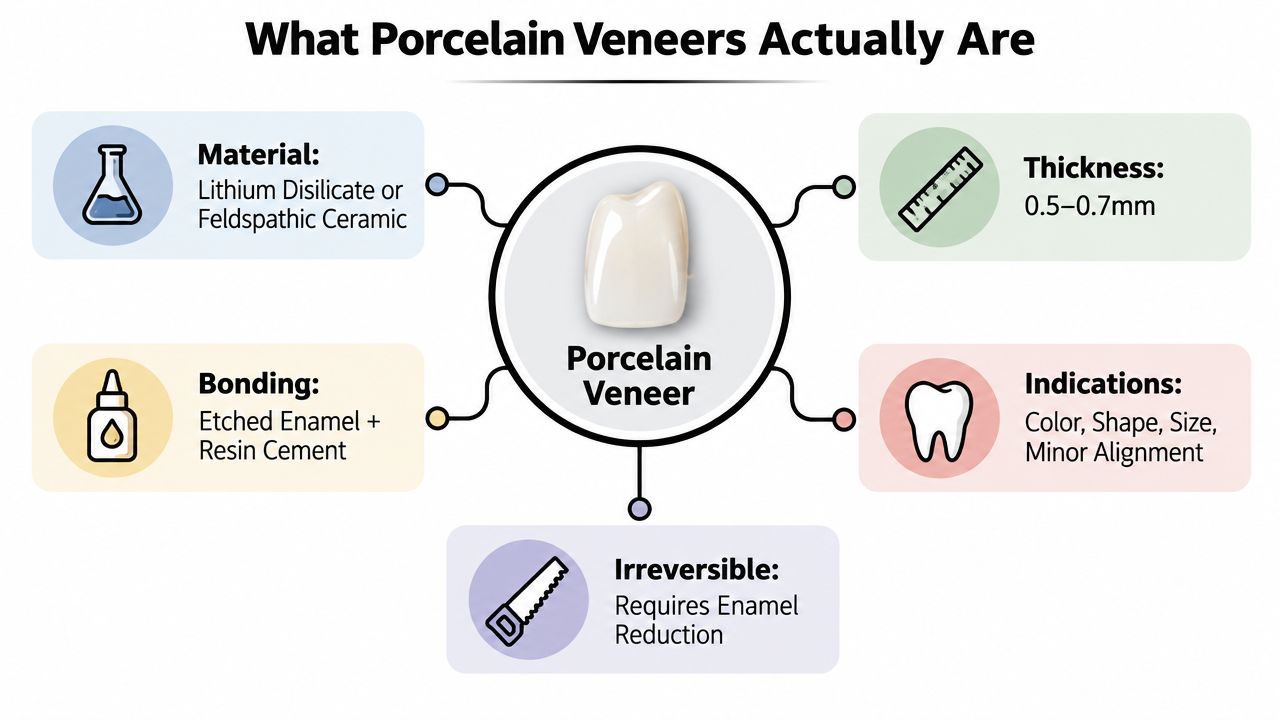
Porcelain veneers are custom-made ceramic shells bonded to the front surface of prepared teeth. They can alter visible tooth color, shape, size, and minor alignment while preserving more tooth structure than a full-coverage crown. A veneer doesn't surround the entire tooth. It covers the facial surface and selected edges, while a crown is designed to protect the tooth around its full circumference.
The treatment has a clear history. California dentist Dr. Charles Pincus introduced veneers in Hollywood in 1928, initially using temporary acrylic fronts for film stars. Modern durability came much later, after dentists learned to etch porcelain for a stronger bond to teeth in the early 1980s. The history of modern veneers is described in this overview of porcelain veneer development.
Today, a ceramist fabricates each restoration from impressions, molds, or digital scans. The porcelain is selected and shaped to imitate the light reflection and translucency of natural enamel. It generally resists staining better than natural tooth structure, although the teeth around the veneers and the margins can still discolor if plaque control is poor.
Preparation determines the commitment
Traditional porcelain veneers usually require removal of a thin layer of enamel. A commonly cited preparation range is about 0.3 to 0.7 millimeters, depending on the tooth and the case, as explained by Aspen Dental's veneer preparation guide. Enamel doesn't grow back, so a prepared tooth will generally need continued coverage or another restoration in the future.
Some patients hear about no-prep or minimal-prep products, including Lumineers, and assume they eliminate the biological trade-off. They may be suitable for selected teeth with favorable shape, position, and available space, but not every smile can receive them without looking bulky or changing the bite. Your dentist should show you exactly where preparation is planned rather than relying on a label.
Porcelain also differs from composite bonding. Bonding uses chairside resin that the dentist shapes directly on the tooth. Porcelain is fabricated outside the mouth and then bonded in place. Composite bonding can preserve more tooth structure and may be easier to repair, while porcelain often offers a more controlled surface finish and stronger resistance to staining.
Are You a Good Candidate for Veneers
The strongest veneer candidates have healthy teeth, healthy gums, enough sound enamel, and a clear cosmetic goal. They may have persistent discoloration, small gaps, chipped edges, worn teeth, or mild shape and alignment concerns. They also understand that veneers improve appearance, but they don't cure untreated decay, gum disease, an unstable bite, or severe tooth-position problems.
A systematic review found that feldspathic porcelain veneers bonded to enamel reached an estimated 95.7% cumulative survival at five years, with a post hoc analysis suggesting that ten-year survival may approach 95.6%. The clinical review of enamel-bonded porcelain veneers explains why enamel matters. Etching and resin bonding are generally more predictable in enamel than in dentin, while aggressive preparation can reduce survival and increase fracture risk.
Use this candidacy screen
- Healthy gums: Active periodontal disease should be treated before cosmetic work. Inflamed tissue makes margin control and long-term hygiene more difficult.
- Adequate enamel: Your dentist should assess how much strong enamel remains and how much would be preserved after preparation.
- A defined cosmetic concern: Veneers make sense when you can describe the problem, such as stubborn discoloration, a chipped incisor, small gaps, or uneven tooth proportions.
- A manageable bite: Severe grinding, clenching, or heavy front-tooth contact requires a protection plan, often including a nightguard or bite treatment.
- Safe daily habits: Nail biting, ice chewing, and opening packages with your teeth can stress ceramic.
- Realistic expectations: The best result may be natural and balanced rather than extremely white, oversized, or perfectly uniform.

Age also matters. Veneers are rarely recommended before facial growth is complete because the teeth, gums, and bite may continue to change. Younger patients and anyone who feels unsure should ask whether whitening, bonding, or aligners could provide enough improvement without beginning a permanent restoration pathway.
Bring these questions to a Katy consultation:
- How many veneer cases do you personally place?
- Will you show me a digital smile preview, wax-up, or mock-up before preparation?
- How much enamel do you expect to remove from each tooth?
- What happens if I grind or clench?
- Can you explain the repair and replacement plan in writing?
- Would bonding, whitening, or clear aligners be a better first step?
If the answers feel rushed, keep looking for a consultation that gives you enough information to decide calmly.
Veneers Compared to Bonding, Whitening, and Aligners
The right question isn't “Which cosmetic treatment is most popular?” It's which problem are you trying to solve? Veneers are a broad cosmetic redesign, but they aren't automatically the best answer for a single chip, color-only concern, or tooth-position issue.
| Option | Tooth Preservation | Treatment Time | Longevity | Best For |
|---|---|---|---|---|
| Porcelain veneers | Requires enamel preparation and is generally permanent | Multi-visit treatment | Long-term, with eventual maintenance or replacement planning | Multiple cosmetic concerns involving color, shape, size, or minor alignment |
| Composite bonding | Usually preserves more natural tooth structure and may be reversible or repairable | Often completed chairside | Requires maintenance and may need repair over time | Small chips, limited reshaping, and modest gaps |
| Professional whitening | Preserves tooth structure | Short treatment course, depending on the plan | Color gradually changes with diet, aging, and habits | Teeth that are healthy but darker than you'd like |
| Clear aligners | Preserves tooth structure while moving teeth | Treatment length depends on tooth movement and compliance | Addresses tooth position, with retention needed afterward | Crowding, spacing, and alignment concerns |
Choose treatment by the underlying complaint
If your teeth are healthy and the only concern is shade, start with professional whitening. Whitening won't reliably correct every type of internal discoloration, and it won't change tooth shape, but it may remove the need for veneers altogether.
If one incisor is chipped or a small gap bothers you, composite bonding may be the more sensible first choice. It usually involves less alteration and lets the dentist add or reshape material directly. It may not deliver the same surface characteristics as porcelain across a full smile, but a limited problem doesn't require a full-arch solution.
Clear aligners are preferable when tooth position or bite causes the dissatisfaction. Veneers can make mildly uneven teeth look more uniform, but masking significant movement needs can create unnecessary preparation and bite compromises. For a closer discussion of material and treatment differences, review this guide to composite veneers versus porcelain.
What Happens at Each Veneer Appointment
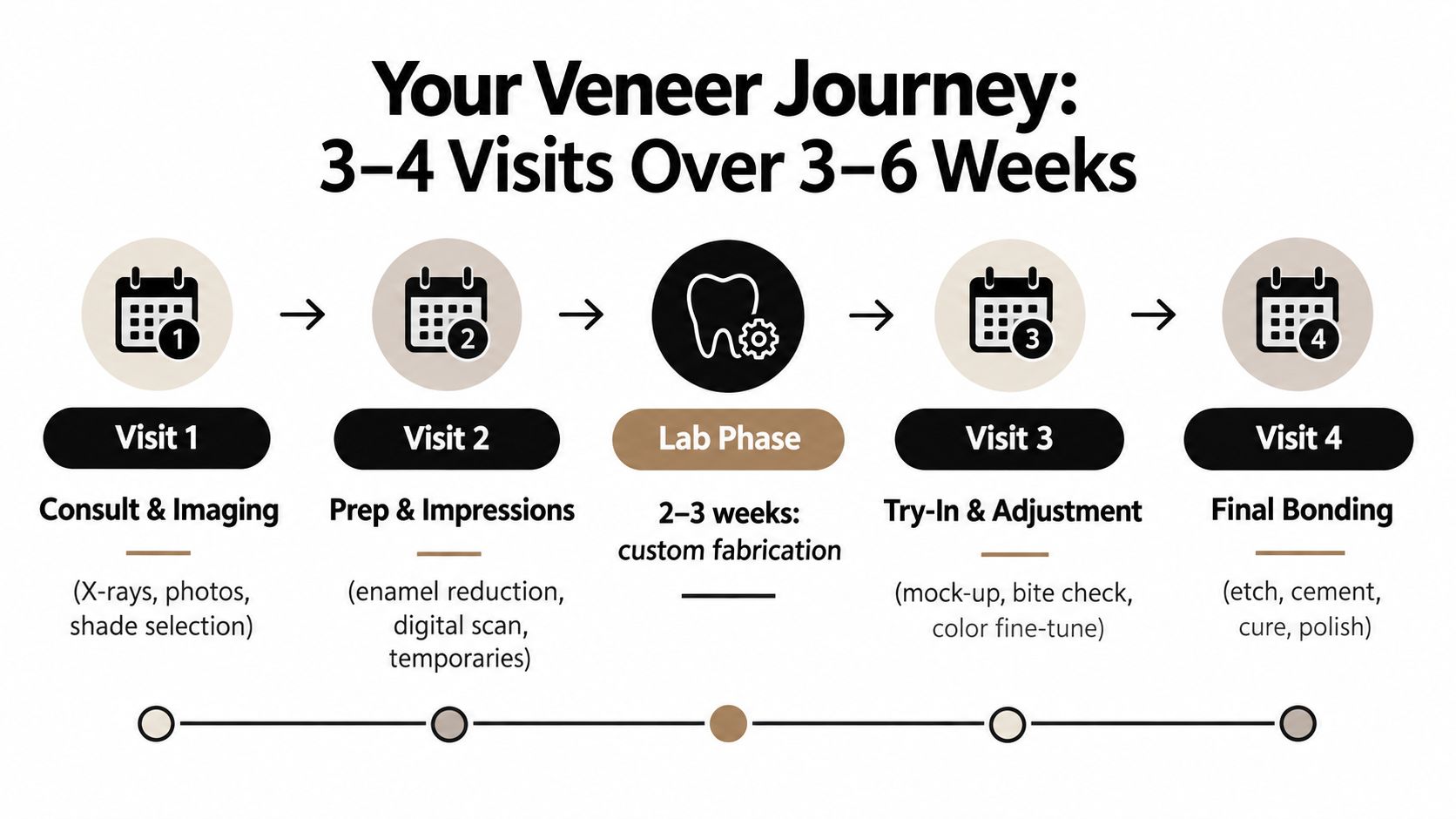
A typical veneer plan in Katy may involve three to four visits over three to six weeks, depending on the number of teeth, laboratory schedule, and design revisions. The sequence matters because each stage protects your teeth and gives you a chance to approve the appearance before final bonding.
Visit one focuses on diagnosis and design
The initial consultation should include a discussion of your goals, photographs, dental X-rays when indicated, a clinical examination, shade assessment, and digital scans or impressions. The dentist evaluates your enamel, gums, existing fillings, bite, and smile line.
A wax-up, mock-up, or digital smile preview can help you judge tooth length, shape, and proportion before preparation. Ask to see the proposed design from different angles and in normal facial expressions. A smile that looks attractive in a single photograph should also feel natural when you speak and laugh.
Visit two prepares the teeth
At preparation, the dentist removes a conservative amount of enamel where needed, then records detailed impressions or a digital scan. Temporary acrylic veneers protect the prepared teeth while the laboratory creates the final restorations. The standard veneer workflow includes preparation, impressions, temporaries, and bonding at a later visit.
Temporaries may feel different from the finished veneers. Speak normally, test your bite gently, and tell the dentist if a temporary feels too long, thick, or difficult to clean. This is useful feedback, not an inconvenience.
The final visits verify, adjust, and bond
At the try-in, each veneer is evaluated for fit, contact points, color, tooth length, speech, and bite. The dentist can make adjustments before cementation. Once you approve the design, the teeth and ceramic are treated for adhesion, resin cement is placed, and each veneer is cured, polished, and checked again.
For nervous patients, tell the practice before scheduling. A comfort-focused appointment may include calm-room pacing, neck support, noise-cancelling headphones, television, aromatherapy, heated or massage chairs, and sedation options when clinically appropriate.
The following video offers a visual overview of the treatment journey:
Why Veneers Can Be Worth the Investment
Porcelain veneers can be a smart investment when conservative options don't address the problem and your teeth are healthy enough to support adhesive restorations. They aren't a default upgrade for every smile. The value comes from solving several appearance concerns with one coordinated design while preserving more tooth structure than full crowns.
The trade-off remains permanent. Once enamel has been removed, it won't regenerate, and the tooth will generally require ongoing coverage. That makes conservative preparation, careful shade planning, and a stable bite more important than choosing the brightest available porcelain.
Patients who often benefit most
Adults with healthy teeth and a stable bite may benefit when whitening, bonding, or aligners can't provide the desired result. This is especially true when tooth size, shape, and color need to change together.
Professionals who feel self-conscious on camera may value a consistent, natural-looking smile for work, social situations, and photographs. The goal should be proportion and facial harmony, not an artificial uniformity that distracts from your expression.
Patients with naturally small or misshapen teeth may need more than whitening or tooth movement. Veneers can add visible length and volume when the underlying tooth form is the central concern.
Veneers may also restore worn or chipped edges, but the dentist must determine whether the restoration is cosmetic or whether the tooth needs more substantial restorative dentistry. A heavily filled or structurally weakened tooth may require a crown instead. A damaged or painful tooth may first need endodontic treatment, a tooth extraction, or another restorative solution.
Don't judge the investment only by the initial fee. Ask for a complete plan that includes diagnostics, temporaries, laboratory work, maintenance, possible nightguard protection, and what happens if one restoration needs repair. A transparent practice should discuss the financial commitment before preparation begins, not after.
How Long Veneers Last and How to Care for Them
Porcelain veneers can serve you well for years, but they require a long-term maintenance plan. Published reviews place ten-year survival above 90%, with reported ten-year ranges around 91% to 95%. The practical takeaway is simple: a small share of veneers will need repair or replacement within a decade, even when the original treatment was carefully planned. This clinical review of veneer survival and complications explains how case selection, enamel quality, bonding, bite force, hygiene, and daily habits affect outcomes.
Another review of porcelain veneer outcomes reports favorable results overall while documenting fractures and mechanical or biological failures over time. These findings do not guarantee a personal result. They show why your dentist should discuss maintenance, protection, and replacement costs before preparing your teeth.
Daily habits protect the margins
Use a soft toothbrush and non-abrasive toothpaste. Clean carefully along the gumline, and floss around every veneer margin so plaque does not cause inflammation or staining beside the ceramic. If you grind or clench, ask whether a professionally designed nightguard suits your bite. Avoid generic appliances that may interfere with how your teeth meet.
Do not chew ice, bite your nails, open packages with your teeth, or repeatedly bite hard foods with the front teeth. These habits can fracture porcelain or weaken the bond, even when the veneers were well made.
Plan for maintenance, not just placement
During hygiene and examination visits, your dentist should inspect the veneer margins, gum health, bite, opposing tooth wear, staining, cracks, and signs of debonding. A damaged veneer may sometimes be repaired or replaced individually, but the decision depends on its shade, design, neighboring restorations, and the available laboratory records.
Replacement-cycle economics belong in your consultation. Ask how the practice handles repairs, replacement, shade matching, and a veneer that fails after the initial treatment period. Include maintenance, professional cleanings, examinations, and possible nightguard protection in your financial plan. Our long-term guide to veneer lifespan explains why lifespan estimates vary by case selection and care.
For patients in Katy, a practical routine includes daily home care, regular cleanings and exams, bite monitoring, and prompt evaluation if a veneer feels loose, sharp, painful, or different. If you also need an emergency dentist, dental implants near me, dental X-rays, or a new patient exam, choose a practice that can coordinate those services with cosmetic care.
If you are considering porcelain veneers in Katy, TX, The Dental Retreat provides cosmetic consultations, digital planning, veneer preparation, custom laboratory fabrication, and final bonding in a comfort-focused setting. At your consultation, ask about enamel removal, alternatives, replacement planning, nightguard protection, and how the practice supports patients who feel anxious about dental treatment.