You notice it in small moments first. A chipped front tooth catches the light in a selfie, a tiny gap looks bigger every time you smile, or a dark spot keeps you from laughing naturally at dinner in Katy, TX. In cases like that, patients often ask the same practical question, what is the difference between veneers and bonding, and which one makes sense for their tooth, their timeline, and their comfort level.
| Feature | Porcelain Veneers | Composite Bonding |
|---|---|---|
| What it is | A custom-made thin shell that covers the front of the tooth | Tooth-colored resin shaped directly on the tooth |
| Typical visit flow | Usually needs multiple appointments | Usually finished in one visit |
| Tooth preparation | Usually requires some enamel reshaping | Usually little to no enamel removal |
| Main strength | More durable, more stain resistant | More conservative, easier to repair |
| Best fit | Bigger cosmetic changes, stronger long-term result | Small chips, gaps, and quick fixes |
Understanding Veneers and Bonding at a Glance
A chipped tooth can make you rethink every photo, and a visible gap can turn a simple conversation into a self-conscious moment. That's usually when people start looking for a cosmetic dentist near me in Katy, TX, or in nearby neighborhoods like Sunterra, Cane Island, Katy Manor, Kingscrossing, Lakehouse, Marisol, The Grange, Anniston, Katy Lakes, Elyson, and Ventanna Lakes.
Two treatments, two very different methods
Veneers are thin, custom-made shells, usually porcelain or ceramic, that bond to the front of the tooth. They're made to change the tooth's color, shape, and surface so the smile looks more even and polished. Because they're fabricated outside the mouth, they're planned carefully and matched to the surrounding teeth.
Bonding uses tooth-colored composite resin, the same general family of material used in white fillings, and the dentist sculpts it directly onto the tooth. The material is shaped, hardened, and polished in one visit. That makes bonding a good fit when the issue is smaller and the goal is a quick improvement without much enamel removal.

Practical rule: if the tooth is healthy and the change needed is modest, bonding can be the more conservative first step. If the smile needs a more durable, polished reset, veneers usually take the lead.
Bonding is often the quicker, simpler choice, but that doesn't make it a lesser treatment. It just solves a different kind of problem. Veneers and bonding can both improve chips, discoloration, gaps, and mild unevenness, but they get there in very different ways.
If you want a deeper primer on bonding itself, see this cosmetic bonding overview. The next question is how those differences affect the tooth, the finish, and how long the result tends to hold up.
How the Materials and Tooth Preparation Differ
The biggest difference between these two treatments is not just how they look. It's what happens to the tooth before the final result goes on, and that matters for comfort, longevity, and how much natural structure stays in place.
Veneers are thin shells, bonding is sculpted resin
Porcelain veneers are built as thin shells, commonly around 0.3 to 1.0 mm thick in preparation-focused descriptions, and they're bonded to the front of the tooth after the surface is shaped for a flush fit (IJRAR veneer thickness overview). That thinness is part of the appeal, because the final result looks like a natural outer layer rather than a bulky add-on.
Bonding works differently. The resin is placed directly where the dentist needs it, then shaped and polished chairside. Because it's additive, the tooth usually keeps more of its original enamel. That's why bonding is often described as more conservative, and in many cases more reversible, than veneer treatment (bonding vs veneers guide).
Enamel preservation changes the whole conversation
Veneers usually require removing a thin layer of enamel so the shell sits naturally and doesn't look thick. That enamel reshaping is part of the reason veneers can create such a clean, uniform finish. It also explains why the treatment is more permanent.
Bonding usually requires little to no enamel reduction. That makes it attractive for minor repairs, especially when the tooth is otherwise healthy. It also means the dentist has more flexibility if the cosmetic issue is small and the patient wants to keep options open later.
Clinically, the question isn't just “Which looks better?” It's “How much healthy enamel do we need to preserve to get the result the tooth actually needs?”
Finishing matters for both options. A well-done veneer depends on precise lab work and careful cementation. Bonding depends on the dentist's ability to layer, contour, and polish the resin so it blends with the tooth, especially at the incisal edge where light reflects most clearly. In real life, the final look often comes down to how well the restoration fits the enamel it's covering.
| Feature | Porcelain Veneers | Composite Bonding |
|---|---|---|
| Material | Porcelain or ceramic shell | Tooth-colored composite resin |
| Thickness | Thin shell, often around 0.3 to 1.0 mm in prep-based descriptions | Built up directly in layers |
| Tooth alteration | Small enamel reshaping is usually needed | Usually little to no enamel removal |
| Design style | Lab-made, planned in advance | Sculpted chairside |
| Reversibility | Generally irreversible | Often more conservative and easier to adjust |
Durability, Survival Rates, and Bond Strength
Veneers often last longer than bonding, but longevity is only part of the decision. The more useful question is where the restoration bonds and how much healthy enamel remains to support it. Enamel provides a more predictable surface than dentin, so preserving it can matter as much as choosing a durable material.
Clinical reviews report veneer survival around 93% at 10 years and 91% at 12 years, with some studies showing 94% at 12 years. The same review notes survival of feldspathic porcelain and glass-infiltrated ceramic veneers around 96% to 98% at 5 years. One retrospective study of 327 direct composite veneers found an estimated 80% survival at 5 years (clinical review). A separate evidence summary reported overall veneer survival of 89% after an average of 9 years, with porcelain veneers at 87% after about 8 years and glass-ceramic veneers at 94% after 7 years (ADA-cited review summary).
Those figures describe groups of restorations, not a promise for one patient. Bonding may need polishing, repair, or replacement sooner, particularly when it is exposed to heavy biting forces, staining foods, or habits such as nail biting. Veneers can also fail, but their ceramic surface generally resists everyday staining and wear better.
Why enamel matters so much
Enamel works like a firm, stable foundation. Dentin is more variable, and a restoration bonded partly or mainly to dentin may be less predictable. A peer-reviewed study found that complete intra-enamel preparation produced the highest shear bond strength, with ceramic bonded to enamel at about 26 MPa versus 15 to 29 MPa to dentin, depending on the adhesive system (bond strength study).
That finding changes how a dentist should frame the choice. A veneer can be the longer-lasting option when enough enamel remains, but removing sound enamel solely to pursue longevity may not suit a healthy tooth with a small cosmetic concern. Bonding can preserve more of the original structure and serve as a sensible first step, even when its maintenance needs are greater.
The failure mode also differs. A veneer may debond as a unit or require replacement if the bond or ceramic fails. Composite bonding more often chips, stains, or wears in a limited area. Those problems can often be repaired or polished during a shorter visit, rather than replacing the entire restoration.
A veneer longevity guide can provide useful context about expected lifespan, but your enamel condition, bite, habits, and the size of the correction matter more than a headline number. The right decision balances preservation with predictable performance.
| Metric | Porcelain Veneers | Composite Bonding |
|---|---|---|
| 10-year survival | Around 93% in clinical reviews | Shorter-lived overall |
| 12-year survival | Around 91% to 94% in reviews | More likely to need touch-ups earlier |
| 5-year survival | Around 96% to 98% in some short-term data | About 80% in one direct composite study |
| Bond strength to enamel | Strong and enamel-dependent | Good for conservative repairs, but more technique-sensitive over time |
| Common failure pattern | Debonding or full replacement | Chip, stain, or wear, often patchable |
The Treatment Experience Compared
Some patients care less about the final material and more about what the process feels like. That's fair, because the appointment count, numbness, and recovery all affect whether the treatment fits a work schedule, a wedding timeline, or just day-to-day life.
Bonding is usually faster and simpler
Composite bonding is often completed in one visit, with chair time often around thirty to sixty minutes per tooth in typical clinical workflows. It often doesn't require numbing, especially when the dentist is only shaping the visible front surface. Since the tooth is usually left intact, the experience feels lighter and more immediate.
Recovery is usually minimal. Some people notice slight roughness or mild sensitivity for a short time, but most go right back to normal routines the same day. That makes bonding a practical choice for patients who want a visible fix without a long treatment path.
Veneers ask for a longer commitment
Veneers usually take two to three appointments over two to four weeks. The first visit is for preparation and impressions or digital scans, and temporary shells may be placed while the lab makes the final restorations. Then the dentist checks fit, color, and shape at a try-in visit before cementing the final veneers.
The process often uses local anesthetic for preparation, since a thin layer of enamel is usually removed. Temporary veneers can affect eating and speech a little, and most patients notice some sensitivity for a few days after prep or cementation. That's normal, but it is still a bigger commitment than bonding.
The trade-off is simple. Bonding is easier to start and easier to undo. Veneers take longer, but they're planned for a more permanent transformation.
Temporary mock-ups can help a lot when someone is unsure about shape or length. They let you see how the smile may look before the final porcelain is made, which reduces guesswork and helps the dentist fine-tune the result. For patients who want control over the final look, that preview can be reassuring.
| Factor | Composite Bonding | Porcelain Veneers |
|---|---|---|
| Visits | Usually one | Usually two to three |
| Chair time | Often about 30 to 60 minutes per tooth | Longer overall because of prep and lab steps |
| Numbing | Often not needed | Common during preparation |
| Recovery | Usually short and mild | Mild sensitivity can last a few days |
| Reversibility | More conservative, often easier to adjust | Permanent commitment once enamel is altered |
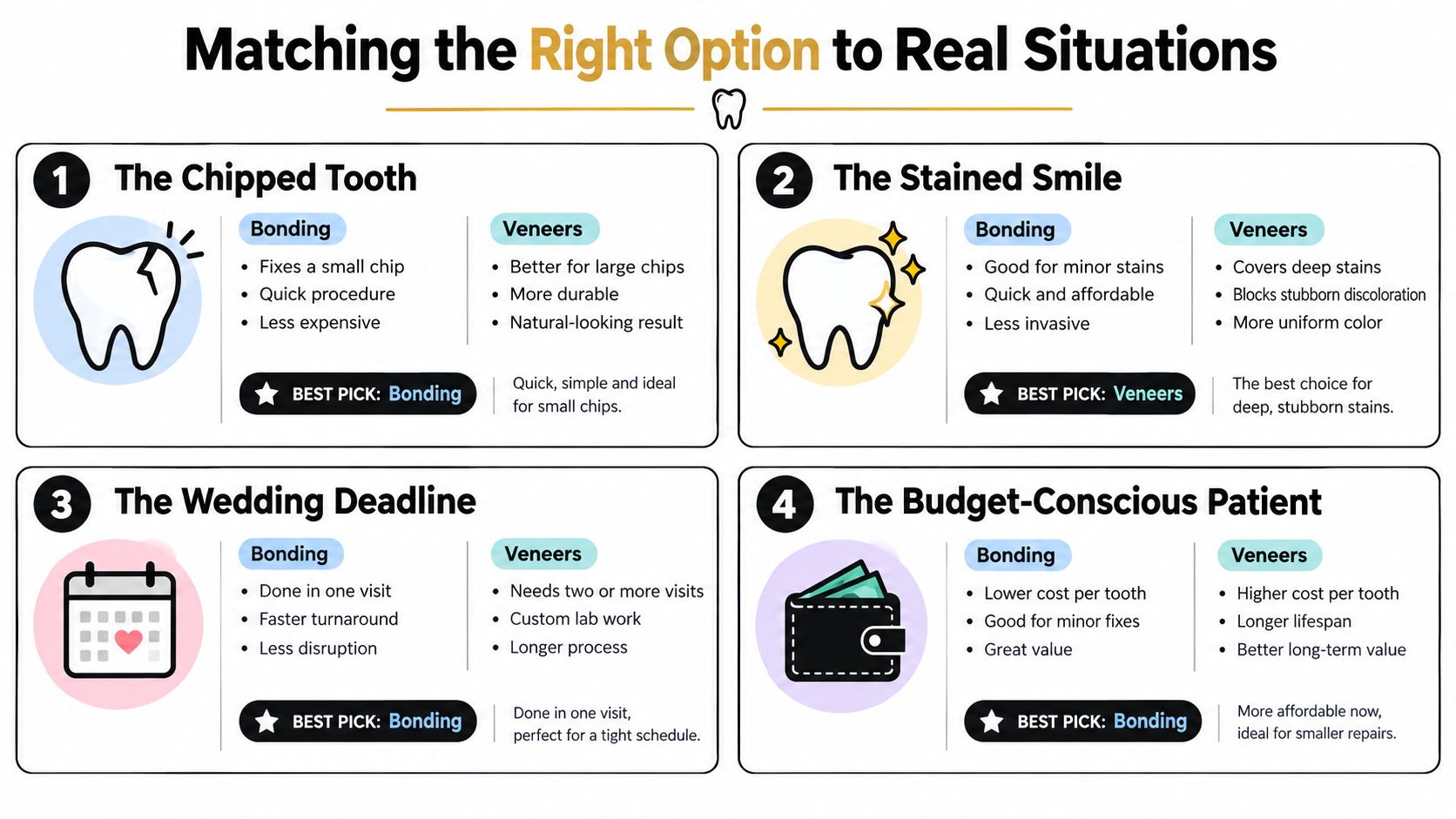
Matching the Right Option to Real Situations
A treatment decision gets easier when it stops being abstract and starts matching an actual tooth. The right choice often has less to do with prestige and more to do with how the tooth looks, how much enamel is left, and how soon the patient wants the change.
Small repair, short timeline, healthy enamel
A young professional chips a front tooth during a weekend basketball game. The damage is modest, the tooth is otherwise healthy, and the person wants the smile fixed before work presentations start again. In that situation, bonding usually makes more sense because it preserves enamel and can be completed quickly.
A similar logic applies to someone who only wants a small gap softened or a tiny edge rebuilt. If the change is local and the surrounding teeth already look good, bonding gives a visible improvement without turning the tooth into a bigger project.
Bigger makeover, bigger change
A bride with ten weeks until the wedding wants a brighter, more uniform smile for photos. If the case involves several teeth and the goal is a polished, symmetrical result, veneers are usually the stronger long-term option. They're better suited for a coordinated makeover where shape, color, and overall harmony all matter at once.
A longtime coffee drinker with one dark front tooth is another common example. If internal bleaching has already failed, a veneer can mask the discoloration more completely than bonding usually can. In cases like that, the issue isn't just hiding a spot, it's creating a predictable color match next to the adjacent teeth.
A college student on a tight budget who has slightly worn and gapped incisors may still be a good bonding candidate. The result might not be as durable as porcelain, but it can meaningfully improve the smile now without a lab fee or a longer treatment timeline.
The decision usually comes down to four things, and they're all practical:
- How much healthy enamel is still available
- How visible or extensive the cosmetic problem is
- How quickly the result is needed
- How long the patient wants the result to hold up
Choosing With Confidence and Next Steps
The clearest way to decide is to start with the tooth, not the trend. If the enamel is healthy and the issue is minor, bonding is often the smarter first step because it preserves more of the natural tooth and can solve the problem quickly. If the tooth is heavily discolored, misshapen, or needs a bigger cosmetic correction, veneers usually give the more complete and durable result.
A simple way to think about it
Bonding fits best when:
- The chip, gap, or edge wear is small
- You want the most conservative option
- You need a faster fix
- You're okay with a repair that may need maintenance sooner
Veneers fit best when:
- You want a more dramatic smile change
- Several front teeth need to match
- Staining, shape, or unevenness goes beyond a small patch
- You want a longer-term result and enamel can support it
For many patients with healthy teeth, bonding is the smarter first step because it protects structure and keeps future options open. That doesn't make veneers a fallback. It makes them the better answer when the smile needs more change than resin can realistically provide.
Best next step: bring a few smile photos, list your priorities in order, and ask the dentist how much enamel can stay untouched. That conversation usually clears up the choice faster than price alone ever will.
If you're comparing cosmetic dentistry options in Katy, TX, a consultation should also cover whether the case needs whitening first, how the final shade will be matched, and what kind of maintenance each option needs. That's especially helpful if you're also considering other services like cleanings and exams, dental x-rays, new patient exams, teeth whitening, restorative dentistry, dental implants, or even emergency dental services for a damaged tooth.
At The Dental Retreat in Katy, patients can get a cosmetic evaluation in a calm, patient-centered setting with treatment planning built around comfort and clarity. If you're weighing veneers versus bonding for a chipped tooth, discoloration, or a smile you want to feel better about, visit The Dental Retreat and schedule a consultation to get a recommendation that fits your tooth, your timeline, and your goals.