A throbbing molar can turn an ordinary Katy weekend into a search for an emergency dentist near me, especially when cold sensitivity has lingered for days and pain makes eating, sleeping, or working difficult. If you're in Sunterra, Cane Island, Katy Manor, Kingscrossing, Lakehouse, Marisol, The Grange, Anniston, Katy Lakes, Elyson, or Ventanna Lakes, you may be asking the same urgent question: root canal vs extraction, which option is right for me?
The honest answer isn't just "save the tooth" or "pull it." The decision depends on whether the tooth is restorable, how much healthy structure remains, the condition of the surrounding bone and gums, your timeline, and the cost of what happens afterward. Root canal therapy and tooth extraction can both resolve an infected or severely damaged tooth, but they lead to very different long-term plans.
When the Choice Between Saving and Removing a Tooth Hits Close to Home
A lower molar wakes a Katy patient before sunrise with a steady, deep ache. Cold sensitivity had appeared during the week, but now breakfast is difficult, lying down increases the discomfort, and a search for an emergency dentist near I-10 presents two options: root canal therapy or tooth extraction.
The decision should start with restorability, not fear or speed. An X-ray may show a tooth that can be treated even when the pain makes it feel hopeless. A root canal followed by a crown costs more upfront than an extraction in many cases, but extraction may create a second treatment decision. If the missing tooth affects chewing, replacement could involve a dental implant, bridge, or another restoration.
Practical rule: Get a diagnosis before choosing treatment. Pain shows that something is wrong, not whether the tooth should be saved.
For a restorable tooth with a reasonable prognosis, preserving the natural tooth is usually the stronger clinical choice. One large study summarized by Healthline's overview of root canal treatment and implants reported that more than 94% of teeth remained functional 3.5 years after root canal treatment. An independent cohort study found that 9.3% of root-filled teeth were extracted within 5 years, leaving approximately 90.7% unextracted during that period. Results still depend on the tooth's complexity, the quality of its final restoration, and ongoing care.
The question isn't simply save or remove
Ask a more useful question: Can this tooth support a reliable restoration, and what will the mouth look like after either choice? Root canal therapy removes infected tissue from inside the tooth while preserving the tooth when enough healthy structure remains. Extraction removes the immediate source of trouble, but it leaves a space that can affect chewing, nearby teeth, and the jawbone.
Root-filled teeth are common. A systematic review found that they represent 8.2% of all teeth worldwide, while 55.7% of adults over 18 have at least one root canal-treated tooth. These figures place root canal therapy among established tooth-preservation treatments rather than unusual last-resort care.
For a Katy patient, access also matters. A dental office near Cinco Ranch, I-10, or another nearby community can assess the tooth, discuss whether it is restorable, and explain the replacement plan before an extraction is chosen. The right recommendation depends on the examination, the remaining tooth structure, the surrounding tissues, your timeline, and the long-term cost of maintaining or replacing the tooth.
The next decisions should compare treatment steps, recovery, cost, and expected durability. That framework makes it easier to judge advice from a dentist in Katy, TX and choose between a tooth extraction and root canal consultation based on your actual situation.
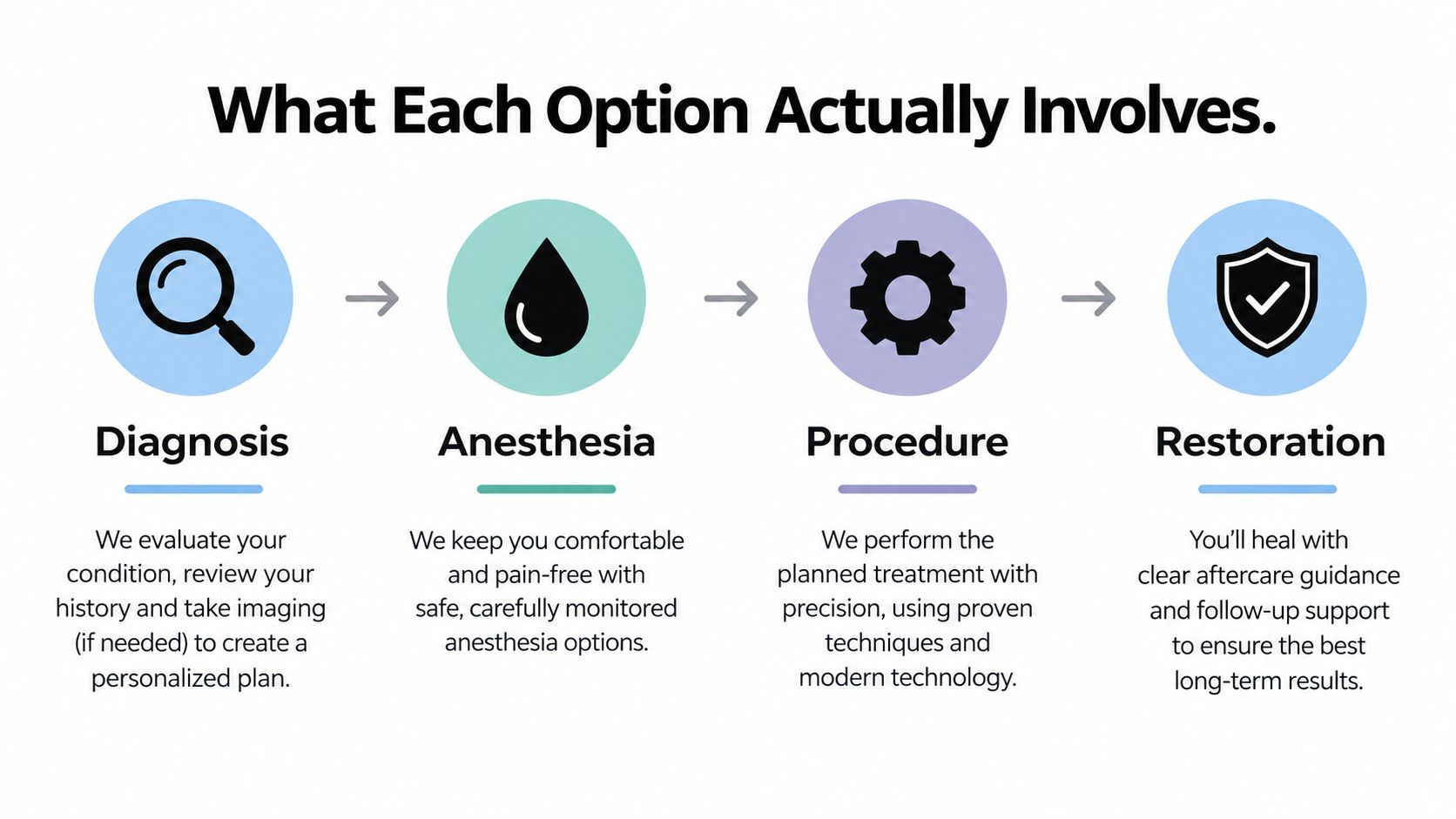
What Each Option Actually Involves
Root canal therapy treats the inside of a tooth while keeping the tooth in your mouth. Extraction removes the tooth from its socket. Both are routine outpatient procedures when properly planned, even when the pain that brings you in feels urgent.
Root canal therapy in plain language
Your dentist begins with an examination, pulp testing, and a periapical X-ray. These checks help identify whether the nerve tissue is inflamed or infected and whether the surrounding bone shows signs of a problem.
After local anesthesia, a rubber dam isolates the tooth. The dentist creates a small opening through the crown, removes the infected or damaged pulp, and cleans the canals. Sodium hypochlorite helps disinfect the canal system, and the cleaned space is shaped and sealed with gutta-percha.
A typical visit may take 60 to 90 minutes, depending on the tooth and its anatomy. Many general dentists perform root canals, while complex molars may need referral to an endodontic specialist. The tooth commonly needs a core build-up and a protective crown during a follow-up visit because the remaining structure may be vulnerable to fracture.
For a patient-friendly explanation of the treatment, see The Dental Retreat's root canal procedure guide. If you're trying to manage nerve-related discomfort before your appointment, DentalHealth.com's nerve pain solutions offers general information, but severe pain, swelling, or fever still calls for professional evaluation.
What extraction involves
For an extraction, the dentist numbs the area and gently loosens the tooth with elevators before removing it with forceps. A surgical extraction may be necessary when the tooth is badly broken, difficult to access, or unable to come out in one piece. The socket is irrigated, and gauze pressure helps control bleeding.
Afterward, protect the blood clot. Don't smoke, use straws, or disturb the area. Increasing pain around the third day, an unpleasant taste, or pain that radiates from the socket can signal dry socket and should prompt a call to your dentist.
A socket preservation graft may be discussed when future dental implants are possible. This helps maintain the extraction site while you decide whether and when to replace the missing tooth.
The procedures differ, but the decision should never be made from fear alone. The right choice depends on whether the tooth can be sealed, restored, and maintained.
Side-by-Side Comparison of Root Canal and Extraction
The most useful comparison focuses on what happens before, during, and after treatment. The table below summarizes common planning considerations, but your tooth's condition can change the recommendation.
Root Canal vs Extraction at a Glance
| Criterion | Root Canal Therapy | Extraction |
|---|---|---|
| Number of appointments | Often 1 to 2, including restoration | Usually 1 for removal, with later visits if replacement is planned |
| Chair time per visit | Often about 60 to 90 minutes, depending on complexity | Varies with a simple or surgical extraction |
| Pain during procedure | Comparable with modern local anesthesia | Comparable with modern local anesthesia |
| Post-operative discomfort | Often about 1 to 3 days | Often about 2 to 5 days |
| Eating and work | Many patients resume normal activities as comfort allows | Soft foods are usually needed initially, with activity adjusted during healing |
| Exercise | Resume when discomfort and bleeding are controlled | Delay strenuous activity as directed, especially after surgical removal |
| Functional lifespan | A crowned tooth can function for 10 or more years when the case and restoration remain stable | An implant or bridge may provide long-term replacement, but requires additional planning |
| Effect on adjacent teeth | Doesn't require reshaping neighboring teeth | A bridge may require preparation of neighboring teeth |
| Jawbone preservation | Maintains the tooth and its supporting area | Bone can be lost after extraction without appropriate preservation and replacement |
| Reversibility | The natural tooth remains, though retreatment may be needed | Removal is permanent, and replacement becomes a separate decision |
Extraction is usually faster and may cost less at the beginning. It also starts a chain of decisions about the socket, the bite, bone preservation, and whether to pursue dental implants near me or another replacement.
Root canal therapy protects the natural tooth and avoids immediate replacement surgery, but it only makes sense when enough strong tooth structure remains. A definitive crown is often part of the plan, not an optional cosmetic add-on. The long-term financial tradeoff deserves its own look.
The Real Cost Picture in 2026
The cheapest first step isn't always the least expensive treatment path. A 2023 cost-effectiveness study reported a mean direct cost of $280.1 for extraction compared with $699.1 for root canal treatment. When the extracted tooth was replaced, the mean cost increased to $1,245.5, while the study found no significant difference in QALYs. See the full 2023 cost-effectiveness study on extraction and root canal treatment for the published analysis.
Cost Breakdown for Root Canal vs Extraction With Replacement
| Treatment Component | Root Canal Path | Extraction + Implant Path |
|---|---|---|
| Diagnosis and imaging | Examination, pulp testing, and X-rays as indicated | Examination, imaging, and replacement planning |
| Immediate treatment | Root canal therapy | Tooth extraction |
| Restoration | Core build-up and protective crown | Implant planning, possible grafting, implant, abutment, and crown |
| Main financial advantage | Preserves the natural tooth and avoids immediate replacement | Removes a tooth that cannot be predictably restored |
| Main financial risk | A compromised tooth may later need retreatment or extraction | Multiple stages can make the total cost substantially higher |
Insurance can make the timing more complicated. Dental plans often apply annual maximums, deductibles, waiting periods, and separate coverage rules to endodontic treatment, crowns, extractions, grafting, and implants. Ask for an itemized estimate before treatment, and confirm benefits directly with your plan.
Three practical financial paths
Save and restore means paying for root canal therapy and the final restoration. This path often carries the higher initial treatment fee, but it retains the natural tooth and avoids immediate replacement costs.
Extract and replace begins with removal and continues through replacement planning. The total may include socket preservation, an implant, an abutment, and a crown. It can be the appropriate investment when the tooth has a poor prognosis.
Extract and leave the gap may appear financially simple, but it can change chewing and the relationship between neighboring teeth. Whether that is acceptable depends on the tooth, your bite, and your overall dental health.
A systematic review found root canal therapy followed by restoration had survival rates of 94% at 2 to 4 years, 94% at 4 to 6 years, and 97% beyond 6 years, with implant-supported single crowns showing similar survival. The findings are detailed in this systematic review of tooth and implant-supported restorations. The right financial question is not “Which procedure costs less today?” It's “Which plan gives this particular tooth a stable future?”
Why Two Honest Dentists Can Recommend Different Treatments
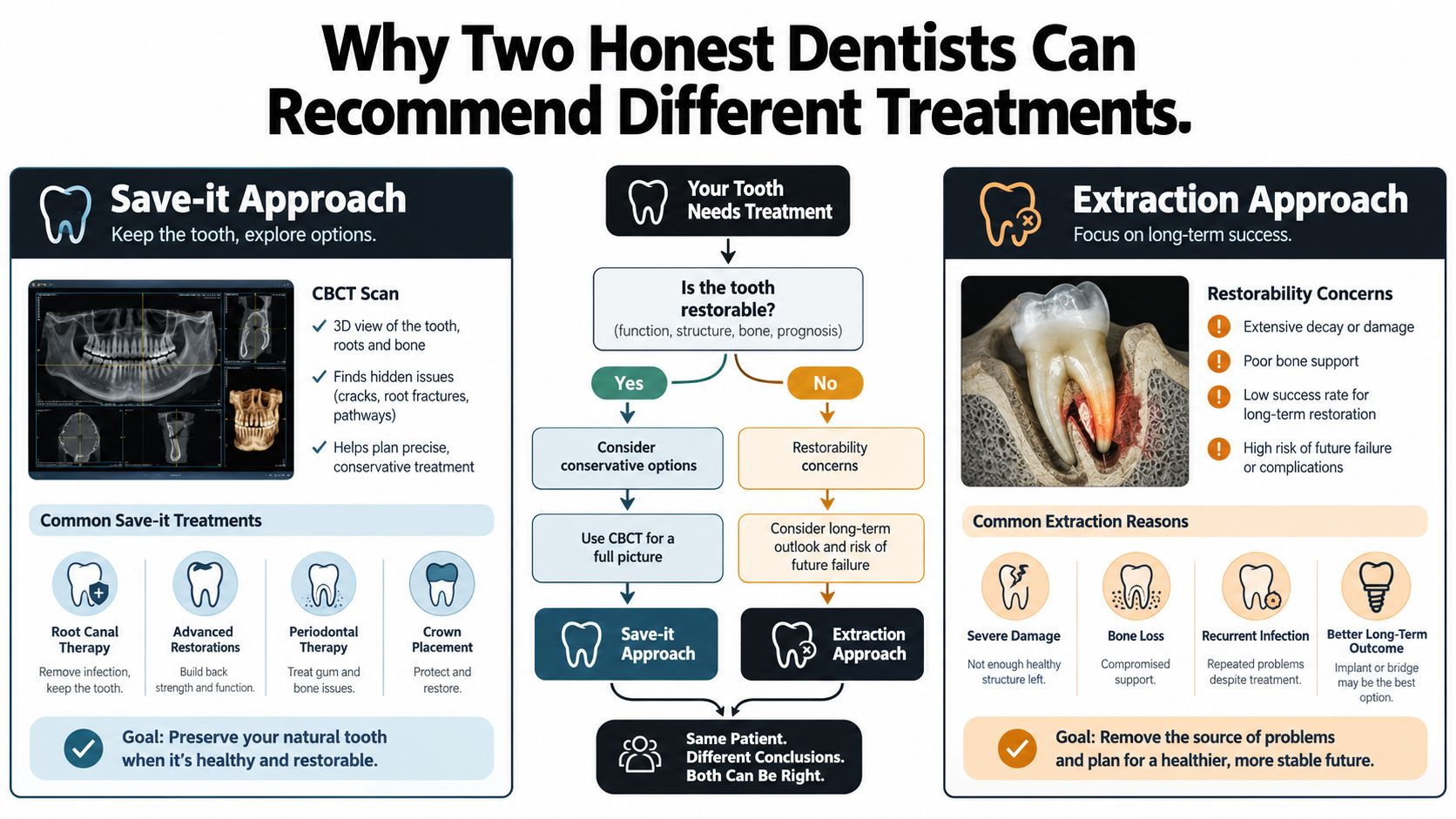
Two dentists can examine the same tooth and reach different recommendations without either one being careless. Borderline cases depend on what the clinician can see, whether the tooth can be isolated and sealed, and whether the remaining structure can support a crown.
A two-dimensional X-ray may not show the full picture. A CBCT scan can clarify complicated root anatomy, external root resorption, bone changes, or a fracture pattern. Recent clinical reviews describe how CBCT findings can shift treatment planning toward more invasive choices in complex endodontic cases, including extraction. The scoping review and prognostic decision tool on preserving or extracting teeth also emphasizes that restorability and multispecialty findings shape the prognosis.
Findings that can change the recommendation
A tooth may lean toward extraction when the examination reveals:
- A vertical root fracture
- A crack extending below the gumline
- Severe periodontal involvement
- Too little sound tooth structure to support a crown
- A post and core that can't be removed or retreated safely
- Root anatomy or resorption that makes cleaning and sealing unpredictable
The clinician also considers the crown-to-root relationship, the quality of the supporting bone, the tooth's position, and whether a predictable restoration is possible. A tooth that looks acceptable on a basic X-ray may become a poor candidate after magnification, periodontal probing, or three-dimensional imaging.
A 2019 systematic review and meta-analysis concluded that both endodontic treatment and extraction followed by implant placement can be viable and predictable. When failures were treated as failures rather than grouped with survivors, endodontic therapy performed moderately better overall, leading the authors to recommend root-preserving treatment first when feasible. You can review the PubMed analysis of endodontic therapy compared with implant treatment.
A second opinion is sensible when the tooth sits near the line between restorable and non-restorable. It isn't an accusation, and it doesn't obligate you to proceed with either plan.
Which Option Fits Your Situation Best
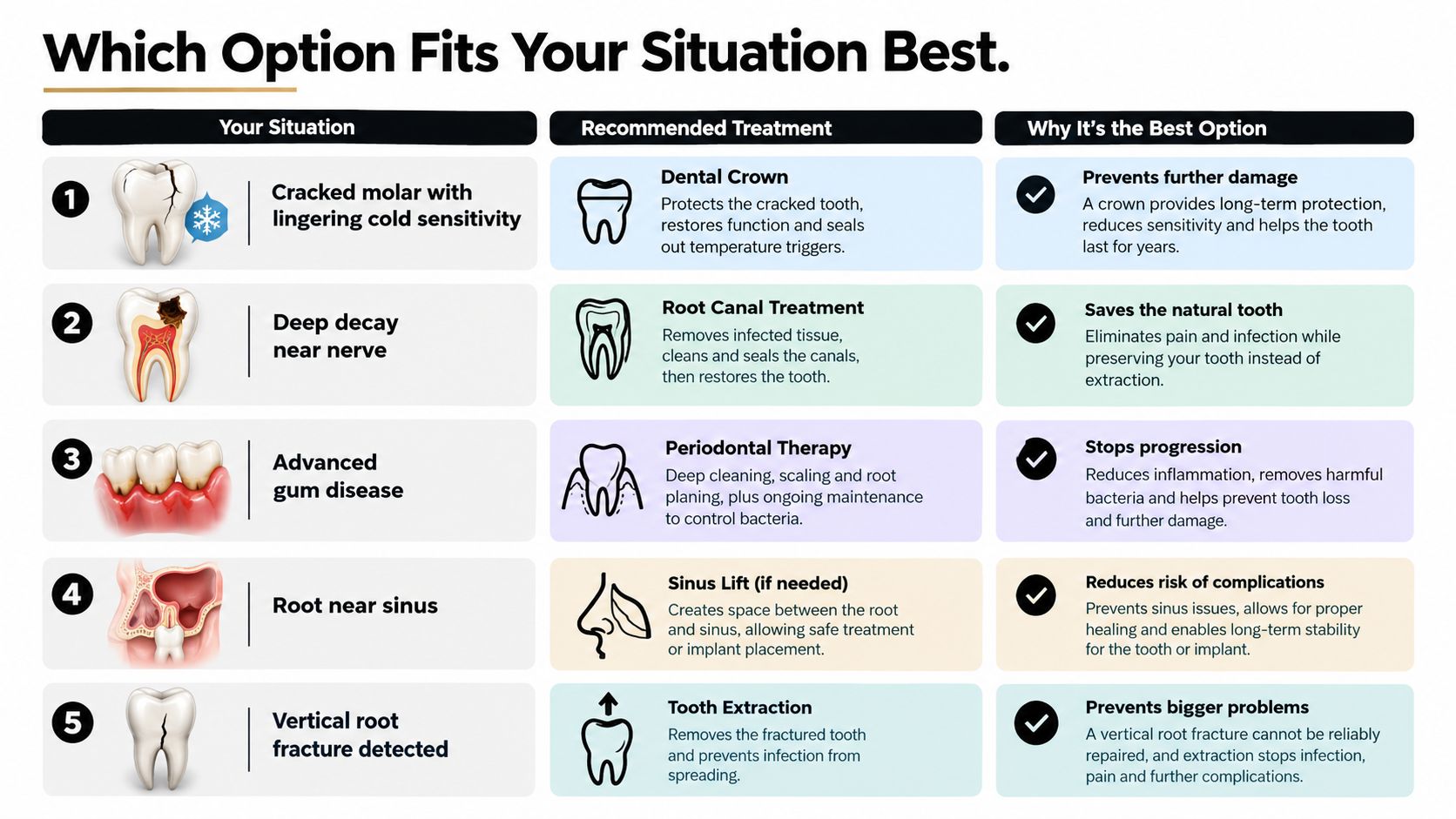
Your symptoms provide clues, but the diagnosis decides. These common situations show how the recommendation changes based on restorability, fracture risk, and the role of the tooth in your bite.
A cracked molar with lingering cold sensitivity
A molar that hurts after cold exposure may have inflamed pulp beneath a crack or deep filling. If the crack hasn't reached the root and the dentist can seal the tooth, root canal therapy followed by a full-coverage crown is usually the stronger choice. The crown protects the remaining structure while the root canal addresses the damaged pulp.
If the crack extends below the gumline or splits the root, a crown can't reliably hold the tooth together. Extraction becomes more predictable, followed by a discussion of an implant or another replacement.
Deep decay reaching the pulp in a younger patient
When decay reaches the pulp, the tooth may need vital pulp therapy or root canal treatment. Preserving the tooth can support jawbone development and maintain the natural bite, so removal should not be the automatic answer when the tooth is restorable.
The dentist will assess how much healthy structure remains and whether the tooth can receive a durable restoration. A young patient may also need a long-term plan that protects the tooth as the mouth changes.
A previously root-canaled tooth with persistent infection
Persistent infection after a root canal doesn't always mean the tooth must come out. Retreatment or an apicoectomy may be possible when the tooth remains structurally sound and the source of infection can be addressed.
Extraction plus an implant may be more predictable when the tooth has a fracture, severe structural loss, or a problem that can't be reached safely. The decision should account for both the endodontic prognosis and the restorative plan. Patients preparing for removal can review what to expect before a tooth extraction.
Multiple compromised teeth and a limited budget
When several teeth need treatment, preserving every tooth immediately may not be financially realistic. A phased plan can prioritize pain relief and infection control, then address restorations over time. In some cases, extraction followed by a partial denture offers a practical way to restore function while the patient plans future care.
That decision should still include the consequences of leaving spaces and the possibility of later replacement. A low initial fee shouldn't hide the need for a long-term plan.
A wisdom tooth or terminal molar
A wisdom tooth that has no useful role, or a terminal molar with a poor strategic value, often points toward extraction. Saving a tooth only makes sense when the treatment improves your overall function and health.
The best tooth to save is one that can be restored, maintained, and used. A tooth that can't meet those conditions may be better removed.
Your Next Step at The Dental Retreat in Katy
A consultation should give you more than a quick recommendation. At The Dental Retreat in Katy, the visit begins with a welcoming conversation, a review of your medical history, and a focused examination of the painful tooth. The clinical team may check your bite, test the tooth with percussion, evaluate the gums, and use dental X-rays or CBCT imaging when the case calls for a closer view.
Dr. Pham or Dr. Nguyen can review the findings chairside with intraoral images and the three-dimensional scan when available. The important question is whether the tooth is restorable, not whether a root canal can technically be performed.
What you should leave knowing
You should receive a clear explanation of:
- Whether the tooth can support a definitive restoration
- What root canal therapy and extraction would involve
- Whether a crown, graft, bridge, or implant would follow
- How urgent the infection or structural damage appears
- What each path is expected to cost, itemized before treatment
- Whether a second opinion would be useful
The practice offers same-week root canal availability and emergency appointments for acute pain. Patients comparing replacement options can also ask about CareCredit and Sunbit financing, especially when an implant plan includes several stages.
The Dental Retreat serves patients seeking a dentist near me in Katy, TX, including families from Sunterra, Cane Island, Katy Manor, Kingscrossing, Lakehouse, Marisol, The Grange, Anniston, Katy Lakes, Elyson, and Ventanna Lakes. Its services also include dental implants, restorative dentistry, cosmetic dentistry, clear aligners, sedation, and emergency dental services, so your consultation can address the wider treatment plan rather than only the painful tooth.
You don't have to decide in the chair. Ask for the diagnosis, the prognosis, the alternatives, and the itemized costs. A calm, well-explained plan is more useful than a rushed answer based only on today's pain.
The Dental Retreat provides root canal evaluations, tooth extraction, restorative treatment, and dental implant planning for patients in Katy, TX. Schedule a consultation online with The Dental Retreat or call (281) 394-9969 to discuss your tooth, review both treatment paths, and receive a written plan with no obligation to proceed that day.