You may be searching for a dentist near me in Katy, TX after years of covering your smile, avoiding photos, or worrying that a discolored, chipped, cracked, or weakened tooth will get worse. The choice between dental veneers vs crowns can feel confusing, especially when both treatments can create a natural-looking smile.
The right restoration isn't the one that looks beautiful today. It should match the condition of the tooth, your bite, your comfort, and the amount of healthy structure that needs to remain protected. For patients in Katy, Sunterra, Cane Island, Katy Manor, and nearby communities, The Dental Retreat provides cosmetic and restorative consultations in a calm, spa-inspired setting where questions are welcome and treatment planning is judgment-free.
Finding the Right Smile Restoration in Katy TX
A patient may walk into a consultation with one concern, such as a dark front tooth, and discover that the tooth has a large old filling or a crack that changes the recommendation. Another patient may have healthy enamel but dislike uneven edges, stubborn discoloration, or small spaces between front teeth. Both patients want a confident smile, but they don't need the same restoration.
That distinction matters. Veneers are generally designed for cosmetic changes on teeth that still have adequate healthy structure, while crowns are intended to cover and protect a tooth that has lost meaningful strength. A veneer may be the more conservative answer for a sound front tooth. A crown may be the more responsible choice when reinforcement is the priority.
The emotional side of treatment matters, too. Many anxious patients delay care because they expect judgment, discomfort, or pressure to choose a more extensive procedure. A comfort-first appointment should give you time to discuss your goals, see the condition of the tooth, and understand why a particular option may be safer for the long term.
Beauty and health need to work together
Cosmetic dentistry can improve the color, shape, and balance of a smile, but appearance shouldn't be separated from oral health. A tooth with untreated decay, gum inflammation, an unstable bite, or inadequate enamel may need foundational care before cosmetic treatment is considered. Cleaning and exams, dental X-rays, and a new patient exam can help identify concerns that aren't visible in a photograph.
A practical rule: The most attractive restoration is one that remains comfortable, cleans well, and protects the tooth underneath it.
Residents of Katy Manor and Kingscrossing may be looking for a cosmetic dentist near me, while someone with sudden pain may need an emergency dentist instead. Tooth extraction, restorative dentistry, dental implants, and other services can become part of a broader plan when a tooth can't be predictably restored. The first step isn't choosing between two products. It's finding out what the tooth can safely support.
The Core Differences Between Veneers and Crowns
A porcelain veneer is a thin restoration bonded to the visible front surface of a tooth. It can alter apparent color, contour, length, or symmetry while preserving more natural tooth structure than full coverage. The Cleveland Clinic describes veneers as coverings for the front surface, whereas crowns cover the entire tooth and may be used after significant decay or trauma. Learn more about how veneers differ from crowns.
A dental crown surrounds the tooth. It restores the visible coronal structure and is shaped to support chewing, contacts with neighboring teeth, and protection against functional forces. Crowns may suit teeth with substantial structural loss, large fillings, fractures, or previous root canal treatment.
Veneers vs crowns at a glance
| Feature | Porcelain Veneers | Dental Crowns |
|---|---|---|
| Coverage area | Front, facial surface of the tooth | Entire tooth structure |
| Primary purpose | Cosmetic improvement of an adequately sound tooth | Structural protection, rebuilding, and function |
| Preparation | Conservative facial-surface preparation | Circumferential reduction for full-coronal coverage |
| Typical concern addressed | Discoloration, small chips, shape, or minor spacing | Cracks, extensive damage, large fillings, or weakened teeth |
| Main biological trade-off | Preserves more tooth structure | Removes more structure but provides more coverage |
| Best decision question | Can the tooth support a bonded cosmetic shell? | Does the tooth need full protection and reinforcement? |
The difference isn't just cosmetic
A veneer works as a carefully bonded facial shell. A crown works as a protective cap around the tooth. Each design addresses a different clinical problem, so the better choice depends on how much healthy structure remains and how the tooth functions under the patient's bite.
The long-term question is whether the restoration preserves a dependable future for the tooth. A veneer may be the better fit when the tooth is adequately sound and the concern is limited to appearance. A crown may be more appropriate when the tooth needs coverage that can help contain weakness and restore function. Modern digital dentistry can support precise planning and the selection of contemporary restorative materials, but technology does not make an unsuitable design predictable.
Veneers developed as a conservative approach for improving the appearance of otherwise intact teeth, with adhesive techniques later supporting their broader cosmetic use. Review the history and clinical role of dental veneers).
A crown can look highly natural when its material and shade are selected carefully. Placing one on a healthy tooth solely to change appearance may remove more structure than necessary. Conversely, placing a veneer on a tooth that needs bracing can leave the underlying weakness inadequately protected. The safest decision balances appearance, remaining tooth structure, bite forces, and how the restoration can serve the tooth over time.
Clinical Indications and Tooth Structure Preservation
The most useful question for a borderline tooth is not, “Which option is stronger?” It's, “Which restoration gives this particular tooth a predictable future?” A tooth with intact enamel and a cosmetic flaw may benefit from minimal preparation and strong enamel bonding. A tooth with a crack, a large filling, severe wear, or previous root canal work may need coverage that extends around the tooth.
Porcelain veneers are typically prepared on the facial surface, with a preparation depth of about 0.3 to 0.5 mm when the clinical goal is to preserve an all-enamel bonding surface. Read the clinical discussion of veneer and crown preparation. Other references describe veneer preparation as about 0.3 to 0.7 mm of enamel, or roughly 1 mm of tooth material, while crowns generally require about 1.5 to 2 mm of reduction around the tooth. Review the preparation differences between veneers and crowns.

When preserving enamel is the priority
Enamel is valuable because it offers a strong, stable surface for adhesive bonding. A veneer may make sense when the tooth is front-facing, the concern is mainly visual, and enough enamel remains to support the restoration. Common examples include persistent discoloration, a small chip, an uneven edge, or a shape concern that doesn't reflect major structural damage.
That conservative approach has limits. A veneer doesn't replace missing walls around a heavily restored tooth, and it isn't a substitute for treating decay or stabilizing a serious crack. Bite forces also matter. Clenching, grinding, or an edge-to-edge bite can create conditions in which a thin, facial restoration is asked to do more than it was designed to do.
When full coverage protects the future
Crowns require more reduction because they must fit over the tooth. That biological cost can be justified when the remaining structure needs reinforcement. A tooth with extensive decay, a deep fracture, a large filling, substantial wear, or a history of root canal treatment may be at greater risk if only its front surface is covered.
Full coverage doesn't guarantee that every tooth will last indefinitely. It does provide a broader framework for restoring shape and resisting functional forces. A clinical evaluation should include the remaining walls, enamel thickness, gum health, bite, symptoms, and any evidence of cracks. Dental X-rays may be useful when the concern involves the root, bone, a previous root canal, or hidden decay.
The England population survey cited in this summary of dental restoration data found that crowns were more common than veneers or shims. That pattern reflects their broader restorative role, not a universal recommendation. The decision still belongs to the individual tooth in front of you.
Durability, Materials, and Long-Term Performance
A borderline tooth may look suitable for either a veneer or crown today, yet the better long-term choice depends on how much structure will remain protected after treatment. Material, thickness, design, bonding, bite forces, hygiene, and the condition of the tooth all influence performance. Even advanced ceramic cannot make up for an unsuitable indication, untreated grinding, poor plaque control, or ongoing inflammation.
Longevity varies by case, restoration design, bite, and maintenance. Veneers can provide many years of service when bonded to suitable tooth structure and maintained carefully, but they may require repair or replacement if they fracture, debond, or develop wear. Patients comparing options can review this practical guide to how long veneers can last and use it as a starting point for questions about future maintenance.
Clinical evidence shows that crown design affects the way failures occur. A systematic review reported an annual ceramic chipping rate of 1.65% for veneered single crowns, compared with 0.39% for monolithic crowns, while the overall 3-year survival rate was 97.6%. A narrative review of veneers reported survival rates above 90% beyond 10 years, with fracture identified as the main failure mode. These figures describe study groups, not an individual patient's forecast. Review the clinical durability findings for veneered crowns and veneers.
What modern materials change
Monolithic restorations use one primary ceramic structure instead of a strong underlying core covered by a separate veneering ceramic. Removing that veneering interface may reduce one location where chipping can begin. Lithium-disilicate and dense zirconia are modern material categories that may be considered according to the tooth's position, cosmetic demands, available clearance, bite, and remaining support.
A 2026 systematic review reported 5-year survival around 98.5% for monolithic lithium-disilicate restorations and 96.8% for monolithic dense zirconia, with lower survival for some veneered and feldspathic options. Those findings apply to specific restoration groups and do not guarantee the same result for every crown or veneer. Review the 2026 evidence on ceramic restoration survival.
Digital dentistry isn't a universal tie-breaker
CAD/CAM planning, digital scans, and milled restorations can improve customization and laboratory communication. Additive manufacturing is expanding, but current evidence maps describe clinical readiness for 3D-printed crowns, veneers, and partial-coverage restorations as preliminary. Research also indicates that milled zirconia can show greater fracture resistance than 3D-printed versions, while veneers remain more vulnerable to fracture because they are thinner and cover less of the tooth. Explore the evidence map for digitally manufactured restorations.
The most future-proof restoration is not automatically the newest material. It is the design that preserves appropriate tooth structure while matching the tooth's indication, bite, appearance goals, and available support. That balance matters most when a tooth sits between cosmetic and restorative treatment.
The Placement Journey and Recovery Timeline
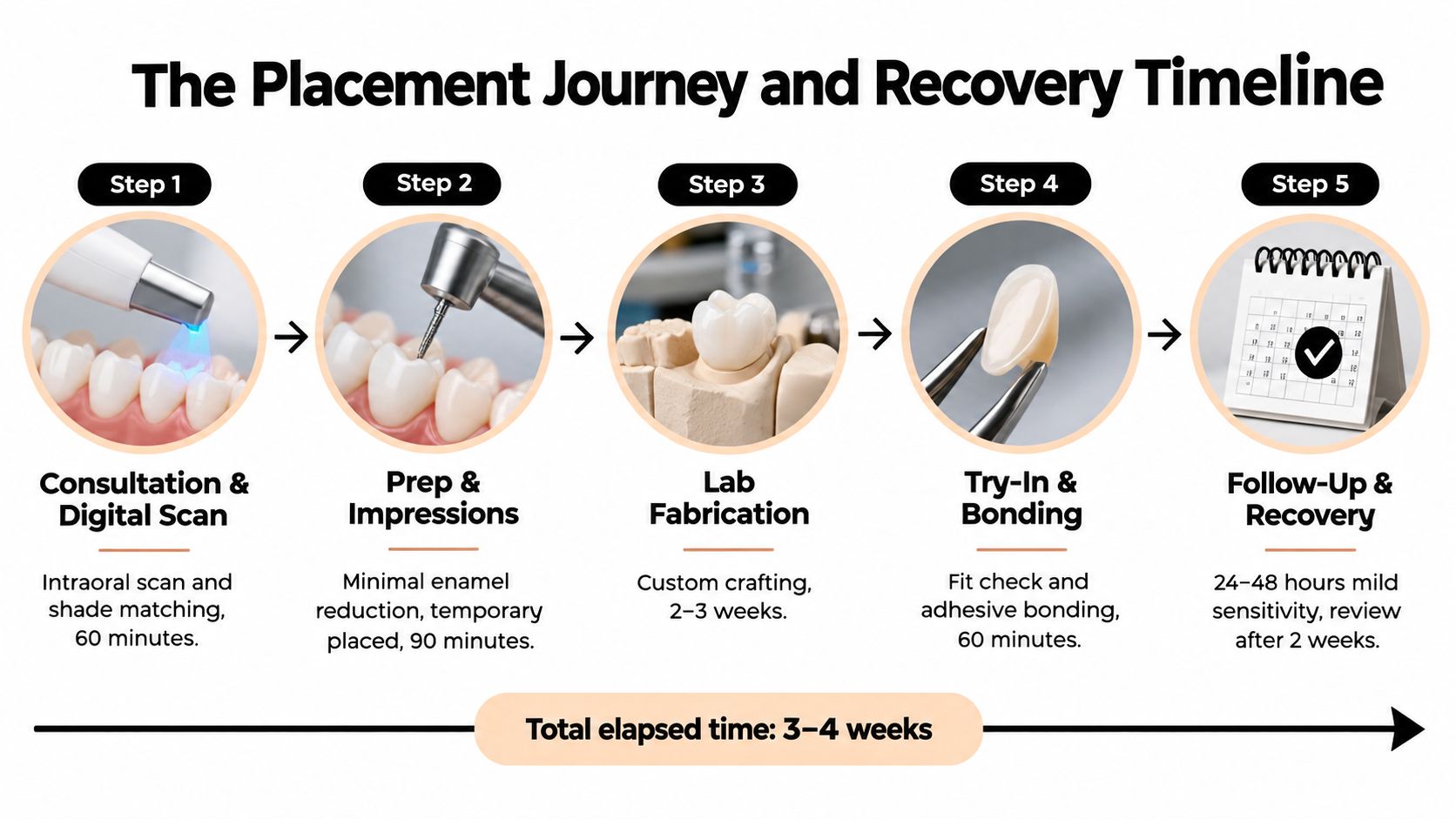
A well-planned restoration appointment should feel orderly rather than mysterious. The process begins with an examination of the tooth and surrounding tissues, then moves through design, preparation, try-in, and final placement. The exact sequence depends on whether you need a veneer, a traditional crown, or another restorative option.
Consultation and preparation
During the first visit, the dentist evaluates the tooth, bite, gums, enamel, existing fillings, and cosmetic goals. Digital scanning and shade matching may help document the starting point and communicate the intended result. If a tooth has symptoms, the dentist may recommend additional testing or X-rays before selecting a restoration.
Preparation removes the amount of structure required for the chosen design. Veneer preparation is typically limited to the facial surface, while crown preparation creates space around the tooth for full coverage. A temporary restoration may be placed when the prepared tooth needs protection while the final restoration is fabricated.
Patients from Elyson and Katy Lakes often ask whether the procedure will hurt. Local anesthetic is used when preparation requires it, and sensitivity can occur afterward, particularly when the tooth has been prepared. The office also offers comfort measures such as noise-cancelling headphones, heated massage chairs, and sedation options for appropriate patients who feel anxious about dental care.
Try-in, bonding, and settling in
At the placement appointment, the restoration is checked for fit, contacts, shape, shade, and bite. A veneer is bonded to the prepared facial surface, while a crown is cemented or adhesively secured over the prepared tooth according to the clinical design and material.
You may notice mild sensitivity or an unfamiliar feeling after treatment. Avoid testing the restoration with hard objects or using the treated tooth to bite unusually hard foods while you adjust. Continue careful brushing and flossing, and contact the office if your bite feels high, pain increases, or the restoration feels loose.
For patients who receive a temporary crown, temporary crown care instructions can help protect the interim restoration until the final appointment.
A short video can also make the process easier to visualize:
Pricing, Insurance, and Local Financing Options
The cost of veneers or crowns depends on the number of teeth involved, the material selected, the laboratory or digital workflow, the preparation required, and whether other treatment must come first. A single veneer on a healthy front tooth is a different clinical project from several restorations on teeth with old fillings, gum concerns, or bite problems.
Insurance usually treats primarily cosmetic changes differently from treatment that restores damaged structure. Veneers may receive limited or no coverage when the purpose is aesthetic enhancement. A crown may be considered for coverage when it is needed to restore function or protect a compromised tooth, but eligibility, deductibles, exclusions, waiting periods, and annual limits vary by plan. The dental office can help you understand what your plan may contribute, but the insurer makes the final determination.
Plan the complete treatment, not just the visible procedure
A responsible estimate should separate the restoration itself from examinations, diagnostic images, decay removal, periodontal care, root canal treatment, temporary restorations, and follow-up visits. Asking for the total recommended plan helps prevent an attractive initial estimate from becoming an unexpected expense later.
Patients in Katy Manor and Kingscrossing who don't have insurance can ask about new-patient specials and membership options. The Dental Retreat offers a new patient exam option that includes cleaning and X-rays, a problem-focused visit option, and an annual membership plan with savings for preventive and periodontal maintenance. Availability and terms can change, so confirm current details directly with the practice.
Financing should support good decisions
Financing can make planned care easier to manage, but it shouldn't be used to justify a restoration that isn't clinically appropriate. Ask which treatment is urgent, which care can be staged, and whether stabilizing the tooth first will affect the final cosmetic plan. A written plan should explain the recommended restoration, alternatives, expected maintenance, and financial terms before treatment begins.
If pain, swelling, a broken tooth, or trauma is involved, don't postpone evaluation while comparing prices online. An emergency dentist can first determine whether the tooth needs urgent stabilization, endodontic care, tooth extraction, or another intervention. Dental implants may be discussed later if a tooth can't be saved, but they aren't a substitute for evaluating a restorable tooth promptly.
Choosing the Right Option with The Dental Retreat
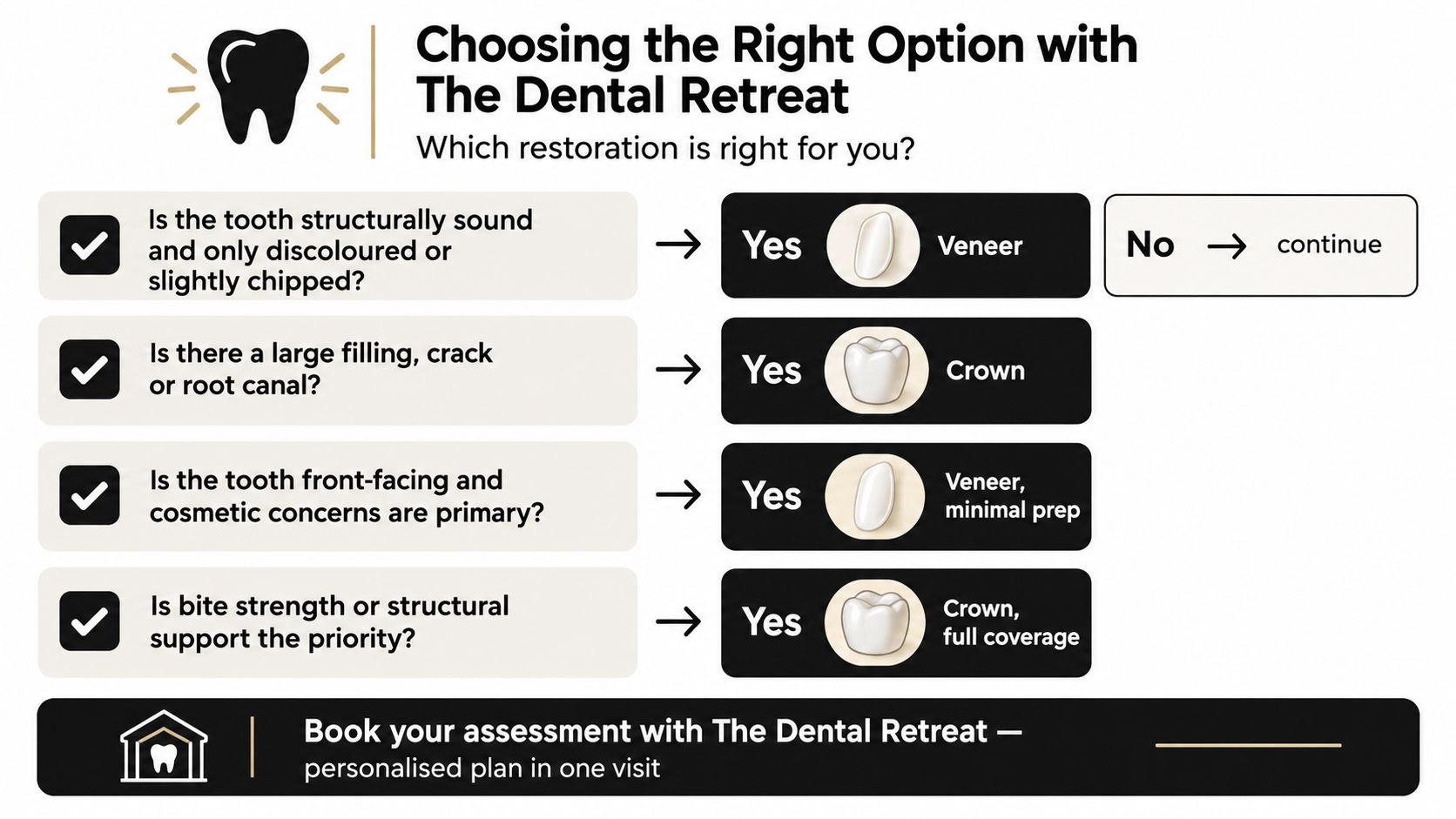
A simple decision framework can help you prepare for a consultation, but it can't replace an examination.
Start with the tooth's condition
If the tooth is structurally sound and your main concerns are discoloration, shape, a small chip, or minor spacing, a veneer may be worth discussing. The dentist will still need to assess enamel, gum health, bite pressure, and habits such as clenching before recommending it.
If the tooth has a large filling, crack, root canal history, extensive wear, or substantial missing structure, a crown may provide the coverage needed to protect it. A front tooth can need a crown just as a back tooth can, and a front tooth isn't automatically a veneer candidate because it shows when you smile.
Ask this at your consultation: “Which option preserves the most healthy tooth while giving this tooth the protection it needs?”
Then consider your wider dental plan
A smile makeover may involve more than one service. Teeth whitening can address surrounding natural teeth, while clear aligners may improve tooth position before cosmetic restorations are designed. Gum treatment may be necessary for stable margins and healthy tissue. If a tooth can't be restored, tooth extraction and dental implants may become part of a replacement plan rather than a veneer-versus-crown decision.
The Dental Retreat serves patients seeking general, cosmetic, restorative, implant, orthodontic, periodontal, endodontic, oral surgery, sedation, and emergency dental services in Katy. Its team uses a personalized planning process and a calm environment with amenities intended to make appointments more comfortable. Patients from Marisol, The Grange, Ventanna Lakes, Anniston, Lakehouse, Katy Lakes, and nearby Katy communities can request an assessment that considers both appearance and long-term function.
Make the decision with evidence from your own mouth
Bring questions about preparation, material, bite protection, maintenance, repair, replacement, and insurance. Ask whether the tooth can safely receive a veneer, what would make a crown more predictable, and how the proposed restoration fits your broader dental care.
Schedule a consultation before choosing a treatment based only on photographs or online comparisons. The right answer may be a veneer, a crown, a different partial-coverage restoration, or preliminary care that makes a later cosmetic result safer.
If you're comparing dental veneers vs crowns in Katy, The Dental Retreat can evaluate your tooth structure, bite, gum health, and smile goals before recommending a personalized plan. Visit The Dental Retreat to request a consultation and take the next step toward comfortable, lasting dental care.