You're sitting in traffic near Katy, TX, mentally comparing another year of crooked teeth with the thought of wearing metal brackets and wires. Maybe you want to feel more confident at work, smile comfortably in family photos, or help your teen straighten their teeth without making orthodontic care the center of every conversation. Clear aligners offer a discreet, removable alternative that can fit more naturally into daily life.
At The Dental Retreat, patients from Sunterra, Cane Island, Katy Manor, Kingscrossing, Lakehouse, Marisol, The Grange, Anniston, Katy Lakes, Elyson, and Ventanna Lakes can discuss clear aligner treatment in a calm, local setting. The right choice depends on your bite, gum health, tooth movement needs, and ability to wear the trays consistently. Clear aligners aren't automatically better for every case, but they can be a practical option for adults and teens who want a more flexible approach to orthodontic care.
Why Clear Aligners Are Transforming Smiles in Katy
Mia, a Katy resident, wanted straighter teeth but worried orthodontic treatment would affect ordinary moments. She pictured brackets catching food at lunch, skipping favorite snacks, and feeling uncomfortable while speaking with coworkers or smiling in family photos. Her hesitation is common among adults and teens who want orthodontic care without making a visible appliance part of every conversation.
Clear aligners offer another way to approach suitable cases. A series of custom, transparent trays fits over the teeth and applies gentle, planned pressure. Each tray provides a small nudge toward the next position, like following a route one turn at a time. Because the trays can be removed, patients can take them out for meals, brushing, flossing, and selected occasions. Progress still depends on wearing them consistently.

A discreet option for everyday routines
For someone balancing work, school, sports, and family life in Katy, a less noticeable treatment can feel easier to manage socially. The trays do not place brackets and wires at the center of your appearance, which may help adults feel more comfortable at work and teens feel less singled out at school.
Removability also gives patients more control over important moments. A presentation, family gathering, or team activity does not have to revolve around visible orthodontic hardware. The practical question is whether the patient can follow the wear schedule and care instructions reliably.
Practical rule: A discreet appliance works only when it is worn as directed.
At The Dental Retreat, adults and teens can discuss whether clear aligners suit their goals in a comfortable Katy setting. The decision should account for the bite, gum health, planned tooth movements, and the patient's daily habits. Aligners are not the right choice for every case, and fixed braces may provide better control for some movements.
The best result comes from matching the treatment to the person, not choosing an appliance based on appearance alone. A consultation can clarify what clear aligners can reasonably address and help you compare that option with traditional braces. The systematic review on periodontal outcomes provides clinical context for the periodontal findings associated with clear aligners and fixed appliances.
How Clear Aligner Treatment Works Step by Step
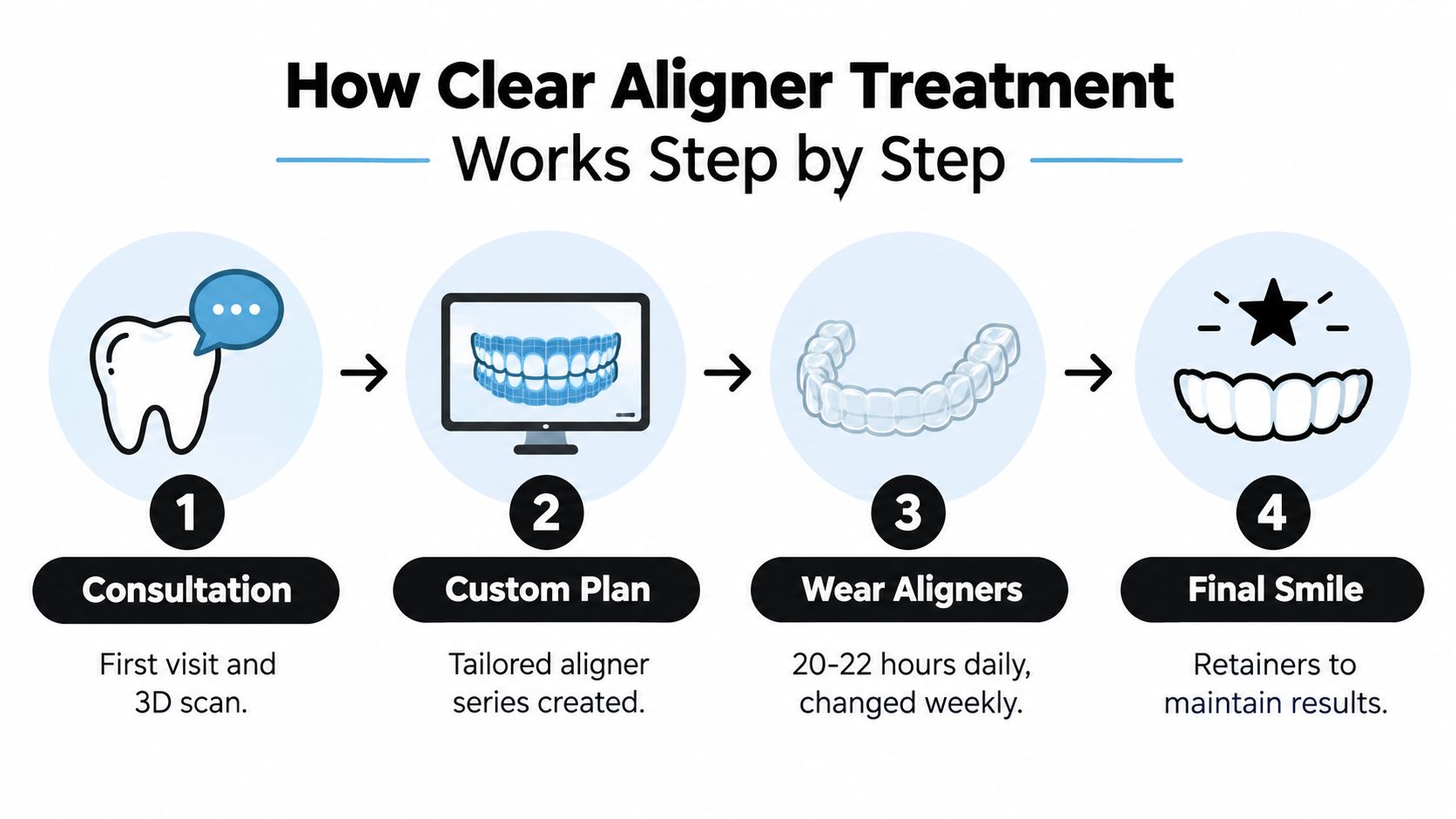
Treatment follows three clinical stages: examination and digital planning, staged tray wear, and retention. Each stage has a clear purpose, so you know what will happen before treatment begins.
First comes the examination and digital plan
Your visit starts with an assessment of your teeth, gums, bite, and smile goals. Digital scans create a three-dimensional record without the discomfort of traditional impression material. The dental team uses that record to design a custom sequence of trays for your teeth.
The plan covers more than appearance. Your provider checks how the upper and lower teeth meet, looks for gum inflammation or decay that may need attention, and considers whether the proposed movements are realistic. You can also ask about attachments, refinements, retainers, and what to do if a tray feels loose or uncomfortable.
At The Dental Retreat, adults and teens in Katy can review these details in a comfortable dental setting before deciding whether aligners fit their needs.
The trays guide movement in stages
Each aligner has a slightly different shape. Once it is seated, it applies gentle pressure to selected teeth. After the planned interval, you change to the next tray, continuing the sequence. Your provider sets the schedule, and trays may be changed weekly or according to your individual plan.
Mild pressure is common when you begin a new stage. Sharp pain, a damaged tray, or a major change in how your teeth meet should prompt a call to the practice. A tray that does not fit properly may need professional review rather than force.
Wear time protects the plan
Clear aligners are removable, but treatment depends on wearing them about 20 to 22 hours daily, as summarized in recent evidence on clear aligner adherence and quality of life. Remove them for meals and oral hygiene, then put them back in promptly. Long or repeated periods without the trays can slow progress and make the next aligner harder to seat.
After active tooth movement, retainers help hold the teeth in their new positions. Teeth may shift without continued retention, so follow the final instructions as carefully as you followed the first tray.
Clear Aligners vs Traditional Braces, What Is the Difference
The choice between clear aligners and traditional braces isn't a contest with one universal winner. It depends on your treatment needs, daily habits, comfort preferences, and how much control your case requires.
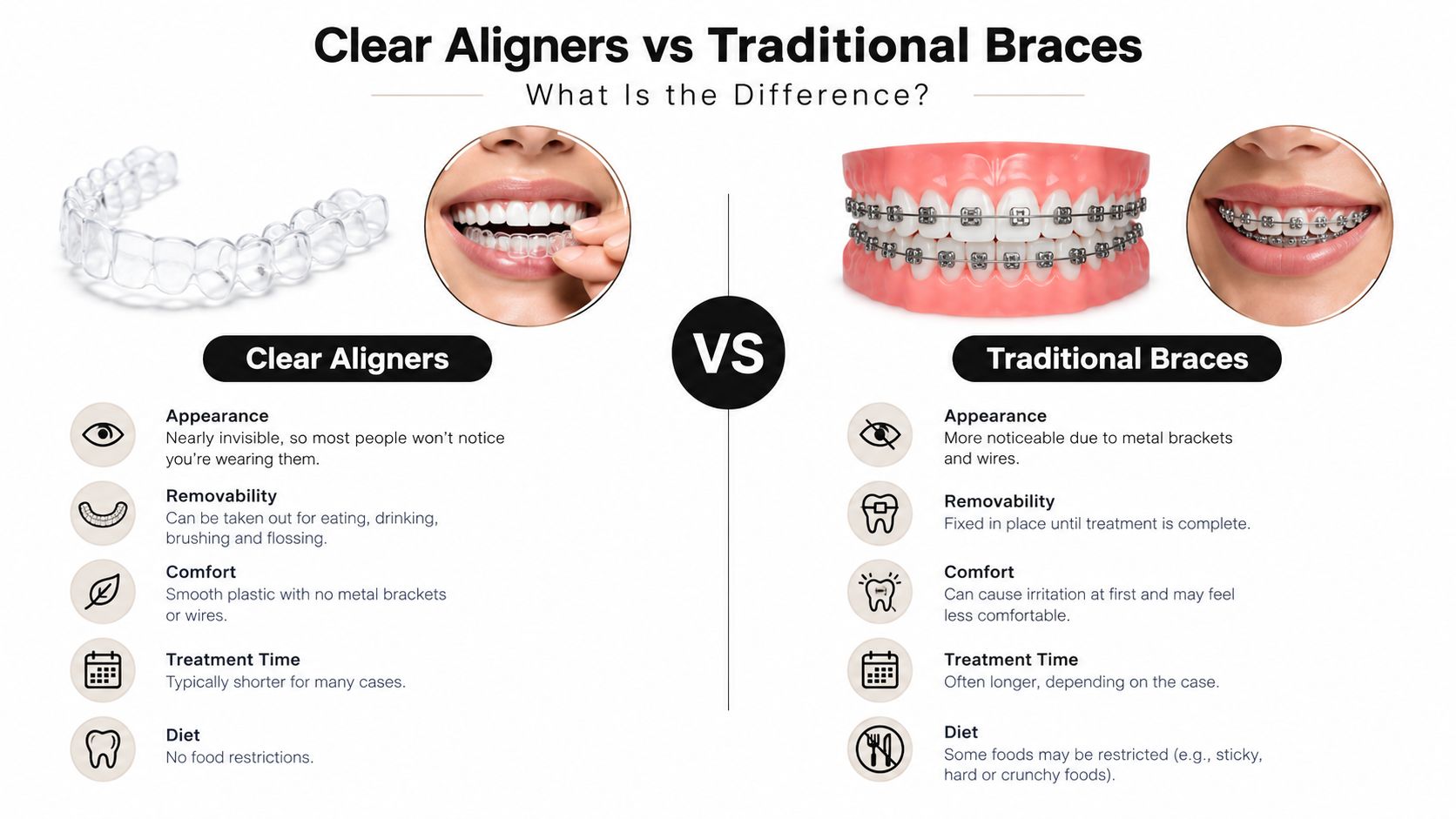
| Treatment factor | Clear aligners | Traditional braces |
|---|---|---|
| Appearance | Low visibility during normal conversation | Brackets and wires remain visible |
| Eating | Trays come out for meals | Food choices may require more care |
| Cleaning | Teeth are accessible after removing trays | Brackets and wires can make brushing more involved |
| Responsibility | You must remember to wear and clean the trays | The appliance stays attached |
| Complex movement | May need attachments or other support | Fixed hardware can offer strong control in selected cases |
Appearance and comfort
Clear aligners are appealing to patients who want orthodontic treatment to be less noticeable. Their smooth surface may also reduce the cheek and lip irritation some people associate with brackets and wires. That doesn't mean aligners feel completely invisible. You may notice pressure when changing trays, and speaking can feel different at first.
Comparative patient research reported higher satisfaction and lower discomfort for clear aligners in one study. The study recorded 85% satisfaction compared with 65% for braces, and discomfort scores of 2.3 out of 10 compared with 5.6 out of 10. The comparative patient-experience study also reported a 75% reduction in the PAR index after 12 months, with average treatment duration of 14.5 months for aligners versus 16.2 months for braces. Those findings describe that study, not a promise for every patient.
Hygiene and lifestyle
Removable trays make it easier to brush and floss normally, but they add a responsibility that braces don't. You must keep track of the aligners, clean them as directed, and put them back after eating. A patient who often forgets removable appliances may find fixed braces more dependable.
For mild to moderate non-extraction cases, a 2025 systematic review found no significant difference in treatment quality or duration in its main analysis between clear aligners and fixed braces, while sensitivity analyses suggested shorter treatment with aligners and limited evidence of similar stability after treatment. The European Journal of Orthodontics review supports a careful comparison rather than a blanket promise.
For a deeper patient-friendly comparison, see clear aligners versus traditional braces. A provider can then relate the general differences to your bite instead of asking you to choose from marketing claims alone.
Clinical and Lifestyle Benefits of Clear Aligners
A clear tray can make orthodontic treatment feel less disruptive, but its value is not limited to appearance. The appliance supports selected tooth movements, fits more easily into work and school routines, and can be removed when daily care requires access. Those advantages depend on suitable case planning and consistent use.
Oral hygiene can be easier to manage
As noted earlier, removing the trays for brushing and flossing gives you direct access to the tooth surfaces. The periodontal review cited earlier found lower plaque and gingival index measurements with aligners than with fixed appliances, although it cautioned that the probing-depth finding should be interpreted carefully. The periodontal evidence review also supports keeping expectations realistic.
The benefit is access, not automatic protection. Trays still need regular cleaning, and teeth still need routine brushing, examinations, and professional care. The adherence review cited earlier also makes the practical point that removable treatment works best when patients can maintain the prescribed daily routine. the adherence review
Modern planning can improve force control
Some tooth movements need more grip than a smooth tray can provide. Attachments are small, tooth-colored shapes bonded to selected teeth. They work like handles, giving the aligner a better surface for directing pressure and guiding movement.
A 2025 review explains that an attachment's shape, size, orientation, and position can change the force vector. In simple terms, these details influence where the tray pushes and how it controls the tooth. The review of clear aligner attachments shows why attachments should be planned for the specific movement rather than added as a standard feature in every case.
Some treatment plans also include elastics or mini-screws. These additions can provide anchorage or extra direction when a tooth or bite needs more control. They are tools for managing complexity, not evidence that clear aligners have stopped working.
The safety conversation needs nuance
Root resorption means shortening or loss of some root structure during tooth movement. Current comparisons generally suggest less external apical root resorption with aligners than with fixed braces, but the certainty of that evidence ranges from low to moderate. The size of any difference may be small for some teeth, and findings can change with the movement, tooth, and case being treated. The umbrella review and comparative evidence on root resorption does not support describing aligners as universally safer.
For a suitable patient, discreet trays and removable care may make treatment easier to live with in Katy. At The Dental Retreat, the useful question is how these benefits fit your teeth, schedule, and ability to follow the plan. If trays are left out regularly, their convenience can reduce the control the treatment needs.
Who Is a Good Candidate for Clear Aligners in Katy
Clear aligners often suit patients with mild to moderate crowding, spacing, and selected bite concerns. They can also help adults who want esthetic correction without committing to a visible fixed appliance. A dentist in Katy should evaluate your teeth and gums before treatment, because active decay, gum inflammation, or an unstable bite may need attention first.
Cases that may respond well
A good candidate usually understands the routine and can follow it consistently. You may be a reasonable candidate if you:
- Want discreet correction: You prefer a lower-visibility option for work, school, or social situations.
- Can follow the schedule: You're prepared to wear the trays for the prescribed daily period and return them after meals and brushing.
- Have manageable tooth movement needs: Your concern involves spacing, crowding, or selected bite changes that the planned system can control.
- Value hygiene access: You want to remove the appliance for brushing and flossing while continuing regular dental care.
Adult anterior open-bite treatment illustrates why professional planning matters. Recent evidence reports average overbite improvement of about 2.76 millimeters with clear aligners in adult cases, while selected patients may need attachments, elastics, or mini-screws for dependable vertical control. The evidence map on adult anterior open-bite treatment shows that aligners can provide measurable correction, but not through a one-size-fits-all approach.
When braces or added support may be wiser
Extraction-based treatment can expose the mechanical limits of aligners. A 2026 systematic review and meta-analysis found excessive mesial tipping of maxillary first molars by a mean difference of -6.08 degrees, under-retraction of -1.93 millimeters, and greater vertical displacement of maxillary incisors in extraction-based cases. The extraction-case analysis suggests that planned movements may not always match achieved movements.
That doesn't rule out clear aligners for every complex case. It means your provider may recommend attachments, elastics, mini-screws, refinements, or fixed braces when those tools offer more predictable control. A consultation is more reliable than an online photo comparison, especially if you have a pronounced bite problem, missing teeth, previous orthodontic treatment, or symptoms that suggest jaw involvement.
Start Your Clear Aligner Journey at The Dental Retreat
Choosing clear aligners should feel like a conversation, not a sales pitch. At The Dental Retreat in Katy, the process can begin with an evaluation of your smile goals, dental health, bite, and practical concerns. The practice combines digital planning with a calm, spa-inspired environment designed for patients who feel nervous about dental visits.
That setting can be useful for adults and teens from Sunterra, Cane Island, Katy Manor, Kingscrossing, Lakehouse, Marisol, The Grange, Anniston, Katy Lakes, Elyson, and Ventanna Lakes. You can ask how removable treatment would fit your schedule, whether attachments or other support may be needed, and how retainers will protect the result. For financial planning, review the practice's clear aligner treatment cost information before your consultation.
Don't choose an appliance based only on how it looks in a photograph. A thorough exam can identify whether clear aligners, traditional braces, or a combination of orthodontic tools makes sense for your teeth and bite.
The Dental Retreat provides personalized clear aligner consultations in a comfortable Katy setting, with digital planning and guidance for adults and teens. Visit The Dental Retreat to discuss your smile goals and schedule an appointment for a treatment recommendation designed to fit your needs.