A Katy parent may notice a dark line on a back molar while a teenager worries about a small chip in a front tooth. Both patients may need a filling, but they don't need the same material. The right answer depends on the tooth, the size of the damaged area, the bite pressure, your appearance goals, and what your dental plan covers.
When looking for a dentist near me, a dentist in Katy, TX, or an emergency dentist because a filling cracked or fell out, you need more than a generic list of pros and cons. You need a clear recommendation for your situation. This guide compares composite vs amalgam fillings and explains when a tooth-colored restoration, a silver-colored restoration, an inlay, an onlay, or a crown makes the most sense.
What This Filling Choice Actually Means for You
A filling isn't just material placed into a hole. It restores chewing, protects weakened tooth structure, and affects how the tooth looks every time you smile or speak. It also comes with a maintenance outlook, a placement process, and a cost decision that can matter long after the appointment.
The visible front tooth
Suppose the damaged tooth is near the front of your mouth. You may see it in the mirror, feel its edge with your tongue, and notice it during every conversation. In that situation, composite resin is usually the clear choice because the dentist can shade-match it to your enamel and bond it directly to the tooth.
A composite filling can also make sense for a small cavity on a premolar, particularly when preserving healthy tooth structure matters. The material is layered and shaped rather than packed into a mechanically prepared space. That conservative approach is one reason composite became central to modern restorative dentistry. Composite fillings entered clinical use as an alternative in the late 1950s and early 1960s, and class II composite restorations entered practice in 1968, helping shift restorative dentistry toward bonding and tooth-colored care (review of composite restoration history).
The cracked back molar
Now consider a large cavity or crack in a back molar that handles force every time you chew. Amalgam may offer the more practical performance choice when maximum bulk stability, a shorter placement process, and a lower initial price matter more than appearance. A very large restoration may still need an inlay, onlay, or crown, regardless of whether the first discussion starts with composite or amalgam.
The decision also changes if you have a strong preference for mercury-free dentistry, a known sensitivity to an amalgam component, a high risk of recurrent decay, or difficulty keeping the tooth dry during treatment. There isn't one universal winner.
Practical rule: Choose the material for the tooth in front of you, not for an abstract argument about which filling is best.
This comparison covers durability, aesthetics, safety, cost, procedure time, and expected lifespan. It also addresses the decisions Katy patients face, including a visible front tooth, a heavily loaded molar, a tight budget, and the desire for a metal-free restoration.
How the Two Materials Are Different
Composite resin is a tooth-colored blend of resin and finely ground glass particles. Your dentist removes the decay, cleans the preparation, applies bonding materials, and places the composite in layers. A curing light hardens each layer, allowing the dentist to rebuild the tooth's shape and polish the surface so it blends with your smile.
The bonding process lets composite adhere to enamel and dentin. That often allows a more conservative preparation because the dentist doesn't need to rely only on the shape of the cavity to hold the filling. The tradeoff is technique sensitivity. Composite needs a clean, controlled, dry field, and moisture can compromise the bond.
What amalgam does differently
Dental amalgam is a metal alloy made from silver, copper, tin, zinc, and mercury. Mercury makes up approximately 50% of amalgam by weight, allowing the other metals to form a workable restorative material (FDA amalgam factsheet).
The dentist removes decay and prepares the cavity with a shape that helps retain the material. The mixed amalgam is packed into the preparation, condensed, and carved to recreate the tooth's grooves and contact points. Unlike composite, it doesn't bond to the tooth in the same way. Its strength comes from the material's mechanical behavior and the prepared shape of the cavity.
How they feel in daily life
Composite is designed to disappear into the smile. It usually feels like natural tooth structure after contouring and polishing, and it doesn't leave a silver mark when you laugh. Amalgam remains visibly metallic, especially on a premolar or a molar that shows when you speak.
Amalgam has strong compressive strength, low creep, high wear resistance, and relatively little dimensional change over time. Composite offers better aesthetics and conservative preparation, but polymerization shrinkage and marginal leakage remain technical concerns. A peer-reviewed review reports typical composite polymerization shrinkage of approximately 1.5% to 5%, depending on the material and conditions (review of composite performance).
The simplest summary is practical. Composite is designed to blend and bond. Amalgam is designed to tolerate heavy chewing force. Your dentist's recommendation should account for both goals.
Side-by-Side Comparison That Matters
The phrase composite vs amalgam fillings sounds like a simple contest, but the better material changes with tooth location and cavity size. Use this table as a starting point, then let an examination, dental x-rays, and a bite assessment determine whether the tooth can support a filling at all.
Composite vs Amalgam Fillings Key Differences
| Factor | Composite Resin | Amalgam |
|---|---|---|
| Durability | Performs well in small to moderate restorations and can perform well in posterior teeth when placed under suitable conditions. | Historically provides stronger long-term durability in many large, high-stress posterior restorations. |
| Appearance | Tooth-colored and shade-matched, so it blends with natural enamel. | Silver-colored and visible in the mouth. |
| Tooth preparation | Bonds to the tooth and may allow a more conservative preparation. | Relies more on mechanical retention, which may require a different cavity shape. |
| Procedure time | Layering, bonding, curing, contouring, and moisture control can make placement longer. | Can often be placed more efficiently once the cavity is prepared. |
| Immediate function | Hardened with a curing light during placement and ready for careful use after the bite is checked. | Needs time to set before you chew normally on it. |
| Cost and insurance | Often has a higher fee, and some plans may pay only up to the comparable amalgam allowance. | Often has a lower fee and may have broader plan coverage, depending on the policy. |
| Safety discussion | Contains no dental amalgam mercury and suits patients who prefer a metal-free option. | The FDA considers amalgam exposure safe for people age six and older at typical exposure levels, while recommending alternatives for certain higher-risk groups. |
| Practical implication | Usually the default for visible teeth, conservative repairs, and patients who prioritize aesthetics. | Worth considering for large back-tooth restorations when force, speed, cost, and retention are central concerns. |
Clinical data support a nuanced durability conclusion. A Cochrane review found a significantly higher failure risk for composite restorations, with a pooled risk ratio of 1.89, with a 95% confidence interval of 1.52 to 2.35 (Cochrane review of amalgam and composite restorations). The ADA also summarizes a 2020 systematic review with annual failure rates of 2.73 for amalgam and 2.19 for large posterior composite restorations, showing why modern placement conditions and restoration size matter (ADA direct restoration materials summary).
That evidence doesn't mean every amalgam will outlast every composite. A small, well-bonded composite on a low-stress tooth may be a better long-term decision than a larger metal restoration that requires more tooth preparation. It means the dentist should be honest about the tradeoff instead of promising that aesthetics and maximum durability always arrive in the same material.
Mercury Safety and the Phase-Down Conversation
Patients often ask whether an amalgam filling is dangerous because it contains mercury. The answer needs accuracy, not alarm. Dental amalgam contains mercury bound in an alloy with silver, copper, tin, and zinc, and it can release small amounts of mercury vapor during chewing, placement, or removal. The FDA states that this exposure isn't associated with adverse health effects for people age six and older (FDA dental amalgam safety information).
That safety position doesn't mean every patient must choose amalgam. The FDA recommends considering non-mercury alternatives when possible and appropriate for certain higher-risk groups. A patient may also reasonably prefer composite because they want a tooth-colored, metal-free restoration, even when both materials are clinically acceptable.
What the phase-down means
The global policy conversation is primarily a phase-down, not a message that every existing amalgam filling has become an emergency. Regulations and programs connected with the Minamata Convention on Mercury are reducing reliance on dental amalgam, while clinical decisions still depend on decay, fracture, restoration size, moisture control, cost, and patient preference. Reporting in the verified clinical background describes restrictions in Europe in 2025 and an announced end to amalgam use in Indian Health Service and tribal programs by 2027, but those policy developments don't create a need to remove a stable filling.
| Year / Body | Position on Dental Amalgam |
|---|---|
| Late 1950s and early 1960s, clinical practice | Composite resin emerged as a clinical alternative. |
| 1968, clinical practice | Class II composite restorations entered practice. |
| FDA guidance | Amalgam exposure is not associated with adverse health effects for people age six and older at typical exposure levels. |
| FDA guidance | Non-mercury alternatives are recommended for certain higher-risk groups when possible and appropriate. |
| Minamata Convention policy direction | Global policy supports reducing reliance on mercury-containing products, including dental amalgam. |
Should an old filling come out?
If an amalgam filling is intact and the tooth underneath is healthy, don't remove it solely because of fear. Removal can temporarily increase mercury vapor exposure and may sacrifice healthy tooth structure. The FDA specifically advises against removing fillings that are in good condition unless there is a clinical reason (FDA recommendations for existing amalgam fillings).
Replacement becomes reasonable when decay develops beneath or beside the restoration, the tooth fractures, the filling leaks or breaks, or the patient and dentist decide that an aesthetic change is appropriate after reviewing the risks. Pregnancy, known sensitivity to an amalgam component, and a strong desire for mercury-free treatment deserve a direct conversation before treatment begins.
What Happens During Each Procedure
Both appointments begin with an examination, dental x-rays when needed, local anesthetic, and careful removal of decay. The difference comes after the tooth is clean and ready to restore. Composite requires bonding and moisture control, while amalgam relies on cavity preparation, condensation, and carving.

Composite placement
The dentist selects a shade before the tooth becomes dehydrated, then isolates the area with cotton rolls, suction, or another dry-field method. After removing damaged structure, the dentist conditions the tooth, applies bonding agent, and places composite in thin increments. Each increment is hardened with a curing light before the next layer is added.
The final steps include contouring the grooves, checking your bite, adjusting any high spot, and polishing the restoration. The material is hard immediately after curing, so you can generally use the tooth once numbness has worn off, although your dentist may recommend avoiding chewing until normal sensation returns.
Composite placement can take longer because every layer, bond, and contour matters. The practice's general dentistry and dental fillings service provides the clinical context for discussing the size, location, and restoration options before treatment.
Amalgam placement
The dentist numbs the area and removes decay in the same basic way. The preparation may include deeper mechanical undercuts because amalgam is retained by the cavity shape rather than bonded directly like composite. The mixed alloy is packed into the tooth, condensed to reduce voids, and carved while it remains workable.
The bite is checked before you leave. Amalgam needs several hours to set fully, so follow the dentist's instructions about when to chew on that side. Mild sensitivity can occur after either type of filling, especially if the decay was deep. Sharp pain when biting, a bite that feels high, or sensitivity that doesn't improve deserves a follow-up call.
A calm appointment can also include comfort measures such as a blanket, neck pillow, noise-cancelling headphones, a heated or massage chair, and television access. Patients with urgent pain may ask whether same-day emergency time is available rather than waiting for a routine visit.
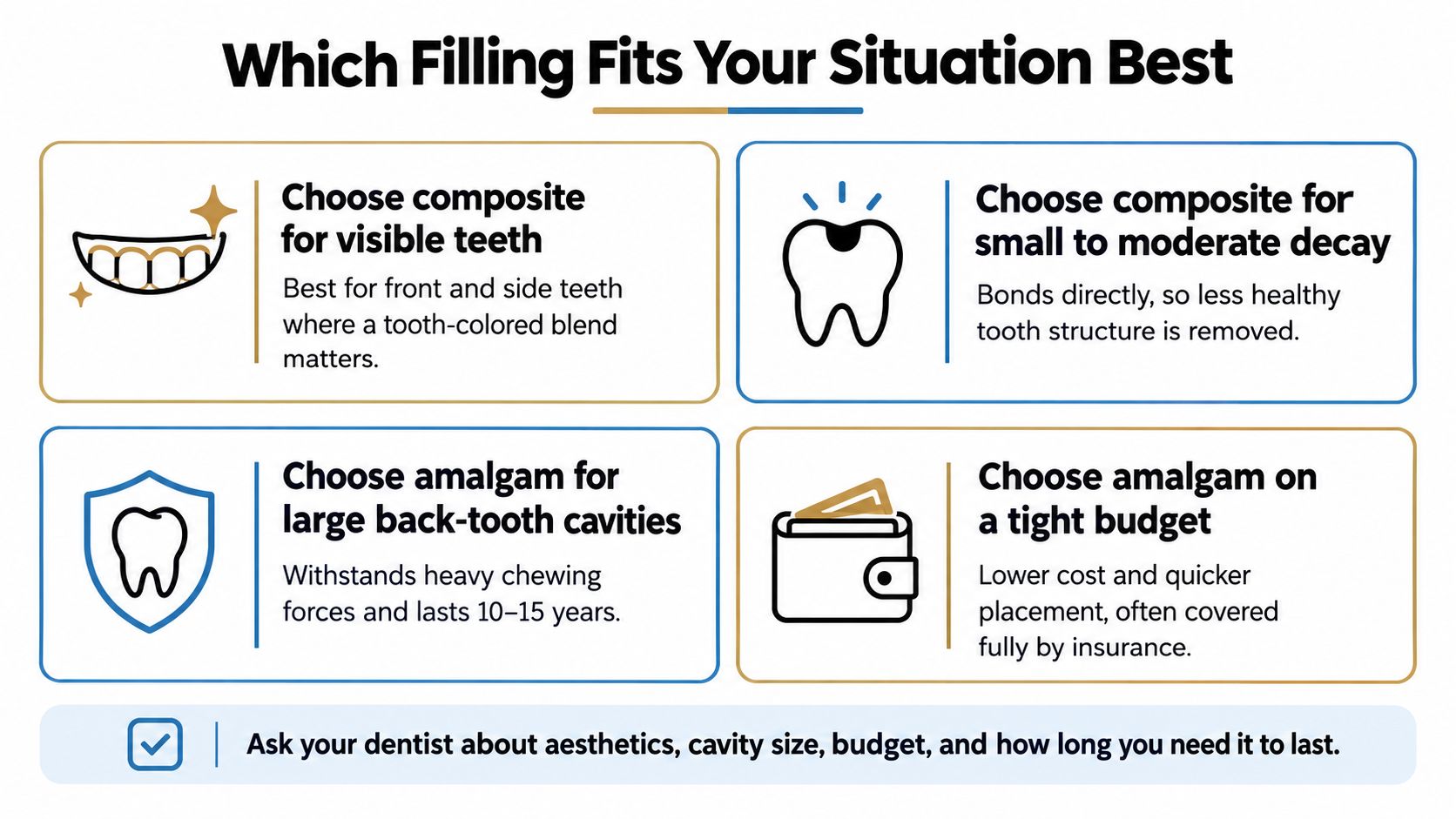
Which Filling Fits Your Situation Best
A simple decision rule works surprisingly well. For a front tooth, choose composite. For a large back molar under heavy bite pressure, consider amalgam or a ceramic onlay. For everything between those extremes, composite is the usual modern default unless the cavity or placement conditions argue against it.
When composite makes more sense
Composite is the strong recommendation for visible front and side teeth, small to moderate cavities, and patients who want a metal-free restoration. It also suits patients who want to preserve as much sound tooth structure as reasonably possible.
Choose composite when:
- Appearance leads the decision: The material can be matched to natural enamel and polished to blend into the smile.
- The cavity is small or moderate: Bonding and layering work especially well when the restoration doesn't need to replace a large amount of missing tooth.
- You prefer mercury-free care: Composite contains no dental amalgam mercury.
- The tooth is accessible and can stay dry: Reliable isolation improves the chance of a durable bond.
The filling evaluation guide can help you recognize symptoms that deserve an examination, including sensitivity, a visible defect, or pain when biting. Don't wait for severe pain. Decay can advance beyond a filling and require root canal treatment, a crown, or extraction.
When amalgam deserves consideration
Amalgam remains reasonable for a very large posterior cavity when heavy chewing force, quick placement, and a lower initial fee matter most. It may also be practical for a patient with a high decay risk or for a tooth where keeping a consistently dry field is difficult.
That doesn't mean amalgam is automatically the best answer for every molar. A very large restoration can weaken the remaining cusps, and a ceramic inlay, onlay, or full crown may protect the tooth more appropriately. An anxious patient may prefer a smaller composite restoration when the tooth and cavity allow it, especially if the dentist can divide care into manageable visits.
The size of the filling guide in the required visual should not be treated as a promise of lifespan. Real outcomes vary with cavity size, bite forces, hygiene, recurrent decay, cracks, and placement conditions. Ask what could cause the tooth to need more than a filling before you consent to treatment.
Lifespan Cost and Alternatives Worth Considering
A filling is a long-term dental decision, but no responsible dentist can promise an exact expiration date. A peer-reviewed review reports that posterior composite fillings typically last three to ten years, with large composite fillings often lasting fewer than five years, while also noting that both composite and amalgam can show excellent longevity beyond seven years (review of dental restoration longevity).
Other clinical summaries report different results. One ADA summary lists 7-year survival of 94.5% for amalgam and 67.4% for composite resin, while 10-year survival is reported as 82.2% for posterior composite restorations and 97.7% for anterior composite restorations. The contrast reinforces a point patients often miss: tooth location and restoration type matter as much as the material name.
| Option | Average Lifespan | Typical Cost Range | Insurance Coverage | Best For |
|---|---|---|---|---|
| Composite resin filling | Often several years, with reported posterior ranges from three to ten years. | Varies by cavity size, tooth, and practice. | A plan may cover part or pay up to a comparable amalgam allowance. | Visible teeth, small to moderate cavities, and conservative repairs. |
| Amalgam filling | Often longer in high-stress posterior use, with clinical studies showing a durability advantage in many situations. | Often lower than composite, but varies by tooth and preparation. | Frequently included when clinically appropriate, subject to plan terms. | Large posterior cavities, heavy chewing, and budget-sensitive care. |
| Ceramic inlay or onlay | Depends on design, tooth structure, bite, and maintenance. | Usually higher than a direct filling and varies by case. | Coverage varies considerably by plan. | Moderate damage when a direct filling may not protect the cusps. |
| Full crown | Depends on remaining tooth structure, bite, hygiene, and recurrent decay. | Varies substantially by material and treatment complexity. | Coverage depends on the diagnosis and dental plan. | Structurally compromised teeth that need cuspal protection. |
Look beyond the initial fee
Amalgam may cost less at the start, while composite may cost more because bonding, shade selection, layering, and finishing require additional clinical steps. Insurance doesn't always make the choice simple. Some plans base payment on the least costly suitable material or an amalgam-equivalent allowance, leaving a patient balance for composite.
A low-cost filling isn't a bargain if the tooth needs a stronger restoration soon afterward. Conversely, choosing a crown for a tooth that only needs a small composite repair adds unnecessary treatment. The sensible question is not only, “What does this filling cost today?” Ask, “What restoration gives this tooth the right protection for its size, location, and remaining structure?”
Common Questions Katy Patients Ask Before Deciding
How long does each filling take?
The answer depends on the number of teeth, the depth of decay, access, and your ability to keep still and comfortable. Composite usually requires more placement steps because the dentist must maintain a dry field, bond the tooth, add layers, cure each increment, and refine the bite. Amalgam can often be placed more efficiently after cavity preparation, but it still requires careful packing and carving.
Does a new amalgam release meaningful mercury vapor?
Amalgam can release small amounts of mercury vapor during chewing, placement, or removal. The FDA says exposure isn't associated with adverse health effects for people age six and older at typical exposure levels, while recommending non-mercury alternatives for certain higher-risk groups. That makes the conversation one of risk, preference, and clinical suitability, not a reason to panic about every existing filling.
Should I remove an old amalgam for safety?
Not if it's intact and the tooth is healthy underneath. Removing a stable restoration can temporarily increase exposure and remove healthy tooth structure. Replacement is more appropriate when the filling has decay around it, the tooth or restoration is cracked, the filling has failed, or you and your dentist decide that a cosmetic replacement is worth the clinical tradeoff.
What if my filling cracks or falls out?
Save the piece if you can, rinse gently, and avoid chewing on that side. Don't place household glue or aspirin on the tooth. Call an emergency dentist promptly, especially if you have swelling, severe pain, fever, a sharp edge, or sensitivity that makes eating difficult. A dentist may repair the tooth with a filling, recommend an inlay or onlay, place a crown, or discuss tooth extraction if the tooth can't be predictably restored. Dental implants can replace a missing tooth later, but preserving a restorable natural tooth is usually the first priority.
Can insurance force me to choose a material?
Your plan may influence what it pays, but it doesn't replace the clinical decision. Ask for a pre-treatment estimate that separates the contracted allowance, your expected balance, and any alternative material fee. If you're comparing composite and amalgam, request the same explanation for each option so you can weigh appearance, longevity, and budget fairly.
Is sensitivity after a filling normal?
Mild sensitivity to cold or pressure can happen after either material, particularly when decay was deep. It should trend in the right direction. Persistent pain, worsening sensitivity, pain that wakes you, or a tooth that hurts sharply when you bite can indicate a high filling, a crack, inflammation, or additional treatment needs.
Katy families in Sunterra, Cane Island, Katy Manor, Kingscrossing, Lakehouse, Marisol, The Grange, Anniston, Katy Lakes, Elyson, and Ventanna Lakes can schedule an exam before committing to a restoration. Bring your insurance questions and tell the dentist whether your priority is a natural smile, maximum chewing strength, mercury-free care, a manageable visit, or predictable long-term planning.
The Dental Retreat provides tooth-colored fillings, restorative dentistry, emergency dental services, and personalized treatment planning in Katy, TX, with comfort options for patients who feel anxious about care. Visit The Dental Retreat to schedule an examination and discuss which filling material fits your tooth, budget, and long-term goals.