Root canal complications affect about 16% of patients, but most are manageable with proper care from an experienced Katy endodontist. A complication doesn't automatically mean the tooth must be removed, especially when you receive prompt evaluation and a treatment plan that considers the tooth's structure, infection, and long-term function.
You may be reading this after a root canal because the tooth still hurts, your gum looks swollen, or biting feels different. A little tenderness can be part of healing, but severe or worsening symptoms deserve attention. For patients searching for a dentist near me in Katy, TX, understanding the difference between expected recovery, procedural complications, and later restorative failure can make the next decision much less stressful.
Understanding Root Canal Complications in Katy
A Katy patient may leave a root canal feeling relieved, then notice tenderness when chewing that evening. The tooth can feel bruised, the jaw may be tired, and the area may remain sensitive while the surrounding tissues settle. That experience is different from pain that intensifies, swelling that spreads, or a tooth that remains infected.
Root canal complications are problems that occur during treatment, shortly afterward, or months or years later. They can include an untreated canal, persistent infection, material extending beyond the root, a separated instrument, a root perforation, or a fracture in a tooth that has lost substantial structure. Some complications are linked to the procedure itself. Others happen because the tooth remains vulnerable after treatment and needs a strong final restoration.
Practical rule: Mild, improving soreness is usually a recovery concern. Worsening pain, swelling, fever, or a draining bump calls for a dental assessment.
What patients can reasonably expect
Most root canals are intended to remove infected tissue, disinfect the canal system, and preserve the natural tooth. A treated tooth may still be tender for a short period because inflammation around the root doesn't disappear the moment treatment ends. Your bite may also feel uneven if the temporary or permanent restoration sits higher than the surrounding teeth.
The problem is not always obvious from symptoms alone. Dental X-rays, a clinical examination, bite testing, and a review of the original treatment help determine whether the issue is healing, reinfection, a missed canal, a crack, or another source of pain. The root canal procedure explained by our Katy dental team gives patients a helpful overview of what treatment involves.
A calm setting for nervous patients
Anxious patients often delay care because they expect discomfort or feel embarrassed about needing retreatment. Our Katy practice provides endodontic care in a spa-inspired setting with comfort measures and sedation options for patients who need help staying relaxed. That approach is useful for people from Sunterra, Cane Island, Katy Manor, Kingscrossing, Lakehouse, Marisol, The Grange, Anniston, Katy Lakes, Elyson, and Ventanna Lakes.
A complication isn't a personal failure, and it isn't proof that a tooth cannot be saved. The right response is a careful diagnosis, an honest discussion of alternatives, and timely treatment.
Common Types of Endodontic Complications
Root canal problems don't all mean the same thing. A short-term flare-up involves inflammation after treatment, while a later failure may involve persistent bacteria, inadequate sealing, a crack, or weakened tooth structure. Recent evidence on complications in root canal care reported complications in 16% of patients, and 75% of those patients had only one complication. The findings are reported in this clinical study of root canal treatment complications.
Inflammation and persistent infection
A flare-up means significant pain or swelling develops after treatment. A recent systematic review found an overall incidence of severe flare-ups of 2.83% across 688 cases, with individual study rates ranging from 0.39% to 9.40% (systematic review of endodontic flare-ups). The review also notes that reported rates have reached 38% in some settings and risk groups, so the patient's diagnosis, symptoms before treatment, and tooth type matter.
Inflammation can follow mechanical irritation, chemical irritation, extrusion of infected debris or irrigant beyond the root tip, or bacteria that remain in a difficult-to-clean canal. Necrotic pulp, active infection, and pain before treatment deserve especially careful working-length control and disinfection.
Procedural complications
A separated file is a small instrument fragment that remains in the canal. It may not cause a problem, but its location can affect whether the dentist can bypass or remove it. A perforation is an unintended opening through the tooth or root, while a filling that extends beyond the root or ends substantially short can interfere with healing.
A retrospective report found obturation extending beyond the apex and obturation more than 2 millimeters short of the apex in about 6% of patients for each issue. Canals not negotiable within 2 millimeters of the apex occurred in 3%, instrument separation in 2%, inadvertent filing beyond the root apex in 2%, and perforation in 1% (reported procedural complications in root canal treatment).
Reinfection and missed anatomy
A tooth can become reinfected if bacteria enter through a leaking filling or crown, if a canal remains untreated, or if a crack allows contamination. Retreatment may solve the problem, but the dentist must first determine whether the tooth is restorable and whether the source is inside the canal system or in the surrounding tissues. Prompt evaluation gives patients more choices than waiting until swelling or structural damage becomes advanced.
Warning Signs and Symptoms to Watch For
A treated tooth may feel tender after care, especially when you bite. That discomfort should generally become easier to manage rather than steadily intensify. If you aren't sure whether your symptoms are normal, call the practice that treated you instead of trying to diagnose the tooth from online information.
Symptoms that deserve a prompt call
Contact a Katy dental office when you notice:
- Persistent or worsening pain: Pain that doesn't settle, returns after improving, or makes sleep and daily activities difficult needs evaluation.
- Swelling: Enlargement around the gum, cheek, or jaw can indicate ongoing inflammation or infection.
- A gum bump: A pimple-like bump, drainage, or a bad taste may signal a sinus tract from an infected tooth.
- Pain with pressure: Discomfort when chewing can come from inflammation around the root, an uneven bite, a crack, or an unresolved infection.
- Fever or feeling unwell: Fever, chills, or unusual weakness can accompany an infection and shouldn't be ignored.
- A change in numbness: Numbness that lasts longer than expected after anesthesia deserves a call, particularly when the treated tooth is near important nerves.
The reason flare-ups occur is not mysterious. Inflammation around the root can increase after mechanical irritation, chemical irritation, or movement of bacteria and infected debris through the end of the canal. Persistent contamination inside an incompletely disinfected canal can also keep the surrounding tissue inflamed, which is why severe symptoms may appear within hours or days of treatment.
What to do while waiting
Avoid chewing hard foods on the treated tooth until your dentist confirms that the final restoration is secure. Keep the area clean with gentle brushing and flossing, follow the instructions provided for medication, and don't place aspirin directly on the gum. If a temporary filling falls out, contact the office promptly so the tooth can be protected from further contamination.
A routine follow-up may be appropriate for mild soreness that is improving. Call immediately for spreading swelling, escalating pain, drainage, fever, or any difficulty swallowing or breathing. The practice's patient education video can also help you understand how endodontic treatment is performed.
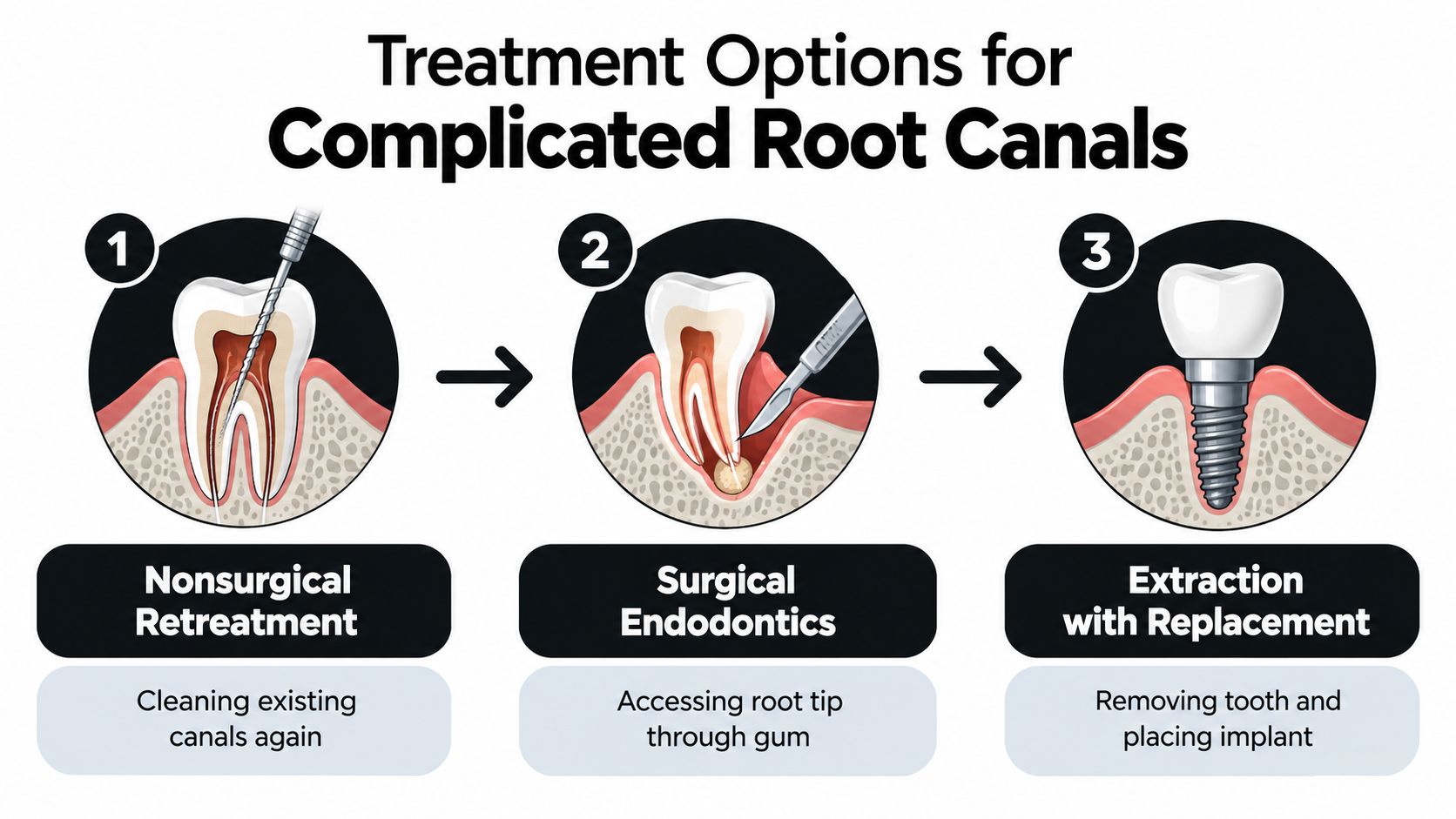
Treatment Options for Complicated Root Canals
Treatment depends on the source of the problem, not just on whether the tooth hurts. A dentist evaluates the quality of the existing root filling, the presence of untreated canals, the amount of remaining tooth structure, the location of the tooth, the condition of the gums and bone, and your general health. A front tooth with solid structure may have different options from a cracked molar with limited remaining walls.
Nonsurgical retreatment
Retreatment involves reopening the tooth, removing existing filling material, locating canals that may have been missed, disinfecting the system, and sealing it again. It can be a sensible choice when infection persists and the tooth remains structurally sound. It may not be practical when the canal cannot be accessed safely, the tooth has a major fracture, or the remaining structure cannot support a restoration.
Surgical endodontics
Root-end surgery, sometimes called an apicoectomy, approaches the infection through the gum and bone near the root tip. It may be considered when infection remains after a well-performed root canal, when a post or restoration prevents access through the crown, or when retreatment from inside the tooth would carry too much risk. The procedure addresses the root-end area while preserving the rest of the tooth when the case is suitable.
Extraction and replacement
Extraction becomes more appropriate when a tooth is vertically fractured, cannot be restored, has inadequate support, or has a prognosis that makes repeated treatment unlikely to succeed. Replacement may involve a dental implant and crown, a bridge, or another restorative option. Patients searching for dental implants near me should understand that implant planning begins with the health of the bone, gums, bite, and neighboring teeth.
Long-term failure can involve the tooth's structure rather than the canal procedure alone. A recent retrospective follow-up found root fracture was the most common complication in endodontically treated teeth, particularly after 4 years, and linked the problem with reduced crown structure and retreatment protocols (long-term complications in endodontically treated teeth). The same source reported that clinicians documented complications in 16.7% of teeth during a one-year period, with 90% of those complication cases occurring in molars.

Our practice can coordinate endodontic evaluation with restorative dentistry, periodontic care, oral surgery, and implant planning. That matters when saving the tooth and replacing it require more than one type of treatment.
Prevention Strategies and Risk Factors
Preventing root canal complications requires work from both the clinical team and the patient. The dentist must understand the canal anatomy, control the working length, disinfect thoroughly, protect surrounding tissues, and choose cases that can be treated predictably. The patient must protect the tooth after treatment and return for evaluation when symptoms don't follow the expected course.
What the clinical team controls
Careful imaging and magnification can help identify complex anatomy. Working-length control reduces the chance of cleaning or filling too far beyond the root, while thorough irrigation and shaping help limit remaining bacteria. A final restoration also matters. A review protocol links long-term complications with root-filling quality and the coronal seal, and defines failure as the later need for nonsurgical retreatment, surgical treatment, or extraction after at least a year (review protocol on long-term root canal outcomes).
The best technical plan can still fail if the tooth is too damaged to restore. A careful examination should address cracks, remaining walls, bite forces, gum support, and whether a crown or other protective restoration is needed after endodontic care.
What patients can do
- Follow temporary-restoration instructions: Don't chew hard or sticky foods on a tooth that hasn't received its final restoration.
- Keep the area clean: Continue brushing and flossing, while using a gentle approach around tender tissues.
- Attend recommended reviews: Dental X-rays and examinations can identify changes that symptoms don't reveal.
- Report changes early: New swelling, a draining bump, or renewed pain is easier to assess before the infection expands.
- Protect the completed tooth: A crown or other restoration may be important for a heavily damaged back tooth.
For nervous patients in Katy, sedation options and a calm environment can make it easier to complete treatment and attend follow-up visits. Comfort tools such as aromatherapy, heated massage chairs, noise-cancelling headphones, and televisions in treatment rooms can reduce the temptation to postpone necessary care. Routine cleaning and exams, new patient exams, and restorative appointments also help identify problems before they become urgent.
When to Seek Emergency Dental Care in Katy
Severe dental pain isn't always an emergency, but certain symptoms require same-day guidance. Call an emergency dentist when pain is uncontrolled, swelling is growing, or infection symptoms are affecting your general health. A root canal complication can sometimes be managed with retreatment or root-end surgery, but waiting can allow infection to spread and can limit restorative choices.
Red flags that need immediate attention
Seek urgent dental care for:
- Severe uncontrolled pain: Pain that doesn't respond to the medication instructions provided or prevents normal activity needs prompt evaluation.
- Significant facial swelling: Swelling that extends into the cheek, jaw, or neck may require urgent treatment.
- Fever with chills: These symptoms can indicate that infection is affecting more than the tooth.
- Difficulty swallowing or breathing: Treat this as an emergency and seek immediate medical help.
- Pus or foul drainage: Drainage from the gum, a bad taste, or a recurring bump can point to an active infection.
- A broken treated tooth: A fracture can expose the canal or leave the tooth unable to withstand chewing.
If you have difficulty breathing or swallowing, don't wait for a routine dental appointment. Seek emergency medical care, then contact a dental office for treatment coordination. For severe pain, swelling, or a suspected infection in Katy, review the guidance for emergency root canal treatment.
Local care with comfort in mind
A practice on Stockdick School Rd. serves patients from Sunterra, Cane Island, Katy Manor, Kingscrossing, Lakehouse, Marisol, The Grange, Anniston, Katy Lakes, Elyson, and Ventanna Lakes. Extended hours can help families arrange care around work and school, while sedation options, aromatherapy, heated massage chairs, and noise-cancelling headphones give anxious patients a more comfortable way to receive treatment.
The right appointment may involve a focused examination, dental X-rays, infection management, bite adjustment, retreatment, or a discussion of tooth extraction and replacement. Patients may also need restorative dentistry after the urgent problem is controlled. If you're comparing a dentist near me, a cosmetic dentist near me, or a provider for dental implants, choose a team that can explain both immediate relief and the tooth's long-term plan.
If you're experiencing pain, swelling, pressure sensitivity, or concern about a previous root canal, The Dental Retreat offers endodontic evaluation, emergency care, sedation comfort options, restorative dentistry, and implant planning in Katy. Schedule a consultation so the team can examine the tooth, explain your choices, and help you move forward with a clear plan.