You notice a little pink in the sink after brushing and tell yourself it's probably nothing. Then, during a routine cleaning at a Katy, TX dental office, the hygienist mentions that your gums need a “deep cleaning.” Suddenly, a visit you expected to be simple feels confusing and expensive. If you searched for “is scaling and root planing necessary” or “dentist near me,” you're probably trying to understand whether treatment is needed or whether a standard cleaning would be enough.
The answer depends on what's happening below your gumline, not how much tartar is visible. This guide will help you understand your periodontal chart, the difference between gingivitis and periodontitis, and the questions to ask a Katy dentist before agreeing to scaling and root planing, also called SRP.
When a Deep Cleaning in Katy TX Becomes More Than a Routine Visit
A patient from Katy Manor came in after postponing her cleaning around work and family commitments. Bleeding while brushing finally prompted her to schedule the appointment she expected to be routine. The exam found inflammation around several teeth, so the office recommended treatment by quadrant rather than one standard polish.
That change can feel unsettling, especially when “deep cleaning” sounds like a more serious version of the same visit. A regular prophylaxis suits a mouth without the attachment loss or bone loss associated with periodontitis. SRP addresses active disease beneath the gumline. The American Dental Association's guidance on periodontitis identifies nonsurgical mechanical instrumentation as the treatment of choice for diagnosed periodontitis.
Why ordinary cleaning may not reach the problem
Plaque begins as a soft film and can harden into calculus, or tartar, that brushing and flossing cannot remove. Patients in Sunterra and Cane Island also ask whether hard water and mineral exposure could explain a rough feeling on their teeth. That possibility may be discussed, while the treatment decision rests on periodontal measurements, radiographs when indicated, and the condition of the supporting tissues.
Your periodontal chart acts like a site-by-site map. Pocket depth shows how far the probe travels beside each tooth. Attachment levels indicate whether gum support has been lost over time. Bleeding on probing, tooth mobility, recession, and bone-loss findings add context. A single symptom or measurement rarely explains every site.
A busy schedule can let inflammation continue. Bleeding, bad breath, gum tenderness, recession, or loose-feeling teeth deserve an evaluation, while bleeding alone doesn't automatically prove that SRP is necessary.
A practical rule: Tie a deep cleaning to documented periodontal disease at the sites being treated. Tartar may support the picture, but the chart should show why therapeutic care is appropriate.
At The Grange, Anniston, Katy Lakes, Elyson, and Ventanna Lakes, patients may show different degrees of inflammation and have different care histories. One person may need routine cleaning and improved home care. Another may have localized periodontal pockets that justify targeted SRP. Ask your Katy dentist to review each measurement with you, so the recommendation matches the teeth that need treatment rather than applying one blanket plan.
What Scaling and Root Planing Actually Does
Think about a favorite mug with a sticky tea stain. A quick rinse may remove the loose residue, but a rough ring can remain along the inside edge. Plaque behaves in a similar way. It begins as a soft bacterial film called biofilm. If it stays in place, it can harden into calculus, also called tartar. Once deposits extend below the gumline, a regular toothbrush and routine cleaning can't reliably reach them.
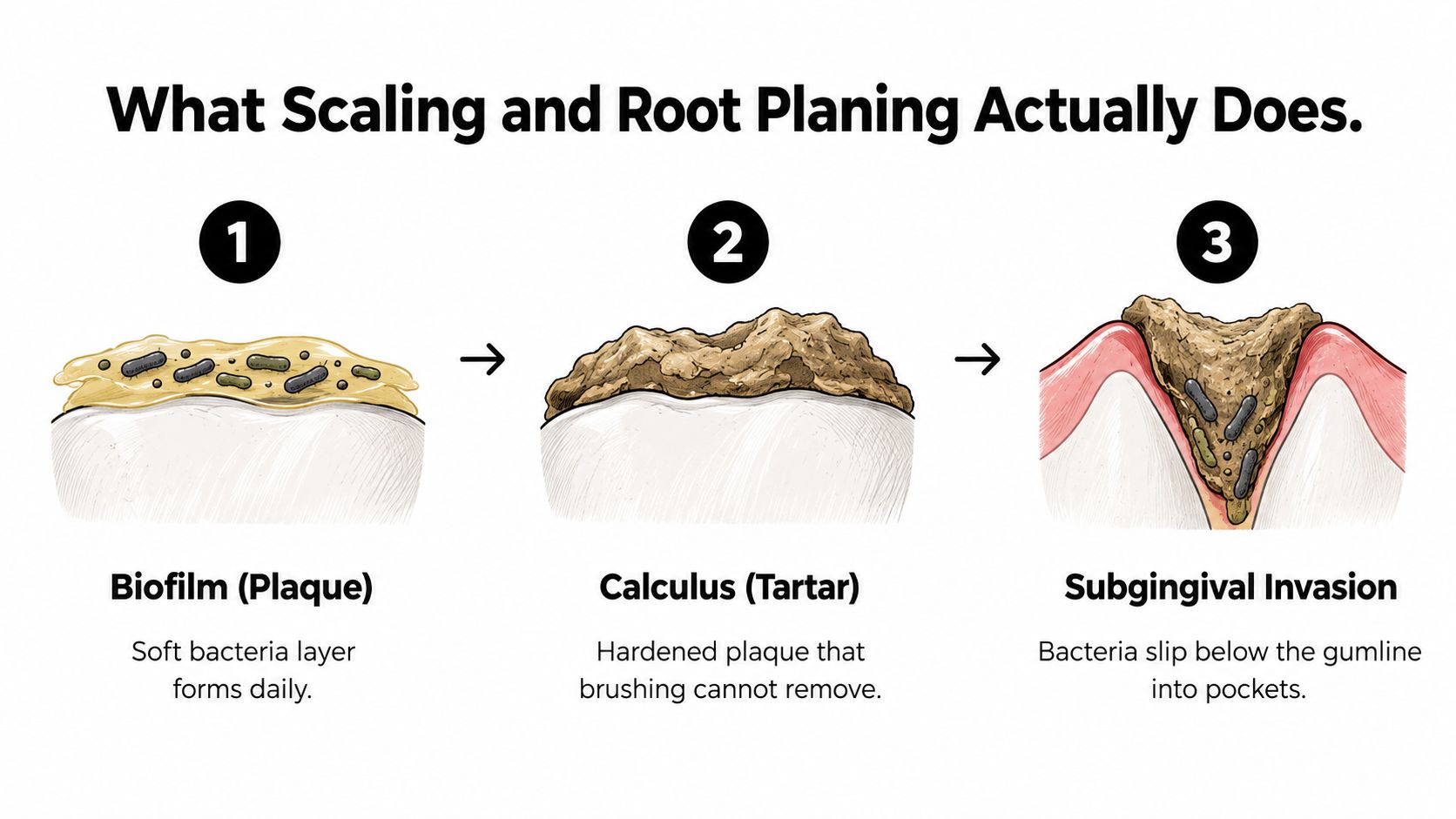
The two parts of SRP
Scaling removes plaque and hardened calculus from the crown and root surfaces. Your dental professional may use an ultrasonic instrument that vibrates deposits loose and flushes the area, along with hand instruments for detailed work around the root anatomy.
Root planing smooths contaminated root surfaces. The goal isn't to reshape a healthy tooth. It's to remove deposits and rough areas that allow bacteria to remain attached, giving inflamed gum tissue a cleaner surface against which it can heal and reattach.
A normal gum sulcus is shallow. Periodontal disease creates a deeper space, or pocket, where bacteria and calculus can remain protected from everyday brushing. The ADA describes typical SRP indications as localized or generalized active periodontal disease with probing depths of 4 to 6 millimeters or deeper, accompanied by horizontal or vertical bone loss shown on radiographs, or recurrent or refractory disease. The ADA's detailed SRP documentation also distinguishes treatment of supporting-tissue disease from preventive cleaning.
Why SRP is therapeutic
A routine cleaning prevents buildup in a relatively healthy mouth. SRP treats an established infection and inflammation pattern in the tissues supporting the teeth. Your dentist may numb the area because instruments need to work below the gumline, where sensitivity is greater.
The realistic goal is to control active inflammation, reduce pocket depths where possible, and help stabilize the attachment around the teeth. SRP can't promise that lost bone will grow back or that periodontitis has been permanently cured. It creates a cleaner environment so healing and long-term maintenance have a better chance.
Signs Your Dentist Looks For Before Recommending Treatment
Your periodontal chart is a map of your gums, not a formality. A dentist or hygienist gently places a measuring instrument beside each tooth and records pocket depths, bleeding, recession, and other findings. Those numbers help identify whether disease is isolated to a few sites or more widespread.
The most important measurement is probing depth, but it shouldn't be read alone. A 4-millimeter pocket may have a different meaning depending on whether the gum has receded, whether attachment has been lost, whether the site bleeds, and whether radiographs show bone loss. The ADA identifies active disease with deeper pockets and supporting bone changes as a typical reason to consider SRP, while the American Academy of Periodontology's clinical definition summarized by the ADA uses attachment loss and probing findings to identify periodontitis.
Read the chart with your dentist
| Clinical finding | What it means | Typical action |
|---|---|---|
| Shallow pocket with no attachment loss | The gum may be healthy or mildly inflamed | Routine cleaning, home-care instruction, and monitoring |
| Bleeding on probing | The tissue is inflamed at that site | Improve plaque control and assess the full periodontal picture |
| Deeper pocket | Bacteria and calculus may be sheltered below the gumline | Consider targeted SRP when other disease findings support it |
| Clinical attachment loss | The gum's supporting attachment has moved away from its normal position | Evaluate for periodontitis and document affected sites |
| Recession | More of the tooth root is exposed | Record root exposure, sensitivity, and attachment levels |
| Tooth mobility | Supporting tissues may be compromised | Investigate inflammation, bone support, bite forces, and other causes |
| Furcation involvement | Bone loss may extend into the area between roots of a multi-rooted tooth | Consider access, prognosis, maintenance, and periodontal referral |
| Radiographic bone loss | Supporting bone has been lost around the tooth | Combine X-ray findings with chart measurements and symptoms |
A recommendation should be site-specific. One quadrant might contain active pockets while another needs only a prophylaxis. Borderline sites may first receive improved home-care coaching and a shorter re-evaluation interval, depending on the complete diagnosis.
Your dentist may also ask about smoking, diabetes, family history, hormonal changes, crowded teeth, and other factors that can affect inflammation or cleaning access. These details don't automatically determine treatment, but they help explain why two patients with similar bleeding may receive different care plans.
How SRP Compares With Other Periodontal Options
A routine prophylaxis and scaling and root planing serve different purposes. Prophylaxis is like cleaning the accessible surfaces of a house. It removes deposits above the gumline and polishes the teeth when there is no active attachment or bone loss. SRP works below the gumline, where deposits and inflammation can remain sheltered. The recommendation should still be tied to specific teeth or sites, rather than applied to the whole mouth automatically.
SRP is commonly the first nonsurgical treatment considered because it removes the physical source of inflammation before surgical access is discussed. Pocket depth can affect that choice. In pockets deeper than 6 millimeters, surgical therapy produced approximately 0.6 millimeters more probing-depth reduction and 0.2 millimeters more clinical-attachment gain after 12 months. In 4 to 6 millimeter pockets, SRP produced about 0.4 millimeters more attachment gain. These results come from a systematic review comparing nonsurgical and surgical periodontal therapy. They support matching treatment to the site's findings and access, not choosing surgery automatically.
| Treatment | Best for | Invasiveness | Typical recovery |
|---|---|---|---|
| Routine prophylaxis | Healthy tissue or uncomplicated gingivitis | Preventive, above the gumline | Usually minimal |
| Scaling and root planing | Active periodontitis at documented sites | Nonsurgical, below the gumline | Temporary tenderness or sensitivity may occur |
| Locally placed antibiotic | Selected persistent pocket after mechanical treatment | Limited adjunctive treatment | Usually localized |
| Periodontal surgery | Deep or inaccessible pockets and certain bone defects | Surgical access | Requires individualized surgical aftercare |
| Laser-assisted therapy | A treatment approach considered by some offices for selected cases | Varies by technique and diagnosis | Depends on the procedure used |
A locally delivered antibiotic, including products such as Arestin, may be placed in a stubborn pocket after mechanical treatment. Medication supports healing only after thorough subgingival calculus removal. For moderate-to-severe disease, low-dose doxycycline may also be considered as support alongside debridement. The medication does not replace careful mechanical treatment.
Surgery may become appropriate when deep, inflamed sites remain difficult to access after healing. Before choosing among periodontal disease treatment options, ask what the proposed treatment is addressing: active disease, a difficult root shape, a bone defect, or a pocket that did not respond adequately to initial care. In a Katy dental consultation, reviewing each charted site can clarify why one tooth may need SRP while nearby teeth receive routine preventive care.
What to Expect During and After Your Visit
Most patients feel more comfortable when they know the sequence before sitting in the chair. Your appointment may be divided into two halves or two visits, with one side of the mouth treated at a time. The exact plan depends on the number and location of active sites.
First, the team reviews your chart and confirms which teeth or quadrants need treatment. Local anesthesia numbs the gums, so you'll generally feel pressure and vibration rather than sharp pain. You can agree on a hand signal before treatment and ask the team to pause whenever you need a break.
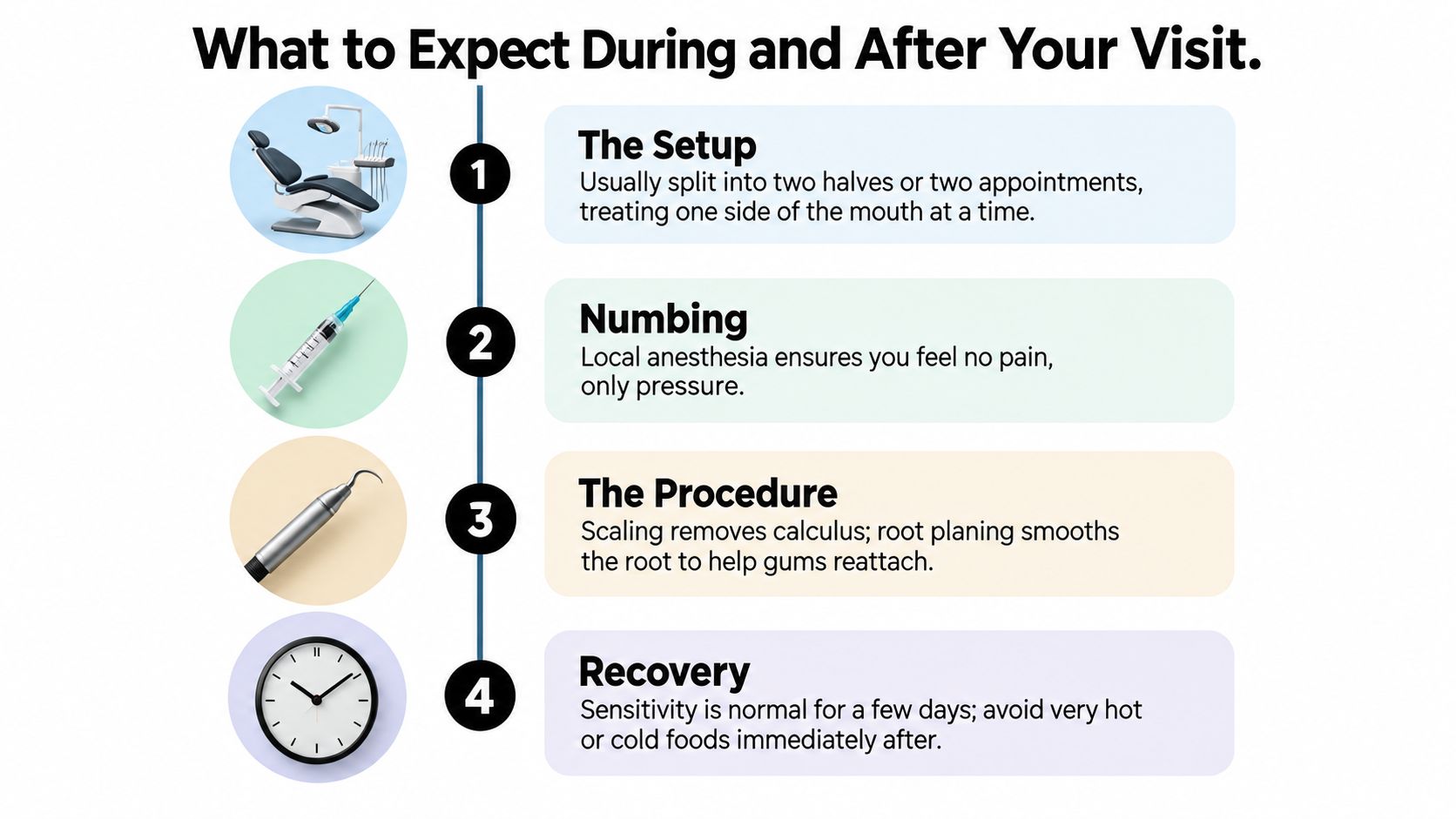
What the instruments do
An ultrasonic scaler vibrates hardened deposits loose, while water helps rinse the area. Hand instruments then allow careful removal around contours that require a more precise touch. Root planing follows, smoothing contaminated root surfaces so the gum tissue has a cleaner environment for healing.
A calm office may offer comfort details such as a blanket, neck pillow, noise-cancelling headphones, streaming entertainment, heated or massage-style chairs, and sedation choices when appropriate. These features don't change the diagnosis, but they can make a periodontal appointment easier for an anxious patient.
For a visual walkthrough, you can watch this short explanation:
Afterward, mild tenderness, slight bleeding, and increased sensitivity can occur for two to three days. Follow the instructions you receive, which may include over-the-counter pain relief, soft foods, gentle brushing, and a prescribed rinse. Avoiding very hot or cold foods immediately after treatment can also make the first hours easier.
Healing needs measurement
The greatest benefit commonly occurs during the first 1 to 2 months, although additional pocket-depth improvement may continue through approximately 5 to 6 months, according to a systematic review of hand and powered instruments for subgingival instrumentation. A follow-up re-evaluation in 6 to 8 weeks gives your dentist an opportunity to measure healing, review bleeding, and decide whether any sites need additional care.
Long-term success depends on daily plaque control and professional maintenance, not repeated aggressive treatment without reassessment. Periodontal maintenance guidance can help you understand why follow-up is part of treatment rather than an optional extra.
Smarter Questions to Ask Before Saying Yes
You don't need to challenge your dentist to ask for details. You're entitled to understand what was found, which teeth are affected, and how the office will judge whether treatment worked.
Ask for a printed or digital periodontal chart. Look at the actual probing depths and bleeding points instead of relying on a general phrase such as “your gums are bad.” Then ask whether the diagnosis is localized or generalized and whether radiographs show horizontal or vertical bone loss.
Questions that clarify the plan
- Which sites are active? Ask the dentist to identify the teeth or quadrants with deeper pockets, attachment loss, bleeding, or bone changes.
- Is this preventive or therapeutic? A routine cleaning may be appropriate for gingivitis without attachment or bone loss. SRP is intended for diagnosed periodontitis.
- Could borderline sites be monitored first? For isolated shallow or borderline pockets, ask whether improved home care and a shorter re-evaluation interval are reasonable.
- What should change after treatment? Ask which measurements the office will repeat, including pocket depth, bleeding, and clinical attachment stability.
- How many visits are planned? Clarify whether treatment will be divided by quadrant and whether the plan includes a follow-up evaluation.
- What does the fee include? Ask for the total expected cost, including periodontal charting, radiographs when needed, anesthesia, adjunctive medication, and maintenance.
- What happens if I wait? A clear answer should explain the likely concern at the affected sites without using pressure or fear.
- What alternatives apply to my diagnosis? You can ask about local antibiotics, referral, surgery, or other approaches, but alternatives should be discussed in relation to your actual chart.
The evidence supports SRP as an effective initial treatment, but it isn't a guarantee that every pocket will close or that periodontitis has disappeared. A review of 72 studies found an average clinical attachment improvement of approximately 0.5 millimeters compared with controls, while also noting that some improvement may occur alongside treatment-related recession. The British Dental Journal review and meta-analysis supports realistic expectations and reassessment.
A trustworthy Katy dentist should welcome these questions. If the answers are unclear, ask for the chart, the X-ray findings, and the proposed stopping point before you consent to treatment.
Schedule a Comfortable Consultation in Katy TX
If you're looking for a dentist in Katy, TX, a periodontal consultation can give you more clarity than a generic recommendation for a deep cleaning. The evaluation should connect your symptoms to specific findings, explain whether routine cleaning or SRP is appropriate, and show you how the team will measure healing.
The Dental Retreat offers a $99 new-patient special that includes a full exam, necessary X-rays, and a personalized deep-cleaning quote for patients who may need periodontal treatment. Uninsured patients can also ask about membership savings for ongoing periodontal maintenance. These options can make it easier to plan care without postponing an evaluation.
Comfort matters when you're already nervous about gum treatment. The practice provides spa-style options such as blankets, noise-cancelling headphones, heated or massage-style chairs, and sedation choices for appropriate patients. The same office also provides cleaning and exams, dental X-rays, teeth whitening, cosmetic dentistry, restorative dentistry, dental implants, tooth extraction, and emergency dental services, so your care plan can stay coordinated if you later need services such as dental implants near me, cosmetic dentist near me, or an emergency dentist.
Bring recent periodontal charts, dental X-rays, or a list of previous diagnoses if you have them. Your first visit should focus on understanding your options, not committing to SRP before you've seen the evidence. Patients from Sunterra, Cane Island, Katy Manor, Kingscrossing, Lakehouse, Marisol, The Grange, Anniston, Katy Lakes, Elyson, and Ventanna Lakes can call the Katy office, request a periodontal consultation online, or stop by to meet the team before scheduling treatment.
The Dental Retreat offers periodontal evaluations, scaling and root planing, and maintenance planning in a calm Katy setting, with recommendations based on your periodontal chart and X-ray findings. Visit The Dental Retreat to request a consultation and get clear answers about whether SRP is necessary for your smile.