A whitening-only smile makeover can be completed in about one hour, but a plan involving aligners, veneers, or implants typically takes 6 to 24 months because tooth movement and healing set the pace. The exact answer depends on which treatments your teeth, gums, bite, and long-term goals require.
You may be looking in the mirror before calling a cosmetic dentist near me, wondering when you'll see the finished smile. Perhaps your concern is mainly discoloration, or perhaps you also have chipped teeth, uneven edges, gaps, missing teeth, or a bite that needs correction. Those concerns can belong to very different treatment pathways.
At The Dental Retreat on Stockdick School Rd. in Katy, TX, patients from Sunterra, Cane Island, Elyson, and nearby Katy communities can receive a plan that separates four kinds of time: chair time, laboratory time, healing time, and orthodontic time. That distinction gives you a more useful answer than a single advertised number.
What a Smile Makeover Really Involves
A smile makeover isn't one standardized procedure. The phrase may describe professional whitening, composite bonding, porcelain veneers, clear aligners, tooth replacement with dental implants, gum treatment, or a combination of these services.
For example, in-office whitening is usually performed in about one hour, according to the American Dental Association's whitening guidance. That represents the short end of the range. A more thorough plan may involve diagnosis, tooth movement, temporary restorations, laboratory fabrication, healing, and retention after the visible work is complete.
Start with the result you want
A patient who wants a brighter smile may need only professional whitening. Someone with worn edges and small chips may be a candidate for bonding after whitening. Another patient may need alignment before veneers because placing restorations over crowded teeth could compromise appearance, cleaning, or bite function.
The same words, smile makeover, can therefore describe one visit or a staged process lasting many months. The treatment sequence matters more than the label.
Four kinds of time matter
Chair time includes the minutes you spend receiving whitening, bonding, preparation, or surgery. Laboratory time covers the production of veneers, crowns, aligners, or implant prosthetics. Healing time allows gums, bone, and surgical sites to recover. Orthodontic time is the period required for teeth to move safely into position.
Practical rule: The longest required phase usually controls the completion date.
This is why a dentist in Katy, TX, can't responsibly promise every patient the same finish date. A consultation identifies the shortest realistic path for your specific smile, rather than giving you a marketing estimate that ignores biology.
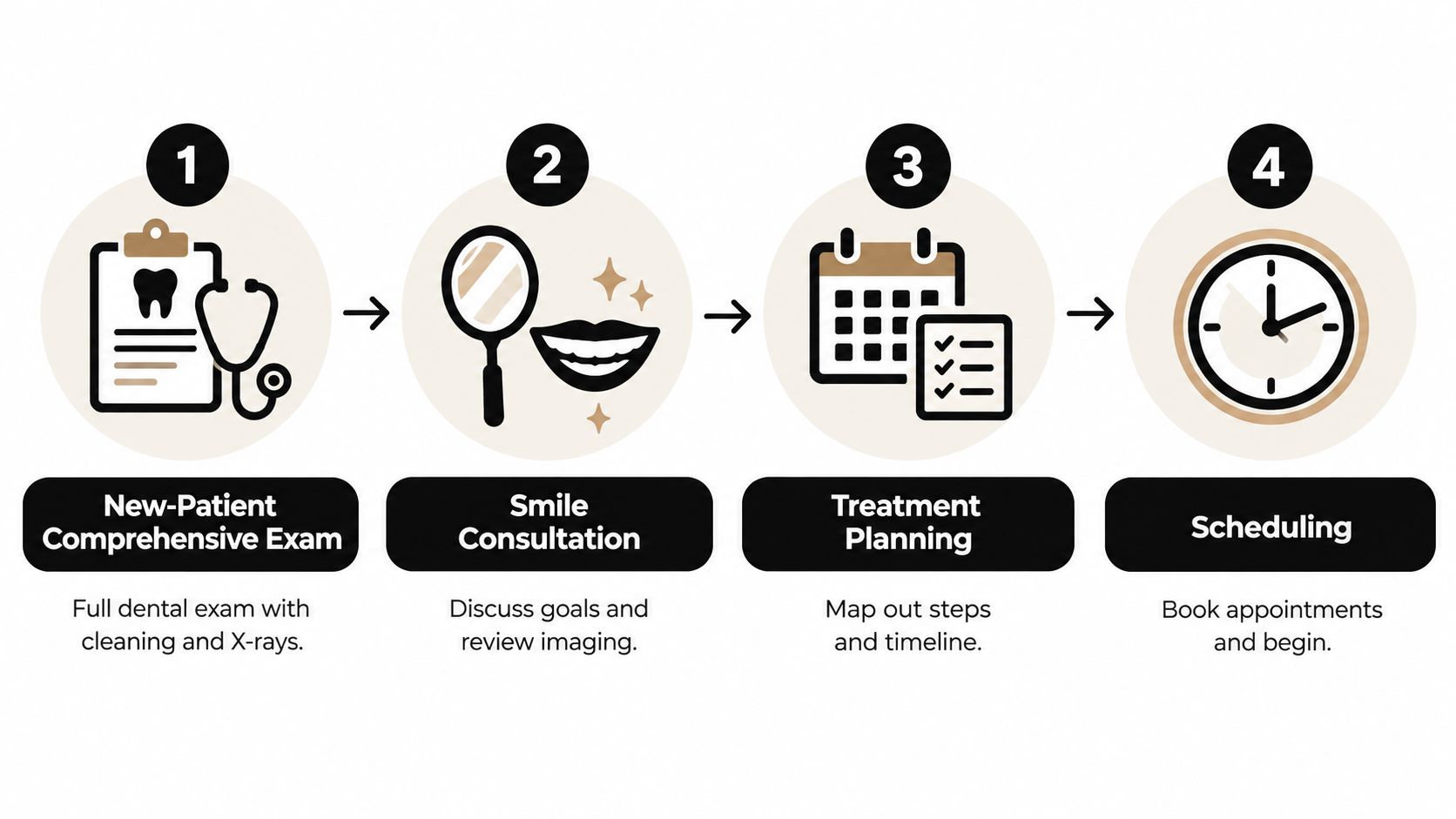
Your First Visits and Planning Stage
The calendar starts before whitening or tooth preparation. At The Dental Retreat, a new-patient exam with cleaning and X-rays is available for $99, while a problem-focused visit is available for $49. The appropriate starting point depends on whether you're seeking a complete evaluation or help with a specific concern, such as pain, a chipped tooth, or a missing restoration.
Your dentist examines the teeth and gums, reviews your medical and dental history, and checks your bite. Dental X-rays can reveal decay, bone changes, infection, or roots that aren't visible in the mirror. When the case calls for more detailed planning, CBCT imaging can show three-dimensional bone and anatomical information, while digital impressions help document tooth shape and position.
What the planning appointment clarifies
A smile consultation connects your concerns with possible treatments. You may discuss:
- Your priorities: Brightness, tooth shape, spacing, chipped enamel, missing teeth, or comfort.
- Your starting condition: Gum health, decay, old fillings, tooth wear, bite stability, and bone support.
- Your desired appearance: Shade selection, photographs, and the proportions that suit your face.
- Your proposed sequence: Whitening, bonding, veneers, clear aligners, tooth extraction, implants, or restorative care.
A mock-up or wax-up may help you understand the proposed tooth length, contour, and arrangement before definitive restorations are made. You can also review what is included in a smile design consultation before your appointment.
Many cases need one to three visits over one to three weeks, depending on imaging needs and complexity. Those figures are a practical planning range, not a promise for every patient. A straightforward cosmetic case may move quickly, while a patient with gum disease, infection, missing teeth, or an unstable bite needs additional evaluation.
Skipping this stage often creates avoidable disappointment. The timeline can't be estimated reliably until the diagnostic information is complete because the final plan may be whitening-only, veneer-and-whitening, orthodontic-then-restorative, or implant-based.
The Four Clocks That Drive Every Timeline
Patients often focus on how long they'll sit in the dental chair. That matters, but it isn't the whole schedule. A procedure may take a short appointment while the surrounding laboratory, healing, or movement phase takes much longer.
| Clock | What It Measures | Typical Range | Can It Be Compressed |
|---|---|---|---|
| Chair time | Whitening, preparation, bonding, or surgery appointments | Minutes to several visits | Sometimes, within safe limits |
| Lab time | Fabrication of veneers, crowns, aligners, or implant prosthetics | Varies by case and laboratory workflow | Only partially |
| Healing time | Recovery after extraction, grafting, gum treatment, or implant placement | Weeks to months | No, not reliably |
| Orthodontic time | Active tooth movement and refinements | Months to about 1 to 2 years in many comprehensive cases | Not safely shortened at will |
Chair time is only one part
A whitening visit may be completed in about one hour, as described by the American Dental Association. That doesn't mean every smile makeover can be scheduled into one hour. Veneers require preparation, records, temporary restorations in some cases, laboratory work, and final delivery. Implant treatment requires surgery and later restoration after the implant integrates with bone.
Laboratory time creates another pause. Your dentist may complete the clinical preparation in one visit, but the definitive veneer, crown, bridge, aligner set, or implant prosthesis still needs to be designed and fabricated. Temporary teeth can protect appearance and function during that interval, but they aren't always the final result.
Healing and movement set the outer boundary
Healing follows biology. After implant placement, osseointegration generally takes about 3 to 9 months, according to Cleveland Clinic's dental implant overview. Clear aligners follow a different clock. Compliance, tooth movement, refinements, and case complexity determine how long the active phase lasts.
A simple way to apply the model is to compare a same-day whitening appointment with an aligner journey lasting 18 months. Both may be described as cosmetic dentistry, but combining them doesn't create an 18-hour visit. It creates a sequence in which each phase must be completed in the correct order.
Cosmetic-Only Pathways and Their Ranges
Cosmetic treatment can be relatively quick when your teeth and gums are healthy and your bite is stable. The most useful question isn't whether you want a brighter or more even smile. It's whether the underlying foundation is ready for cosmetic work.
In-office Zoom whitening can be completed in about one hour, and The Dental Retreat currently offers an in-office Zoom whitening special for $350. Dentist-supervised home whitening follows a slower schedule. The NHS explains the difference between power whitening and tray-and-gel treatment, with tray treatment generally used over several weeks.

Common short-path examples
Composite bonding can often be completed in one visit when the dentist can safely correct small chips, gaps, or uneven edges without more extensive preparation. The material is shaped directly on the tooth and adjusted for appearance and bite.
Custom-tray whitening commonly takes two to four weeks in a typical cosmetic schedule. The final result depends on the product, wear instructions, baseline shade, and type of discoloration. Existing crowns, fillings, and implants don't whiten like natural enamel, so matching may require restorative planning.
Porcelain veneers usually involve two to four appointments across two to six weeks, including laboratory fabrication. The first visits may include records, shade and shape planning, tooth preparation, and temporaries. The final appointment delivers and checks the restorations.
A whitening-and-bonding plan may be completed in under a month when no gum, bite, or restorative problems delay treatment. A veneers-and-whitening plan commonly runs four to eight weeks, because the laboratory and appointment sequence adds time.
The video below illustrates the clinical setting and process patients may encounter during professional whitening.
Cosmetic treatment should begin only after the dentist confirms that your gums are healthy and your bite is stable. Whitening, bonding, or veneers placed over untreated disease can lead to sensitivity, poor margins, gum irritation, or the need to redo work. A faster appointment isn't a faster outcome if it creates rework.
Full Reconstruction Pathways and Their Ranges
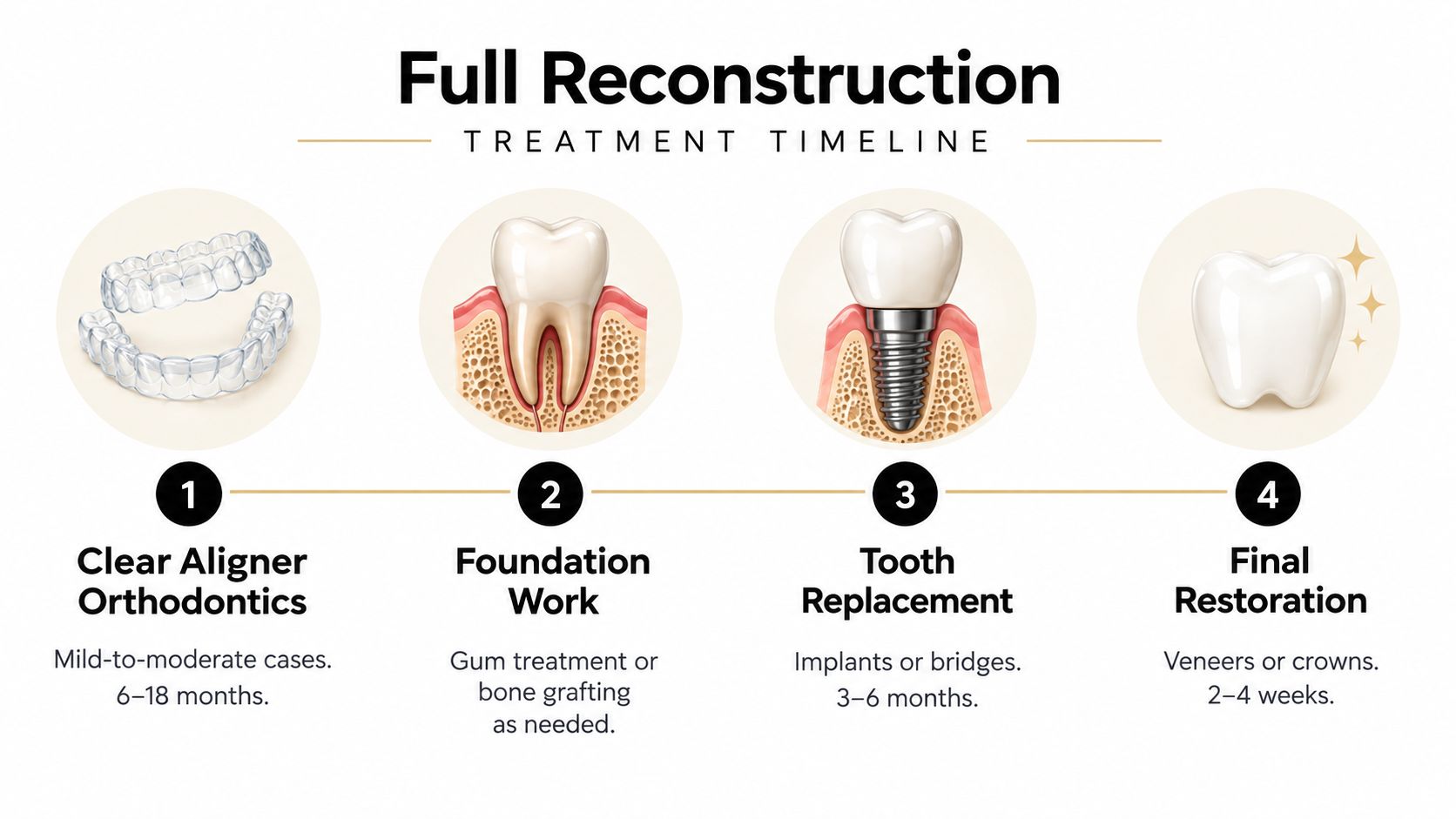
A full reconstruction follows a different logic from cosmetic-only care. The dentist may need to move teeth, rebuild bone or gum support, replace missing teeth, and then complete the visible restorations. Each phase has a clinical purpose, so the sequence can't always be rearranged to fit a preferred deadline.
Clear aligner orthodontics
Clear aligners from The Dental Retreat may be appropriate for selected alignment problems. Mild-to-moderate malocclusions commonly require about 6 to 18 months of uninterrupted wear, while complex cases may last 24 months or longer, according to a 2024 review in the European Journal of Orthodontics.
For mild-to-moderate non-extraction cases, systematic-review summaries place median treatment duration at roughly 14 to 22 months. Extraction cases can take longer. One review reported averages of approximately 22.3 ± 4.6 months for cases involving extraction of two premolars and 21.0 ± 4.2 months for extraction of four premolars, although those figures don't predict an individual patient's result.
Missed wear time can prevent trays from tracking correctly. That may lead to refinement scans and additional aligners, which is why daily compliance forms part of the timeline.
Implants and full-arch treatment
A single dental implant may require extraction, socket healing, bone grafting, implant placement, osseointegration, gum healing, and final crown delivery. The implant itself usually needs 3 to 9 months to integrate with the jawbone before the definitive restoration is attached, as explained in the earlier Cleveland Clinic source.
Bone grafting or infection treatment can add another healing interval. You may receive a temporary tooth during this time, but a temporary restoration doesn't mean the permanent implant smile is complete. Patients considering Dental implants near me should ask which milestone controls final delivery. The dental implant healing timeline depends on bone, tissue, implant stability, and the type of restoration.
Full-arch approaches such as All-on-X may provide temporary fixed teeth on the day of surgery. The American Academy of Implant Dentistry describes a typical sequence involving imaging, implant placement, temporary teeth, follow-up during approximately six months of healing, and later delivery of permanent teeth in its explanation of the teeth-in-a-day concept. “Teeth in a day” generally means temporary teeth are placed promptly, not that every stage is finished that day.
When orthodontics and implants must be combined, the timeline can approach two years. The American Academy of Implant Dentistry notes that braces may add 6 to 12 months to an implant journey that may already run 6 to 12 months, depending on the case.
What Can Make a Smile Makeover Take Longer
A brochure estimate often describes the uncomplicated pathway. Your personal timeline may extend because the dentist finds a condition that must be treated before cosmetic work can remain healthy and stable.
Health and foundation factors
Untreated gum disease can cause bleeding, inflammation, recession, and unstable tissue around future restorations. A tooth may need a filling, root canal treatment, or tooth extraction before a veneer or crown is appropriate. Extraction followed by socket preservation or bone grafting adds clinical appointments and healing time.
A bite problem can also change the sequence. Your dentist may recommend bite adjustment, restorative correction, or TMJ-focused care before placing final cosmetic restorations. Protecting function matters because a beautiful result that cannot tolerate normal chewing isn't a successful makeover.
Faster isn't automatically better. A staged plan often finishes sooner than cosmetic work that must be removed and redone.
Patient and discoloration factors
Missed appointments create gaps between phases. Missed aligner wear can lead to poor tracking and refinements. Resistant discoloration can also change the estimate. Tetracycline-related staining may require approximately 3 to 4 months of nightly treatment on average, according to the American Dental Association's summary of whitening evidence.
The practical answer to how long does a smile makeover take comes after diagnosis, not before it. A local exam identifies whether you need an emergency dentist for pain or infection, periodontal care, alignment, cosmetic dentistry, restorative dentistry, or dental implants. That sequence is more valuable than a generic promise based only on the visible appearance of your teeth.
Planning Your Visit and Next Steps in Katy
Your first visit should leave you with more than a treatment name. Whether you're coming from Katy, Sunterra, Cane Island, Elyson, or Anniston, you should understand what needs attention first, which appointments can happen together, and when you'll see a temporary versus final result.
The Dental Retreat offers a calm setting with aromatherapy, heated massage chairs, noise-cancelling headphones, and TVs in every room. Extended hours and bilingual care can make longer treatment easier to fit around work and family responsibilities. Options include a $99 new-patient special, a $49 problem-focused visit, a $350 Zoom whitening special, and membership plans starting at $299 per year.
Request a consultation and diagnostic workup so your dentist can assess your gums, teeth, bite, bone, and cosmetic goals. You'll leave with a phased timeline built around your actual needs, rather than an estimate that treats every smile makeover as the same procedure.
The Dental Retreat provides dental care in Katy, including whitening, veneers, clear aligners, restorative dentistry, tooth extraction, emergency services, dental implants, and full-arch treatment. Visit The Dental Retreat to request a consultation and learn how long your personalized smile makeover is likely to take.