An uninsured root canal in the U.S. commonly costs about $700 to $2,100 depending on the tooth, with molars at the top of that range. That procedure-only figure is rarely your final bill.
You may be calling between work meetings because a tooth hurts when you chew, or comparing estimates while wondering how you'll pay without dental coverage. The most useful answer isn't the lowest advertised price. It's a written explanation of what it will cost to diagnose the problem, treat the tooth, and finish restoring it.
If you're searching for a dentist near me in Katy, TX, start with a problem-focused appointment and a complete treatment estimate. You shouldn't have to guess whether dental X-rays, a buildup, or a permanent crown will become separate charges later.
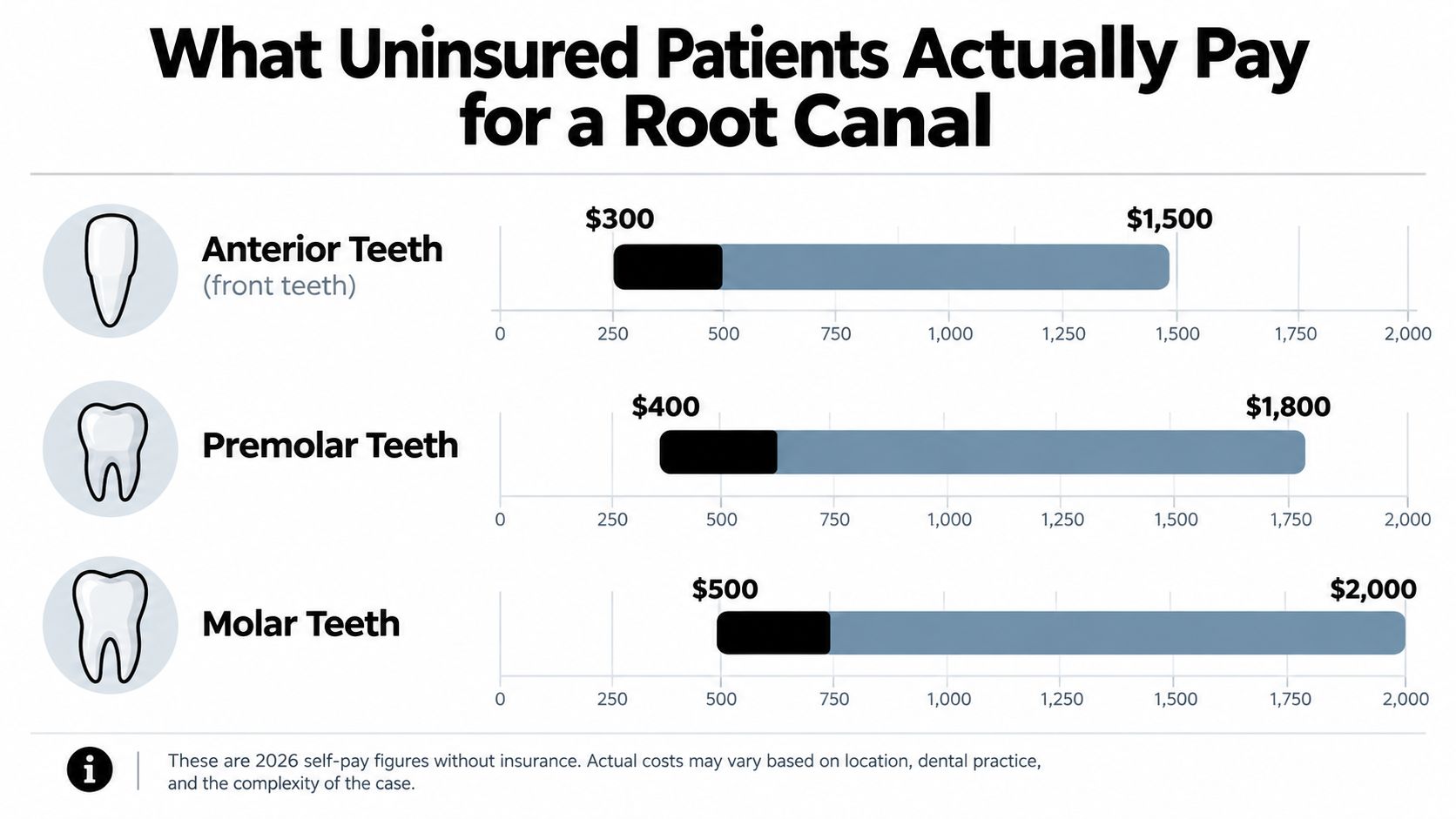
What Uninsured Patients Actually Pay for a Root Canal
National uninsured estimates vary substantially by tooth. GoodRx's root-canal cost summary lists approximately $776 to $1,911 for a front tooth, $757 to $1,798 for a bicuspid, and $1,030 to $2,471 for a molar, with cash-pay averages around $1,200.
Those ranges are a starting point for a phone conversation, not a guaranteed fee for your tooth. They also show why the commonly quoted opening range isn't a hard ceiling. A complicated molar can exceed it.
Use the chart as a visual guide to tooth-based pricing, then rely on an itemized local estimate rather than assuming an illustrated range applies to your case.
Separate the treatment fee from the finished tooth
When you ask, “How much does a root canal cost without insurance?”, ask a second question immediately: “Does that include the permanent restoration?”
A quote for cleaning and sealing the inside of the tooth isn't necessarily a quote for completing your dental care. The dentist must also decide how to protect and rebuild the tooth afterward. Compare estimates only after you know where each treatment plan ends.
Practical rule: Compare the cost of a finished, restored tooth, not just the price attached to the words root canal.
Put local estimates in context
For Katy patients, Houston-area pricing is more useful than assuming a national average will match a neighborhood office. Still, even a nearby published estimate can't account for your tooth's condition, the treating provider, or the restoration you need.
When you call from Sunterra, Cane Island, or Katy Manor, explain whether you already have a diagnosis and whether the tooth has been treated before. Ask the scheduling team which visit will establish an accurate fee.
Bring any existing written estimate. Don't treat a higher total as automatically unreasonable or a lower total as automatically better. First check whether both plans cover the same services and the same stage of completion.
Why Front Teeth, Premolars, and Molars Cost Different Amounts
The dentist is treating the inside of a specific tooth, not performing an identical service on every tooth. The number and shape of its canals help determine how much work is involved.
The tooth-complexity explanation and fee analysis summarized by Gale describe how additional roots and canals increase treatment time, instrumentation, and imaging needs. Its ADA Health Policy Institute benchmark places average endodontic-therapy fees at approximately $754 for an anterior tooth and $1,099 for a molar in inflation-adjusted 2015 dollars, excluding the final restoration. These are historical comparison figures, not current Katy prices.
The anatomy comparison below illustrates why the tooth's location matters, although your dentist must assess the actual canal anatomy.

What the tooth's position tells you
Front teeth generally present a less extensive canal system than back teeth. Premolars fall between front teeth and molars in the usual pricing pattern, but the tooth category alone doesn't tell the dentist everything.
Molars require attention to a more extensive internal system. The dentist must locate and treat the canals rather than just fill an opening in the chewing surface. That difference explains why a back-tooth estimate can be higher even when the visible damage looks small.
Ask the office to identify which tooth needs treatment. Descriptions such as “a tooth on the upper left” are useful when scheduling, but the written plan should identify the tooth precisely.
Understand what treatment is intended to accomplish
Root-canal treatment addresses damaged or infected tissue inside the tooth. Cleaning and sealing that internal space is different from repairing its outside surface, which is why endodontic treatment and restorative dentistry appear as separate parts of a plan.
The intended benefits are relief from the tooth's underlying problem and preservation of a usable natural tooth when it can be restored. Ask your dentist to explain what the diagnosis means for comfort, chewing, and the tooth's outlook.
- Ask about the diagnosis. Which findings make root-canal treatment necessary?
- Ask about anatomy. Is this a straightforward case or a more complicated canal system?
- Ask about predictability. What could change the recommended treatment after the dentist evaluates the tooth more closely?
You don't need to learn technical terminology. You do need a plain-language explanation of why your tooth requires the proposed care.
The Line-Item Charges Hidden Inside a Root Canal Quote
An uninsured treatment plan can contain several separate services. Itemized doesn't mean overpriced. Incomplete is what makes a quote difficult to trust.
The following Typical Uninsured Charges in a Root Canal Treatment Episode come from Lovett Dental's published root-canal and crown billing breakdown. These are general benchmarks, not this practice's fees; the final column identifies what you should verify rather than promising how an office bundles charges.
| Service | Typical Uninsured Range | Often Included in Root-Canal Quote |
|---|---|---|
| Examination or consultation | $50 to $200 | Don't assume, confirm separately |
| Dental X-rays | $25 to $250 | Verify the imaging included |
| Root-canal treatment | $700 to $2,100 | This is the central procedure charge |
| Core buildup | $200 to $500 | Ask whether it's separate |
| Temporary restoration | Up to $300 | Confirm temporary protection |
| Final crown | $900 to $2,000 | Don't assume it's included |
| Follow-up care | Up to $200 | Ask which follow-up services are covered |
Questions to pair with each charge
For the examination, ask whether the quoted visit is a new patient exam, a specialist consultation, or a problem-focused evaluation. If you've booked emergency dental services, ask whether that evaluation is credited toward treatment.
For dental X-rays, ask which images are included and whether additional imaging could be needed. A general phrase such as “imaging included” should be clarified before you authorize care.
A core buildup rebuilds the supporting portion of the tooth before the final restoration. If the plan also lists a post, ask why it's needed and whether its fee is included in the buildup or listed separately.
Don't sign a treatment plan with an unexplained blank where the permanent restoration should be.
Make the endpoint explicit
Ask what will be in your mouth when each appointment ends. Temporary protection and a completed permanent crown aren't interchangeable endpoints, and you should know which one the quoted payment covers.
Other possible entries include an emergency visit, anesthesia, sedation, or additional specialist evaluation. There isn't a universal fee you can safely assign to those services without a provider's estimate.
Finish the review with this question: “What could I still owe after paying this total?” Ask the team to identify known separate charges and explain how they'll communicate any changes. That conversation is more valuable than a verbal assurance that the price is “all-inclusive.”
Root Canal and Crown Versus Extraction and Implant
Compare complete treatment plans, not a root canal against extraction alone. Saving a tooth and removing it are different decisions, and replacing a removed tooth introduces another set of services.
Historical ADA-survey-based figures summarized by Jackson Ave Dental put combined root-canal-and-crown treatment at approximately $2,155, with a reported range of $1,590 to $3,072. Separately, a Houston-area complete-treatment pricing guide estimates an uninsured molar episode at roughly $3,500 to $5,000 including treatment, buildup, and crown.
Those figures describe different benchmarks. Neither is a guaranteed local quote, and the historical average shouldn't be presented as today's price.
Use this comparison to frame the services involved, not as a substitute for individualized estimates.

Compare the clinical choice and the financial choice
For saving the tooth, ask whether the dentist considers it predictably restorable. A treatment plan should explain both the root-canal recommendation and the restoration needed afterward.
For tooth extraction, ask what the plan includes after removal. If replacement is recommended, request a separate complete estimate for a dental implant, bridge, or partial denture.
There's no verified implant-price benchmark to apply universally here. If you're searching for dental implants near me, insist on a personalized replacement plan rather than comparing an advertised implant starting price with a finished tooth-saving total.
| Decision question | Save the tooth | Remove and consider replacement |
|---|---|---|
| What must be assessed? | Whether the tooth can be treated and restored | Whether removal and replacement are appropriate |
| What needs pricing? | Treatment and final reconstruction | Removal and the selected replacement pathway |
| What should you ask? | What is the tooth's expected outlook? | What happens if replacement is delayed or declined? |
For more help discussing those choices, review the practice's root canal versus extraction guide.
This video provides another way to consider the treatment decision before your consultation.
My recommendation is straightforward: choose the clinically appropriate option you can plan to complete. Don't pay to preserve a tooth without understanding its outlook, and don't choose removal solely because its immediate fee looks smaller.
Endodontist Versus General Dentist and the Cost of Sedation
A specialist referral can change both where you receive care and how the bill is assembled. It shouldn't leave you wondering whether the original estimate still applies.
DentalPlans' uninsured root-canal guide lists procedure-only ranges of $700 to $1,100 for anterior teeth, $800 to $1,300 for premolars, and $1,000 to $1,600 or more for molars. It also identifies specialist evaluation, retreatment status, and curved roots as factors that can materially increase the fee.
Don't treat a referral as an automatic reason to reject treatment. Ask what the specialist will address and request an updated estimate before making a financial commitment.
Clarify who handles each part
A general dentist may handle an appropriate root-canal case, while an endodontist focuses on treatment inside the tooth. The recommendation should depend on the case, not on which provider has the lower advertised price.
Curved or calcified canals and previously treated teeth deserve an explicit discussion. Ask whether the proposed care is initial treatment or retreatment, and whether additional procedures are being considered. Don't assume every complex tooth requires surgery.
- Confirm the treating provider. Will the root canal happen at the local practice or after referral?
- Confirm consultation charges. Is the specialist evaluation included in the estimate?
- Confirm the handoff. Who will provide the buildup and permanent restoration?
- Confirm estimate ownership. Which office will explain charges if the plan changes?
Ask whether existing records can be forwarded. That doesn't guarantee that further imaging won't be necessary, but it gives the receiving clinician the information already available.
Separate numbing from sedation
Local anesthesia and sedation aren't the same service. Ask what the base treatment fee includes for comfort and what would be charged separately.
If you're anxious, discuss options such as nitrous oxide, oral sedation, or IV sedation with the treating clinician. Availability and suitability require confirmation; don't assume every option is offered for every appointment.
Budget safeguard: Have the office quote your chosen comfort plan before treatment day, not after you've arrived expecting it to be included.
Ask whether sedation is priced per visit or by another billing method, and request preparation and transportation instructions. Tell the team about medications, health conditions, and previous sedation experiences.
At a Katy practice with sedation services, the useful conversation is specific: what you need, what the clinician recommends, and what that choice adds to your written plan.
Payment Plans, Membership Savings, and Smart Questions to Ask
Being uninsured doesn't mean you've failed to plan. CareQuest Institute's 2025 oral-health equity report reports that about 26% of U.S. adults had no dental insurance, with uninsured adults under age 65 particularly likely to go without needed care because of cost.
Start by separating two questions: Can the total cost be reduced, and can payment be spread out? A discount affects the price. Financing affects when you pay and may introduce additional costs.
Use this checklist to identify payment pathways, then verify actual terms rather than relying on illustrated savings claims.

Check savings before applying for financing
Ask whether a dental membership plan reduces the specific services on your treatment plan. Look beyond included cleaning and exams: confirm whether root-canal treatment, restorative work, and specialist care qualify.
For an in-office special, ask about eligibility, exclusions, and whether it can be combined with membership pricing. A promotional examination fee isn't a discounted root canal unless the written terms say so.
If you have an HSA or FSA, check eligible expenses and account requirements with your plan administrator. Don't assume funds are available or that every related charge qualifies.
Dental-school clinics, community health centers, and public or charitable assistance are additional avenues to investigate if private self-pay care is beyond your budget. Ask about eligibility, availability, and whether the needed treatment is provided before relying on that pathway.
Ask about the entire payment obligation
For third-party financing, review interest, fees, credit approval requirements, and promotional repayment conditions. Choose based on the total amount you'll owe, not just an attractive monthly payment.
Ask whether clinically appropriate staged treatment can spread payments across appointments. The dentist should define the safe sequence and timing; don't create your own delay between treatment and necessary restoration.
- Visit credit. Is the emergency evaluation payment credited toward recommended treatment?
- Written discounts. Which services receive membership or promotional pricing?
- Financing terms. What will I owe if I don't meet the promotional conditions?
- Treatment changes. What happens financially if the tooth can't be saved?
- Safe timing. Which services can be staged without compromising the plan?
The practice's guide to affording dental care without insurance can help you prepare for that conversation.
Delaying evaluation isn't a payment plan. Prompt assessment helps you understand the problem and preserve available choices before you commit to an expense.
Plan Your Visit to The Dental Retreat in Katy, TX
For patients in Kingscrossing, Lakehouse, Marisol, The Grange, Anniston, Katy Lakes, Elyson, and Ventanna Lakes, start with a visit that matches your concern. Tell the scheduling team if you need an emergency dentist for pain rather than a routine preventive appointment.
Bring existing X-rays or estimates, a medication list, and your questions about payment. Share your budget directly so the team can discuss practical options.
Request your written estimate
Federal self-pay pricing protections summarized by CoveredUSA provide for a written Good Faith Estimate before scheduled care or when requested, identifying itemized expected charges, applicable CDT procedure codes, and total expected cost. Ask for that document and clarify any separate provider charges.
The practice on Stockdick School Rd. offers general, endodontic, restorative, implant, and sedation services in a calm setting. If you also searched for a cosmetic dentist near me, mention those goals, but prioritize the painful tooth before elective teeth whitening or other cosmetic dentistry.
The Dental Retreat offers a $49 problem-focused visit, a $99 new-patient special with cleaning and X-rays, and membership plans starting at $299 per year. Visit The Dental Retreat to request an appointment, confirm offer eligibility, and ask for an itemized root-canal treatment estimate that identifies what's included and what may remain due.