A back molar throbs when you drink something hot, then aches long after you've put the cup down. You're chewing on the other side, sleeping poorly, and wondering if the tooth can be saved or if it's headed for removal. Searching for a dentist near me or an emergency dentist in Katy, TX makes that question feel urgent, not theoretical. The choice between dental implants vs root canal treatment is not about which procedure sounds more modern. It depends on what your specific tooth can still do, what each option requires of you over months and years, and what happens if the first plan needs follow-up care.
Dental Implants vs Root Canal at a Glance
Say you're a Katy, TX patient with a throbbing molar, trying to decide whether to save it or replace it. It's the same question many neighbors in Sunterra, Cane Island and Elyson bring to a new patient exam. The core difference is simple. Root canal therapy keeps your natural tooth by removing infected pulp and sealing the root, while a dental implant replaces a tooth that's missing or can't be saved with a titanium post, an abutment and a crown.
Root Canal Therapy and Dental Implants on Key Criteria
| Criterion | Root canal therapy | Dental implant |
|---|---|---|
| Main purpose | Saves a natural tooth with infected or inflamed pulp | Replaces a missing tooth or one that cannot be saved |
| Natural tooth kept | Yes, the root is cleaned, filled and sealed | No, the tooth is removed first if still present |
| Typical visits | Usually one or two appointments for the canal work | Several appointments spread over several months |
| Final restoration needed | Crown in most molars and many front teeth | Abutment and crown placed on the implant |
| Surgery involved | No surgery to the jawbone | Yes, placement of a titanium post in the jawbone |
| Usual way it fails | Re-infection, crack or root fracture, sometimes leading to extraction | Gum inflammation around the implant, screw loosening or crown repair |
That table doesn't pick a winner, and that's intentional. A 2025 systematic review comparing root canal treatment with implant-supported restorations found both treatments commonly showed survival rates above 95%, with reported failure rates ranging from 0.7% to 12.0% and no statistically significant overall difference in failure. Root canal treatment showed a slight advantage in treatment success under some definitions.
A headline survival number can't tell you whether your tooth has enough healthy structure left to hold a crown.
So the decision turns on your tooth, not a ranking. If the structure is sound, preserving it can be reasonable. If it can't predictably be saved, extraction and replacement enter the conversation. The pages below walk through how each option works, how long it lasts, what recovery feels like, and what it costs over time, so you can talk with a dentist in Katy, TX from a clearer starting point.
Signs a Tooth Needs Root Canal or Replacement
Pain is usually what gets your attention first. Lingering sensitivity to hot or cold that stays after the drink or food is gone is different from a brief zing that fades in seconds. Throbbing pain that wakes you at night, hurts when you bite, or seems to pulse on its own also points deeper than the enamel.
What Those Symptoms Usually Mean
Inside each tooth sits the pulp, soft tissue with nerves and blood vessels. When deep decay, a crack, or repeated dental work lets bacteria reach it, the pulp becomes inflamed or infected, and pressure inside the tooth has nowhere to go. That's why the pain lingers. A bump or pimple on the gum, swelling, a bad taste, or a tooth that darkens can signal infection draining from the root tip. Our guide to signs you need a root canal walks through these warning signs in more detail.
Other situations point toward replacement instead. A tooth already lost to decay, trauma or gum disease needs a plan to fill the gap. So does a tooth with too little structure left above the gum to hold a crown, or a root that's fractured lengthwise.
How Your Dentist Interprets the Signs
Symptoms alone don't decide treatment. The American Association of Endodontists guide to root canal treatment lists the factors that shape the choice, including the tooth's location, the quality and volume of supporting bone, periodontal health, whether enough healthy tooth structure remains for predictable restoration, and systemic health factors. Dental x-rays and a careful exam show whether infection can be controlled and whether the tooth can be rebuilt.
If extraction is chosen, the missing tooth generally needs replacement with an implant or bridge to restore chewing and help prevent neighboring teeth from shifting. For tooth loss across a full arch, an All-on-4 implant-supported restoration may be discussed.
If you're in pain now, don't wait for it to settle on its own. The Dental Retreat in Katy, TX offers endodontic, implant and emergency care, including a $49 problem-focused visit for urgent pain, so you can get a diagnosis before the options narrow.
How Root Canal Therapy Works Step by Step
Root canal therapy has a reputation it doesn't deserve. With modern numbing and magnification, most patients describe it as no more uncomfortable than a standard filling. The goal is straightforward. Remove the infected tissue, disinfect the inside of the tooth, seal it, then protect what's left.

The Seven Steps and Why Each One Matters
- Exam and X-rays: Your dentist confirms the diagnosis and studies the root shape, since canals curve and branch differently in every tooth. This step also checks whether enough structure remains to restore the tooth afterward.
- Local anesthetic: The tooth and surrounding area are numbed so you feel pressure, not pain. A rubber dam often isolates the tooth to keep it clean and dry during treatment.
- Access opening: A small opening is made through the crown to reach the pulp chamber. This gives a straight path into each canal without removing more tooth than necessary.
- Pulp removal: The infected or inflamed pulp is taken out of the chamber and canals with fine instruments. Removing this tissue removes the source of most of your pain.
- Cleaning and shaping: The canals are cleaned, shaped and disinfected so bacteria and debris don't remain sealed inside. When infection is severe, medication may sit in the tooth between visits, so this stage sometimes takes more than one appointment.
- Filling and sealing: The empty canals are filled with a biocompatible material and sealed. A tight seal matters because it helps keep bacteria from re-entering the root.
- Temporary, then permanent restoration: A temporary filling closes the opening at first. A permanent crown follows to protect the tooth from fracture and restore normal chewing.
What You'll Notice Afterward
Some tenderness for a few days is common as tissues around the root calm down, and over-the-counter pain relievers usually handle it. Avoid chewing hard food on the tooth until the crown is placed, because a treated tooth without its final restoration can crack under bite pressure.
Practical rule: The crown isn't an optional extra. It's the part that lets the saved tooth handle daily chewing.
That's why the crown appointment is usually scheduled soon after the canal work finishes. Think of root canal therapy and the crown as one treatment in two parts. Skipping the second part puts the first part at risk, even if the tooth feels fine.
How Dental Implant Treatment Unfolds Over Several Months
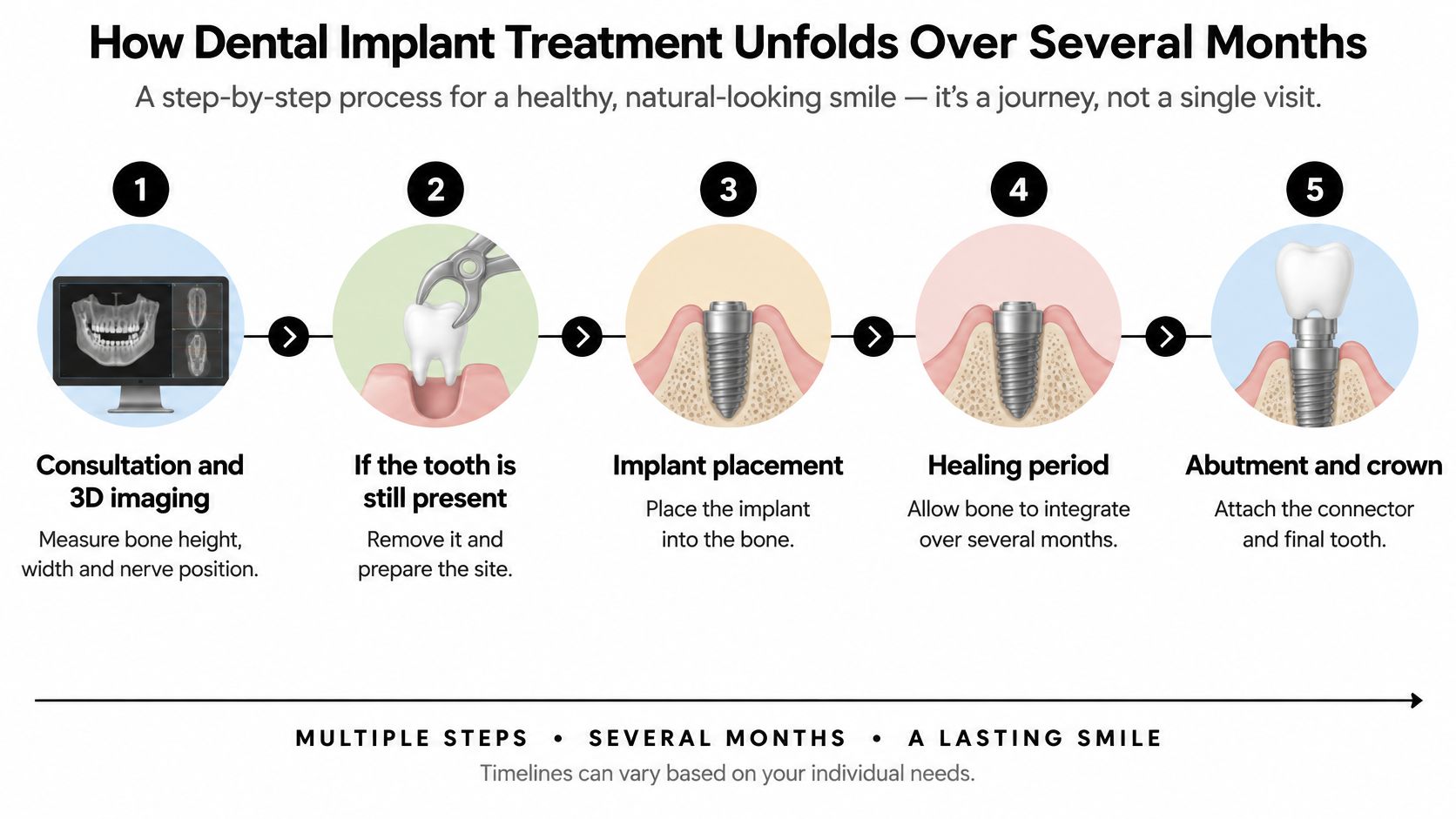
An implant isn't a single visit. It's a staged process where each phase sets up the next, and the waiting periods aren't delays. They're healing time your bone needs. For dental implants near me in Katy, understanding that timeline helps you plan work, family and budget around it.
From Planning to Placement
Treatment starts with a consultation and 3D imaging. The scan measures bone height and width and shows where nerves and sinuses sit, so the implant can be positioned safely and at the right angle for the future crown. Your dentist also reviews gum health and medical history at this stage.
Next, if the failing tooth is still present, it's extracted. When the socket has lost volume, bone grafting may be added to rebuild support for the implant. Some patients can move to placement quickly, while others heal first. The titanium implant is then placed in the jawbone under local anesthesia, with sedation available for anxious patients.
Healing Is Where the Real Work Happens
After placement comes osseointegration. In plain terms, your bone grows around the post and anchors it like a natural root. This typically takes several months before the final tooth is attached, and loading the implant too early can disturb that bond. The upper jaw often takes longer to heal than the lower jaw because its bone is usually softer.
Our overview of the dental implant healing timeline explains what to expect at each stage. Patients who smoke or have uncontrolled diabetes may need a longer or more careful plan, since both can slow healing. In some cases, a temporary tooth can be worn during healing for appearance and light function, as long as it doesn't press on the implant.
Once integration is confirmed, the abutment, a small connector, is attached to the post. Impressions or digital scans are taken, and your custom crown is made to match neighboring teeth. At the final visit, the crown is fitted and your bite is adjusted so chewing forces spread evenly. The Dental Retreat's implant team plans each stage around your bone, gum health and goals, so you know the sequence before the first appointment.
How Long Each Option Lasts and What Success Really Means
You'll see a lot of percentages when you compare these treatments, so it helps to know what they count. Survival means the tooth or implant is still in place. Success asks more. It asks whether it works well, without pain, infection or ongoing complications. A treatment can survive without fully succeeding, which is why two honest numbers can look very different.
Long-Term Survival of Root Canal Teeth and Implant Single Crowns
| Follow-up period | Root canal and restoration | Implant-supported single crown |
|---|---|---|
| 2 to 4 years | 94% | 96% |
| 4 to 6 years | 94% | 97% |
| Beyond 6 years | About 97%, based on fewer studies | About 97%, with a 96% to 98% confidence interval |
Those figures come from a systematic review summarized in the U.S. National Library of Medicine Bookshelf comparison, which reported 94% survival for root canal therapy and restoration versus 96% for implant-supported single crowns at 2 to 4 years, and about 97% for both beyond 6 years. Read them as broad reassurance that both options can last, not as a promise for your tooth.
Why the Columns Are Hard to Compare Directly
Implant studies often report survival, while root canal studies often use stricter success criteria that require complete healing on an X-ray and no symptoms. That mismatch can make implants look better on paper even when real-world outcomes are close. One large retrospective study illustrates the caution needed. In a study of 13,434 patients, overall survival was 98.3% for implants compared with 72.7% for root canal treatment, a difference reaching statistical significance at p < 0.001, yet 58.8% of implant removals occurred during the first year, compared with 35.2% of root-canal-treatment failures in that same period. Patient selection, follow-up length and the definition of failure all shape results like these.
What shapes your result is more specific. Remaining tooth structure, gum health, smoking, diabetes, the quality of the final crown and daily hygiene all matter. An implant may stay in place while needing tightening, component replacement or bite adjustment, whereas a root canal tooth that fails often ends in extraction. Ask for a tooth-specific prognosis instead of relying on a generic percentage.
Recovery Time and Aftercare for Each Treatment
Recovery is where these two paths feel most different day to day. Root canal aftercare is measured mostly in days. Implant aftercare stretches across a healing phase measured in months, even though the first week is usually the hardest part.
The First Few Days
After root canal therapy, expect mild tenderness when you bite, which usually responds to over-the-counter pain relievers. Chew on the other side and avoid hard or sticky foods on the treated tooth until your permanent crown is in place. Keeping that crown appointment on schedule is part of aftercare, not paperwork.
After implant placement, soreness, swelling and possible bruising for several days are normal. You'll eat soft foods early on while the site settles, and stitches are commonly removed in about one to two weeks. Cold compresses, rest and any prescribed medication help most patients through the first stretch comfortably.
The Healing Phase and Long-Term Routine
For implants, the longer phase is quiet but important. While bone bonds with the post, the site must stay clean and undisturbed, so you'll rinse gently and avoid probing the area with your tongue or fingers. For a root canal tooth, healing time mainly runs until the permanent crown is seated and your bite feels even again.
Long term, both options ask the same habits of you:
- Brush twice daily: Use a soft brush and clean carefully around the crown or implant where plaque collects at the gumline.
- Floss or use interdental brushes: Daily cleaning between teeth protects the gum support both treatments depend on.
- Keep professional cleanings: Routine cleaning and exams let your dentist spot gum inflammation early, which matters especially around implants.
Healthy gums protect both a saved tooth and an implant. Neither one is maintenance-free.
Call the office promptly if you notice fever, pain that worsens after the first few days, swelling that spreads, or a bite that suddenly feels different. Those signs are easier to address early. You can also raise aftercare questions before treatment begins, so your plan, time off and follow-up visits are clear before your first appointment.
What Each Option Costs Over Time
Most price comparisons stop at the first procedure, and that's where they mislead. A root canal fee doesn't include the crown. An implant fee may not include extraction, grafting or the final crown. The honest comparison covers every stage, plus maintenance and your time.
Cost Drivers That Patients Often Miss
| Cost item | Root canal path | Implant path |
|---|---|---|
| Initial treatment | Root canal procedure | Consultation, imaging, extraction if needed and implant placement |
| Final restoration | Crown on the treated tooth | Abutment and crown on the implant |
| Extra procedures | Retreatment or post placement if the canal fails | Bone grafting or gum treatment if bone or gum support is low |
| Ongoing care | Routine checkups and crown maintenance | Peri-implant cleanings and monitoring for gum inflammation |
| Time away from daily life | Usually a few short visits | Several months across multiple stages |
Long-term numbers show why the full picture matters. A long-term comparative analysis of endodontic treatment and implants reported nine-year survival of 83.4% for endodontic treatment versus 97.9% for implants, with mean cumulative costs of approximately USD 1,243 versus USD 2,667. In mandibular anterior teeth, root canal treatment had higher survival and function time at lower cost. The cheaper path isn't always weaker, and the pricier path doesn't always deliver more value.
Four Common Scenarios
A restorable molar usually means root canal plus crown over a few visits. A cracked tooth hinges on whether the crack reaches the root and whether what's left can hold a restoration. A failed root canal may allow retreatment, or it may mean extraction and an implant, adding stages either way. A front tooth with thin bone may need grafting before an implant, adding cost and time. Implant patients also experience more postoperative interventions, which can change the budget and schedule.
Ask for an itemized estimate covering every stage. Check how your benefits plan handles endodontic, crown and implant coverage and annual maximums, and ask what costs might appear over several years. Keep two questions separate. Is the tooth clinically saveable, and can you comfortably afford the path that fits.
Choose the Right Option for Your Tooth in Katy
No option is best for everyone, and that's not a cop-out. It's the honest answer. The right choice depends on your tooth's structure, your bone and gums, your health, and how much treatment you're willing to take on.
A consultation gives you a chance to see your own X-rays and hear both paths explained for your tooth:

Which Option Usually Fits Each Situation
| Situation | Usually favored | Main reason |
|---|---|---|
| Infected tooth with solid bone and enough healthy structure | Root canal therapy with a crown | The natural tooth can be kept and restored |
| Tooth with a vertical root fracture | Extraction, then implant or bridge | The root cannot be reliably saved |
| Tooth with little structure left or a failed earlier root canal | Extraction and implant, case by case | Restoration may not be predictable |
| Missing tooth with healthy neighboring teeth | Implant or bridge | Protects chewing and prevents shifting |
| Front tooth where appearance matters | Either, depending on bone and gum health | Bone volume and gum support decide the result |
| Loss across a full arch | All-on-4 implant-supported restoration | Fewer implants can support a full set of teeth |
Before you decide, ask four questions. What's my tooth's realistic outlook if we save it. How many visits and stages does each plan need. What's the next step if the first option fails. And what follow-up schedule should I expect over the next few years, not just the next few weeks.
This short video offers another view of how dentists weigh saving a tooth against replacing it:
Patients across Katy, including Cane Island, Sunterra and Elyson, can book a consultation at The Dental Retreat on Stockdick School Rd. in Katy, TX, where sedation options are available if dental visits make you anxious. You'll leave with a tooth-specific plan, clear costs, and time to decide without pressure.
If a painful or damaged tooth has you weighing root canal therapy against a dental implant, The Dental Retreat in Katy, TX can evaluate the tooth, review your bone and gum health with digital imaging, and lay out both paths with transparent, staged costs. New and existing patients from Sunterra to Elyson are welcome to schedule a consultation, and urgent tooth pain can start with a problem-focused visit. Reach out through The Dental Retreat to book your appointment and get a clear plan for your tooth.