Whitening should wait at least 30 days after bracket removal, and many clinicians prefer 1 to 3 months. White spots often need 3 to 6 months of remineralization before bleaching is considered.
You've finally had your braces removed, but the mirror shows yellow edges, chalky squares, or a darker patch where a bracket used to sit. It's understandable to want a brighter smile right away, especially when you've been looking forward to this moment.
For patients searching for a dentist in Katy, TX, the safest starting point isn't a stronger whitening gel. It's finding out what's causing the uneven color. At The Dental Retreat, we approach that conversation without judgment, with attention to your oral health, comfort, and goals for your finished smile.
When to Start Whitening After Braces
A Katy patient who notices chalky squares on removal day may hope to whiten that weekend. The better approach is to finish bracket and adhesive removal, check the teeth, and give the enamel, the tissue inside the teeth, and the gums time to settle.
A 2022 systematic review of whitening during and after orthodontic treatment found that whitening began 7 to 90 days after bracket removal, averaging 40.2 days, and concluded that low-quality evidence supports waiting at least 30 days. That's a reasonable minimum for assessment, not automatic clearance to bleach.
How long to wait before whitening after braces
The appearance of your teeth helps determine the next step. A uniform shade mismatch needs a different plan from opaque patches or painful gums.
| What you see after removal | Suggested wait | What to do first |
|---|---|---|
| Even color, healthy gums, no sensitivity | Complete the minimum recovery interval and receive clearance | Exam, shade photo, then choose an office-based or take-home approach |
| Routine orthodontist advice | Follow the individualized waiting period recommended after examination | Professional exam rather than same-week bleaching |
| White-spot or chalky patches | Allow a monitored remineralization period before cosmetic treatment | Fluoride home care and monitoring; bleaching isn't the repair |
| Sore gums, leftover glue, decay, or cracks | Until those problems are treated | Cleaning and any needed fillings or adhesive removal |
| Brackets still on | Don't routinely whiten | Wait for removal and evaluation of the entire tooth surface |
Professional advice often allows more recovery time than the minimum. In a 2021 survey of 133 orthodontists, 99.2% said their patients requested whitening, more than 80% preferred recommending it after bracket removal, 50% advised waiting 1 to 3 months, and 39.6% recommended longer than 3 months.
Those responses describe clinicians' preferences, not a rule that everyone needs the same delay. Your dentist should explain what needs to improve before you start, rather than just handing you a date.
Why patchy teeth sometimes need longer
A yellowish tooth and a chalky white patch aren't necessarily different degrees of the same stain. The patch may reflect a change within the enamel, so making the surrounding tooth lighter doesn't necessarily correct the problem.
Residual adhesive can also make a tooth look uneven. That material needs professional assessment and removal, not repeated applications of peroxide. A crack, cavity, or irritated gumline deserves attention before any cosmetic treatment.
Practical rule: Ask what the discoloration is before asking how quickly it can be whitened.
Whitening while brackets remain attached adds another concern: exposed enamel can respond differently from enamel beneath the brackets. An experimental review of bleaching and orthodontic appliances also describes reduced bracket bond strength associated with 35% hydrogen peroxide and 22% carbamide peroxide; laboratory findings support caution, but they don't predict whether an individual patient's bracket will fail.
Once the teeth are ready, the useful decision is which method fits your mouth, not which gel is strongest. A realistic plan should account for your starting shade, sensitivity, visible dental work, and ability to follow treatment instructions.
In-Office Whitening Compared With Take-Home Trays
Professional whitening can happen in the dental chair or through a dentist-directed home plan. Neither option should be selected just because your braces are off or an important event is approaching.
The main trade-off is direct supervision versus gradual control. In-office treatment keeps application and gum protection in the dental team's hands. Take-home treatment lets you follow a prescribed schedule between visits, with a tray and gel combination chosen for your teeth.
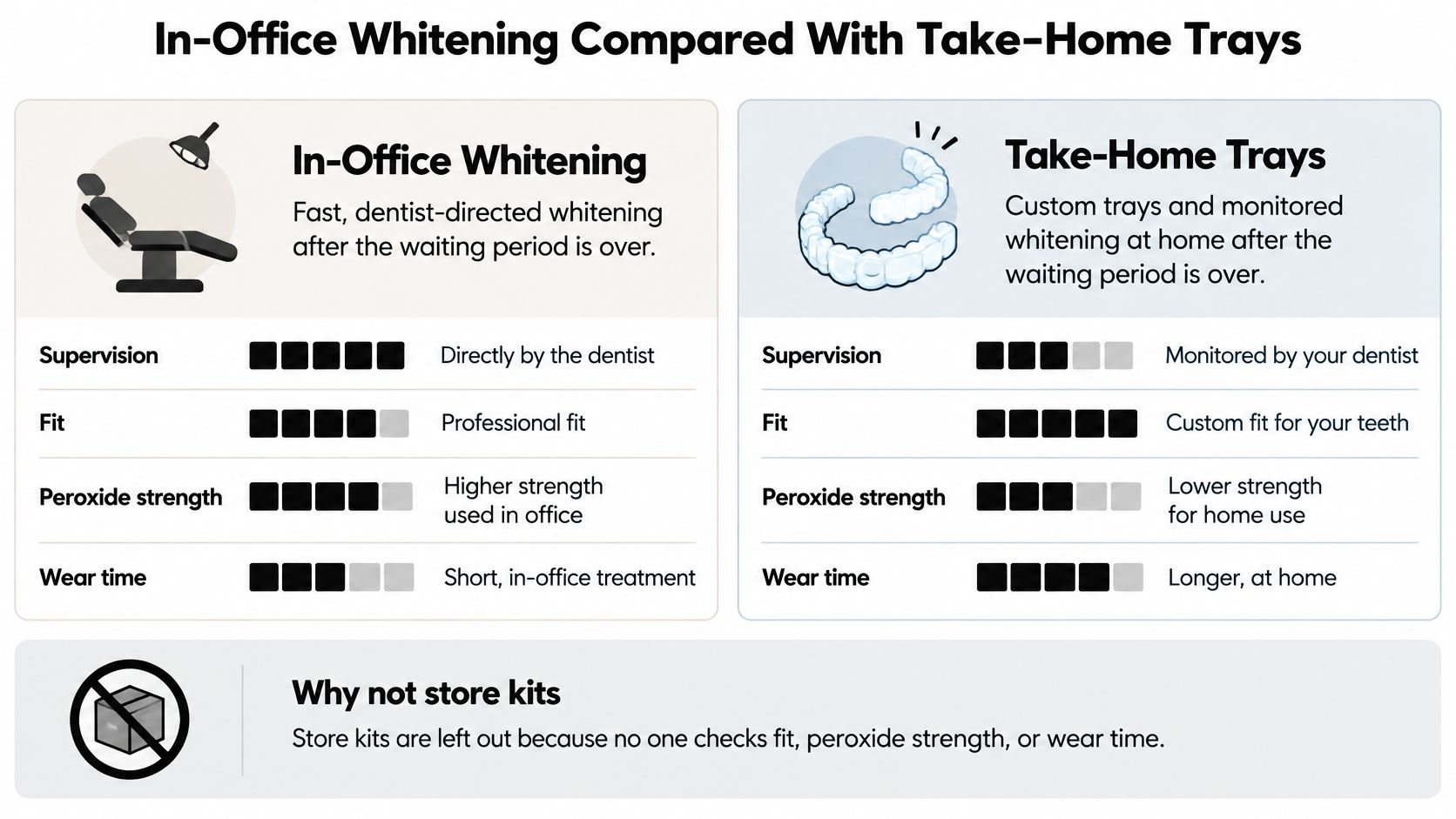
In-office versus take-home whitening after braces
| Factor | In-office visit | Custom take-home trays |
|---|---|---|
| Typical agent | Professionally selected hydrogen peroxide formulation | Dentist-selected home whitening formulation, often carbamide peroxide |
| Time to a visible change | Whitening is performed during a supervised appointment | Color develops across the prescribed treatment course |
| Sensitivity pattern | Symptoms can feel sharper after treatment | The schedule can be adjusted if sensitivity develops |
| Best fit | Healthy gums and a preference for supervised application | A preference for gradual treatment and willingness to follow a home schedule |
| Restorations and retainers | Existing dental work must be included in shade planning | The same shade-planning issue applies; tray fit must accommodate a bonded wire |
There isn't a universal treatment duration or peroxide strength that suits every post-braces patient. Products have different formulations, and wear instructions aren't interchangeable. Overnight use is appropriate only when the dentist specifically prescribes it for that product.
A clinical trial published in the European Journal of Orthodontics found that bleaching increased lightness and reduced yellow and red color measurements in orthodontically treated and untreated teeth, but the groups didn't respond identically. That's a reason to evaluate the entire smile instead of promising that every tooth will reach exactly the same shade.
Choose for comfort and consistency
In-office care may appeal to someone who doesn't want to manage gel application at home. It also allows the dental team to watch the gums and respond to discomfort during treatment. A supervised visit doesn't, however, guarantee that all uneven areas will disappear.
Take-home trays may suit someone who wants a more adjustable process. The responsibility shifts toward careful use: applying the prescribed amount, keeping to the wear schedule, and reporting irritation rather than pushing through it.
The best whitening method is one you can use comfortably and correctly, with a clear plan for checking the result.
For a bonded retainer, the tray must fit around the wire without pressing on it or leaving an unstable edge. Don't assume a removable retainer is also a whitening tray, even if it looks similar.
Store kits aren't included in this comparison because buying one doesn't include a clinical check of enamel, tray fit, peroxide strength, or wear time. Patients weighing professional approaches can review our guide to teeth whitening options before discussing their preferences at an examination.
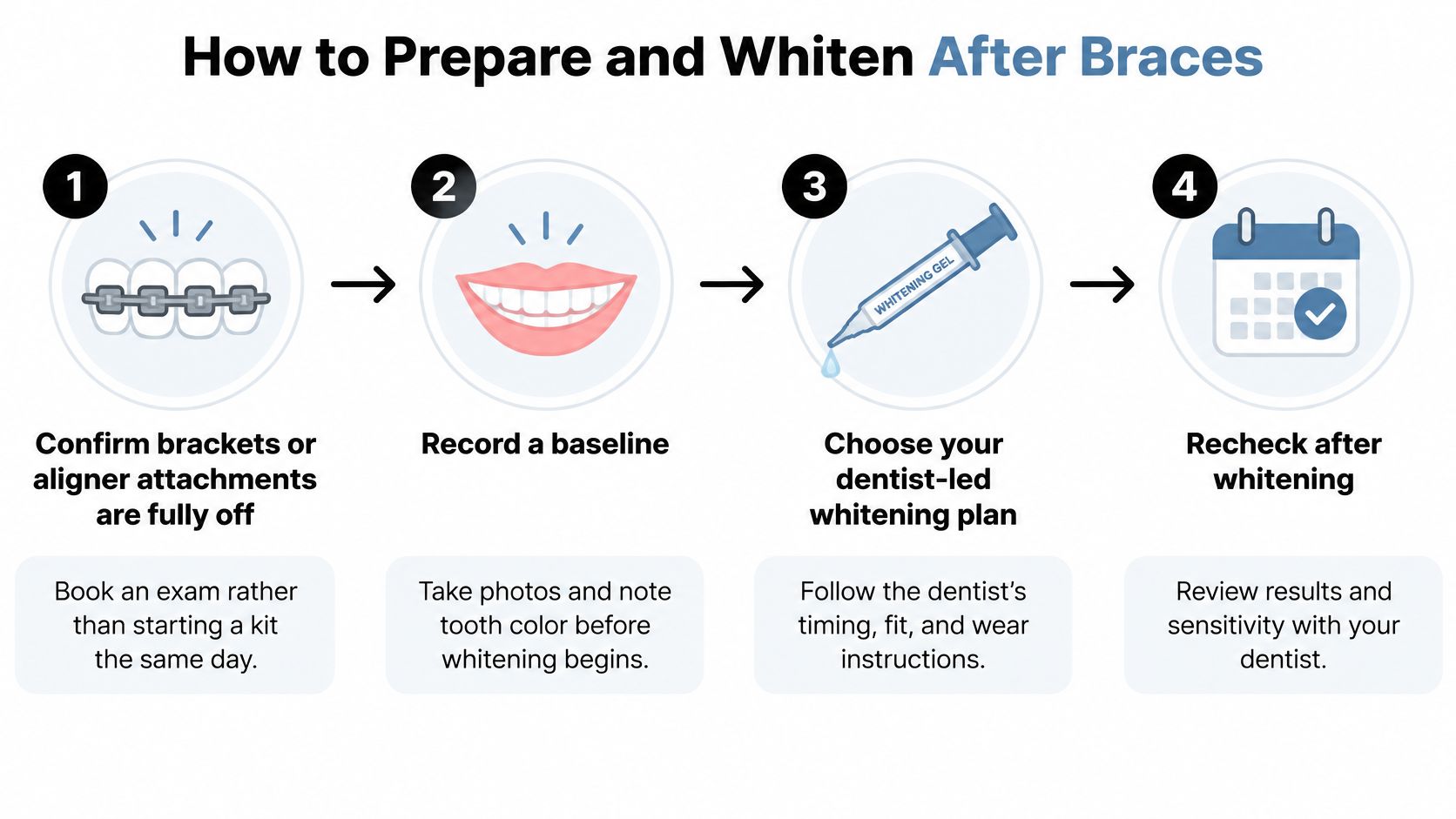
How to Prepare and Whiten After Braces
Preparation makes whitening a controlled treatment rather than trial and error. Bring the date your braces came off, details of any retainers, and a description of what bothers you most: overall yellowing, isolated marks, or a tooth that looks different from its neighbors.
The systematic review published through Redalyc supports examination, baseline shade recording, hygiene, and treatment of active disease before bleaching, with a minimum 30-day interval after bracket removal. For opaque white spots, it describes deferring cosmetic treatment for roughly 3 to 6 months, because early remineralization may continue for up to 6 months.
A dentist-led preparation sequence
Confirm that orthodontic removal is complete.
Have brackets or aligner attachments and remaining adhesive assessed before starting gel. The common mistake is assuming that anything visible after the removal appointment must be a stain.Record the starting shade before changing it. Consistent-light photographs and a shade guide help the dentist compare results fairly, while the exam checks for decay, cracks, gum inflammation, and chalky areas. Avoid judging progress from bathroom photographs taken under different bulbs.
Clean the teeth and treat active problems.
Professional cleaning may address deposits and surface staining before bleaching is needed. Fillings, gum care, or adhesive removal should come first when indicated, because whitening won't correct those conditions.Let the examination determine when you're ready. Healthy-looking enamel and persistent chalky patches shouldn't follow the same cosmetic timetable. Use the recommended fluoride home care and keep review appointments instead of repeatedly testing whitening strips.
Follow the selected gel and wear instructions exactly.
For trays, use the demonstrated amount and remove excess gel from the gumline as directed. More gel, stronger peroxide, and longer wear aren't shortcuts to a better result; stop and contact the dental team if pain becomes sharp or persistent.Reassess the finished shade before changing visible dental work. Don't rush to replace an otherwise sound restoration while the tooth color is still being evaluated. The dentist should decide whether polishing, repair, replacement, or no further treatment makes sense.
Protect your orthodontic result throughout treatment.
Keep wearing your retainer as prescribed and coordinate whitening around that schedule. Don't soak a retainer in peroxide or postpone needed retention while waiting to finish cosmetic care.
The visual below summarizes the main checkpoints to discuss at your visit.
Keep aftercare practical
Continue fluoride toothpaste and thorough cleaning between the teeth. Ask whether a remineralizing product belongs in your plan rather than adding several products with overlapping purposes. Rinsing with water after staining foods or drinks is a simple habit, but it doesn't replace brushing or professional care.
Coffee, red wine, and dark sauces can contribute to staining, so discuss realistic adjustments rather than attempting an overly restrictive diet. Your dentist should provide product-specific aftercare instructions and arrange a shade review before further treatment.
Consider a hypothetical Cane Island teenager whose teeth look clean after removal and whose exam finds no white spots. The family can use that visit to discuss whether whitening is appropriate, establish the recovery plan, and coordinate retainer use. They don't need to make every cosmetic decision on removal day.
For a patient with chalky patches, the same visit may lead to enamel care rather than bleaching. That's still progress: the patient leaves knowing what the marks represent, what to do at home, and what the dentist will reassess.
Sensitivity White Spots and Bonding That Will Not Whiten
Pause whitening if pain becomes severe or persistent. Mild temporary sensitivity and a painful tooth that needs diagnosis shouldn't be treated as the same thing.
This illustration highlights why a consultation should consider both discomfort and uneven enamel.
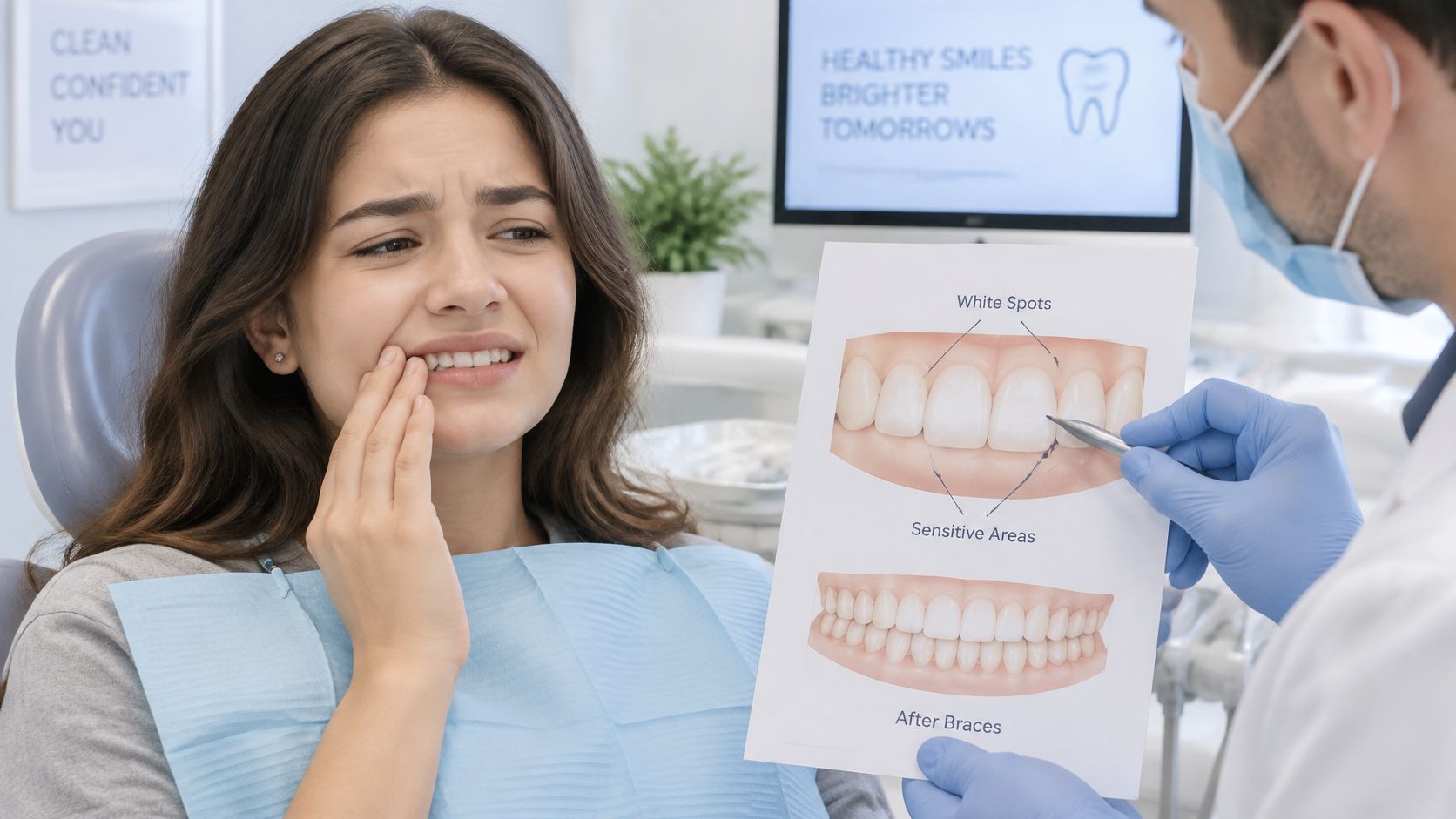
Manage sensitivity without chasing a stronger result
The American Dental Association's whitening guidance reports that temporary mild-to-moderate sensitivity can affect up to two-thirds of users early in bleaching; with strips or trays, it commonly begins within 2 to 3 days and usually resolves by approximately day 4 after treatment. Those patterns don't mean you should ignore worsening pain or continue until a deadline.
Tell the dentist about sensitive teeth and exposed roots before gel is applied. A well-fitting tray should limit contact with the gums, and the prescribed concentration and wear schedule should reflect your comfort. A potassium nitrate desensitizing toothpaste may be appropriate, but it shouldn't substitute for examining an isolated painful tooth.
White spots need a different diagnosis
The American Association of Orthodontists explains that plaque and acids retained around brackets can remove minerals from enamel. These marks aren't stains that the braces painted onto the teeth, and some early lesions may become less noticeable as plaque control and enamel health improve.
A systematic review of bleaching post-orthodontic white-spot lesions found one randomized clinical trial and eight laboratory studies, with very low-certainty evidence that could neither support nor refute bleaching as an effective treatment. Whitening may reduce contrast in some cases, but it can also leave a chalky area visibly distinct while surrounding enamel becomes lighter.
A brighter tooth isn't necessarily a repaired tooth. Appearance and enamel health need separate assessments.
For a hypothetical Kingscrossing patient with white squares on the front teeth, the useful question is whether those areas need stabilization or another lesion-specific approach. Fluoride care, monitoring, and possible appearance-focused treatment should be discussed according to the diagnosis, not selected from photographs alone.
This video can support your conversation with the dental team.
Adhesive and restorations aren't ordinary enamel
Bracket adhesive, composite bonding, crowns, and veneers shouldn't be expected to bleach like natural teeth. Applying more peroxide to a shade mismatch can increase discomfort without changing the material responsible.
Residual orthodontic adhesive should be assessed before whitening. Existing visible restorations should then be considered against the finished natural tooth shade, with replacement reserved for situations where it's appropriate.
Our explanation of cosmetic bonding can help you understand how tooth-colored material differs from enamel. If you have both leftover glue and a veneer, the sequence matters: address the adhesive first, plan whitening for the natural teeth, and then decide whether the veneer still matches acceptably.
Book a Post-Braces Whitening Visit in Katy
If your teeth look patchy after braces, start with an examination, not a whitening appointment chosen by shade alone. The uneven color may come from stains, mineral changes, or leftover adhesive, and each calls for a different plan.
At the first consultation, The Dental Retreat team reviews your oral health history, aesthetic preferences, and any concerns or anxieties. The office is on Stockdick School Rd. in Katy.
What to bring and discuss
Share when your braces came off, whether your teeth feel sensitive, and which areas look different. A retainer and a few earlier photos can help make the conversation more specific.
- Retainer details: Bring your removable retainer and mention any bonded wire.
- Earlier photographs: Photos showing the color or white spots before and after braces can help explain what has changed.
- Comfort concerns: Mention dental anxiety, previous whitening discomfort, or any tooth pain.
- Your priorities: Say whether you're concerned about patchiness, overall shade, or visible dental work.
The examination helps distinguish stain, mineral changes, and adhesive before whitening begins. X-rays may be appropriate depending on the findings, while visible enamel and gums need to be examined directly.
A clear local plan without pressure
Dr. Rabeea Afzal has helped patients with their smiles for over 10 years. The team can explain what to address before whitening and what to reassess afterward.
The Dental Retreat offers whitening, bonding, porcelain veneers, and smile makeovers. Digital Smile Design lets patients preview a planned smile with digital design tools before treatment starts. The new-patient in-office Zoom whitening special is $450. Flexible financing is available, and the practice may offer promotions, bundled pricing, or complimentary initial consultations. Sedation dentistry is also offered.
You don't need to decide on a procedure before you come in. Bring your questions and describe the uneven color you see. A personalized consultation can help you understand the options and choose a next step that suits your teeth and goals.
Visit The Dental Retreat to schedule a personalized consultation in Katy. Bring your retainer details and any photos of white spots to help start the conversation.