If a damaged tooth still has a healthy root, why replace it before finding out whether it can be saved? That's the question worth asking when you're comparing dental implants vs crowns in Katy, TX, especially if pain, a crack, or a missing tooth has made eating uncomfortable.
At The Dental Retreat, we help patients understand what's happening beneath the visible tooth before choosing a restoration. The right decision isn't about selecting the newer or more expensive option. It's about keeping a tooth when that's predictable and replacing it when it isn't.
Dental Implants vs Crowns Side by Side
The condition of your tooth decides the treatment. A conventional crown covers a damaged natural tooth that still has a usable root. A dental implant replaces a missing root with a titanium or zirconia post, and a custom crown becomes the visible replacement tooth.
That distinction clears up a common misunderstanding: an implant and a crown aren't always competing treatments. An implant usually needs a crown to complete the restoration. The meaningful comparison is a crown supported by your natural tooth versus a crown supported by an implant.
Dental implants vs crowns at a glance
| Question | Dental implant | Dental crown |
|---|---|---|
| What it replaces | Missing root and the visible tooth | Damaged crown of a tooth with a viable root |
| Surgery | Post placed in the jaw, then healing | Tooth shaped; no artificial root |
| Typical timeline | Often several months, with a temporary tooth | Often two visits once the tooth is stable |
| Neighboring teeth | Left untouched, unlike a bridge | Left untouched |
| Bite feel | No natural ligament; bite is checked carefully | Keeps the tooth's natural feel |
| Best fit | Tooth missing or not predictably restorable | Enough healthy tooth and root remain |
What the differences mean for you
Start with what remains below the gumline, not just what you can see in the mirror. A badly chipped tooth may still have a strong foundation. A tooth with a small-looking fracture may have deeper damage that makes a crown unreliable.
The surgical difference affects planning, too. An implant requires a healing period in the jaw, while a conventional crown uses the root you already have. Your calendar, comfort needs, and ability to manage a temporary restoration all belong in that conversation.
Neither option normally requires reshaping healthy neighboring teeth. That's particularly relevant when you're replacing a missing tooth and comparing an implant with a conventional bridge, which uses adjacent teeth for support.
Practical rule: Don't agree to remove a tooth until you understand what makes it restorable or non-restorable.
Both treatments can provide durable function, but a strong survival record doesn't identify the best choice for an individual tooth. The examination has to come first.
For patients from Katy, Sunterra, Cane Island, and Elyson searching for a dentist near me, The Dental Retreat maps the choice to the tooth, gums, bite, and personal priorities, rather than recommending the same restoration for everyone.
How Each Procedure Actually Unfolds
A crown appointment prepares an existing foundation. Implant treatment creates a new one. Knowing why each visit is needed makes the process easier to plan, particularly if you're worried about discomfort or going without a visible tooth.
The illustration shows the different treatment paths.
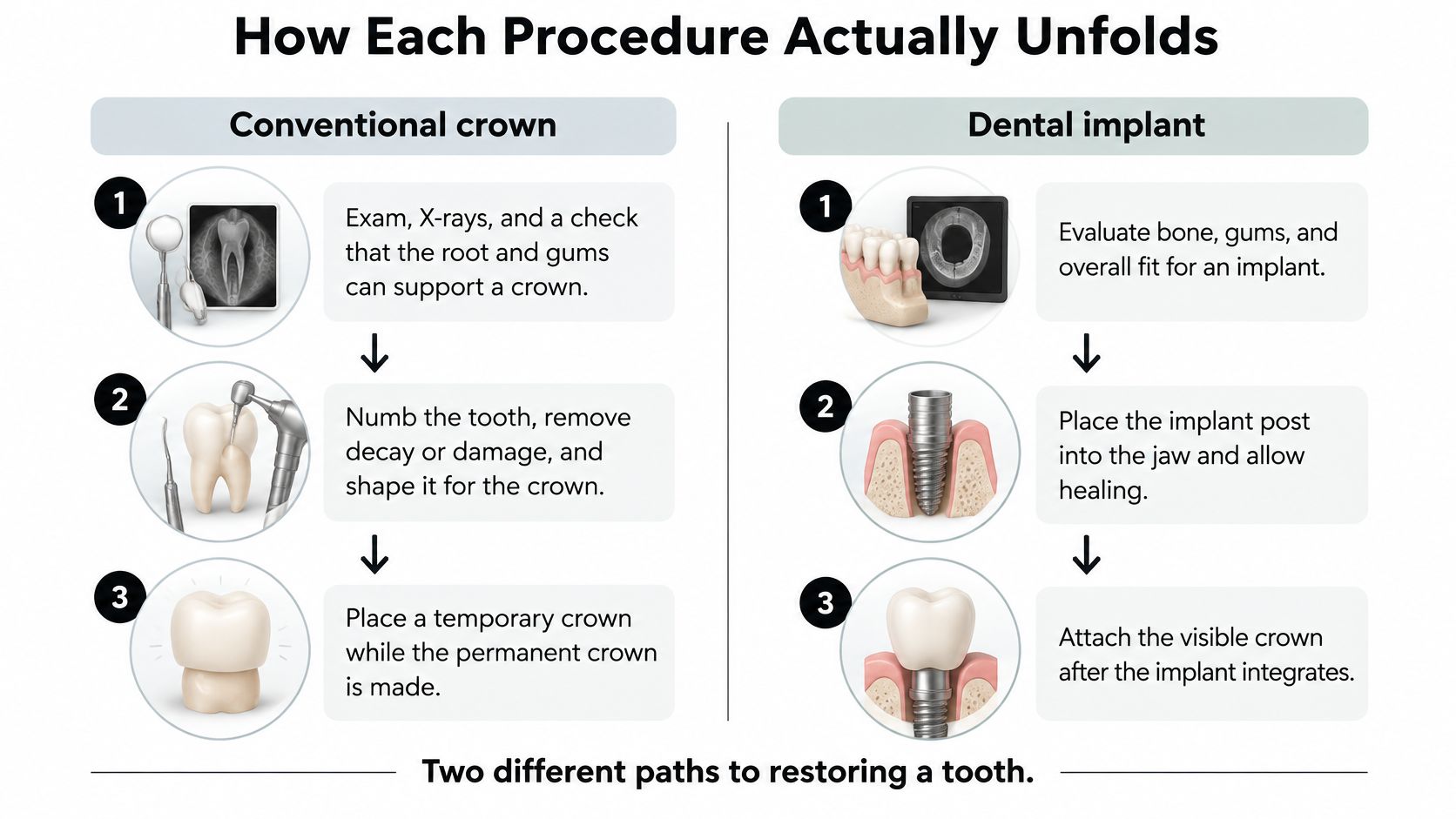
The conventional crown pathway
Check the foundation. We examine the tooth, take appropriate dental X-rays, and evaluate the gums and root. The important question is whether enough sound tooth remains to hold a crown securely.
After numbing the area, the dentist removes decay or an old restoration and shapes the remaining tooth. If the inner tissue is infected or irreversibly inflamed, root canal therapy may be needed before the crown is completed.
Record the shape and protect the tooth. A digital scan or impression guides the laboratory restoration. A temporary crown protects the prepared tooth while the final crown is made.
The final crown is checked for fit, contacts, appearance, and bite before it's cemented or bonded. Material choices include all-metal crowns for hidden molars and porcelain or ceramic options where appearance matters.
Our explanation of the root canal and crown procedure can help you understand how those treatments work together when the nerve is involved. A crown alone doesn't treat an infection inside the tooth.
The implant-supported crown pathway
Plan around the bone and gums. We use advanced imaging, including 3D scans, to assess bone density, jaw structure, and other factors before placement. Gum disease and any necessary preparatory treatment must be addressed first.
The implant post is placed into the jaw. We numb the area thoroughly with local anesthesia, so most patients feel pressure or vibration rather than pain during placement.
Allow the bone to integrate. Osseointegration means the implant becomes anchored through its connection with living bone. The American Dental Association's implant guidance describes temporary crowns, bridges, or dentures that may be used while the permanent replacement is being prepared.
Once the implant is stable and the tissues are ready, the dentist attaches the connector, called an abutment, and the custom crown. A complete restoration typically includes the post, abutment, and visible crown.
Immediate implant placement or a same-day temporary tooth may be possible in selected circumstances. Neither automatically means you'll leave with the finished permanent restoration.
Bone grafting may be necessary when the available bone can't adequately support the proposed implant, adding another healing stage. For patients from Ventanna Lakes, Marisol, and Anniston, we coordinate related care, including tooth extraction, root canal therapy, bone grafting, and crowns, around the clinical needs of the site.
Longevity and What Survival Rates Mean
Separate the implant post from the visible crown when comparing longevity. They're different components, and they can have different outcomes. The figures below describe published groups, not a personal expiration date for your restoration.
Survival figures for implants and crowns
The crown-type estimates come from a systematic review of tooth-supported and implant-supported restorations; the broader implant dataset and long-term crown study are identified in their respective rows.
| Outcome | Time frame | Reported survival |
|---|---|---|
| Implant supporting a single crown | 5 years | 96.8% |
| Implant-supported single crown | 5 years | 94.5% |
| Implant supporting a single crown | 10 years | 95.2% |
| Implant-supported single crown | 10 years | 89.4% |
| Metal-ceramic tooth-supported crown | 5 years | About 95% |
| All-ceramic tooth-supported crown | 5 years | About 91% |
| Implants in a 158,824-implant dataset | Overall | 97.79% |
| Implant-supported crowns in a 2024 study of 678 crowns | Up to 30 years | 96.8% |
Read the outcome, not just the percentage
The implant fixture can remain functional even when its crown needs replacement. Likewise, a natural-tooth crown can remain in service while requiring attention to its bite, surrounding gums, or an area of new decay.
The distinction between the supporting implant and its crown is shown below.

A 2024 prospective clinical study following 89 implants reported 100% implant survival and 96% restoration survival at five years. Those separate outcomes illustrate why a promise that an implant lasts isn't the same as a promise that every component will remain unchanged.
Material-specific results also need their proper context. A 2024 study of 601 posterior implant crowns estimated 10-year survival of 93.5% for monolithic lithium-disilicate crowns and 95.9% for veneered-zirconia crowns.
Survival isn't a repair-free guarantee
A restoration that survives can still need maintenance. Ceramic may chip, an implant screw may loosen, or a contact or bite may need correction without the entire treatment being classified as a failure.
A useful longevity discussion includes both how long a restoration may function and what care it may need along the way.
These studies also don't establish that a healthy natural root should be removed to obtain a particular implant survival percentage. Different patients, materials, clinical conditions, and follow-up periods make simple rankings misleading.
For your own plan, we evaluate smoking, periodontal health, available bone, decay risk, hygiene, and heavy bite forces. These factors help explain why your likely outcome may differ from a published average.
Our guide to dental implant success rates provides additional context for discussing treatment expectations. Bring questions about both the implant foundation and the replacement crown to your consultation.
Cost Recovery and Everyday Upkeep
There isn't one Katy price for an implant or a crown. A useful estimate explains what needs treatment, why it's needed, and which components are included, rather than presenting a restoration fee without its supporting care.
For implants, we evaluate your anatomy, jawbone health, number of missing teeth, materials, health needs, and goals. Imaging and preparatory procedures such as grafting or gum treatment can affect the total because they address the conditions needed to support the restoration.
Compare complete treatment plans
A crown estimate should account for the amount of tooth remaining, whether a supporting buildup or root canal is needed, and the selected material. An all-metal restoration for a hidden molar serves different appearance priorities from a porcelain or ceramic crown in the smile.
We provide a transparent, customized estimate and flexible financing options. We also occasionally offer implant packages, so ask what's currently available and exactly what the package includes before comparing it with another treatment plan.
Paying more for an implant doesn't help a tooth that could have been crowned safely.
For patients without insurance, our new-patient exam options and membership plans can help with planning routine dental care alongside a larger restoration. Keep preventive visits in the budget rather than treating them as optional after the crown is fitted.
Recovery and maintenance are different expenses
After implant placement, some swelling and minor discomfort are normal and typically ease within a few days. Our usual guidance includes appropriate over-the-counter relief, cold compresses, and soft foods, adjusted to your medical history and procedure.
A crown appointment may leave temporary gum tenderness or sensitivity. A bite that feels persistently high needs checking, not repeated hard chewing to make it settle.
Maintenance matters even when the restoration remains usable. An ITI consensus on implant survival and complications reported 98.3% estimated five-year survival for metal-ceramic implant-supported single crowns, but 86.7% freedom from all recorded complications over the observation period.
That gap helps explain why the purchase price isn't the whole financial picture. Screw tightening, ceramic repair, or other prosthetic maintenance may become necessary without losing the implant.
- For an implant: Clean around the restoration daily and attend monitoring visits so inflammation around the post can be identified and managed.
- For a natural-tooth crown: Clean carefully at the crown edge, where the remaining tooth is still vulnerable to decay.
- For either restoration: Report movement, a changed bite, food trapping, or discomfort promptly.
The best value is a clinically appropriate treatment you can maintain, not merely the lowest initial fee or the most expensive replacement.
Which Option Fits Your Tooth
An implant isn't automatically the more modern or longer-lasting choice. The better question is whether the remaining tooth can support a predictable restoration without asking you to accept an unreasonable risk of repeated treatment.
A 2025 review of tooth preservation and implant replacement emphasizes considering remaining tooth structure, periodontal condition, restorability, bone, systemic health, smoking, complexity, cost, and patient preferences together. Comparative evidence discussed in that review identified smoking, molar location, and substantial initial bone loss as failure predictors, while treatment modality itself wasn't statistically significant.
A visual explanation can make those distinctions easier to understand during your visit.

When preserving the tooth makes sense
Say a back tooth has a large cavity and a broken wall, but its root is solid and its gum support is manageable. After removing the damaged tissue, the dentist may find enough healthy structure for a buildup and crown.
If the nerve is involved, root canal therapy may make preservation possible. This approach retains the natural ligament around the root, including its sensory feedback about biting pressure, and avoids implant surgery.
A crown doesn't make the underlying tooth immune to future problems. New decay, another fracture, nerve-related complications, or periodontal disease can still affect its prognosis.
When replacement is more predictable
A deep root fracture, decay extending where a sound restoration can't be secured, or repeated structural failure may make saving the tooth unreliable. The precise fracture location and amount of accessible healthy tooth matter more than whether the tooth currently looks intact.
If the tooth is already missing, the question changes from preservation to replacement. We then evaluate the space, bone, gum tissue, bite, and neighboring teeth to determine the appropriate implant configuration.
Which restoration fits the situation
| Situation | Usual direction | Why |
|---|---|---|
| Large crack or cavity, solid root | Crown, root canal if the nerve is involved | Keeps the natural root and avoids surgery |
| Root fracture or non-restorable tooth | Extraction, then implant | A crown cannot hold what is left |
| One missing tooth, healthy neighbors | Single implant and crown | Neighbors stay unprepared |
| Several missing teeth | Implant bridge or multiple implants | Avoids a long tooth-supported bridge |
| Most or all teeth failing | Full-arch implants, including All-on-4 when appropriate | Fixed teeth instead of a denture alone |
| Active gum disease | Treat gums first | Implants are planned only after infection is controlled |
| Sudden pain, swelling, or trauma | Emergency visit first | The definitive choice waits until the tooth is stable |
These are starting directions, not diagnoses. In particular, a fracture limited to a repairable area shouldn't be treated like a non-restorable root fracture.
Our implant care includes single implants, multiple replacements, and complex full-arch restorations. When periodontal disease is present, we treat and resolve it before implant surgery proceeds; full-arch options also require an anatomy-based plan.
The accompanying video offers another way to approach the crown-versus-implant discussion.
Make room for uncertainty without ignoring disease
For a borderline tooth, ask what findings would change the recommendation. A defined monitoring period may be reasonable when it's clinically safe, with a scheduled reassessment and clear symptoms that should prompt an earlier visit.
A second opinion can also help before an irreversible tooth extraction. For anxious or cost-conscious adults in Katy Lakes, Kingscrossing, and The Grange, understanding the uncertainty is part of informed consent, not an obstacle to treatment.
A comparative evidence review reported a randomized trial with survival probability of 1.00 for implant-supported crowns and 0.936 for tooth-supported crowns, a difference that wasn't statistically significant. That finding doesn't prove identical outcomes; it does caution against declaring a universal winner.
If you're in Lakehouse, Sunterra, or greater Katy with sudden swelling, severe pain, or trauma, an emergency dentist should assess the immediate problem first. Seek urgent medical care for difficulty breathing or swallowing, or rapidly spreading swelling, rather than waiting for a restoration consultation.
Book a Crown or Implant Consult in Katy
If you're looking for a dentist in Katy, TX, bring your questions, concerns, and treatment priorities to a consultation rather than deciding from a webpage. We review your oral health history, aesthetic preferences, and anxiety from the start so the plan fits more than an X-ray.
An examination and appropriate imaging help establish whether a crown is feasible or whether implant replacement, grafting, or a full-arch plan deserves consideration. Our implant consultations are designed to help you find out whether implants are the right fit, not to assume that they are.
Turn the comparison into a personal plan
Ask for a written recommendation that identifies the proposed treatment and its reasoning. It should make the next steps understandable, including preparatory care, temporary restorations, maintenance, and estimated costs.
If appearance is a priority, Digital Smile Design lets you visualize a proposed smile before treatment begins. Patients searching for a cosmetic dentist near me can discuss color and shape alongside function, including whether related cosmetic dentistry or teeth whitening belongs in the overall plan.
Plan for comfort as well as treatment
Our office offers aromatherapy, heated massage chairs, and noise-cancelling headphones. Sedation is also available when appropriate, including for patients whose anxiety or longer treatment needs warrant that discussion.
We welcome patients from Katy and nearby neighborhoods including Elyson, Ventanna Lakes, Katy Lakes, and The Grange. For swelling or a broken tooth, contact us about a same-day problem visit rather than waiting for a routine consultation slot.
The Dental Retreat offers crown and implant consultations focused on preserving a restorable tooth and replacing one that can't be predictably saved. Visit The Dental Retreat to schedule your consultation, request a written crown-versus-implant plan, and discuss financing or any current implant package before treatment starts.