For most uninsured patients, what is root canal treatment cost depends on the tooth, with front teeth at about $620 to $1,100, premolars at about $705 to $1,250, and molars at about $870 to $1,472. Those figures cover the canal procedure only, not the filling or crown that protects the tooth afterward.
So why does one quote look hundreds of dollars lower than another for the same aching tooth? You are likely not comparing the same treatment. One estimate may stop at cleaning the canals, while another includes imaging, a buildup, and a crown. When looking for a dentist near me or an emergency dentist in Katy, TX, understanding the entire episode of care helps you budget without surprises.
Root Canal Cost at a Glance in Katy, TX
What do root canal price ranges include, and what might still be added to the bill? Published ADA-derived benchmarks in Forbes Health's root canal cost guide place uninsured fees at approximately $620 to $1,100 for an anterior tooth, $705 to $1,250 for a premolar, and $870 to $1,472 for a molar.
Uninsured fees by tooth type
| Tooth Type | Typical Uninsured Range | Why the Price Changes |
|---|---|---|
| Anterior (front) tooth | $620-$1,100 | One main canal, shorter visit |
| Premolar | $705-$1,250 | Often two canals, more cleaning and shaping |
| Molar | $870-$1,472 | Several canals, longest visit and most imaging |
Back teeth often cost more because they usually have more canals to find, clean, shape, disinfect, and seal. The ranges are a starting point, not a quote for your tooth. Fees can also vary with the tooth's condition and whether treatment is provided by a general dentist or an endodontist, a root canal specialist.
A root canal is only one part of the possible bill. The estimate may also include an exam and imaging, a buildup to replace missing tooth structure, and a final restoration such as a crown. Ask for an itemized estimate so you can compare the same stages of care.
At The Dental Retreat, a consultation provides a personalized cost estimate, so you see your own numbers before committing. To prepare, note which tooth hurts and when symptoms began, then ask which parts of the episode of care are included in the estimate.
What Root Canal Treatment Involves Step by Step
Think of the inside of a tooth like wiring inside a wall. The soft center, called the pulp, holds the nerve and blood vessels. When deep decay, a crack, or an old filling lets bacteria reach that center, the pulp becomes inflamed or infected and can't heal on its own.
You might notice lingering sensitivity to hot or cold, throbbing pain that wakes you at night, tenderness when you bite, a tooth that's turning darker, or a small bump on the gum. Some infected teeth hurt only occasionally, which is why an exam matters more than guessing from pain alone.

From diagnosis to sealed tooth
- Exam and X-rays: We confirm which tooth is the source and how the roots are shaped. Clear imaging prevents treating the wrong problem.
- Numbing: Local anesthesia keeps the visit comfortable. Most patients feel pressure, not sharp pain.
- Removing infected pulp: We open the tooth and remove the damaged tissue inside. This stops bacteria from continuing to irritate the nerve space.
- Cleaning and shaping: Each canal is cleaned, shaped, and disinfected with fine instruments. Curved or narrow canals take patience and skill.
- Filling and sealing: The empty canals are filled and sealed so bacteria can't easily return.
- Restoring the top: We place a temporary or permanent restoration to close the tooth. A final filling or crown is then planned to protect it during chewing.
Each step explains a line on your bill. Imaging, anesthesia, specialized tools, disinfecting solutions, sealing materials, and the restoration afterward all take time and materials.
Emergency pain relief isn't always the same as definitive treatment. A first visit may focus on diagnosis and calming an acute flare up, with the full cleaning, sealing, and restoration completed at a planned follow up.
Factors That Change Your Final Bill
Two patients can both need root canal therapy and receive different estimates. That doesn't mean one quote is wrong. It usually means the teeth, infection, or restoration plans aren't identical.
What moves the price most
- Tooth location and canal count: This sets the base fee. Front teeth are simpler to reach, while molars sit farther back and hide more canals.
- Severity of infection: A tooth with an abscess or swelling may need extra visits, medication, or drainage before it can be sealed safely. More visits add time and cost.
- Retreatment: If a tooth was treated before, we first remove old filling material and look for missed canals or new infection. That extra detective work is usually priced higher.
- Unusual anatomy: Narrow, curved, or calcified canals need careful imaging and slower instrumentation. Rushing raises the risk of a missed canal.
- Who performs treatment: A general dentist and an endodontist may charge differently. Complex molars, retreatments, and cracked teeth are the cases most often referred.
- Sedation: If anxiety makes treatment hard, sedation adds a fee but can help you complete care comfortably. We offer sedation options for patients who experience dental anxiety.
- The restoration plan: A small filling and a full crown don't cost the same. Back teeth that carry heavy chewing force usually need stronger coverage.
Ask about these factors before treatment begins, not after you see the bill. Most cost drivers can be explained openly once imaging shows the shape of your roots.
Your pre treatment checklist
Before you accept a quote, confirm the tooth number, the expected canal count, and whether this is first time treatment or retreatment. Ask whether sedation is included, what restoration is planned, and whether that restoration is in the price you're holding.
Bring that checklist to any dentist near me search result you call. You'll get clearer answers, and you'll spot an incomplete estimate quickly because it won't answer those five points.
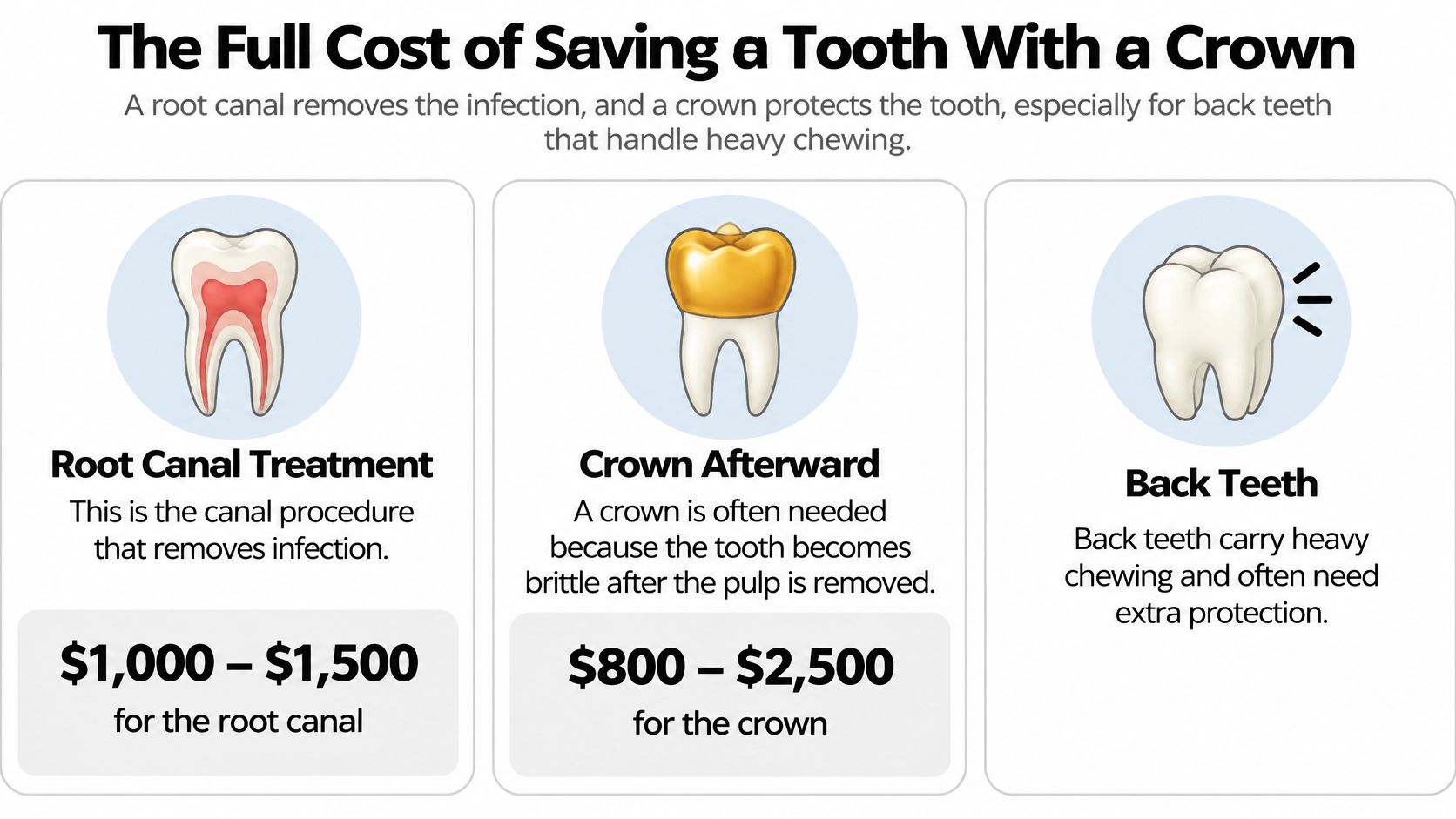
The Full Cost of Saving a Tooth With a Crown
Many patients assume the root canal fee is the whole bill. It usually isn't. Once the pulp is removed, the tooth no longer has its internal blood supply and can become more brittle, while molars and premolars absorb strong chewing forces every day.
A crown covers and protects the whole visible tooth, like a helmet over a weakened structure. A filling repairs a smaller area and may suit a front tooth or a tooth with plenty of healthy structure left. Choosing between them isn't cosmetic guesswork, it's about how much tooth remains and where it sits in your bite.
Modeled charges for a molar episode
A U.S. cost model using ADA dental fee survey data in BMC Oral Health's published cost model listed average simulated charges of $1,109.31 for root canal treatment on a molar, $1,095.76 for a porcelain-fused-to-metal crown, and $294.82 for a direct composite restoration.
| Item | Modeled Charge | What It Covers |
|---|---|---|
| Molar root canal | $1,109.31 | Canal treatment only |
| Porcelain-fused-to-metal crown | $1,095.76 | Full protection for the restored tooth |
| Direct composite filling | $294.82 | Smaller restoration, not a crown |
| Molar root canal plus crown | About $2,205 | Combined modeled total before insurance |
| Nonsurgical retreatment | $1,246.06 | Repeat treatment on a previously root-treated tooth |
On that basis, a molar root canal plus crown could total roughly $2,205 before insurance adjustments, although actual fees vary by location, tooth condition, materials, and provider. The same model lists nonsurgical retreatment at $1,246.06, which shows why a previously treated tooth follows a different fee path.
Your written estimate should show the exam and diagnostic X-rays, temporary restoration, anesthesia or sedation if used, the endodontic procedure, core buildup, and the permanent crown. Our listed treatments include dental crowns and root canal therapy, along with related restorative dentistry such as dental fillings, dental bridges, and dental implants, so we can plan the restoration with the canal treatment rather than as an afterthought.
If a quote doesn't mention a crown, ask whether you need one and whether it's included. That one question closes the biggest gap between an advertised price and a real budget.
Root Canal or Extraction Which Costs More Over Time
Pulling a tooth often looks cheaper on the first day. The longer view can reverse that math, especially if you replace the missing tooth.
In a peer-reviewed economic evaluation in the National Library of Medicine's cost effectiveness study, the mean cost of root canal treatment was $689.10 versus $280.10 for extraction, and when an extracted tooth required replacement, the mean pathway cost rose to $1,245.50.
| Path | Mean Cost in the Evaluation |
|---|---|
| Root canal treatment | $689.10 |
| Extraction alone | $280.10 |
| Extraction followed by replacement | $1,245.50 |
Extraction removes the infection source quickly and carries the lowest upfront cost. A gap, though, can lead to a dental implant, bridge, bone graft, or denture, plus extra visits and maintenance. Root canal treatment keeps your natural tooth in place, so neighboring teeth don't have to carry a replacement or drift into an empty space.
Those figures are averages from one evaluation, not a promise for your mouth. Only an exam can show whether a specific tooth can be saved predictably.
Ask three questions at your consultation. Can this tooth be saved with a reasonable restoration, what replacement would be needed after tooth extraction, and how many visits would each path take? Our guide to comparing a root canal and extraction walks through that decision, and we offer both tooth extraction and dental implant services for patients weighing the options.
The goal isn't the lowest first bill. It's the lowest total cost over time for a tooth that stays comfortable and functional.
Insurance, Membership and Payment Options
Insurance may reduce what you pay, but the amount depends on how your plan classifies treatment and what benefits remain. Root canal therapy and a crown may fall into different benefit categories, so check each one separately.
An American Dental Association News report on public understanding of dental insurance gives a representative combined estimate of about $3,000 for a root canal followed by a crown. The report describes common benefit structures with preventive care covered at 100%, basic procedures at roughly 80%, and major treatment at approximately 50%. It also gives $1,500 per year as an example of an annual maximum, the plan's cap on benefits during a benefit year.
Typical benefit tiers
| Benefit Category | Typical Coverage | How It Applies |
|---|---|---|
| Preventive (exams, cleanings) | About 100% | Some diagnostic visits and X-rays may fall here |
| Basic procedures | About 80% | Root canal may be classed here, depending on the plan |
| Major procedures | About 50% | Crowns usually fall here |
| Annual maximum | Example $1,500 per year | Caps total benefits in one benefit year |
For a $3,000 root canal-and-crown episode, a plan paying half of a major procedure might contribute about $1,500 in theory. Your actual benefit may be lower if you have a deductible, your plan uses different negotiated fees, or you have already used part of your annual maximum.
Before treatment, ask your insurer how it classifies the root canal and crown, whether your deductible is met, and how much of your annual maximum remains. The $3,000 figure is an illustrative benchmark, not a quote for your tooth.
If you don't have full coverage
The Dental Retreat offers flexible financing options. Review the payment plans for dental treatment and compare the total out-of-pocket cost, not just the monthly payment. The practice also occasionally offers special promotions, bundled treatment pricing, or complimentary initial consultations.
The Healthy Adult Plan costs $299 and includes 2 free annual checkups and cleanings, 1 annual oral cancer screening, any additional X-rays needed, 1 limited exam and X-rays, and 20% off any procedure. It is a membership plan, not dental insurance.
Your First Visit and How to Book a Katy Consultation
What should a first visit clarify? The cause of your tooth pain, whether the tooth can be saved, and the likely cost of the full treatment, including any restoration it needs.
Your dentist reviews your symptoms and dental history, examines the tooth, and may take X-rays to assess the roots. The Dental Retreat uses 3D imaging to create treatment plans suited to each patient's anatomy and AI-powered X-ray analysis to help detect dental issues. After the exam, ask for a personalized cost estimate that separates the root canal from the crown or other restoration.

Before choosing a treatment date, review your insurance benefits and payment options. The Dental Retreat offers flexible financing options. Aromatherapy, heated massage chairs, and noise-cancelling headphones are available to help patients feel more at ease during visits.
Booking steps
- Call or request an appointment online: Ask to schedule a consultation for the painful tooth.
- Describe the problem: Share where it hurts, how long it has hurt, and whether you have swelling.
- Bring relevant details: Note any past treatment on the tooth and how your symptoms have changed.
- Ask for a personalized estimate: Request separate costs for the exam, imaging, root canal, and restoration.
- Review payment options: Check your insurance benefits and ask about financing before deciding.
- Compare the full treatment cost: Include the crown or other restoration, not just the root canal.
If you have swelling, fever, or facial pain, contact a dental office promptly. If the practice is closed, seek emergency dental care.
The Dental Retreat welcomes patients from Katy and nearby communities. Schedule a consultation to discuss whether your tooth can be saved and get a personalized estimate for its treatment. At The Dental Retreat, you can review your options and payment choices before deciding how to proceed.