A tooth came out on Tuesday. By Thursday evening the cheek is puffy, the ice pack has stopped helping, and the ache has moved up into the jaw. That's usually the moment someone searches for a dentist near me in Katy, TX, at nine at night, wondering whether the recovery has gone sideways.
Most of the time it hasn't. The oral surgery healing process follows a pattern the body repeats after every extraction, graft and implant, and once you can see the pattern, the strange days stop feeling alarming. Swelling that climbs on day two is doing its job. A socket that looks pale and odd is often knitting itself closed. Pain that fades and then returns is a different story.
The confusion comes from mixing two timelines. The one you feel is measured in days. The one happening inside the bone is measured in months. This guide keeps them separate and pairs every stage with a clear threshold for calling the office, whether your surgery was a straightforward tooth extraction or a graft placed in preparation for dental implants.
Healing Timeline by Procedure at a Glance
Nearly every patient leaves with the same question. How long until my mouth feels normal again?
There's no single number, because the answer depends on which tooth came out, how much bone surrounded it, and how your body responds. What helps is a reference you can read as a range rather than a promise. Use the table as your default, then adjust it with the instructions your own surgeon gave you.
| Procedure | Soft tissue closes | Bone healing | Normal daily activity returns |
|---|---|---|---|
| Simple tooth extraction | 1-2 weeks | 3-4 months (up to about 4 months for a large molar) | 48-72 hours |
| Wisdom tooth removal | 2-3 weeks | 3-4 months | 2-3 days; heavy exercise after about 1 week |
| Bone graft or socket preservation | 2-3 weeks | 2-5 months before implant | 2-3 days |
| Implant placement | 2-4 weeks | 13-28 weeks (submerged) or 13-40 weeks (non-submerged) | 1-2 days |
| Apicoectomy (root-end surgery) | 1-2 weeks | 6-12 months, confirmed by X-ray | 2-3 days |
Read every row as a window, not a deadline. Two people with the same molar removed can heal weeks apart, and neither is doing anything wrong.
The reason the columns look so different is that gum and bone run on separate clocks. After a tooth extraction, the socket heals from the bottom upward. A blood clot forms first and protects the underlying jawbone and nerves, helping prevent dry socket. The clot gradually integrates with surrounding tissue, new tissue fills the socket, and the gum eventually closes over the area, as the Cleveland Clinic tooth extraction guide describes. Patients can often return to routine activities within 48-72 hours, but complete jawbone healing takes several weeks, and healing for a large molar may take as long as four months.
That gap explains most of the worrying. A whitish appearance over the socket can be part of normal healing rather than an infection, though worsening pain, swelling, fever, or foul odor calls for professional evaluation.
The on-track test: pain that eases by day three or four, no fever, and swelling that goes down rather than up.
If a symptom broke that pattern, that's the right instinct. Also know what the 3-4 month row marks. It's the point where most patients are stable enough to plan the next step, not the point where healing stops. Remodeling keeps going long afterward. Feeling better and being finished are two different things, and the rest of this guide keeps them apart.
How Bone and Gum Tissue Rebuild Over Months
An extraction socket rebuilds in three stages, the way a house goes up on an empty lot. First the frame, then the structure, then the finishing work that continues long after the rooms look usable. That finishing work is the part patients never see.
Stage one, the frame. Within hours, a blood clot fills the socket and shields the bone and nerve endings beneath it. Everything that follows depends on that clot staying put, which is why early aftercare focuses so heavily on protecting it. A clot that dissolves or dislodges too soon leaves bone exposed, and pain that worsens after a quiet first stretch is the signal to call the office.
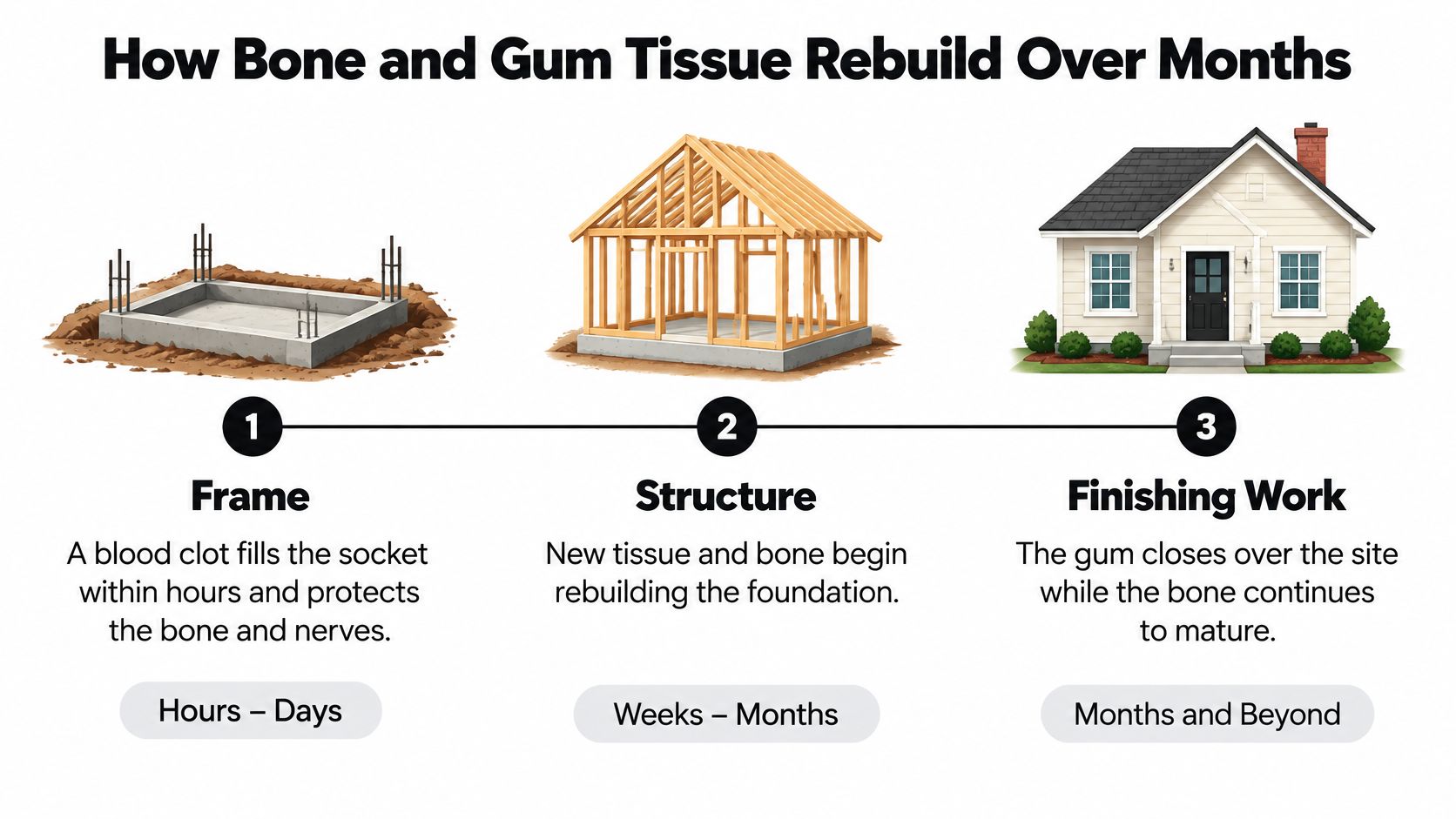
Stage two, the structure. Granulation tissue replaces the clot over the first weeks while the gum begins closing over the site. Histological research shows granulation tissue is largely replaced by woven bone within 6-8 weeks, although woven bone can be detected as early as 2 weeks after extraction (a review of human extraction socket healing). Woven bone is the body's scaffolding: it forms quickly, and strength comes later.
Stage three, the finishing work. Mineralized bone forms first at the deepest part of the socket and builds upward toward the opening over the weeks that follow. Woven bone then matures into denser, more organized lamellar bone, a remodeling process that continues long after the site feels normal under your tongue.
How Much Healing Varies Between Patients
Human socket biopsies show just how wide that variation runs. Two patients can reach the same healing stage with very different proportions of new woven bone and mature lamellar bone, and studies report complete mineralized healing at different points depending on the patients, the teeth, and the methods used. That spread is one process measured at different times, so the timelines overlap rather than disagree.
Why the Surface Closes Before the Bone Does
A gum that has closed over the socket can still sit over bone that is actively rebuilding. The surface often looks dramatically improved while internal remodeling stays active for months, and healing time shifts with extraction complexity, infection, smoking, systemic health, socket size, and whether grafting or ridge preservation was performed.
If the site looks fine on the surface but pain deepens, swelling returns, or a bad taste develops, treat that as a reason to call rather than a reason to wait. Implant and graft planning runs on months rather than days for exactly this reason: the bone has to be ready, and a closed gum is only the first sign that it is.
The First Three Days of Swelling and Pain Control
Day two often looks worse than day one. That follows the expected course: university dental post-operative instructions describe swelling commonly increasing during the first 48-72 hours, or roughly three days, before gradually improving (Harvard School of Dental Medicine oral surgery instructions).
| Day after surgery | Expected swelling and bruising | Expected pain | What helps |
|---|---|---|---|
| Day 1 (first 24 hours) | Swelling begins, some oozing | Highest in the first hours | Ice pack 20 minutes at a time |
| Days 2-3 (48-72 hours) | Swelling peaks | Often at its highest, then starts easing | Warm compresses after about 48 hours; head raised |
| Days 4-7 | Swelling gradually eases | Should keep improving | Soft foods; gentle rinses as the surgeon directs |
| Days 7-14 | Bruising and jaw stiffness may remain | Mild or none | Gentle jaw movement; call if swelling rises on day 4 or later |
The first 24 hours belong to cold. Apply an ice pack near the surgical side for 20 minutes at a time, then give the skin a rest before the next round. After about 48 hours, warm compresses take over. Bruising and jaw-muscle stiffness can stay noticeable for 7-14 days, lingering well after the puffiness itself starts to fade.
Over-the-counter pain relief is usually the first option, taken exactly as your dentist or surgeon directs. Prop your head on an extra pillow at night, keep drinking fluids, and stay with soft foods for a few days, steering chewy or crunchy food away from the surgical side. Jaw stiffness is common during this stretch. Gentle opening exercises help as comfort allows, without forcing anything.
A cheek that looks bigger on Saturday than it did on Thursday deserves a phone call rather than another ice pack.
That is the threshold worth memorizing: contact an oral-surgery or emergency-dental provider if pain or swelling starts increasing on the fourth day or later, since delayed worsening can signal a complication rather than ordinary healing. Recovery rarely moves in a straight line, so a slightly puffy morning after a good day can still be normal. What matters is the overall direction, and tracking makes that direction visible. Note your swelling and pain once in the morning and once in the evening, because a written pattern is far easier to describe over the phone than a vague sense that today feels worse. The practice also keeps an oral surgery pain management page for patients who want more detail on staying comfortable at home.
Protecting the Blood Clot and Your Daily Aftercare Routine
Everything in the first week circles back to one structure: the clot sitting in the socket. Protecting it is the central mechanical rule after extraction or any other oral surgery, and each step below exists for a reason you can picture.
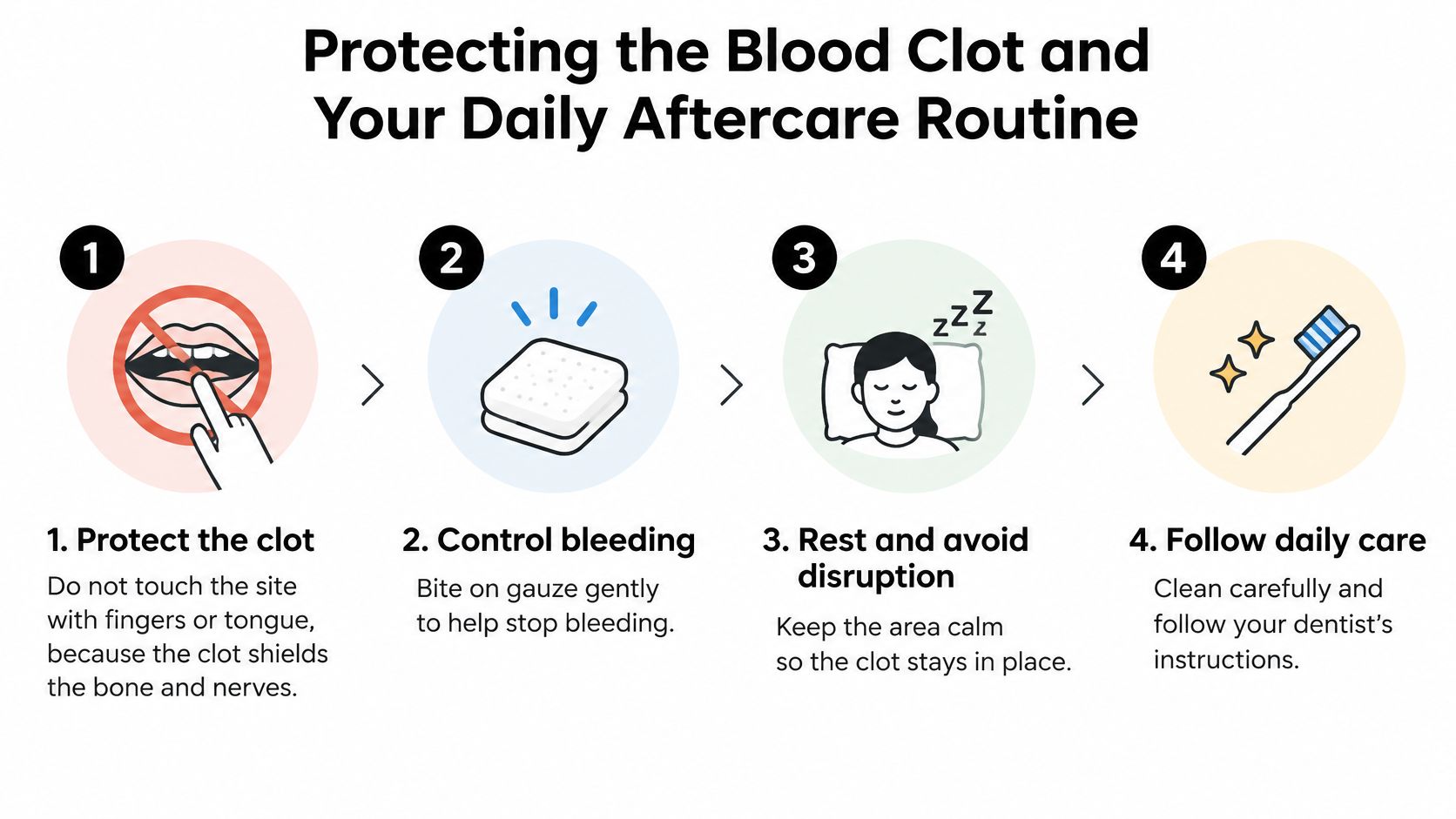
- Keep fingers and tongue away from the site. The clot shields bare bone and nerve endings. Touching or prodding it reopens the very layer doing the protecting, and the University of Bristol oral surgery aftercare guidance lists avoiding disturbance of the wound with fingers or tongue as a first principle.
- Control bleeding with steady pressure, not repeated checking. Bite firmly on gauze for 30-45 minutes when bleeding occurs. If it continues, place fresh damp gauze and keep up the pressure rather than lifting the gauze every few minutes to look.
- Skip suction, spitting and smoke. Forceful rinsing, repeated spitting, smoking and straws all create the same problem, a pressure change or physical pull that can dislodge the clot. A straw in a milkshake on day two is a genuine risk, and so is a cigarette.
- Start gentle rinses only after the first 24 hours. Warm salt water, about one-half teaspoon of salt in one cup of warm water, is the standard. Rinse softly and let the liquid fall out of your mouth instead of spitting it across the sink.
- Brush everything except the wound. Clean the rest of your teeth normally from day one, since a mouth full of plaque doesn't help healing. Work carefully around the surgical area and follow whatever your dentist told you about cleaning it directly.
- Use chlorhexidine mouthwash only as instructed. Evidence supports chlorhexidine for reducing postoperative alveolitis, but timing and contraindications matter, and it isn't a substitute for gentle mechanical care, per a review of post-extraction care.
Keep the eating and resting habits from the earlier days going, since they support the same goal. Skip hot liquids, alcohol and anything with hard edges for the first week, and stay hydrated.
On a normal day, a healing site looks unremarkable. The gum edges draw together a little more each day, tenderness fades rather than migrates, and no new swelling appears. If a throbbing pain starts building around day two to four and the socket looks empty, read our dry socket prevention guide before assuming the worst.
Implant and Bone Graft Healing Takes Several Months
An implant site runs on two tracks at once. The gum seals within a few weeks, which is the part you can see and feel. The bone has to bond directly to the implant surface, and that track takes months. Clinically, this explains why an implant can feel rock solid before it's biologically ready for full functional loading. Early mechanical stability doesn't prove complete osseointegration.

Two Tracks, One Implant
The bone-side timeline starts faster than most patients expect. Early woven-bone formation begins within approximately 5 days, and measurable bone-to-implant contact has been reported at about 35.8% by day 7 and 46.3% by day 28 in cited experimental data. By approximately 12 weeks, the interface can mature into more organized lamellar bone, according to a review of dental implant healing.
Reviews report broad ranges for the full process, roughly 13-28 weeks for submerged implants and 13-40 weeks for nonsubmerged implants. What shifts you within that range: placement into a fresh extraction socket versus healed bone, whether grafting was used, smoking, poorly controlled blood sugar, immune-suppressing medication, implant design, primary stability and the anatomy of the site.
That's why loading decisions rest on stability, bone quality, surgical site condition and your personal risk factors, not on a calendar alone. Poor glycemic control and immunosuppressive therapy can impair both wound healing and osseointegration, which raises the value of a medical-risk review and closer follow-up before the restoration stage.
When a patient has periodontal disease, our care team at The Dental Retreat treats and resolves it before implant surgery goes ahead, because active gum infection works against the bonding you're paying months for.
For the graft side, a randomized controlled trial compared extraction sites grafted with demineralized freeze-dried bone allograft at two healing intervals. Sites allowed 18-20 weeks held 47.41% new vital bone, against 32.63% at 8-10 weeks, a difference of 14.78 percentage points and statistically significant at P = 0.01, as reported in the Journal of Periodontology trial. Broader reviews describe the greatest dimensional change in the ridge during the first 3 months, with remodeling continuing after that.
Practical rule: the waiting period between extraction and implant placement isn't lost time. It's the window in which the bone you'll be loading gets dense enough to hold it.
Placement itself is usually easier than the waiting. The office numbs the area thoroughly with local anesthesia, so most patients feel only pressure or vibration rather than pain. Afterwards, some swelling and minor discomfort is normal and is typically managed with over-the-counter relief, cold compresses and soft foods, easing within a few days.
The healing looks like this from the inside over those first months.
Wisdom Tooth, Apicoectomy and Warning Signs After Oral Surgery
A socket can feel mostly fine on day four and still be far from healed underneath. That gap between comfort and progress is the thread running through every procedure below, and it is why recovery is easier to read as a pattern than as a single finish line.
Wisdom Tooth Removal Day by Day
Function and quality of life can dip sharply right after third-molar surgery, then climb back through the first week. The catch is that the climb is rarely steady, and many patients feel worse on day two or three than they did on the day of surgery before things turn. That early worsening is common, so the signal that matters is the direction across several days, not any single morning.
A day-by-day plan earns its keep here. In a 2025 patient-information study, 34.4% of patients who experienced postoperative problems said a short, plain-language daily planner was their main source of answers, against only 3.1% for a conventional leaflet (patient-information research on postoperative guidance).
- Days 1-2: rest, liquids and soft food, ice early and often, no strenuous activity. Keep the head raised and stay ahead of the pain rather than chasing it.
- Days 3-5: soft meals, gentle brushing near the site, short walks. Swelling should be easing, not growing.
- Days 6-7: return to work or school is common. Heavy exercise waits about a week, since a spike in blood pressure can disturb a clot that is still organizing.
Lower wisdom teeth generally cause more jaw stiffness than upper ones, because more muscle and bone surround them. Steady, gentle opening and closing helps that settle, while forcing the jaw wide can set it back.
Apicoectomy Recovery Has Its Own Pace
Root-end surgery, done when a root canal did not heal, tends to surprise patients in the opposite direction. The outside can look almost unremarkable within days, with tenderness for a few days and swelling that is usually milder than an extraction. The part that takes time is invisible: bone fills in around the root tip over roughly 6 to 12 months, and follow-up X-rays confirm that progress rather than your comfort level. Feeling fine early is expected and welcome, but it is not the same as the bone being done.
Normal Healing, Dry Socket or Infection
Not every painful or slow-healing socket is an infection, and not every clean-looking one is fine. A 2025 ambulatory oral-surgery study reported approximately 5.5% localized postoperative complications, most occurring after flap extractions, while a recent expert consensus estimates postoperative infection at roughly 2% overall, varying by procedure and patient factors (complications after ambulatory oral surgery).
The pattern that most often earns a call is improvement followed by a turn for the worse, which is why the table reads the direction of symptoms rather than the symptom alone.
| Symptom | Usually normal or a concern | Action |
|---|---|---|
| Pain eases, then returns or worsens after day 3 | Possible dry socket | Call the office the same day |
| Swelling increases on day 4 or later | Possible infection or complication | Call the office the same day |
| Fever, pus, or foul taste or smell | Infection concern | Call urgently; go to emergency care if you feel very unwell |
| Whitish film over the socket | Usually normal healing | Monitor; report if pain or swelling increases |
| Bleeding continues after 30-45 minutes of firm pressure | Concern | Call an emergency dentist or go to emergency care |
| Numbness that does not improve | Concern | Call the surgeon promptly |
| Trouble breathing or swallowing, or swelling spreading under the jaw or eye | Emergency | Seek emergency care now |
The middle column matters as much as the last one. Pain that returns several days after an extraction points toward alveolar osteitis, the clinical name for a dry socket, where the clot breaks down and leaves bone exposed. Fever, progressive facial swelling, purulent drainage or feeling systemically unwell raises concern for infection, and that needs a clinician rather than a rinse.
What Not to Do While You Wait
Do not probe the socket with a finger, a cotton swab or a toothpick, since each poke can reopen tissue that is trying to close. Do not smoke, because it impairs healing and disturbs the clot at the same time. Do not take leftover antibiotics from a previous prescription, and do not start an unprescribed antiseptic rinse in place of an examination. Extensive wound opening, graft or membrane exposure, and spreading infection may need debridement, reclosure, guided healing or systemic antibiotics, and only an exam can tell which.
Call the same day for pain that returns, swelling that grows after day three, fever, pus, or bleeding you cannot stop with pressure. Call emergency services for trouble breathing or swallowing, or swelling that spreads under the jaw or toward the eye.
Book Your Post-Surgery Check in Katy, TX
The follow-up visit is where the timeline stops being a guess. Your surgeon confirms the site is closing the way it should, checks that the bone is on track, and removes stitches when the tissues are ready for it, which is usually a far less eventful appointment than patients expect.
At The Dental Retreat on Stockdick School Rd. in Katy, TX, the team reviews each patient's oral health history, aesthetic preferences and any concerns or anxieties from the first consultation onward, so nobody arrives at surgery day with unanswered questions. When implant or graft planning needs a closer look, consultations and detailed 3D imaging are part of the care plan. Patients who dread dental visits can settle in with aromatherapy, plush seating and noise-cancelling headphones.
Families across Katy, Cane Island, Sunterra, Elyson and Lakehouse can book a visit for a dentist near me search or for a second opinion after a slow-healing extraction, with extended hours and bilingual care available. If a surgery is already on your calendar, schedule your healing check before the procedure rather than after, while the dates are easy to plan.
The one action worth taking today: if any warning sign from the table above is happening right now, call the office the same day instead of waiting to see whether tomorrow is better.
A tooth extraction, a graft or an implant is only the first half of the treatment, and The Dental Retreat plans the second half with you. From pre-surgical 3D imaging to the follow-up visit that confirms your bone is filling in as expected, the team walks you through each stage in plain language, with sedation options and a calm, spa-inspired setting for anyone who needs it. If you're comparing dental implants near me options in Katy, or you'd like a professional eye on a socket that isn't healing the way you expected, The Dental Retreat is ready to help you book a consultation.