Bone grafting alone runs about $549 to $5,148 per graft depending on material, so a bone-loss implant case usually costs several thousand dollars more than a standard single implant before the crown is even placed. The table below shows each option's planning range and what drives it, so you can see where your situation is likely to land.
When looking for dental implants near me or a dentist near me in Katy, TX after being told you don't have enough bone, that gap between an advertised implant price and your actual quote can feel confusing. It isn't a surprise fee. It's a separate stage of treatment with its own materials, healing time, and follow-up. This guide walks through dental implants with bone loss cost one stage at a time, in plain language, so you can read any estimate line by line and know what you're paying for.
Typical Planning Costs for Each Bone-Loss Implant Option
A standard single implant and a bone-loss implant aren't priced the same way, and the difference is mostly the graft stage. When you have enough healthy bone, you're paying for the implant fixture, the abutment that connects it to the tooth, and the crown. When bone has to be rebuilt first, graft material, a membrane, extra surgical time, and months of healing are added before that same implant work begins.
| Treatment option | Planning range | Main cost drivers |
|---|---|---|
| Standard single implant (no graft) | Priced after exam, with no graft line item added | Implant fixture, abutment, crown |
| Single implant with bone graft | Base implant cost plus $549 to $5,148 per graft | Graft type, membrane, healing period, implant and crown |
| Sinus lift with implant (per side) | Base implant cost plus graft cost in the same $549 to $5,148 range, set by graft type | Sinus augmentation, graft, implant and crown |
| Short implants (no graft needed) | Priced after exam, with grafting avoided where bone height allows | Shorter implant, crown, 3D imaging |
| All-on-4 (per arch) | Priced after exam per arch, set by bridge material and number of stages | Four implants, fixed bridge, same-day temporary teeth |
| Zygomatic implants (per arch) | Priced after specialist exam per arch, set by surgical complexity | Specialist surgery, cheek-bone implants, fixed bridge |
The three factors that move your price most
How much bone is missing matters first. A small defect filled at the time of placement costs less than a large defect that needs its own surgery and a separate healing period. Location matters too, since an upper back tooth near the sinus is a different job from a lower front tooth.
How many teeth you're replacing changes the math quickly. One implant with one graft is a contained plan. A full arch spreads the cost across four or more implants and a fixed bridge, which can cost less per tooth than replacing every tooth individually, but it's a much larger total.
Materials and planning shape the rest. At our practice, high-grade titanium or zirconia, advanced 3D imaging, and a seasoned professional are factors that contribute to the final price and success of the implant procedure. Better imaging doesn't just add a line item. It shows exactly how much grafting you need, which can prevent paying for more bone work than your case requires.
Practical rule: Treat every range here as a planning figure from commonly reported U.S. ranges, not a quote. Your anatomy, health history, and goals decide the final number.
That's also why a phone estimate can only go so far. Two patients in Katy, TX can both ask about one missing molar and receive very different totals, because one has a wide, tall ridge and the other has a thin ridge that needs rebuilding. The exam is what separates those two cases.
Your practical next step is a consultation with 3D imaging that produces a personalized, itemized estimate. Once you have that document, the staged breakdown that follows will help you check that each line belongs there.
Why Bone Loss Adds Stages and Which Graft Type Fits
An implant is a small post that sits in your jawbone and works like a tooth root. It needs enough bone packed around it to stay stable under chewing force, the same way a fence post needs enough firm soil to stop wobbling. When that bone is missing, placing the post anyway risks a loose implant, so the bone has to be rebuilt first or during the same visit.
During a consultation, we sketch this sequence out chairside, and it looks something like this.
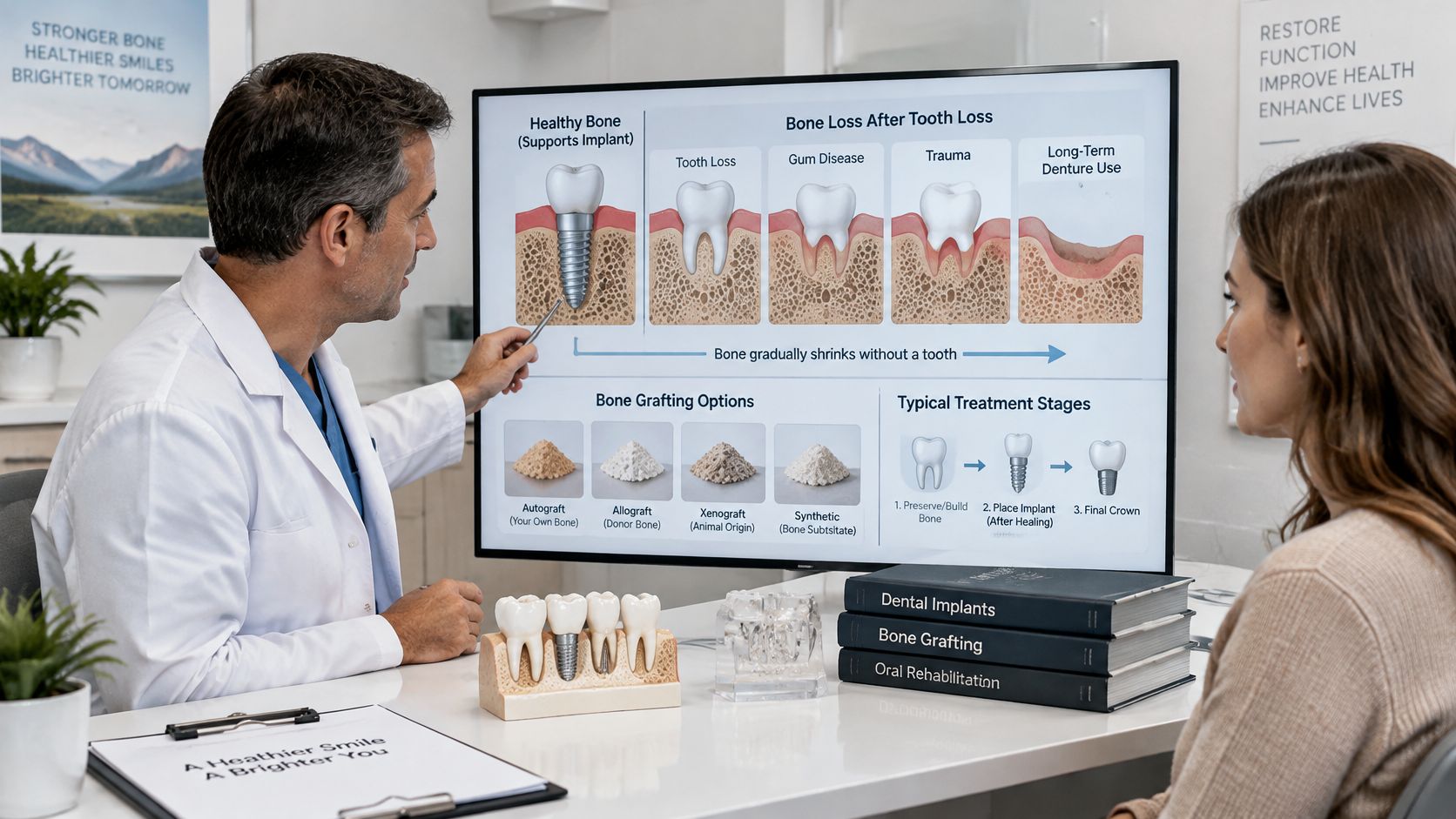
Why bone shrinks and doesn't grow back on its own
Your jawbone stays thick because tooth roots stimulate it every time you chew. Take the tooth away and the stimulation stops. Bone then shrinks after tooth loss, gum disease, trauma, or years of wearing a denture. A 2021 peer-reviewed review reported that bone resorption after tooth loss is irreversible without intervention and described bone grafting as a commonly accepted requirement for approximately 1 in every 4 dental implants. Needing a graft is common, and waiting does not reverse it.
We use advanced imaging technology, including 3D scans, to assess bone density, jaw structure, and other critical factors before implant placement. The scan shows height, width, and density, which tells us whether you need grafting at all and, if so, how much. If you have periodontal disease, our care team treats and resolves it before dental implant surgery goes ahead, because grafting into infected tissue invites failure.
The stages a bone-loss case can add
A straightforward implant moves from exam to placement to crown. A bone-loss case inserts extra steps between those points, and each step becomes its own line on your estimate.
- Evaluation and 3D imaging: The scan that measures your bone and plans graft size and implant position.
- Tooth extraction: Needed when a damaged tooth must come out before the site can be rebuilt. Sometimes grafting happens the same day to preserve the socket, which folds two stages into one visit.
- Grafting: Bone material fills the missing area, usually covered by a thin membrane that shields it while it heals.
- Healing: The graft needs real time to mature into solid bone before it can hold an implant. This waiting period is an active part of treatment, the stage where graft material becomes living bone.
- Implant placement, abutment, and crown: Once the bone is ready, the post goes in, then the connector and final tooth follow after integration.
Each surgical visit is numbed thoroughly with local anesthesia, so most patients feel pressure or vibration rather than pain. For a closer look at the grafting step itself, our guide to what bone grafting for dental implants involves explains the procedure in plain language. For upper back teeth, a sinus lift slightly raises the sinus membrane and adds bone density to the upper jaw area so it can support an artificial root.
The video below shows the same sequence in motion.
Comparing the four graft types
| Graft type | Typical graft cost | Reported implant survival |
|---|---|---|
| Xenograft (animal-derived) | $549 to $1,386 | Outcome depends mainly on defect size and healing time |
| Synthetic alloplast | $576 to $1,375 | Outcome depends mainly on defect size and healing time |
| Human-donor allograft | $652 to $1,575 | 97.36% weighted mean across 501 implants in block grafts |
| Autograft (patient's own bone) | $2,161 to $5,148 | Outcome depends mainly on defect size and healing time, plus recovery at the harvest site |
Those graft-only figures usually exclude the implant fixture, abutment, crown, diagnostic imaging, anesthesia, extraction, and treatment of infection. A graft quote that looks low may be missing those lines.
The evidence behind donor bone is reassuring. A systematic review of allogeneic bone-block grafts followed 323 grafts for at least 12 months and recorded 13 graft failures, a 4.02% graft-failure rate, while across 501 implants the weighted mean cumulative implant-survival rate was 97.36%. That record helps explain why donor grafts are often recommended instead of harvesting your own bone.
An autograft uses your own bone, which means a second surgical site, more soreness, and longer healing. For a large defect it can still be the right choice. Often it is not necessary. Since results across graft types track defect size and healing more than material, the decision comes down to fit. Ask three questions before you decide: which graft do you recommend, why does it suit my defect size, and is the membrane included in the price?
How to Build a Staged Budget From Your Quote
A single total tells you almost nothing. A staged budget tells you what happens, when you'll pay for it, and what could change. Use this routine with any estimate you receive for dental implants in Katy, TX.

A six-step routine for reading any estimate
- Ask for an itemized estimate. It should list extraction, grafting, membrane, implant fixture, abutment, crown or denture, sedation, temporary teeth, and CBCT or 3D imaging on separate lines. Separate lines stop one bundled number from hiding a missing crown or membrane.
- Group the lines into stages. Sort them into diagnosis and imaging, bone work, healing, implant placement, and restoration. This shows you what you're paying for now versus months from now.
- Mark each line required or optional. Ask us to explain why each required item is needed for your specific defect. A complete implant restoration typically includes the titanium or zirconia post placed in the jaw, the abutment, and the custom-crafted crown, so all three should appear somewhere.
- Ask what happens if something doesn't heal as planned. Find out what you'd pay if the graft fails, the membrane is exposed, or an implant must be removed, and whether any revision is included. It's an uncomfortable question, but it's much easier to ask before treatment than after.
- Check whether follow-up and maintenance are included. Healing checks, follow-up imaging, and periodontal maintenance are part of protecting the result, not extras. The 2025 AO/AAP consensus recommends professional monitoring and maintenance roughly every 3 to 4 months, so ask how those visits are handled and priced.
- Compare totals only after the stages match. Two quotes are only comparable when both include the same graft, the same restoration, and the same follow-up. A lower total that skips the crown is not lower.
The cheapest initial treatment may not be the lowest-cost option if it leaves out risk assessment, baseline imaging, or a recall plan.
At our office, the clinical team evaluates your anatomy, discusses your personal goals, and provides a fully transparent, customized estimate along with flexible financing options. Financing can spread staged costs over time, which often lines up naturally with staged treatment, since you aren't paying for the crown on the day of the graft. A consultation provides that personalized cost estimate, and you can take it home and compare it line by line.
Timelines and Success Rates by Treatment Option
Time is the part of the cost people feel most. Each healing stage adds weeks or months, but that time is doing real work, because bone and implant need to fuse before they can handle chewing force.
| Treatment option | Typical timeline | Why it varies |
|---|---|---|
| Standard single implant (no graft) | 3 to 6 months | Healing after implant placement before the crown |
| Single implant with bone graft | Several months for the graft to mature, then 3 to 6 months to the final crown | Graft maturing before implant placement |
| Sinus lift with implant | Several months for sinus graft healing, then implant integration before the crown | Sinus healing plus implant integration |
| Short implants | 3 to 4 months | Less bone work when height is adequate |
| All-on-4 (per arch) | 3 to 6 months | Same-day temporary teeth, final bridge after healing |
| Zygomatic implants (per arch) | 4 to 6 months | Specialist surgery and integration time |
Why grafted cases take longer
A graft isn't solid bone on the day it's placed. It's a scaffold your body gradually replaces with your own bone, and that process takes several months. Placing an implant too early into soft, immature graft risks instability, which is why a two-stage approach, graft first and implant later, is common for larger defects.

Shorter routes exist for the right anatomy. Short implants can use the bone height you still have and skip grafting. All-on-4 can provide same-day temporary teeth on four angled implants, with the final bridge delivered after healing. Neither shortcut is automatically better. Both depend on what your scan shows.
What the outcome numbers actually mean
The long-term picture for grafted bone is strong. A systematic review of long-term vertical bone-augmentation studies found implant survival rates ranging from 88% to 100%, with a mean survival rate of 97.1%, and follow-up after loading ranged from 1 to 7.1 years, averaging 2.9 years.
Read those words carefully. Survival means the implant is still in place. Success is stricter, and it includes the reconstructed site meeting predefined clinical ideals for bone levels and tissue health. An implant can survive without meeting every ideal, which is why maintenance still matters after a good surgical result. Our page on the dental implant success rate explains that distinction further.
Your personal outlook also depends on defect size, smoking, uncontrolled diabetes, gum disease, and hygiene. Treat these figures as study ranges that show what's achievable, not a guarantee for any one patient.
Membership Savings and Total Cost Over Time
An implant placed in rebuilt bone keeps costing money after the crown goes on. Recall visits, periodontal cleanings, follow-up imaging, prosthetic repairs, and management of risks like smoking or diabetes are all part of owning that tooth. Ignoring them doesn't remove the cost. It usually converts a small, planned cost into a larger, unplanned one.
Think about it as total cost of ownership. A stable, monitored implant is almost always cheaper to keep than an implant that's ignored until bone loss returns and revision or removal becomes necessary. Catching early inflammation at a routine maintenance visit can mean a cleaning and closer monitoring. Catching it late can mean surgery.
What membership does to the yearly math
Our Adult Perio Plan costs $359 and includes 3 annual periomaintenances, 1 limited exam and X-rays, 20% off any procedures, 2 free annual checkups and cleanings, 1 annual oral cancer screening, and any additional X-rays needed. For a patient with a history of gum disease and grafted bone, those three maintenance visits line up closely with the monitoring rhythm implants need.
Do the comparison concretely. Add up what three periomaintenance visits, exams, and X-rays would cost individually in a year, then compare that total with $359. Then ask how many recommended visits fall outside the plan, so you're comparing the same schedule, not a cheaper, thinner one. The 20% off procedures also softens the cost if a repair or additional treatment comes up.
A useful test: If a low quote has no recall plan attached, ask what year two and year three will cost before you call it the cheaper option.
Upfront costs can be spread out as well. We offer flexible financing options, and we occasionally offer special deals or package deals to help patients with the cost of dental implants. Ask for a written plan that shows the treatment total and the expected yearly maintenance total side by side. That's the number you can budget around.
Which Bone-Loss Option Fits Your Situation
The right option usually becomes clear once your situation is described plainly. These are the patterns we work through at an exam, organized by what you're dealing with rather than by procedure name.

Matching common situations to likely options
- One or two missing teeth with moderate ridge loss: This often suits a single implant with a bone graft. The defect is contained, so rebuilding that one area and placing one implant is usually the most direct and cost-effective route.
- Missing upper back teeth with a thin sinus floor: This often calls for a sinus lift. The sinus sits close to the roots of upper molars, and when bone below it is thin, lifting the membrane and adding bone creates the height an implant needs.
- Enough bone height but limited width or depth: Short implants may let you avoid grafting altogether. They use the bone you have, which can shorten treatment and remove the graft stage from your budget.
- Severe loss across a full arch, and you want fixed teeth quickly: All-on-4 points in this direction. Four implants support a full fixed bridge, and angled placement often uses available bone to reduce or avoid grafting.
- Extensive upper-jaw loss where standard implants aren't feasible: Zygomatic implants anchor into the cheekbone instead of the upper jaw. This is specialist surgery, reserved for cases where conventional options won't work.
Our dental implant care covers a single implant, multiple replacements, or a complex full-arch restoration, so the recommendation isn't limited to one technique. The clinical team evaluates your situation to recommend the implant configuration for restoring full function and beauty.
One caution applies to every option above. Smoking, uncontrolled diabetes, and active gum disease raise risk and can change which option we recommend, or require treatment first. Being candid about those factors at your visit protects both your health and your investment.
What to Expect at Your Katy Implant Visit
Say you book a visit because a molar came out years ago and you've been told the bone looks thin. Here's how that first appointment typically goes at our Katy, TX office.
We start with your health history and your goals, then examine your jaw and gums. Next, 3D imaging measures your bone height, width, and density, which answers the central question of whether grafting is needed and how much. You'll see the images with us, not just hear a conclusion.
From there, you receive an itemized estimate listing imaging, extraction, grafting, membrane, implant, abutment, crown, sedation, and follow-up on separate lines, along with financing options. Insurance coverage for grafts and implants varies by plan, so we can verify your benefits before any treatment is scheduled.
Bring a short checklist to make the visit count.
- Current medications: A full list, including anything for bone health or blood pressure.
- Medical history: Note diabetes, smoking, or other conditions that affect healing.
- Existing dental X-rays: Bring them if you have them, since older images show how bone has changed.
- Your questions: Especially the graft type, membrane, and revision questions from this guide.
The first appointment is a conversation, not a sales pitch. No treatment is required that day, and you're welcome to take the estimate home.
Book Your Bone-Loss Implant Consultation in Katy
You don't need to know whether you need a graft before you call. That's exactly what the exam and 3D imaging are for. We offer consultations for patients considering dental implants, so you can find out whether implants are the right fit for you, and detailed 3D imaging is part of the implant care plan.
The single next step is simple. Request a consultation online or call our office, and ask specifically for a bone-loss consultation so your visit is planned around 3D imaging. You'll leave with a personalized, itemized estimate you can review at your own pace, and you can ask about current promotions and financing before committing to any plan. We occasionally offer special promotions, bundled treatment pricing, or complimentary initial consultations, so ask what's available when you book.
Patients from Katy and nearby communities are welcome to book a visit. Whether you lost a tooth recently, lost teeth long ago, or wear a denture that no longer fits well, you can start with one appointment.
Bone loss adds stages, and it adds cost. It rarely closes the door on a stable, well-planned implant. A clear estimate and a realistic timeline both start with that first visit.
If you're weighing dental implants with bone loss cost and want numbers based on your own bone rather than a generic range, The Dental Retreat offers consultations with detailed 3D imaging and a transparent, itemized estimate covering grafting, implant placement, and restoration. Book your bone-loss implant consultation in Katy, TX today, ask about flexible financing and current promotions, and leave with a staged plan you can budget with confidence.