Root canal cost with insurance commonly ranges from about $200 to $1,100 for a front tooth, $200 to $1,250 for a bicuspid, and $300 to $1,472 for a molar, and the crown is usually a second bill. Your actual share depends on your tooth, your plan's allowed fee, and how much coverage remains when you receive care.
If you're in Katy with a throbbing tooth and an insurance card in hand, you probably want pain relief and a clear financial answer, not another confusing estimate. You can plan for both by separating the treatment your tooth needs from the rules your insurance uses to pay for it.
Why a Root Canal Bill Is Rarely One Number
It's a weeknight in Katy, your back tooth hurts when you bite, and you're searching for a dentist near me or an emergency dentist. Before you agree to treatment, you want to know whether the quoted number is the whole bill or just the beginning. It rarely is.
A root canal bill arrives in layers, like a repair estimate for a house: the inspection, the work itself, and the finish each come as separate lines. National fee averages for a molar run higher than for a front tooth, and most plans cover only part of restorative care, so the same procedure can produce very different out-of-pocket figures from one patient to the next.
The difference between a fee and your responsibility
Your root canal cost with insurance is your share of the plan's allowed fee for that tooth, after the deductible and within the benefits still available, not a percentage of the office's full listed charge. The figure is the insurer's allowed fee for that tooth once your remaining annual maximum applies, plus a separate claim for the crown, plus any balance above the allowed fee if your dentist is out of network.
That math also leaves out the examination, X-rays, and final restoration. An estimate for treating the inside of the tooth isn't an estimate for completing its repair.
Start with the scope: Ask whether the estimate covers the root canal alone or the complete treatment needed to make the tooth usable again.
At The Dental Retreat, the administrative team works to maximize any dental insurance benefits available to each patient, and a consultation provides a personalized cost estimate. Patient Blanca described that help this way: “Staff was super helpful in explaining your cost and insurance coverage.”
Identifying the painful tooth is the first practical step. A front tooth and a back chewing tooth can need very different amounts of work, even when both are called a root canal.
Root Canal Cost With Insurance by Tooth
| Tooth | Typical uninsured fee | Common insured patient share | Why the fee differs |
|---|---|---|---|
| Anterior or front tooth | $620–$1,100 | $200–$1,100 | Usually one canal and a shorter visit |
| Bicuspid or premolar | $705–$1,250 | $200–$1,250 | Often one or two canals |
| Molar | $870–$1,472 | $300–$1,472 | Multiple canals, more time, specialist more likely |
These national planning bands come from ADA fee-survey ranges reported by Forbes Health, which places uninsured and insured patient costs at approximately $620–$1,100 and $200–$1,100 for anterior teeth, $705–$1,250 and $200–$1,250 for bicuspids, and $870–$1,472 and $300–$1,472 for molars, respectively.
Front teeth and premolars
An anterior tooth is a front tooth, such as an incisor or canine. Its internal pathway is generally more straightforward to access and clean, which helps explain why its treatment usually falls below molar treatment in national fee comparisons.
A bicuspid, also called a premolar, sits between the canine and the larger back chewing teeth. Its anatomy can be more involved than a front tooth's, so the dentist needs to assess the internal spaces rather than judge complexity from the visible size of the tooth.
The overlapping insured and uninsured bands can look confusing. They don't mean insurance never helps. They mean that having an insurance policy doesn't establish a guaranteed discount or a predictable patient payment without checking the policy's rules.
Why molars require more work
Molars have multiple internal canals and can have curved or narrow roots. The dentist must find, clean, shape, and seal those spaces, often with more difficult access at the back of your mouth.
That additional work can mean a longer appointment and a greater likelihood of specialist involvement. An endodontist is a dentist who focuses on treatment inside teeth, including complicated root canal anatomy.
The national averages and the ranges describe different things. An average gives a broad reference point, while a range shows how far individual fees or patient payments can extend. Neither is a Katy invoice, and neither tells you the contracted fee for your particular insurance network.
Circle the row that matches your tooth, but don't treat the lowest number as a promise or the highest number as your inevitable bill.
For an in-network claim, the insurer's negotiated allowed fee generally becomes the basis for calculating covered treatment. Your written estimate should identify that amount rather than leave you to apply a coverage percentage to an online price.
A separate crown and limited remaining annual benefits can push your total responsibility above the root-canal-only row. The useful question is therefore specific: What does my plan pay for this tooth, with this treating dentist, under my current benefits?
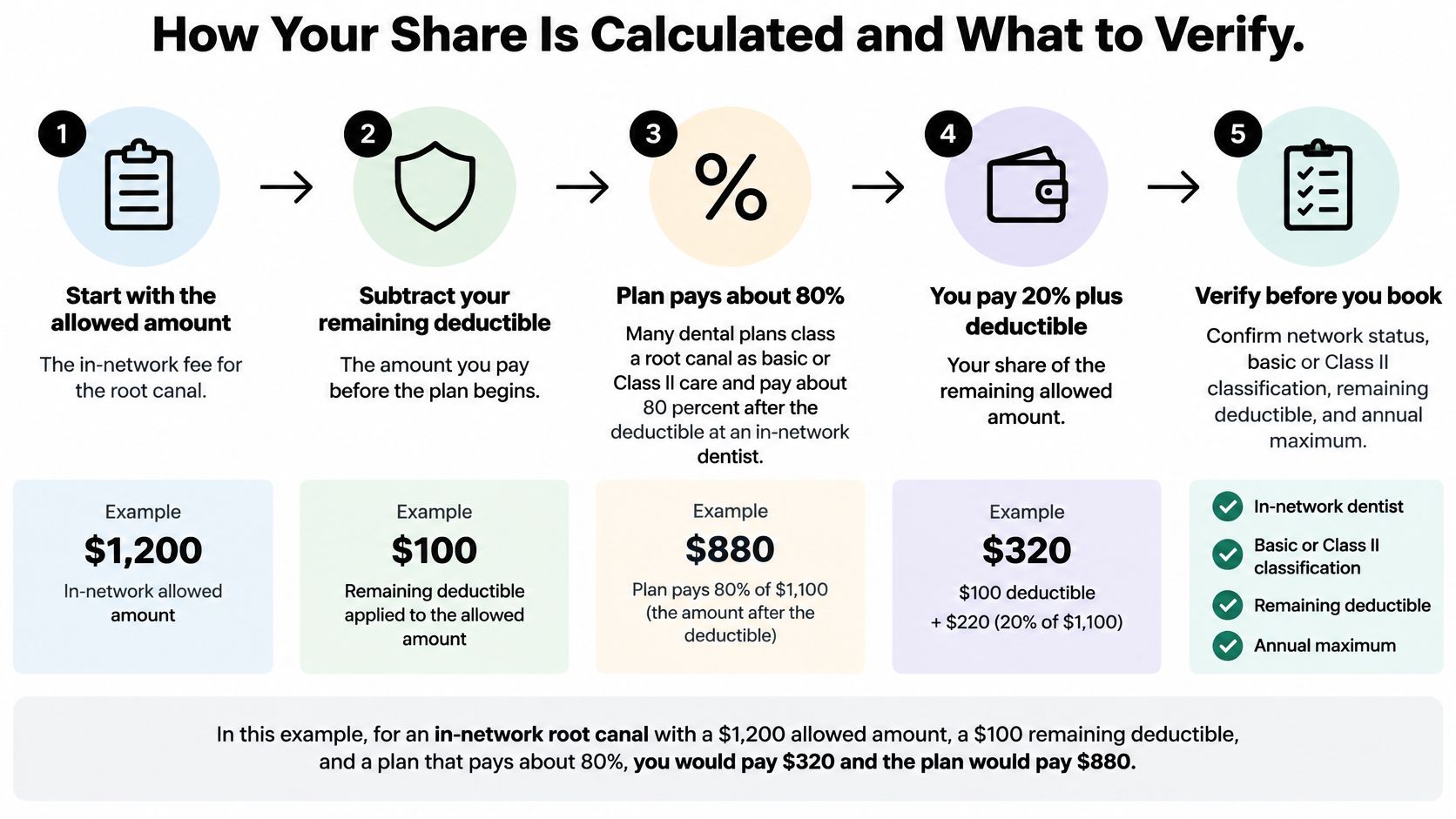
How Your Share Is Calculated and What to Verify
Start with a worked example rather than the percentage printed on your insurance card. FAIR Health's dental-plan guide identifies root canals as typical Class II or basic services, notes that 80% reimbursement is common, and illustrates a $1,000 allowed fee, $100 deductible, and 20% patient coinsurance, producing an approximately $280 patient payment.
- Start with the allowed fee. In this example, the insurer recognizes $1,000 for the root canal, not necessarily the office's full charge.
- Subtract the $100 deductible still owed, leaving $900 eligible for percentage-based coverage.
- Apply the patient's 20% coinsurance to that remaining $900, producing $180.
- Add the deductible back. The patient owes $100 plus $180, or $280.
- Check available benefits. That result assumes the plan has enough remaining benefits to pay its calculated share.
The calculation below shows how those pieces fit together.
Why the coverage percentage isn't enough
Using the same hypothetical allowed fee and deductible, a plan paying half of the eligible balance would leave the patient with $100 plus half of $900, or $550. That's a worked comparison, not a quote for your policy.
Some plans don't follow this percentage model at all. They use fixed copayments or fixed-dollar allowances, so applying a familiar coinsurance formula can give you the wrong answer.
Think of the allowance like a gift card with a defined value. The card doesn't expand because the menu price is higher. Similarly, the insurer calculates payment using the amount its rules recognize, not automatically whatever the dentist charges.
Our explanation of dental deductibles and copays can help you distinguish the amount you pay before benefits begin from the share you owe for a particular service.
In-network and out-of-network bills
In network, you generally owe the applicable deductible and coinsurance on the contracted allowed fee for covered treatment. Confirm the network status of the dentist performing the procedure, particularly if you're referred for endodontic care.
Out of network, the plan may calculate its payment from its own allowance while the dentist charges more. You can then owe your usual share plus the amount above that allowance, often called balance billing.
The Dental Coverage Guide explains this distinction and gives a broad root-canal-only national range of roughly $600–$1,600, which cannot reliably predict an individual bill. Choosing a convenient location or specialist without checking the allowance can change your responsibility substantially.
Our office works with most major insurance plans. That doesn't mean every product from every insurer has identical network terms, so we help check the specific coverage information available for your appointment.
Waiting periods and treatment limits
A Texas Humana plan document illustrates how specific these rules can be: it lists a $50 deductible, a $1,250 individual maximum in year one, increasing to $1,500 in year two and thereafter, and 50% coverage after the deductible for applicable basic or major services. The same document lists six-month basic-service and 12-month major-service waiting periods, potentially waived with qualifying proof of 12 months of prior coverage and no lapse longer than 63 days, and limits treatment to one root canal per tooth per lifetime.
Those are that plan's terms, not universal rules. If you've recently changed coverage or the tooth has been treated before, those details deserve particular attention.
Before booking treatment, have your insurer or our administrative team confirm:
- Network status and allowance. Identify the treating dentist and the allowed fee for the tooth.
- Deductible and benefit balance. Check what remains, not just the original yearly amounts.
- Treatment categories. Verify whether the root canal, buildup, and crown receive different coverage.
- Timing and approvals. Ask about waiting periods, preauthorization, and pretreatment review.
- Treatment history limits. Confirm any restrictions on previously treated teeth or lifetime benefits.
Keep the insurer's response with your estimate. A predetermination helps with planning, but final payment remains subject to eligibility, policy terms, and claim processing.
Why the Crown Often Costs More Than the Root Canal
Think of root canal treatment as repairing damaged plumbing inside a house. Cleaning and sealing the internal spaces addresses the problem inside the tooth, but a weakened back tooth may still need a protective roof, the crown.
A successful root canal doesn't replace missing tooth structure or restore biting strength by itself. Posterior teeth often need a buildup, which replaces lost structure beneath the restoration, and a crown over the chewing cusps.
The restoration is a separate financial decision
The Dental Roundup cost guide gives national uninsured averages of approximately $984 for a front tooth or premolar and $1,337 for a molar, describes restorative coverage around 50%–80%, and places a combined root canal and crown episode at approximately $2,500–$3,100. Its theoretical 80%-covered molar example leaves about $267 before the deductible and other restrictions, illustrating why an isolated procedure calculation can understate the completed treatment bill.
The American Dental Association's discussion of insurance misunderstandings describes a root canal and crown costing about $3,000 together, with a typical dental policy paying only about one-third of that total. These are national illustrations, not our office's fees.
The crown doesn't necessarily have a higher office fee than the root canal in every case. Your share can nevertheless be higher because the restoration falls into a different benefit category or because earlier treatment has used available benefits.
For example, a policy might classify the root canal as basic treatment and the crown as major treatment. Don't assume the coverage percentage for the first claim also applies to the second.
What a complete written estimate includes
Each applicable service should appear separately:
- Examination. A limited problem-focused or full assessment.
- X-rays. Diagnostic images needed to evaluate the tooth.
- Root canal therapy. Cleaning, treating, and sealing the internal canals.
- Buildup. Replacement of missing structure when needed.
- Crown. The definitive protective restoration.
- Follow-up. Clarification of any separately billed review or adjustment.
An emergency evaluation, sedation, retreatment of an old root canal, or specialist care can add other charges when clinically appropriate. Those aren't automatic additions for every patient.
We provide root canal therapy, crowns, extractions, and implants, alongside emergency dentistry, endodontics, oral surgery, sedation dentistry, periodontal care, dental deep cleaning, restorative dentistry, and cosmetic dentistry. If the tooth can't be saved, extraction followed by an implant, bridge, or denture is a different treatment plan with its own estimate.
Request a written predetermination separating endodontic treatment from the restoration, with the deductible, coinsurance, and remaining benefits identified.
When the Annual Maximum Runs Out
A patient arrives with a painful molar in November. The root canal is clearly needed, but the annual maximum is nearly used. That is when the percentage stops being useful. What matters is what the insurer can still pay before renewal.
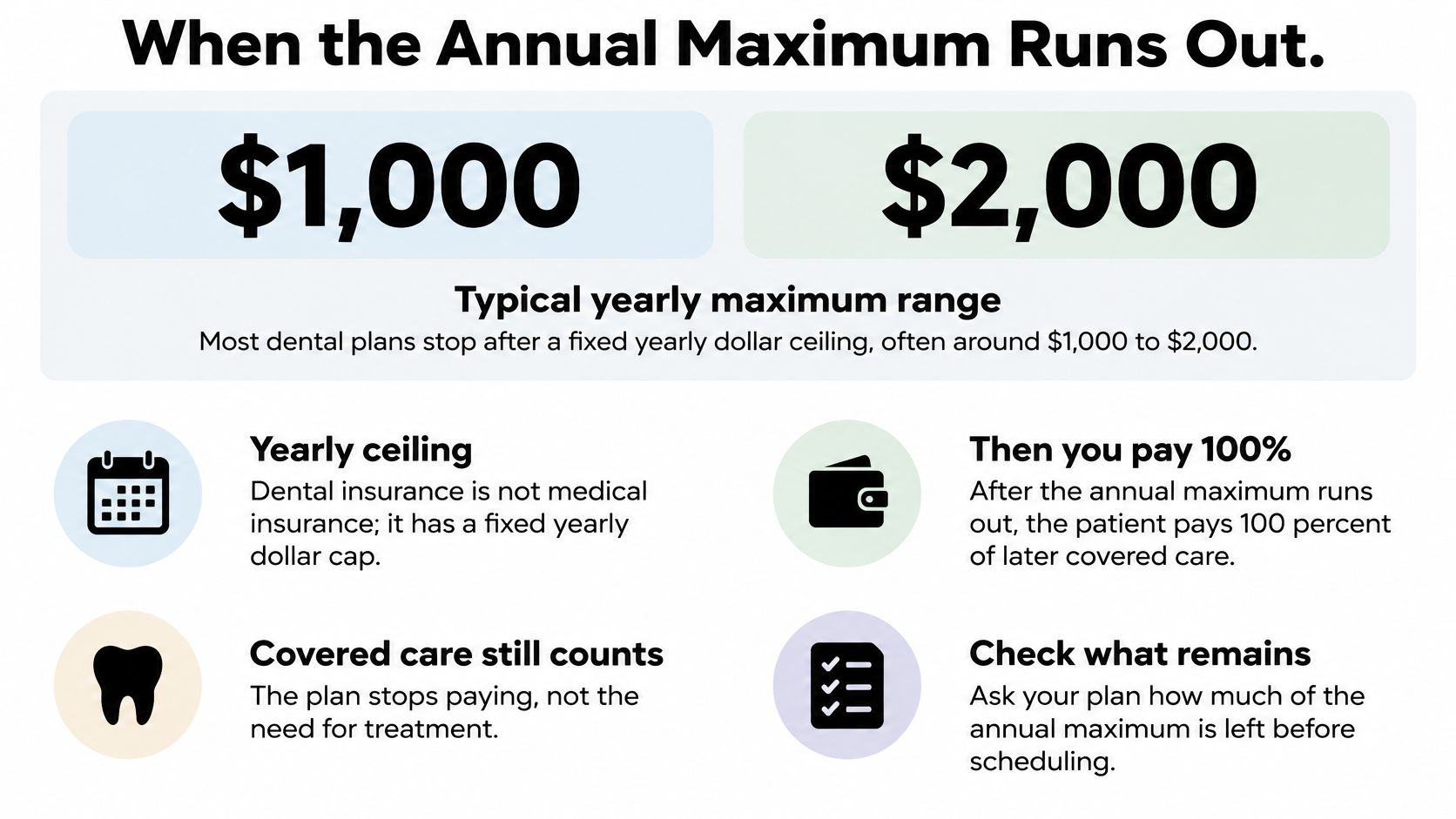
CareQuest Institute's report found that 12% of insured U.S. adults, approximately 32 million people, reached or exceeded their annual dental benefit maximum in 2024. Among those who reached the limit, 46% said it prevented further treatment, 39% delayed or discontinued care until benefits renewed, and 39% paid the remaining costs themselves.
An annual maximum works like a prepaid allowance for covered dental care. The plan pays up to a fixed yearly limit. Once that limit is reached, the patient usually pays the full cost of additional covered care for the rest of the benefit year.
Your out-of-pocket figure for a root canal is the plan's allowed fee for that tooth minus the portion your insurer can still pay from the remaining maximum. If the dentist is out of network, any balance above the allowed fee is yours as well. A separate crown claim can draw down the same remaining maximum.
Two patients with the same coverage percentage
Consider a hypothetical patient with $1,800 in benefits still available. If the root canal is covered and the other policy conditions are satisfied, the insurer may have enough available to pay its full calculated share of an in-network molar procedure.
Now consider a patient with $200 left after deep cleaning and other treatment. Even if the policy normally provides generous coverage, the insurer can contribute no more than that remaining balance toward additional covered claims before renewal.
These scenarios aren't quotes. They show why two patients with the same stated coverage percentage can receive very different estimates. One has room in the allowance. The other pays mostly out of pocket.
Check dollars, not just percentages: what your insurer can still pay matters as much as the benefit category.
Timing care without risking the tooth
Benefits may renew on a calendar-year or contract-year schedule. When clinically safe, timing a non-urgent restoration across that date may affect coverage. That decision belongs with the treating dentist. A swollen or painful tooth shouldn't wait for an insurance calendar.
If benefits run out, our administrative team can explain payment options. Our comparison of a dental savings plan versus dental insurance explains the approaches; membership plans cannot be combined with insurance or other promotions.
Before scheduling, ask the insurer or our team what the plan has already paid this benefit year, and whether pending claims could reduce the balance.
Get a Written Root Canal Estimate in Katy
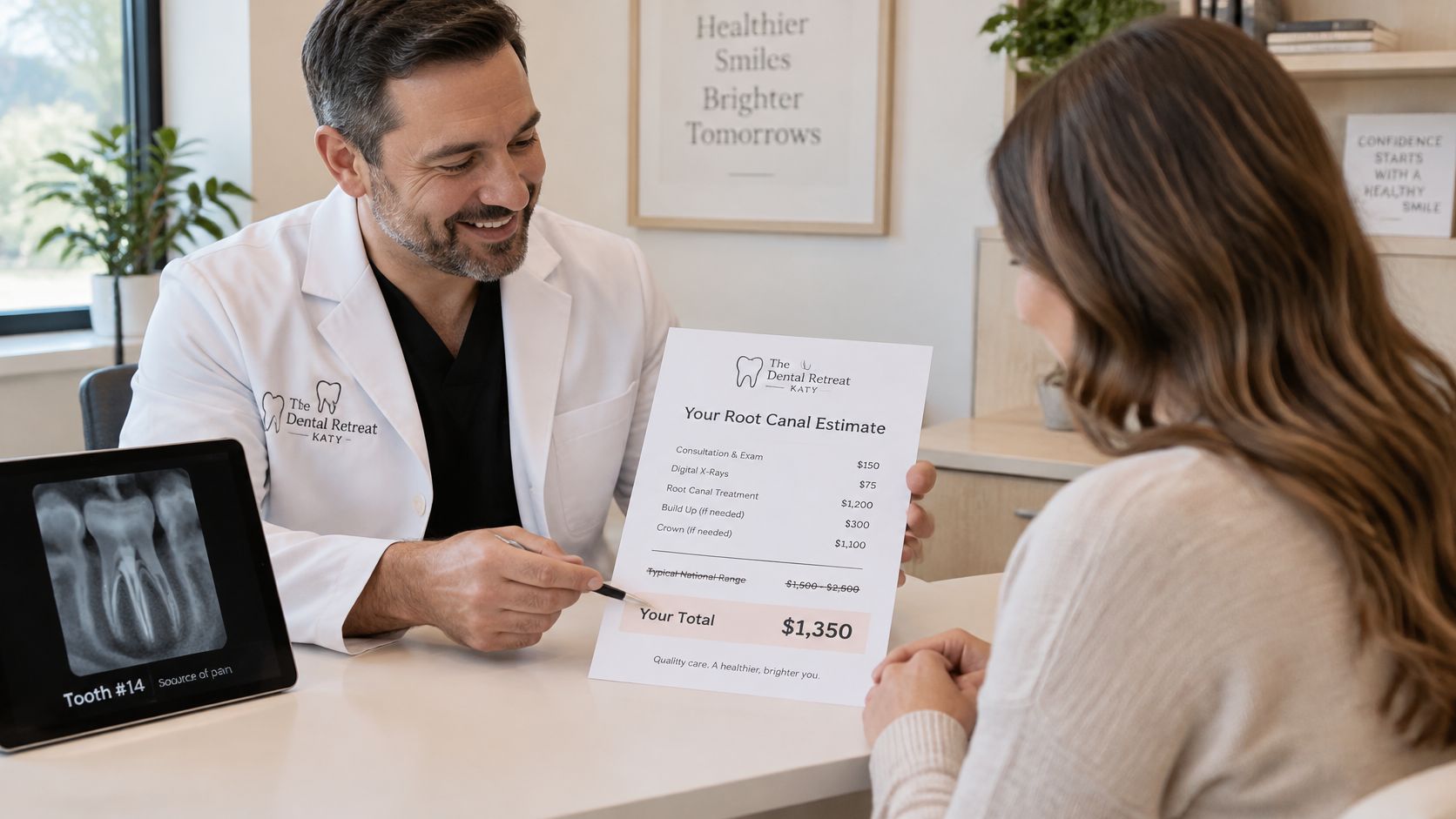
A consultation at The Dental Retreat turns a national price range into a personalized estimate. The visit begins with an examination of the painful tooth and appropriate dental X-rays so we can assess the cause, the remaining tooth structure, and whether root canal treatment is suitable.
A written estimate makes the treatment and payment discussion easier to follow.
Treating the cause and protecting your bite
The clinical goal is straightforward: remove infected tissue, relieve the toothache, and protect the tooth so chewing feels comfortable again. During treatment, the dentist numbs the area, cleans the internal canals, and seals them before completing the appropriate restoration.
Saving a treatable tooth preserves its role in your bite and helps you return to ordinary meals without guarding a painful side. If damage makes the tooth unsuitable for preservation, we can discuss tooth extraction and replacement, including dental implants, as a separate plan.
Tell us if you're anxious about treatment. Our office offers sedation dentistry and comfort amenities such as aromatherapy, heated massage chairs, and noise-cancelling headphones, so you can discuss what would help you feel more at ease.
This video offers another way to learn about the practice before your appointment.
Bring the information that makes an estimate useful
Our administrative team works to maximize the dental insurance benefits available to each patient. Where insurance information is available, we can help identify the allowed fee, deductible, coinsurance, and remaining annual benefit for the proposed treatment.
Bring your insurance card and mention recent treatment, pending claims, changes in coverage, or a previous root canal on the same tooth. We offer flexible financing options and can discuss those alongside your personalized estimate without assuming insurance will cover everything.
We welcome patients from across Katy and the surrounding communities. If you're looking for a dentist in Katy, TX, start with an evaluation of the problem that's worrying you rather than trying to diagnose it from an online fee chart.
When booking, describe your pain and ask for a written estimate that separates the root canal from the crown before treatment begins and states the allowed fee for that specific tooth. If you have facial swelling, fever, or worsening pain, contact the office promptly; difficulty breathing or swallowing requires immediate emergency medical attention.
The Dental Retreat offers root canal therapy, restorative care, personalized cost estimates, insurance assistance, and flexible financing options. Visit The Dental Retreat to request a consultation in Katy, bring your insurance card, and ask us to separate the root canal and crown costs so you can make an informed treatment decision.