Redness, swelling, bleeding, a bad taste, pus, or looseness can be dental implant infection symptoms, and infection can progress with little or no pain. Don't wait for a toothache before arranging an examination.
You may have noticed blood on your floss this morning, or a crown that feels different when you chew. If you're searching for a dentist near me in Katy, TX, The Dental Retreat's approach starts with understanding what changed, checking the implant's support, and explaining what needs attention without assuming the worst.
Quiet Bleeding and Early Implant Warning Signs
Say a Katy neighbor had an implant placed last year. It's comfortable, chewing feels normal, and there's no sharp pain. Then a little blood appears on the floss beside the crown.
That's easy to dismiss, especially when the bleeding stops quickly. But comfort doesn't establish implant health. The AO/AAP clinical consensus translation describes pain as uncommon and emphasizes objective findings such as bleeding, drainage, pocket changes, and bone loss.
Timing changes what a symptom means
After implant placement, some swelling and minor discomfort are normal. These usually ease within a few days with the recommended over-the-counter relief, cold compresses, and soft foods. Follow your surgical instructions, especially if your medical history limits which medicines you can take.
Symptoms that begin after the implant has healed deserve a different response. Bleeding that returns, swelling that lingers, tenderness at the gum line, or an unpleasant taste shouldn't be treated as routine recovery.
Consider another hypothetical patient near Elyson who reports almost no soreness. A maintenance X-ray shows that bone around the implant has receded. The patient's experience and the imaging aren't contradictory: tissue and bone changes don't always produce a noticeable toothache.
How often signs appeared in implants with peri-implantitis
A 2025 cross-sectional study reported the following findings among implants already affected by peri-implantitis: bone loss in 100%, bleeding in 88.46%, suppuration in 84.62%, edema and redness in 58% each, and visible pus in 30.77%.
| Finding | Share of affected implants |
|---|---|
| Bone loss | 100% |
| Bleeding | 88.46% |
| Suppuration | 84.62% |
| Edema | 58% |
| Redness | 58% |
| Visible pus | 30.77% |
Suppuration means pus-like discharge detected during assessment. It isn't necessarily the same as pus you can see in the bathroom mirror. Likewise, edema means swelling.
These findings describe affected implants in that study, not the likelihood that your particular symptom means infection. Their practical message is that waiting for obvious pus or significant pain can leave important changes undetected.
Practical rule: Report a change around an implant even when you can still eat comfortably.
At the serious end of the spectrum, an FDA adverse-event report documenting an April 10, 2024 event described an abscess, pain, inflammation, acute bone loss, and implant loss. That individual report doesn't predict what will happen to another patient, but it illustrates why assessment matters.
For readers in Sunterra, Cane Island, Kingscrossing, and Elyson looking for a dentist near them, the useful distinction is how soon to be seen, not whether the implant hurts enough to justify calling.
Signs to Match With How Soon to Call
Dental implant infection symptoms and when to be seen
| Sign | Usual meaning | When to be seen |
|---|---|---|
| Mild swelling or soreness for a few days after placement | Expected early healing | Call if it isn't easing within a few days |
| Red or swollen gum around the implant | Soft-tissue inflammation | Prompt dental visit |
| Bleeding when brushing or on gentle probing | Inflammation; bleeding alone doesn't prove bone loss | Prompt visit rather than home monitoring |
| Pus, bad taste, or unpleasant odor | Possible drainage from infected tissue | Same day or next day |
| Gum recession or a deepening pocket | Possible progressing disease | Exam with probing and X-rays |
| New discomfort while chewing | Inflamed tissue or a bite problem | Prompt evaluation |
| Implant or crown feels loose | Lost support or a loose restoration | Urgent visit; don't try to separate these at home |
| Facial swelling, fever, spreading redness, or trouble swallowing or breathing | Infection that may be spreading | Emergency dentist the same day |
| Little or no pain | Disease can still be present | Don't wait for pain |
Use this chart to describe your concern when you call, not to diagnose yourself. A clinical review of dental implant complications identifies swelling, bleeding, drainage, discomfort, unpleasant taste, and movement as reasons for prompt professional evaluation, while noting that some cases have few noticeable symptoms.
Healing should move toward improvement
Early soreness is different from soreness that appears after months of comfortable function. During recovery, the overall direction should be toward less swelling and better comfort, not increasing symptoms or new drainage. Our dental implant healing timeline can help you understand the recovery process, but a new concern still deserves a call.
Red or puffy gum tissue calls for a prompt appointment. Bleeding during brushing also needs attention, although it doesn't establish that bone has been lost or that the implant is failing. You don't need to wait through weeks of repeated bleeding to make the concern legitimate.
Pus, a recurring bad taste, or a localized unpleasant odor warrants a same-day or next-day assessment. Tell the office whether the taste comes from the implant area and whether there's a bump or drainage. Don't squeeze the tissue to demonstrate it.
Movement and spreading symptoms need faster action
Recession, a pocket that seems deeper, and new chewing discomfort need measurements and imaging. Don't insert anything under the gum to test pocket depth yourself.
A loose-feeling crown may involve the restoration rather than the implant body. Because you can't reliably identify the moving component at home, avoid testing it repeatedly or chewing hard foods on it while arranging urgent care.
Emergency distinction: Trouble breathing or significant difficulty swallowing requires immediate emergency medical care. Call emergency services rather than waiting for a dental appointment.
Facial swelling, fever, spreading redness, or rapidly increasing pain also warrants urgent assessment. Tell the dental team about these symptoms immediately so they can direct you appropriately.
Finally, the absence of pain doesn't clear an implant. Harsh scrubbing and leftover antibiotics won't answer whether its supporting tissues are healthy.
What to Do Before Your Visit
Safe home care should keep the area clean and comfortable without disturbing it. These measures support you while you arrange an examination; they aren't treatment for supporting-bone loss.
Brush gently. Use a soft toothbrush and fluoride toothpaste around the implant crown and gum line. Don't stop cleaning altogether because the tissue bleeds, but avoid forceful scrubbing.
Clean between teeth carefully. Use floss or an interdental brush if your dentist has shown you the right technique and size. Don't push an oversized brush into sore tissue or force floss beneath the gum.
Reduce irritation. Choose soft foods if chewing is uncomfortable and use a cold compress outside the cheek for swelling. A gentle warm salt-water rinse may soothe soreness, but don't swish forcefully after recent surgery unless your postoperative instructions permit it.
Don't self-prescribe. Avoid leftover antibiotics, unverified rinses, and attempts to drain a gum bump. Antibiotics taken without assessment can alter symptoms without resolving the underlying problem.
Bring a useful symptom record
Write down details you might otherwise forget:
- Onset: When bleeding, swelling, or discomfort began.
- Changes: Whether symptoms are improving, recurring, or worsening.
- Drainage: Any bad taste, odor, or visible discharge.
- Health information: Current medicines, allergies, and relevant medical conditions.
Our guide to caring for dental implants provides additional daily-care guidance. If the crown moves, avoid manipulating it and tell the office when you call.
Book the examination rather than waiting to see whether home care makes everything disappear. Fever or spreading swelling requires urgent assessment, and breathing or swallowing difficulty requires immediate emergency care.
Gum Inflammation Versus Bone Loss
Think of an implant as a plant supported by surrounding soil. Peri-implant mucositis resembles irritated topsoil around the plant. Peri-implantitis includes that irritation plus erosion of the deeper support.
The comparison is only an analogy: an implant isn't a natural tooth with roots. Its stability depends on its connection with the surrounding bone.
The distinction between gum inflammation and loss of support is illustrated below.
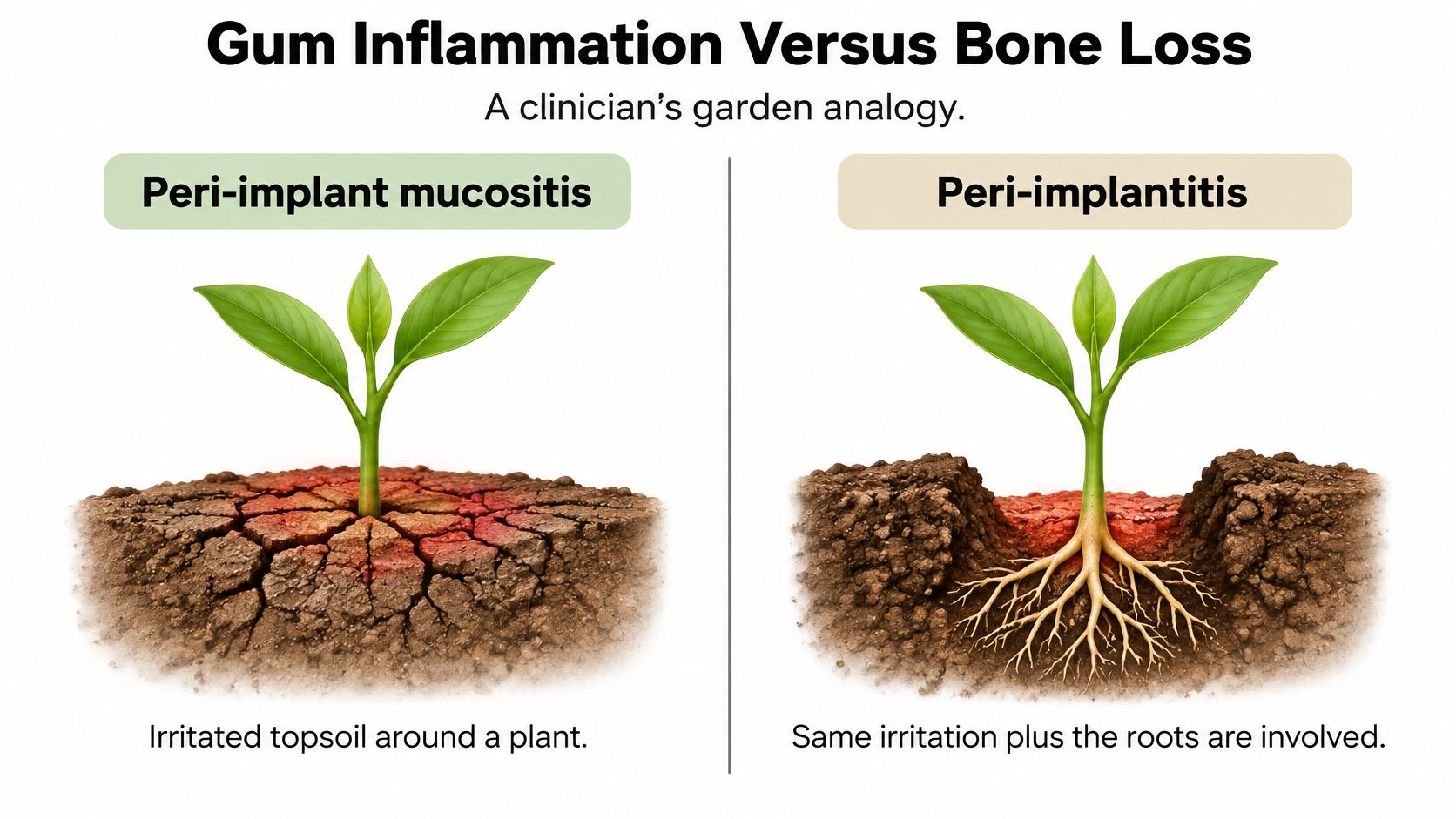
Similar-looking gums can have different problems
Mucositis involves inflammation without supporting-bone loss. Peri-implantitis involves inflammation together with progressive loss of that bone. Redness, swelling, tenderness, bleeding, bad taste, or discharge can overlap, so appearance alone can't establish severity.
Bleeding within approximately 30 seconds of gentle probing is a recognized inflammatory indicator, according to a review of peri-implant disease diagnosis. That's a professional assessment, not a reason to probe your own gums.
The International Team for Implantology consensus report places the positive predictive value of bleeding on probing alone at approximately 7% to 58%, depending on disease prevalence. In plain language, bleeding is an important clue, but it isn't a reliable stand-alone verdict about bone loss.
Measurements establish what the mirror cannot
When earlier records exist, the dentist compares current pocket measurements and radiographs with records taken after the restoration was placed. A change over time is more informative than an isolated measurement.
When earlier records are unavailable, the 2017 World Workshop consensus describes a diagnostic combination of bleeding and/or suppuration, a probing depth of at least 6 mm, and radiographic bone levels at least 3 mm apical to the most coronal portion of the implant's intraosseous segment. That last phrase identifies a reference point on the part of the implant placed within bone.
These aren't home-check thresholds. A dentist must identify the correct reference point and interpret the findings in clinical context, including normal early bone remodeling.
A mirror can show irritated tissue. It can't show how much bone remains around the implant.
Mobility of the implant body is particularly concerning because it may indicate loss of its connection with bone. It's different from a loose crown component, even though both may feel similar to you.
For patients near Katy Lakes, Ventanna Lakes, or The Grange, a useful evaluation includes probing and dental X-rays, not reassurance based only on how the gum looks.
Who Is More Likely to Develop Infection
Previous severe gum disease, inadequate plaque control, and irregular professional maintenance are important risk factors. Diabetes is also a risk indicator. A review of peri-implant disease risk factors identifies these associations and explains why continuing supportive care matters after implant treatment.
Risk isn't a judgment about how carefully someone tries to care for their teeth. A restoration's shape, access around the implant, and a person's health can make daily cleaning more demanding. The useful response is to identify what needs support, not assign blame.
These factors are best understood as reasons for closer monitoring.
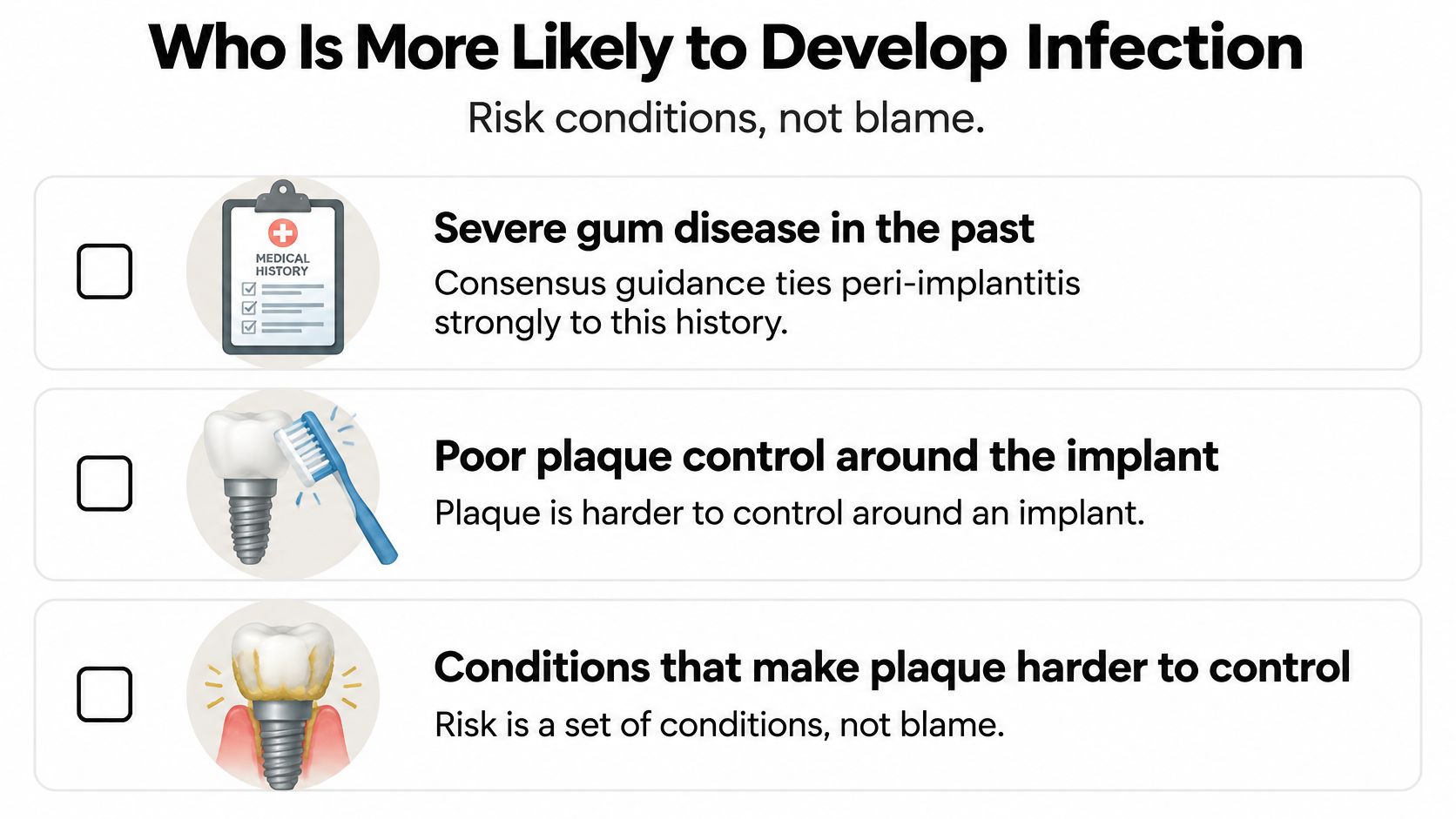
Why maintenance matters after treatment is finished
An implant doesn't get a cavity, but its surrounding gum and bone remain vulnerable to inflammation. Cleaning the visible crown isn't the whole task. The gum line and spaces around the restoration also need consistent attention.
When plaque remains around the implant, gum tissue may become inflamed. Deeper pockets can make access more difficult, and supporting-bone loss can reduce stability for chewing. None of those changes can be judged reliably by how bright or clean the crown appears.
Regular cleaning and exams give the clinician a record of the tissue's condition. Missed visits mean there may be fewer opportunities to identify change before you notice a problem.
A risk factor isn't a prediction
A history of periodontitis doesn't automatically rule out implants forever. It does mean gum health needs careful assessment, control, and ongoing maintenance. Similarly, diabetes should be part of the health conversation rather than a detail left off the medical form.
Practical priorities differ between patients:
- Past gum disease: Keep the recommended periodontal maintenance schedule, even when the implant feels comfortable.
- Difficult cleaning access: Have the team demonstrate a technique that fits your restoration rather than forcing a tool that doesn't fit.
- Diabetes or changing health: Update your medical history and medicines so your dental plan reflects your current needs.
For readers in Katy Manor, Marisol, Anniston, and Lakehouse, new bleeding or swelling deserves particular attention when these risks are already known. Don't assume a rinse will resolve a problem because it temporarily improves the taste or appearance.
The benefit of maintenance is practical: it helps preserve comfortable chewing, makes daily cleaning more manageable, and gives you a clearer understanding of your mouth's health.
How a Dental Visit Finds and Treats It
A symptom-focused visit starts with questions, not a treatment decision. Tell us when the implant was placed, when you first noticed a change, and whether the crown, your bite, or your medical history has changed.
The initial assessment follows a straightforward sequence.
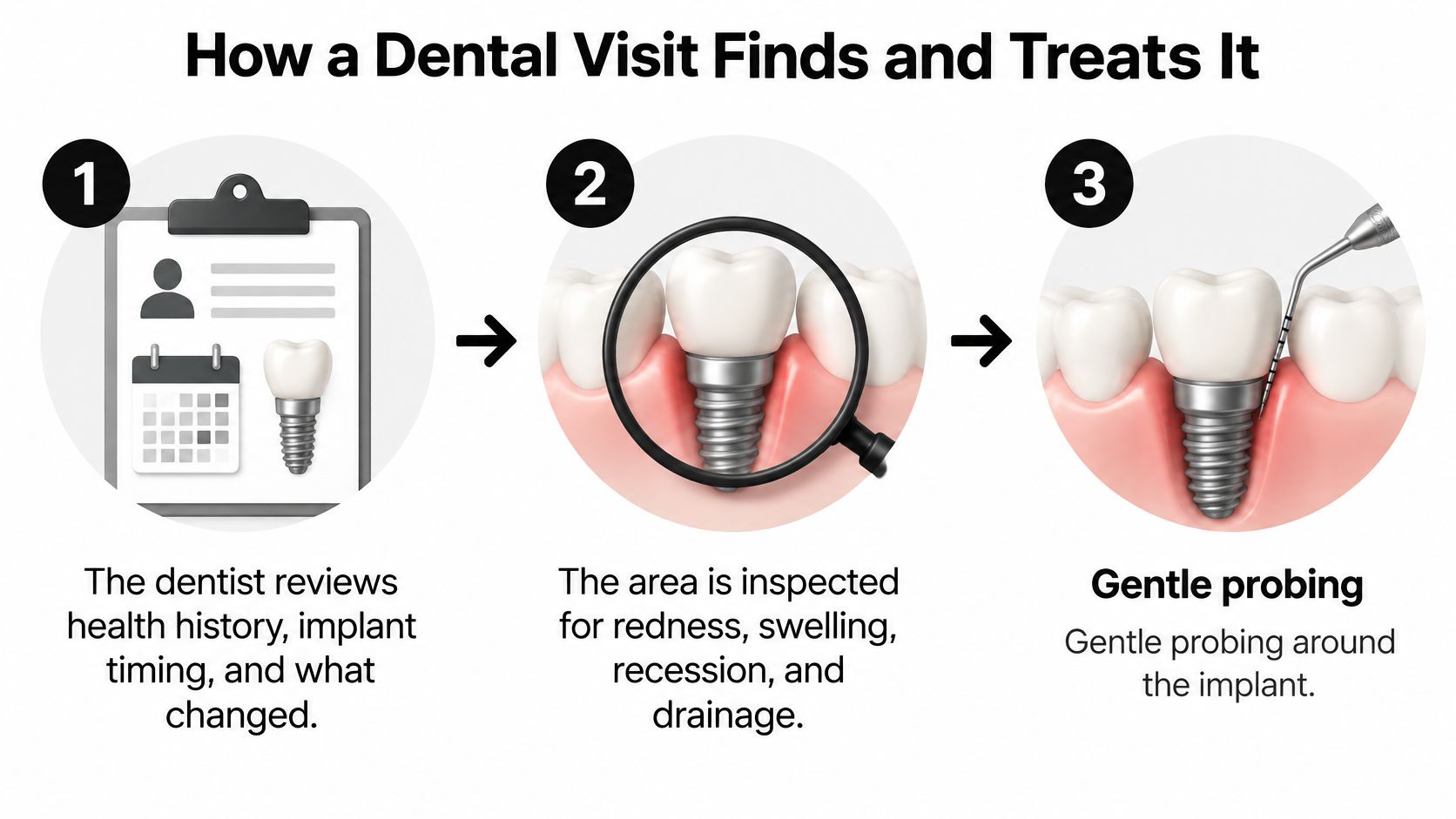
What the dentist checks
Review the history. Implant timing, earlier treatment, current medicines, and your account of the symptoms help establish context. Bring previous implant records if you have them.
The dentist inspects the area for redness, swelling, recession, and drainage. The crown and nearby teeth also need attention because discomfort doesn't always originate where it seems to.
Measure gently. Probing records pocket depth, bleeding, and any discharge. These findings help distinguish a surface concern from a problem that needs further investigation.
Existing records are compared with current findings when available. The peri-implant disease diagnostic review emphasizes examination and imaging rather than relying on visible symptoms alone.
Assess the bone. Dental X-rays help identify supporting-bone changes beyond expected early remodeling. Advanced imaging may be appropriate when the anatomy or treatment question requires more detail; it isn't automatically necessary for every concern.
Before new implant surgery, active periodontal disease must be addressed. At The Dental Retreat, our care team treats and resolves periodontal disease before implant surgery goes ahead.
Treatment follows the cause
Care may involve professional cleaning around inflamed tissue and adjustments to daily plaque control. More involved findings may require surgical assessment, bone grafting, crown repair, or other restorative work. A plan to preserve support must account for the location and extent of the problem, not just the symptom that brought you in.
A loose natural tooth beside an implant may need tooth extraction, while a damaged tooth may need a crown or root canal. Those are separate decisions made after examination, not automatic consequences of an implant concern.
For implant placement, we numb the area thoroughly with local anesthesia. Most patients feel pressure or vibration rather than pain; you should tell the team if you feel anything uncomfortable.
This video provides additional implant-care context.
Patients from Katy Lakes and Ventanna Lakes should expect clear explanations of the findings and the reasons for each recommendation. The aim is to protect support, restore comfortable function, and avoid choosing treatment from symptoms alone.
Book an Implant Check in Katy
If bleeding, drainage, swelling, or looseness brought you to this page, choose a problem-focused visit rather than continuing to watch the area at home. When you call The Dental Retreat in Katy, TX, describe what changed and whether symptoms are worsening so our team can help direct your next step.
If you're still deciding whether implants are right for you, choose a planned consultation. Searching for dental implants near me often raises questions about suitability, comfort, appearance, and cost. A consultation gives those questions a place in an individualized clinical discussion.
Choose the appointment that fits your concern
For active symptoms, the priority is identifying the cause and determining what needs treatment. For future implant planning, the conversation includes oral and medical history, anatomy, personal goals, and any worries about care. Examination, probing, and appropriate imaging help guide the options.
Our team evaluates each patient's anatomy and goals and provides a transparent, customized estimate with flexible financing options. Implant planning may involve replacing a single tooth, several teeth, or a full arch, so there isn't one plan that fits everyone. Tell us about dental anxiety as well; sedation options are available.
- If something has changed: Request an implant check and describe the symptom when booking.
- If you're considering replacement teeth: Request a consultation to discuss whether implant care fits your needs.
- If appearance is your main concern: Explain it, but have bleeding or swelling assessed before focusing on cosmetic changes.
If you initially searched for a cosmetic dentist near me because your implant looks longer or the gum line has changed, mention that change specifically. Appearance can be part of a health assessment, not just a cosmetic preference.
We welcome neighbors from Sunterra, Cane Island, Katy Manor, Kingscrossing, Lakehouse, Marisol, The Grange, Anniston, Katy Lakes, Elyson, and Ventanna Lakes.
Call or request a consultation today. Seek same-day emergency assessment for fever or facial swelling, and immediate emergency medical care for trouble swallowing or breathing. Timely evaluation helps protect chewing, comfort, and your smile.
The Dental Retreat offers implant evaluations, emergency dental care, and personalized consultations for patients concerned about bleeding, swelling, or changes around an implant. Visit The Dental Retreat to request a problem-focused appointment or an implant consultation in Katy, and let our team help you take the next step with a clear plan.